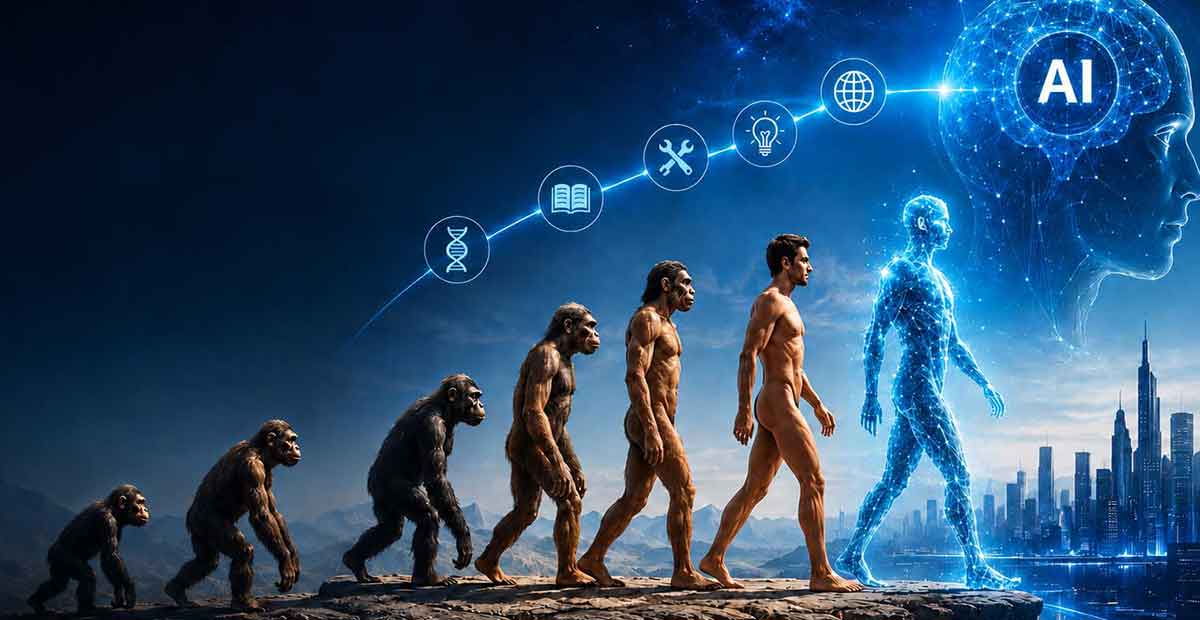
AI, Genetic Evolution, and the Acceleration of Intentional Adaptation
By John F. Groom
Intentional Adaptation: An Adaptive Structure
Theory Perspective
For most of the history of life on Earth, adaptation was dominated by a slow and largely unguided process: genetic evolution. Organisms varied, mutations occurred, environments imposed selective pressures, and traits that improved reproductive success became more common over generations. Human beings changed this equation. Humans did not cease to evolve genetically. But increasingly, they developed another means of adapting to reality: the intentional creation of structure.
Rather than waiting for random genetic mutations to produce thicker skin, humans made clothing. Rather than evolving natural shelter, they built houses. Rather than waiting for biological resistance to disease, they developed sanitation, vaccines, antibiotics, and medical systems. Rather than evolving wings, they built airplanes. Artificial intelligence may now radically accelerate this transition.
From the perspective of Adaptive Structure Theory (AST), AI is important not merely because it makes existing activities faster or more efficient. Its deeper significance is that it compresses the time required for humans to observe reality, organize information, generate possible responses, test alternatives, make decisions, implement solutions, evaluate outcomes, and adapt again. Genetic evolution remains constrained by biological time. AI-assisted intentional adaptation increasingly operates at computational speed.
From Genetic Adaptation to Intentional Structural Adaptation
The underlying rate of human genetic mutation is relatively stable over long evolutionary periods, although it is not literally constant. Mutation rates can vary with parental age, environmental exposures, DNA-repair mechanisms, and other biological factors. But the fundamental constraint remains: meaningful genetic adaptation generally depends on reproduction, inheritance, differential survival or reproductive success, and change across generations. Intentional adaptation operates differently. A human being can encounter an environmental problem and create a new structure in response. That structure may exist entirely within the mind as a new conceptual framework. It may take the form of a
behavioral routine, an institution, a tool, a machine, a computer program, a building, a medical treatment, or a global technological network. The essential principle is the same: a sentient being perceives reality and creates structure that changes its relationship with that reality. This is one of the central ideas of Adaptive Structure Theory. Greater adaptive capacity arises not simply from possessing more information, but from creating increasingly effective structures for understanding and interacting with the world. The history of human civilization can therefore be viewed partly as the history of accelerating intentional structural adaptation. Language allowed humans to preserve and transmit structures of thought.
Writing allowed those structures to survive individual human memory. Printing allowed them to be replicated at scale. Science created systematic structures for testing claims against reality. Computers accelerated the manipulation of information. The internet connected billions of people and information sources. Artificial intelligence now accelerates the creation, evaluation, combination, and modification of structure itself.
AI Compresses Adaptive Time
The most important consequence of AI may be time compression. Consider a human being confronting a complex problem before the development of modern AI. The individual might spend weeks gathering information, months comparing possibilities, years acquiring specialized expertise, and perhaps a lifetime testing only a small number of potential solutions. AI can dramatically compress this process.
The adaptive cycle becomes:
Observe reality → structure information → generate alternatives → compare possibilities → predict consequences → act → measure outcomes → revise Every stage can potentially be accelerated. A person can analyze more information. More alternatives can be generated. More perspectives can be considered. Contradictions can be identified more quickly. Historical precedents can be retrieved.
Potential consequences can be modeled. Outcomes can be recorded and compared. Failed approaches can be modified rather than forgotten. The result is not simply greater productivity. It is an increase in the number of meaningful adaptive cycles that can occur within a single human lifetime.
A person who previously might have completed ten substantial cycles of experimentation and revision may eventually complete hundreds or thousands. And because digital structures can be preserved and transmitted, one person's successful adaptation can become the starting point for another person's next adaptive cycle. This creates the possibility of cumulative adaptation at unprecedented speed.
The Growing Asymmetry Between Genetic and Intentional
Adaptation
Genetic evolution continues to operate at biological speed. Humans are still born, mature, reproduce, and die according to biological timescales that have not changed nearly as dramatically as our technological environment. Intentional structural adaptation, however , is accelerating. This creates a growing asymmetry.
The relative relationship might be expressed conceptually as:
Intentional Adaptive Impact ÷ Genetic Adaptive Impact As AI capabilities increase, this ratio may increase enormously. Genetic mutations generally must spread through reproduction. An advantageous mutation affecting one person does not instantly change the biology of everyone else. An intentional structural adaptation can operate very differently. One person can develop a better algorithm, medical procedure, agricultural technique, educational method, physical device, decision framework, or organizational structure. Once digitized, that innovation can potentially reach millions or billions of existing people without waiting for a single new generation to be born.
AI therefore potentially increases three dimensions of intentional adaptation simultaneously: Speed. Adaptive cycles can occur more rapidly. Reach. Successful adaptations can spread globally. Replicability. Digital structures can be reproduced at extremely low marginal cost.
This means that the relative importance of genetic mutation as the primary means by which humans adapt to changing environments may continue to decline, even though genetic evolution itself continues. Increasingly, humans do not wait for their biology to adapt to the environment. They restructure their environment, their behavior , their tools, and their own decision processes.
AI as an Adaptive Multiplier
Adaptive Structure Theory does not require AI itself to be sentient. This distinction is fundamental. AI may create, evaluate, and optimize extraordinarily sophisticated structures without experiencing pleasure, pain, satisfaction, fear , or any other form of subjective value. Under the value framework associated with AST, value cannot exist independently in an abstraction, institution, country, company, community, family, or artificial system merely because that structure exists. Value ultimately requires a sentient being capable of experiencing it. A country has value only insofar as its existence and structure ultimately affect sentient beings.
A family has value because of its effects on the individuals who experience family relationships. A company has value because of what it does for or to people and other sentient beings. And AI has value insofar as it changes the experienced reality of sentient beings. AI can therefore be understood as an adaptive multiplier. It dramatically increases the capacity of sentient beings to create structures that improve their relationship with reality, without necessarily being a locus of experienced value itself. This distinction prevents a fundamental conceptual error: confusing the sophistication of a structure with the existence of subjective experience.
A highly sophisticated AI system may be extraordinarily effective at adaptation without itself experiencing the value produced by that adaptation.
From Random Change to Intentional Change
The deepest historical transition may be understood as a change in the dominant mechanisms of adaptation. Early life adapted almost entirely through biological evolution. More neurologically complex organisms gained greater behavioral flexibility. They could learn from experience rather than depending entirely on genetic change. Humans developed extraordinary capacities for abstraction, language, cumulative culture, technology, and intentional environmental restructuring. AI now multiplies those capacities.
The trajectory can be expressed simply:
Genetic adaptation → behavioral adaptation → cultural adaptation → technological adaptation → AI- accelerated intentional structural adaptation Each new layer does not necessarily eliminate the previous one. Genetic evolution continues. Human learning continues. Culture continues. Technology continues. But the relative contribution of each mechanism changes.
A human confronting cold weather does not need to wait for descendants with greater biological cold tolerance. The human creates clothing, shelter , heating systems, transportation networks, weather forecasting, and energy infrastructure. A human confronting a disease does not need to wait for natural selection to produce resistance over many generations. Humans can identify the pathogen, sequence its genome, develop treatments, reorganize behavior , and potentially create a vaccine. With AI, each part of that response may become faster .
This suggests a profound principle:
The more rapidly intelligence can create effective structure, the less adaptation depends upon random biological change alone.
The Individual Becomes More Consequential
AI may also change the relative importance of individual human action. A genetic mutation begins with an individual but generally achieves broad adaptive significance only through reproduction and population-level selection over time. An AI-assisted idea can spread almost immediately. A single individual may identify a problem, use AI to structure the available evidence, develop a new solution, test it in reality, document the outcome, and make the resulting knowledge globally accessible. This dramatically increases the potential adaptive impact of individual action. The key word, however , is potential.
AI can accelerate bad reasoning as well as good reasoning. It can produce more misinformation, more ineffective structures, and more confidently expressed errors. Faster structure creation does not automatically mean better adaptation. The decisive issue is whether structures are tested against reality. Adaptive Structure Theory therefore distinguishes between complexity and adaptive effectiveness.
A more complicated structure is not necessarily a better structure. The relevant question is whether the structure creates a more successful relationship between a sentient being and reality. AI increases the rate at which structures can be generated. But evidence, provenance, outcome measurement, and repeated contact with reality determine whether those structures are actually adaptive.
The Importance of Persistent Adaptive Knowledge
This is where AI alone encounters a fundamental limitation. An AI system can generate a useful answer today and another answer tomorrow. But if the underlying observations, decisions, interventions, outcomes, identities, provenance, and relationships are not persistently structured, humanity may repeatedly solve similar problems without accumulating the full value of previous experience. The greater opportunity is not merely to generate more answers. It is to transform successful adaptation into persistent, attributable, interoperable knowledge. A human confronts a problem.
A possible solution is proposed. The solution is implemented. The result is observed. Successes and failures are documented. The evidence is preserved. Provenance is established.
The resulting adaptive knowledge becomes available for future human and AI reasoning. This creates a cumulative adaptive system rather than a succession of disconnected AI interactions. Within the broader DataUniversa and Connected AI vision, this is particularly important.
DataUniversa can provide semantic identity, interoperability, and admissibility. Provenance systems can establish where observations and claims originated. Human Observation and Solution Intelligence can preserve the often messy reality of how individuals actually solve problems. Decision systems can connect choices with outcomes.
The objective is to allow one successful adaptation to become structured input for the next. AI compresses the adaptive cycle. Connected AI can make the results of those cycles cumulative.
A New Phase in the History of Adaptation
The history of life can be viewed partly as a progression in the speed and intentionality of adaptation. For billions of years, adaptation occurred overwhelmingly through genetic variation and natural selection. Sentience introduced the capacity to experience reality. Increasing intelligence allowed organisms to modify behavior based on experience. Human intelligence enabled deliberate abstraction, cumulative culture, and large-scale environmental restructuring. AI may now represent another major transition: the acceleration of intentional structural adaptation beyond the unaided cognitive speed of individual humans.
This does not make biological evolution irrelevant. Human bodies remain biological. Genetic inheritance continues. Mutations continue. Natural selection continues. But the relative balance is changing.
Genetic evolution remains constrained by generations. Intentional adaptation can occur within years, days, hours, or potentially seconds. Genetic change usually spreads through reproduction. Digital structure can spread globally almost instantaneously. Genetic evolution is largely unguided. Intentional adaptation can be directed toward explicit objectives, tested against outcomes, and repeatedly revised.
The widening gap between these mechanisms may become one of the defining characteristics of the AI era.
The Central Proposition of Adaptive Structure Theory
Life initially adapted to reality primarily through inherited biological change. Sentient intelligence created the capacity for behavioral and intentional adaptation. Human beings dramatically expanded this capacity through language, culture, science, and technology. Artificial intelligence now compresses the time required to create, test, transmit, and revise adaptive structures, potentially making intentional structural adaptation increasingly dominant relative to genetic adaptation as the principal means by which humanity responds to a changing environment.
The implications extend far beyond productivity. AI changes how much adaptive work can occur within one human lifetime. It changes how quickly one person's solution can reach others. It changes how many alternatives can be considered before action. It changes how rapidly failures can be identified and corrected. Most importantly, it potentially changes the relationship between time and human agency. Genetic evolution gave life the capacity to adapt across generations. Human intelligence gives individuals the capacity to adapt within a lifetime.
AI may give individuals the capacity to undertake vastly more meaningful adaptive cycles within that same lifetime, and to make the results available almost immediately to the rest of humanity. From the perspective of Adaptive Structure Theory, that may be the deeper significance of artificial intelligence: AI is not merely a new tool within the human environment. It is an accelerator of the process by which humans intentionally restructure their relationship with reality.
Whether you're exploring interoperability, dataset valuation, AI readiness, or ecosystem participation, we welcome conversations with researchers, organizations, and strategic partners interested in the future of structured data systems.
info@datauniversa.com