Air Travel Is an Old Miracle
By: John F Groom
Air travel is a miracle. But it is an old miracle. We solved the spectacular problem of moving hundreds of people safely through the sky at roughly 550 miles per hour decades ago. Since then, we have become remarkably good at refining that solution without fundamentally changing it. Modern aircraft are safer, quieter, more efficient and vastly more sophisticated than the first generation of jetliners. But from the passenger’s perspective, the basic proposition remains remarkably familiar.
And we may now be fairly close to the limits of what this particular architecture can give us. The next dramatic improvement in air travel may require a genuine technological breakthrough. That breakthrough may not come soon. And, intriguingly, it may have less to do with building a slightly better airplane than with redesigning the entire system around it.
This points toward a broader principle of technological change: some technologies do not keep improving exponentially. They experience a revolutionary period, reach a highly effective mature form, and then spend decades on the relatively flat portion of an S-curve.
From Kitty Hawk to 550 MPH
The extraordinary thing about aviation is how quickly the original revolution occurred. On December 17, 1903, the Wright brothers made the first successful powered, controlled flight of a heavier-than-air aircraft. Their first flight lasted about 12 seconds and covered 120 feet. Their longest flight that day lasted 59 seconds and traveled 852 feet.
Only 55 years later, the Boeing 707 entered commercial service. By 1960, ordinary paying passengers could cross the Atlantic in a pressurized jetliner traveling at roughly 550 miles per hour. New York to London had become a matter of hours rather than days.
Think about the magnitude of that transition. In 1900, controlled powered human flight did not exist. By 1960, the fundamental architecture of modern long-distance air travel was largely in place: large pressurized aircraft, jet engines, swept wings, high-altitude cruising, major airports, air-traffic control and hundreds of passengers moving between continents at close to the speeds we travel today. Humanity went from can’t fly at all to something recognizably similar to modern commercial aviation in about the span of one person’s working life. That was the steep portion of the S-curve. Then something interesting happened.
Sixty-Five Years Later, We Still Fly at About 550 MPH
Imagine someone who flew from New York to London in 1960 being placed aboard a modern Boeing 787. Much would astonish him. The engines are vastly more efficient and reliable. The aircraft contains sophisticated computers and sensors. Navigation is extraordinarily precise. Materials have changed. Noise has declined. Entertainment, communications and passenger information have transformed. Safety has improved enormously.
But tell him what is going to happen during the trip and he would understand immediately. We are going to a large airport. We will check our luggage, wait, board a large tube-shaped airplane and sit in rows facing forward. We will take off from a runway, climb to around 35,000 feet and travel at roughly 550 miles per hour. We will share a small number of bathrooms. Several hours later, we will descend toward another large airport, land on a runway, retrieve our luggage and continue to our actual destination.
The details have changed tremendously. The architecture has not. That is very different from computing. A computer user from 1960 transported to 2026 would encounter something almost incomprehensible. The transformation in processing power, storage, networks, interfaces, software and artificial intelligence has been staggering. A 1960 airline passenger transported to 2026 would mostly need someone to explain airport security and how to connect his phone to the Wi-Fi.
The S-Curve
Computing has perhaps distorted our expectations about technology. We have lived through decades in which computers repeatedly became smaller, faster, cheaper and more powerful. That experience makes exponential technological improvement seem almost normal.
It isn’t necessarily normal. Many technologies follow something closer to an S-curve. At first, progress is slow because the problem is extremely difficult. Then some combination of scientific understanding, engineering capability and economic demand produces a breakthrough. Progress accelerates dramatically.
Eventually, however, the technology becomes very good. The easiest improvements have been captured. Physical limits begin to matter. Existing infrastructure becomes deeply embedded. Safety requirements accumulate. Customers become accustomed to a particular architecture. Enormous industries form around it.
The curve begins flattening. Improvements continue, sometimes extremely important ones. But they become refinements rather than revolutions. Commercial aviation looks increasingly like such a technology.
That Does Not Mean Nothing Has Changed
Calling aviation mature should not be confused with saying aviation has stopped progressing. Modern aircraft are extraordinary machines. Engines consume less fuel, require less maintenance and operate with astonishing reliability. Aircraft structures are lighter and stronger. Navigation and weather forecasting are better. Cockpit automation has transformed flight operations. Safety has improved dramatically. Airlines and airports coordinate enormous global networks that would have been unimaginable during the early jet age.
A modern Boeing 787 is not simply a 1960 Boeing 707 with better seats. Technologically, it is enormously more advanced. But there is a distinction between improving the machinery and changing the capability experienced by the user. Suppose engineers create an aircraft that uses 20 percent less fuel. That would be an enormous engineering and economic achievement. Airlines might save billions of dollars. Emissions could fall substantially.
The passenger might notice almost nothing. He still flies at approximately 550 miles per hour. He still sits in approximately the same position. He still travels between large airports. He still spends much of his journey doing things other than flying. That is what mature technology can look like: enormous sophistication devoted to increasingly incremental improvements in the original solution.
The 550-MPH Airplane That Travels at 100 MPH
The maturity of the airplane also exposes another phenomenon. Once the spectacular technological problem has been solved, much simpler problems can become the bottleneck. Consider a 500-mile trip. The airplane itself might cover the distance in a little more than an hour. But the passenger’s journey doesn’t begin when the wheels leave the runway. He travels to the airport, parks or gets dropped off, walks through the terminal, checks luggage, goes through security, walks to the gate and waits. Boarding begins well before departure. Perhaps the flight is delayed. Eventually everyone squeezes through one or two doors and finds a seat.
The aircraft pushes back, taxis and waits for clearance. Finally, the 550-mile-per-hour part begins. At the destination, the process runs roughly in reverse. The result can be remarkable. A transportation system containing a machine capable of traveling at roughly 550 miles per hour can produce a door-to-door average speed of perhaps 100 or 150 miles per hour on a shorter journey. The airplane isn’t slow. Everything around the airplane is slow.
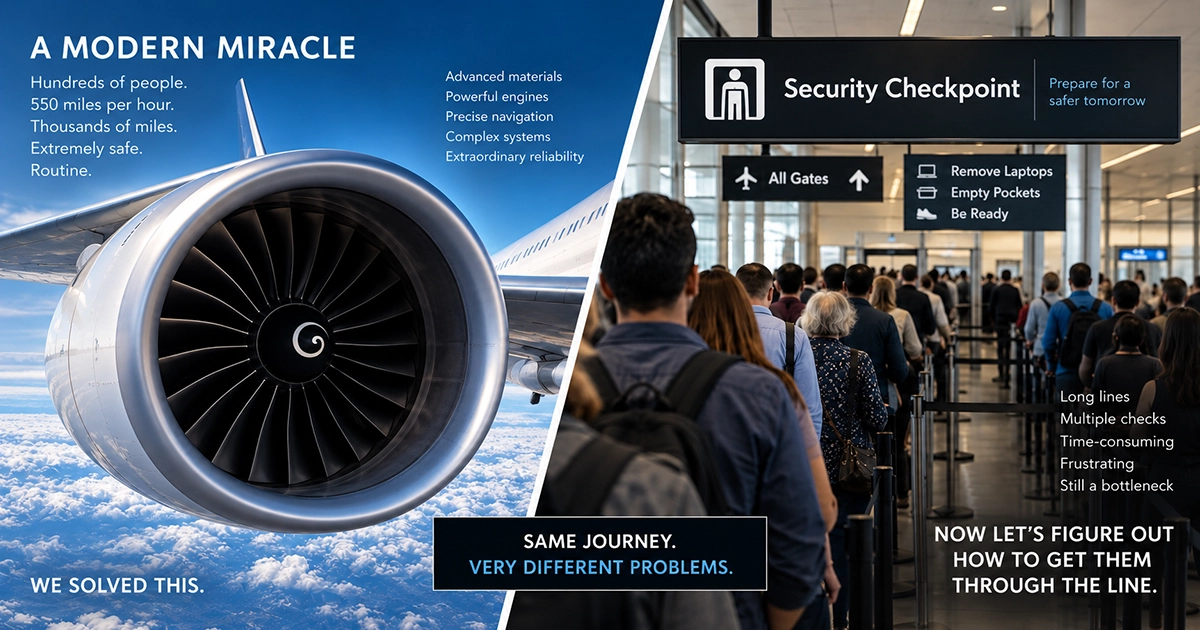
We Solved This. Now Let’s Get Everyone Through the Line.
Airport security provides an almost comic illustration. Imagine describing the problem from first principles. First, we must build a machine capable of carrying 200 human beings several miles above Earth. It must travel at roughly 550 miles per hour for thousands of miles. Its engines must operate reliably under enormous thermal and mechanical stresses. It must navigate through darkness, clouds and bad weather. Thousands of aircraft must simultaneously occupy the sky without colliding. The machine must descend from 35,000 feet and repeatedly land on a relatively narrow strip of pavement.
We have solved that problem so successfully that passengers routinely complain when the Wi-Fi is slow. Now consider another problem. We have 100 people standing in a terminal. We need to determine whether they and their belongings can safely proceed through a doorway. Sometimes that produces a long line. This is not because airport security is actually an easy problem. Security involves difficult tradeoffs involving risk, privacy, staffing, equipment, false positives, regulation and human behavior.
But that is precisely the point. The bottleneck in an advanced technological system does not necessarily reside in its most technologically advanced component. Once the hard problem has been solved, something previously secondary can become the constraint. The bottleneck moves.
And Sometimes the Problem Isn’t Technology at All
The passenger cabin provides another example. After more than half a century of aerospace development, economy passengers still spend long flights sitting in narrow chairs beside strangers, with limited ability to move and a small number of shared bathrooms.
Why haven’t aerospace engineers solved this? They have. We know how to make extremely comfortable aircraft interiors. Walk into the first-class cabin of the right international flight and the technological mystery disappears. Passengers can have beds, private compartments, excellent food and considerable personal space.
The economy-class problem is primarily economic. Space aboard an aircraft is valuable. Give every passenger twice as much of it and either the aircraft carries far fewer passengers or fares have to rise substantially. Millions of customers have repeatedly demonstrated that when choosing between a cheaper cramped seat and a significantly more expensive comfortable one, many choose the cheaper seat.
So the narrow economy seat is not evidence that humanity cannot engineer a better seat. It is evidence that the system is optimizing something else. This distinction becomes increasingly important as technologies mature. When something seems stubbornly unimproved, we should ask why. Perhaps we don’t know how to solve it. Perhaps the laws of physics make improvement difficult. Perhaps we know exactly how to solve it but the solution costs too much. Perhaps consumers won’t pay for it. Perhaps regulations prevent it. Perhaps existing infrastructure locks us into an old architecture. Or perhaps dozens of participants who could collectively solve the problem cannot coordinate their actions.
Those are very different forms of technological stagnation.
The Next Revolution May Not Be a Better Airplane
This leads to a counterintuitive possibility. Perhaps the next major improvement in air travel won’t come primarily from the airplane. Imagine leaving home for a flight without worrying about an arbitrary two-hour airport buffer. Your identity has already been verified. Your luggage travels separately and appears at your destination. Transportation to the airport responds to the aircraft’s actual operating status. Security screening becomes increasingly passive and continuous rather than concentrated in a queue. You arrive through the optimal terminal entrance and proceed directly toward your aircraft.
Meanwhile, much better coordination among aircraft, airports, weather systems and air-traffic management prevents small disruptions from cascading across an entire continent. At the destination, transportation is synchronized with your actual arrival.
The airplane still travels at 550 miles per hour. But perhaps two hours disappear from the journey. For many passengers, that could matter more than increasing the aircraft’s cruising speed by 20 percent. The breakthrough would not really be an airplane breakthrough. It would be a system breakthrough.
Or We May Need an Entirely New S-Curve
There are, of course, technologies that could produce another true aviation revolution. Practical supersonic transportation could dramatically reduce long-distance travel times. New aircraft configurations might fundamentally change economics and cabin design. Electric propulsion or other energy breakthroughs could alter short-distance aviation. Highly autonomous smaller aircraft might someday allow passengers to bypass giant hub airports entirely.
Perhaps some combination of these technologies will eventually create an aviation system as different from today’s system as the Boeing 707 was from transportation in 1900. But we should be careful about assuming that it will. There is no law of technological progress saying that the next breakthrough must arrive when we want it.
The Concorde demonstrated this rather dramatically. Humanity actually introduced supersonic passenger service in 1976. Passengers could cross the Atlantic at more than twice the speed of sound. Yet economics, noise, operating constraints and other factors prevented supersonic aviation from replacing conventional subsonic jets. Concorde disappeared from scheduled service in 2003.
For more than half a century, therefore, the dominant cruising speed of commercial aviation has remained in roughly the same range. Perhaps another revolution is coming. Perhaps it is 10 years away. Perhaps it is 50 years away. Perhaps the technology that ultimately creates it has not yet been invented. In the meantime, we will continue polishing an extraordinarily successful existing solution.
What Changes, What Doesn’t
That may be the most interesting lesson air travel offers about technological progress. Some technologies remain on the steep part of their curve for a surprisingly long time. Computing has done that. Artificial intelligence may now be doing it. Others experience an extraordinary revolutionary period and then mature.
Air travel went from Kitty Hawk to intercontinental jet transportation in less than 60 years. That was an almost unbelievable technological transformation. Then the basic solution became extremely good. Another 65 years passed. Aircraft became safer, cleaner, quieter, more reliable and more efficient. Almost everything underneath the surface improved.
Yet an airline passenger still goes to an airport, sits in a tube with wings and travels at roughly 550 miles per hour to another airport. That isn’t technological failure. It is technological success becoming mature. And perhaps that is something we should appreciate more clearly when thinking about the future. Progress does not guarantee that every important technology will continuously transform itself. Sometimes civilization encounters a difficult problem, experiences a burst of extraordinary innovation, and arrives at a solution that is simply very, very good.
Then the revolution ends. Engineers spend decades making the miracle cheaper, safer and more efficient. Bottlenecks migrate to less glamorous parts of the system. Eventually further improvements within the existing architecture produce diminishing returns. And civilization waits for another breakthrough. Air travel is still a miracle. We just happen to be living several decades after the miracle occurred.
Whether you're exploring interoperability, dataset valuation, AI readiness, or ecosystem participation, we welcome conversations with researchers, organizations, and strategic partners interested in the future of structured data systems.
info@datauniversa.com