Building in Parallel: How a Small Company Can Operate Like an AI System
By John F. Groom
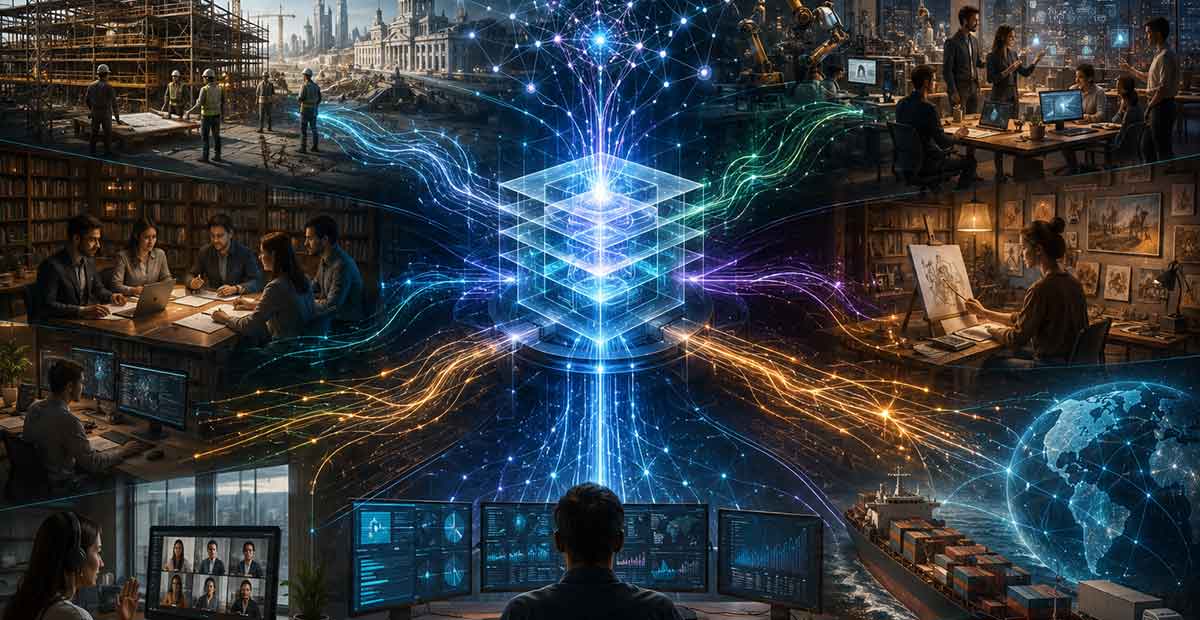
One of the greatest organizational achievements of the Chicago World's Fair of 1893 was not simply the scale of what was built, but the way it was built. The fair was completed because thousands of different activities occurred simultaneously. While architects designed one building, engineers surveyed another site. Contractors poured foundations elsewhere, electricians wired completed structures, landscapers prepared finished areas, exhibitors assembled displays, and administrators developed the systems needed to manage millions of visitors.
The project could never have succeeded if every task had been completed sequentially. Progress depended on coordinating many different processes that advanced in parallel while remaining connected through shared objectives and carefully managed dependencies.
The same principle underlies modern artificial intelligence.
A powerful AI processor does not complete one calculation before beginning the next. Instead, thousands of processing units perform enormous numbers of calculations simultaneously. At an even larger scale, AI data centers coordinate processors, memory, storage, networking, and software across thousands of systems, allowing countless operations to occur at the same time.
Although the technologies are very different, the underlying principle remains remarkably similar.
As systems become more complex, progress depends less on doing one thing exceptionally well and more on coordinating many different activities simultaneously while continuously integrating what each process produces.
Global Fast Fit and DataUniversa have evolved in much the same way.
By conventional standards, they remain relatively small organizations. Yet at any given moment, dozens of very different processes are unfolding simultaneously across seven countries. Some initiatives require years to complete, while others move from idea to implementation in days. Certain activities are highly predictable, while others evolve organically through experimentation and experience. Some can proceed independently, whereas others must wait until earlier work has reached a particular stage before they can begin.
All of this is happening while artificial intelligence itself continues to evolve at an extraordinary pace.
The challenge is therefore much larger than simply managing many projects at once. It requires understanding which activities can proceed in parallel, which must remain sequential, which should begin immediately because they involve unavoidable delays, which need time to develop organically, and which must be continually reevaluated as the surrounding AI landscape changes.
Starting the Longest Clock First
One of the earliest strategic decisions made while building the Global Fast Fit and DataUniversa ecosystem was to begin filing trademark applications long before many of the systems carrying those names had been fully developed.
The reasoning was straightforward.
Trademark registration takes time.
Rather than waiting until every website, product, business model, and technical system had reached maturity, the trademark process was started immediately. More than two and a half years later, most of those applications have now been approved, with only India still progressing through examination.
Had trademark protection been treated as the final step in the process, several years would have been lost unnecessarily. By recognizing that trademarks operate on one of the organization's longest independent timelines, that clock could begin running while virtually every other part of the organization continued to develop.
During the same period, software was being written, datasets were being collected, websites were being built, teams were expanding across seven countries, exercises were being tested, patents were being filed, and the overall strategic direction of the ecosystem continued to evolve.
None of those activities depended on waiting for trademark approvals, just as the trademark applications themselves did not depend on waiting for everything else to be completed.
This illustrates one of the most valuable forms of organizational parallelism.
Identify the longest independent process, start it as early as possible, and allow it to advance while every other compatible process continues moving forward.
Patents: Parallel in Time, Sequential in Knowledge
Patents introduce a very different organizational challenge.
Like trademarks, patents involve lengthy external timelines. Once an application is filed, it may spend years moving through examination before a final decision is reached. From that point forward, much of the process proceeds independently of the day-to-day work taking place inside the organization.
The invention process itself, however, rarely follows the same pattern.
Unlike trademark filings, inventions cannot simply be scheduled or completed all at once because the ideas themselves do not exist simultaneously. New concepts emerge through experience, experimentation, unexpected problems, and connections between earlier discoveries. One invention often creates the conditions that make another possible. A challenge encountered while collecting data may reveal the need for an entirely new structure. That structure may expose opportunities for data recombination, which then raises questions about provenance, ownership, valuation, or interoperability. Each solution becomes the foundation for the next generation of ideas.
Innovation therefore follows a largely sequential path, even though the legal protection surrounding those innovations proceeds in parallel.
Concept A makes Concept B possible. Concept B reveals the need for Concept C. Eventually, Concept C may even reshape the understanding of Concept A. The organization is continually learning from its own previous work, making invention less like manufacturing and more like an evolving conversation with the problems it is trying to solve.
This creates a fundamentally different organizational model from trademarks.
The objective is not to file every patent on the first day because much of today's intellectual property simply had not been conceived when the project began. Instead, inventions mature organically as understanding grows. Once a concept reaches an appropriate level of development, the legal process begins while the organization continues creating the next generation of ideas.
At any given moment, multiple generations of innovation therefore exist simultaneously. Earlier patents may be moving through examination, recently developed concepts may be undergoing drafting, and entirely new inventions may still be emerging from current work. Sequential knowledge creation and parallel legal processing become complementary parts of the same system.
Seven Countries: Parallel Human Development
Building teams across seven countries introduces yet another form of parallelism.
Unlike trademarks or patents, this process cannot be planned with the same degree of certainty because its most important variables are human rather than administrative or technical. Every country develops according to its own opportunities, constraints, relationships, and local conditions.
Kenya and Uganda currently provide some of the most mature examples, but every participating country follows its own developmental path. People are recruited, some exceed expectations while others struggle, and individuals originally brought into one role often prove exceptionally capable in another. Programs that succeed in one region may perform very differently elsewhere, while entirely new leaders and opportunities emerge through experience rather than planning.
No international organization can fully design this process in advance because many of its most valuable discoveries occur only after people begin working together.
A team member's true capabilities become apparent through real projects rather than interviews. Local opportunities often reveal themselves only after someone is already operating within the community. An initiative originally intended to solve one problem may unexpectedly produce valuable datasets, expose an entirely new market, or demonstrate an unforeseen application for an existing system.
Each country therefore becomes its own learning environment.
Some locations naturally become stronger in human performance data collection. Others develop expertise in software, education, health, music, entrepreneurship, or other forms of human activity. What succeeds in one country may fail in another—or succeed for completely different reasons.
Rather than treating those differences as organizational problems, DataUniversa views them as valuable sources of information.
The seven-country network functions as a series of parallel experiments unfolding simultaneously. Different environments generate different observations, different failures, different successes, and different insights. Some approaches survive unchanged, others are modified, and some are abandoned entirely. Frequently, the most valuable outcomes are the ones nobody originally expected.
The objective is not to eliminate that messiness.
Much of the organization's learning comes from it.
The real challenge is preserving enough structure to learn across seven very different environments without imposing so much uniformity that local adaptation—and the knowledge it produces—is lost.
Reintegrating Legacy Systems into a New Architecture
One of the realities of building a long-term technology platform is that the future is rarely constructed from a blank slate.
Many of Global Fast Fit's original data collection systems were created years before the broader DataUniversa architecture existed. At the time, they were designed to solve immediate operational problems. The focus was straightforward: collect exercise submissions, record completion times, store participant demographics, and compare performances. Those systems accomplished exactly what they were intended to do, generating years of valuable data and practical experience long before the current vision for DataUniversa had fully emerged.
Today, however, the challenge has changed.
Those same systems must now operate within a much broader ecosystem that includes GMIP identifiers, semantic structures, provenance, interoperability, package architectures, data recombination, ownership rights, valuation models, Broad Context, Living Knowledge, and many other capabilities that simply did not exist when the original software was written.
This is a challenge shared by nearly every successful technology organization.
Legacy systems cannot simply be discarded because they contain years of accumulated data, operational workflows, institutional knowledge, and real-world experience. At the same time, they cannot remain frozen in the form in which they were originally created. They must evolve alongside the larger architecture that surrounds them.
As a result, another long-running process unfolds in parallel with trademarks, patents, team development, software engineering, and daily operations: the continuous modernization of existing systems so they become compatible with an architecture that continues to expand.
The future, in other words, is built not only through new development, but through the continual reintegration of everything that came before.
Building While the Environment Keeps Changing
Managing multiple internal processes would already be challenging if the surrounding technology landscape remained stable.
It does not.
Artificial intelligence is advancing at an extraordinary pace. Capabilities that seemed experimental only a year or two ago have rapidly become routine. Tasks that once required custom software can increasingly be performed through AI-assisted workflows. Costs continue to change, model capabilities improve, multimodal systems become more capable, and AI agents are beginning to automate work that previously required significant human effort.
This means that every internal process must periodically be evaluated against an external environment that has changed since that process originally began.
A system designed six months ago may still represent an excellent solution.
Or it may already contain components that AI has made unnecessary.
Tasks that once required programmers may now be partially automated. Data structures originally designed for people may need to become machine-readable. Business models that previously demanded large teams may increasingly be achievable with much smaller organizations supported by AI.
Recognizing this, Global Fast Fit and DataUniversa have adopted a practice of reviewing monthly assessments of changes within the AI landscape and evaluating what those developments mean for the organization.
Those reviews serve an important purpose.
They are not simply reports describing what has changed in artificial intelligence.
They are recurring synchronization points that ask a much more important question:
Given everything that has changed in AI, what should change in us?
Parallel Learning Across the Organization
The evolution of AI introduces another layer of parallelism that exists entirely within the organization itself.
Every team member is learning to use AI differently.
A software developer naturally applies AI differently than a writer. A fitness coach interacts with different capabilities than a patent researcher. Team members in Kenya may discover entirely different workflows than colleagues in Uganda or other participating countries because their daily work, available resources, and local priorities are different.
Even within the same organization, AI is not advancing uniformly across every function.
Video analysis is evolving differently from legal research. Website development is changing differently from exercise analytics, communications, healthcare, financial analysis, field operations, or creative work. In some areas AI already performs a substantial portion of the workload. In others it remains primarily an assistant, while certain activities continue to rely heavily on human judgment, physical presence, local knowledge, trust, creativity, or specialized expertise.
For that reason, there is no single organizational AI adoption curve.
There are many.
Every individual, every discipline, and every country progresses at its own pace while AI itself continues evolving unevenly across different domains.
The organization therefore cannot simply announce that everyone should "adopt AI."
Instead, it must continuously learn how AI changes each role, how individuals can apply it most effectively within their own work, and how those separate learning experiences can ultimately strengthen the organization as a whole.
This creates another form of parallel development: a decentralized learning system in which people across multiple countries continually discover new ways to combine human expertise with rapidly advancing artificial intelligence.
A Small Company with Many Clocks
At any given moment, Global Fast Fit and DataUniversa are managing an extraordinary number of independent processes, each operating according to its own timeline. Trademark applications continue moving through different national legal systems while patents exist at various stages of invention, drafting, filing, examination, and approval. Teams continue developing organically across seven countries as exercise programs and other initiatives generate real-world data. Legacy software is continually modernized, new DataUniversa architectures are designed, existing datasets receive new semantic identities, websites evolve for an AI-mediated discovery environment, individual team members develop new AI capabilities, and the organization itself is continually reassessed against changes occurring throughout the broader AI landscape.
None of these processes share the same clock.
Some unfold over many years, while others progress in months, weeks, or even days. Certain activities proceed continuously, whereas others occur only when specific milestones are reached. Some are highly predictable and follow well-defined external processes. Others are inherently uncertain because they depend on invention, human relationships, or changing market conditions. Some can be accelerated through additional effort, while others simply require patience. Some operate almost entirely independently, while others depend on work that has not yet been completed elsewhere in the organization.
Viewed this way, the organization resembles far less an assembly line than a modern AI system.
Rather than moving one project from beginning to end before starting the next, numerous processes advance simultaneously. Some exchange information continuously, some remain largely independent until their outputs are needed elsewhere, and others periodically synchronize before moving forward again. The effectiveness of the organization depends less on any individual activity than on its ability to coordinate many different activities that are all evolving at different speeds.
The Organizational Advantage of Smallness
Large organizations often solve complexity by assigning more people to more projects.
Small organizations rarely have that luxury.
What they possess instead is the potential to integrate change much more quickly. When information moves rapidly, decision-making remains concentrated, team members make effective use of AI, and assumptions are continually reexamined, even a relatively small group can coordinate a surprisingly large number of simultaneous initiatives.
Artificial intelligence significantly expands that capability.
The defining question is no longer simply "How many employees does an organization have?" Increasingly, the more meaningful question becomes "How many useful processes can the organization initiate, coordinate, evaluate, and continuously integrate?"
A company of ten people using AI effectively is not merely a more productive ten-person company. It becomes a fundamentally different type of organization in which human judgment directs a much larger network of machine-assisted processes operating simultaneously across many different domains.
The same principle applies geographically.
An organization working across seven countries does not necessarily require seven large national offices. Instead, it can establish relatively small local nodes that generate relationships, experimentation, practical experience, and valuable data while remaining connected through a shared architectural framework. Geographic reach therefore expands without requiring organizational size to grow at the same rate.
From the Chicago World's Fair to AI Systems
The Chicago World's Fair demonstrated that thousands of human activities could be coordinated simultaneously within a common organizational structure.
Modern AI processors demonstrate that enormous computational complexity can be managed through parallel processing.
Global Fast Fit and DataUniversa apply the same underlying principle to organizational development.
Legal processes, invention, software engineering, data collection, team building, international operations, field experimentation, AI adoption, and strategic planning all operate according to different timelines and different rules. Attempting to force them into one uniform process would reduce the effectiveness of each. Instead, the organization seeks to understand the nature of every process and coordinate them intelligently.
Some activities should begin immediately because they involve unavoidable delays. Others must wait until the necessary knowledge exists. Certain systems can be carefully designed from the beginning, while others must be allowed to evolve through experience. Existing tools require continual adaptation as the surrounding architecture changes. Different countries need the flexibility to develop in different ways, and individual team members must learn to apply AI according to the unique demands of their own work. Throughout all of this, the organization must continually reassess itself as the external AI environment continues to evolve.
This may ultimately become one of artificial intelligence's most important organizational consequences.
The defining characteristic of future organizations may no longer be their size alone. Instead, competitive advantage may increasingly depend on the number, diversity, and complexity of the processes an organization can operate simultaneously—and on how effectively it integrates what those processes learn.
The Chicago World's Fair demonstrated that extraordinary complexity could be managed through parallel human organization. AI systems demonstrate that extraordinary computational complexity can be managed through parallel processing.
The emerging lesson for organizations such as Global Fast Fit and DataUniversa is remarkably similar.
Even a small company can operate across many simultaneous clocks—legal, technical, conceptual, human, geographic, and strategic—provided it develops the ability to coordinate those processes as parts of a single evolving system.
Ultimately, the organizations best positioned for the AI era may not be those that perform one activity faster than everyone else. They may be the organizations that become exceptionally good at running many different kinds of processes simultaneously, understanding the dependencies between them, and continuously recombining what each process learns into something more valuable than any individual process could produce on its own.
Whether you're exploring interoperability, dataset valuation, AI readiness, or ecosystem participation, we welcome conversations with researchers, organizations, and strategic partners interested in the future of structured data systems.
info@datauniversa.com