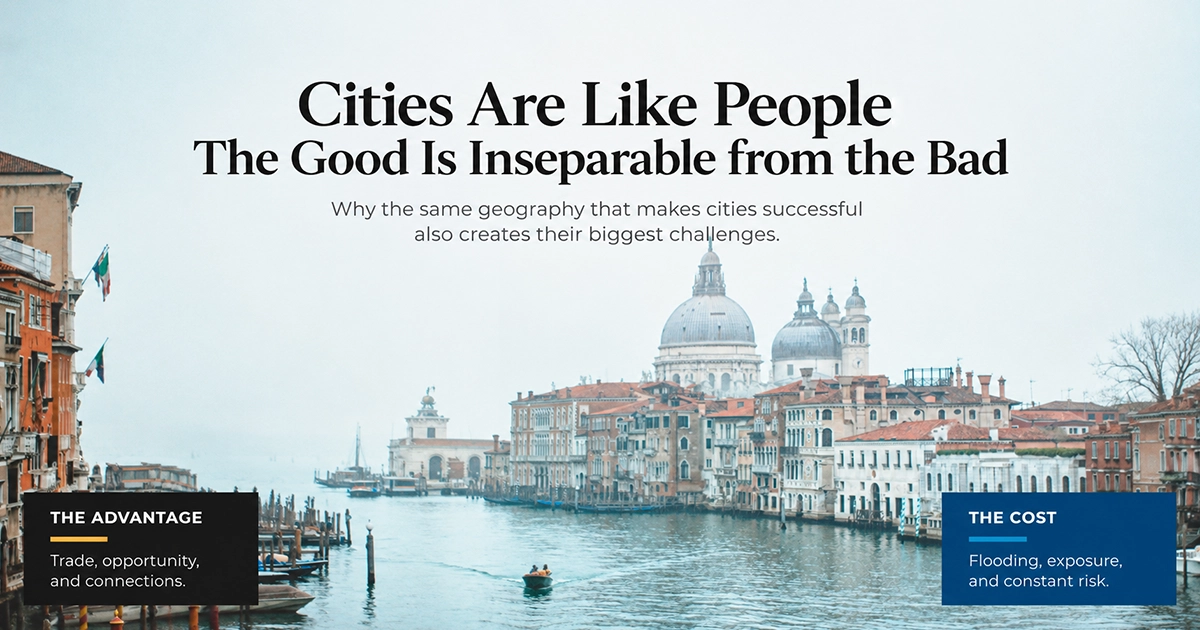
Cities Are Like People: The Good Is Inseparable from the Bad
By John F Groom
DU | Technology and Society
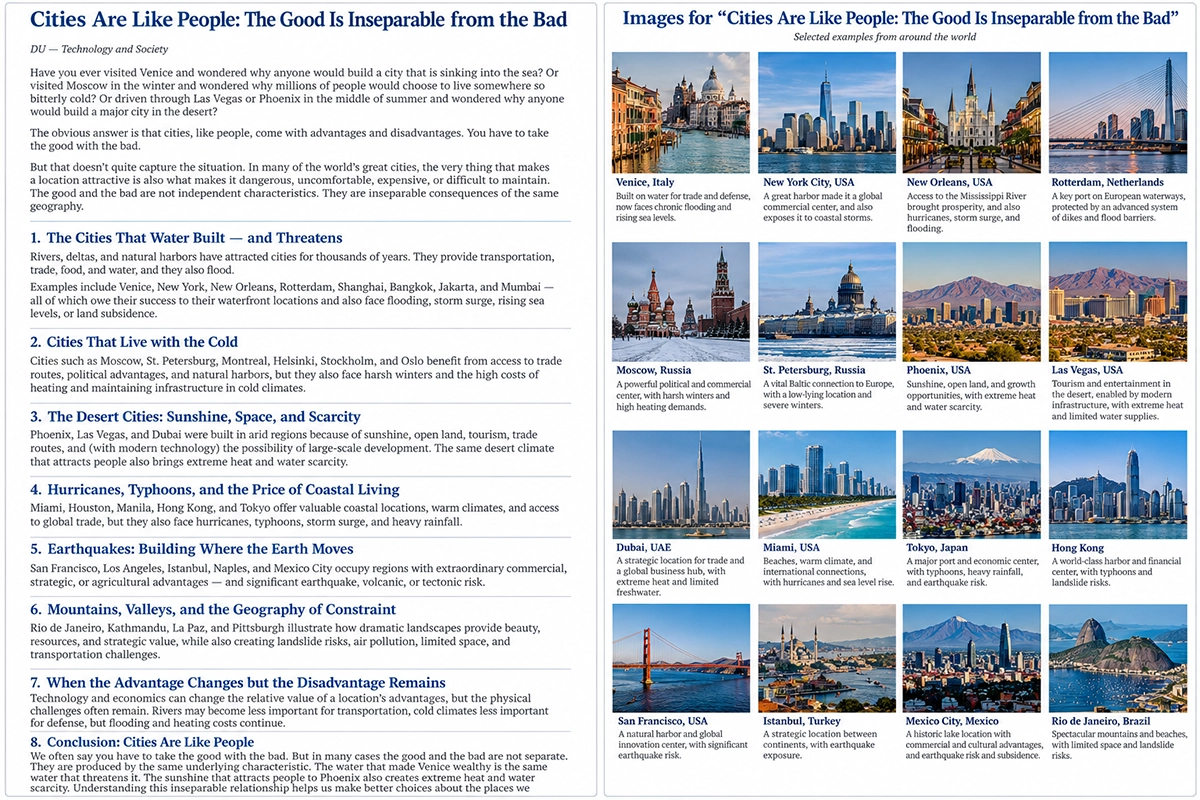
Have you ever visited Venice and wondered why anyone would build a city that is sinking into the sea? Or visited Moscow in the winter and wondered why millions of people would choose to live somewhere so bitterly cold? Or driven through Las Vegas or Phoenix in the middle of summer and wondered why anyone would build a major city in the desert?
The obvious answer is that cities, like people, come with advantages and disadvantages. You have to take the good with the bad. But that doesn’t quite capture the situation. In many of the world’s great cities, the very thing that makes a location attractive is also what makes it dangerous, uncomfortable, expensive, or difficult to maintain. The good and the bad are not independent characteristics. They are inseparable consequences of the same geography.
Venice did not become a great trading center despite being surrounded by water. It became a great trading center because it was surrounded by water. The same geography that facilitated its commercial success and helped protect it from invading armies now exposes it to flooding and rising sea levels. And Venice is hardly alone.
The Cities That Water Built and Threatens
Consider New York City. Its extraordinary natural harbor, access to the Atlantic, and connection to the Hudson River helped make it one of the world’s great commercial centers. Ships brought goods and immigrants from across the Atlantic, while the Hudson and Erie Canal connected it to the interior. But the extensive waterfront also exposes transportation tunnels, electrical systems, and neighborhoods to coastal storms. Hurricane Sandy demonstrated those vulnerabilities in 2012.
New Orleans offers an even more dramatic example. Its position near the mouth of the Mississippi River made it an exceptionally valuable port for the American interior. Yet that same position places the city amid low-lying land, wetlands, river flooding, hurricanes, and coastal storm surge. Levees, pumps, and flood barriers are essential to its existence. Hurricane Katrina in 2005 revealed what happens when those defenses fail.
Rotterdam’s position in the Rhine-Meuse delta made it one of the world’s great ports, but the Netherlands must continually invest in dikes, barriers, pumps, and water management. Shanghai benefits from access to the Yangtze River and international shipping, but faces typhoons, flooding, and subsidence. Bangkok’s canals and Chao Phraya River facilitated commerce and agriculture, but now pose flood-management challenges. Jakarta grew as a port but faces severe flooding and land subsidence. Mumbai’s natural harbor helped establish its commercial importance, while monsoons and reclaimed land complicate drainage. Rivers, deltas, estuaries, and natural harbors have attracted cities for thousands of years. They provide transportation, trade, food, and water. They also flood.
Cities That Live with the Cold
Moscow’s growth was influenced by its position within networks of rivers and overland routes, its defensibility, and its rise as a political center. The cold was not the attraction; the location’s advantages were sufficient to justify living with it.
St. Petersburg was established to connect Russia to Europe through the Baltic Sea. But the low-lying Neva delta was marshy, vulnerable to flooding, and subject to harsh winters. Montreal grew along the St. Lawrence River, a vital commercial route, while accepting severe winters and the cost of maintaining infrastructure in a cold climate. Helsinki, Stockholm, and Oslo likewise combine maritime advantages with northern winters. Over time, people developed the technology and institutions necessary to make these places not merely habitable but prosperous.
The Desert Cities: Sunshine, Space, and Scarcity
Phoenix grew with irrigation, transport, inexpensive land, and eventually widespread air conditioning. Its warm winters and abundant sunshine attracted retirees, tourists, and new residents. Yet those same arid conditions bring extreme summer heat, high cooling demands, and pressure on water resources.
Las Vegas developed around a desert oasis and transportation routes, then expanded with tourism and entertainment. Hoover Dam, Lake Mead, and air-conditioned buildings helped enable its growth. Its sunshine and dry weather are attractive during much of the year, but its summers and dependence on limited water supplies are formidable challenges.
Dubai’s Persian Gulf location facilitated trade, while modern aviation, finance, tourism, and infrastructure transformed its scale. But extreme heat and limited natural freshwater supplies require substantial investment in cooling and desalination. Sunshine may be an advantage in winter and a liability in summer: the same characteristic has opposite consequences depending on the activity and season.
Hurricanes, Typhoons, and the Price of Coastal Living
Miami’s beaches, warm winters, waterfront property, and proximity to Latin America helped make it a center of tourism, finance, and international business. Its coastal setting also brings hurricanes, storm surge, and sea-level rise. Porous limestone complicates flood protection.
Houston’s Gulf access supported its port and energy industries, while its flat terrain and bayous contribute to severe rainfall flooding. Manila’s bay facilitated maritime commerce, but the city faces typhoons and intense rain. Hong Kong’s deep natural harbor helped establish its international importance, while its mountains and coast expose it to typhoons, landslides, and storm surge. Tokyo Bay and the Kanto Plain offered valuable access and room for development, but the metropolitan area must contend with typhoons, flooding, and earthquakes. Proximity to the sea creates commercial opportunity and physical danger at the same time.
Earthquakes: Building Where the Earth Moves
San Francisco’s natural harbor and Pacific position supported its commercial development, but the surrounding fault systems bring earthquake risk. Los Angeles offers coastal access, a favorable climate, and extensive development opportunities, while occupying a tectonically active region.
Istanbul controls a strategic passage between the Black Sea and Mediterranean, a location that helped make it the capital of empires. It also lies near the North Anatolian Fault. Naples has a historic port, Mediterranean setting, and fertile volcanic surroundings, but faces hazards from Vesuvius and Campi Flegrei.
Mexico City’s predecessor, Tenochtitlan, benefited from an island setting in Lake Texcoco, with defensive, agricultural, and transportation advantages. The modern metropolis occupies a former lake basin whose soft sediments can amplify earthquake shaking, while groundwater extraction contributes to subsidence. A geographic advantage in one era can become an engineering burden in another.
Mountains, Valleys, and the Geography of Constraint
Rio de Janeiro’s mountains, beaches, and Guanabara Bay give it scenery and a natural harbor, but steep terrain constrains development and creates landslide hazards. Kathmandu’s valley supported agriculture and trade but can trap air pollution and faces seismic risk. La Paz’s dramatic Andean setting brings difficult infrastructure requirements and landslide exposure. Pittsburgh’s rivers and nearby coal deposits powered its industrial development, while its hills and valleys complicate transport and expose some areas to flooding. These cities were not necessarily badly located. Their advantages and disadvantages are products of the same physical setting.
When the Advantage Changes but the Disadvantage Remains
Cities were often founded because a location offered advantages under the economic and technological conditions of the time. Those conditions change. Rivers may become less essential after highways and railroads; harbors may lose some of their relative importance as supply chains evolve. Yet the flooding remains. Conversely, air conditioning transformed desert cities, while flood barriers, pumps, and earthquake-resistant construction made difficult environments more manageable.
Cities also accumulate buildings, institutions, businesses, skills, and cultural significance. Those assets create reasons to remain even when the original geographic advantage has diminished. Millions of people do not live in Venice, Moscow, or New Orleans solely because someone centuries ago judged the location favorable. They live there because generations built something valuable that cannot easily be moved.
Why Not Simply Move Somewhere Better?
Why not build New Orleans on higher ground, Venice on dry land, or Phoenix somewhere cooler? Because moving far enough to escape the hazard may also eliminate the advantage. Move a city away from its harbor and it loses the harbor. Move it from the desert and it may lose the sunshine and winter climate that attracted residents. Some hazards can be reduced through engineering; sometimes safer nearby development or relocation makes sense. But there is rarely a location offering every benefit without corresponding costs.
The same applies beyond natural disasters. Centrality brings congestion. Mountain scenery limits developable land. Isolation offers peace but reduces access to markets. Every geographic choice is a package.
Cities Are Like People
We often say that in relationships we must take the good with the bad. Someone may be ambitious but difficult to live with, independent but resistant to compromise, or cautious but reluctant to take opportunities. Yet those qualities may not be separate: the ambition that drives achievement may also create the difficulty; the independence that fosters originality may also resist compromise.
The same is true of cities. Venice’s water was not one characteristic that made it wealthy and another unrelated characteristic that now threatens it. It was the same water. New York’s harbor, Miami’s coastline, Rotterdam’s delta, Istanbul’s strategic position, and Phoenix’s desert climate are variations on this principle.
Rather than imagining that we can select the advantages and reject the disadvantages, we should ask what underlying characteristics produce both. Which costs can technology, adaptation, or judgment reduce? Which are intrinsic to the advantages we value? And when does the package cease to be worth its price? The lesson of the world’s cities is not simply that every place has good and bad characteristics. It is that, very often, the good is inseparable from the bad.
Whether you're exploring interoperability, dataset valuation, AI readiness, or ecosystem participation, we welcome conversations with researchers, organizations, and strategic partners interested in the future of structured data systems.
info@datauniversa.com