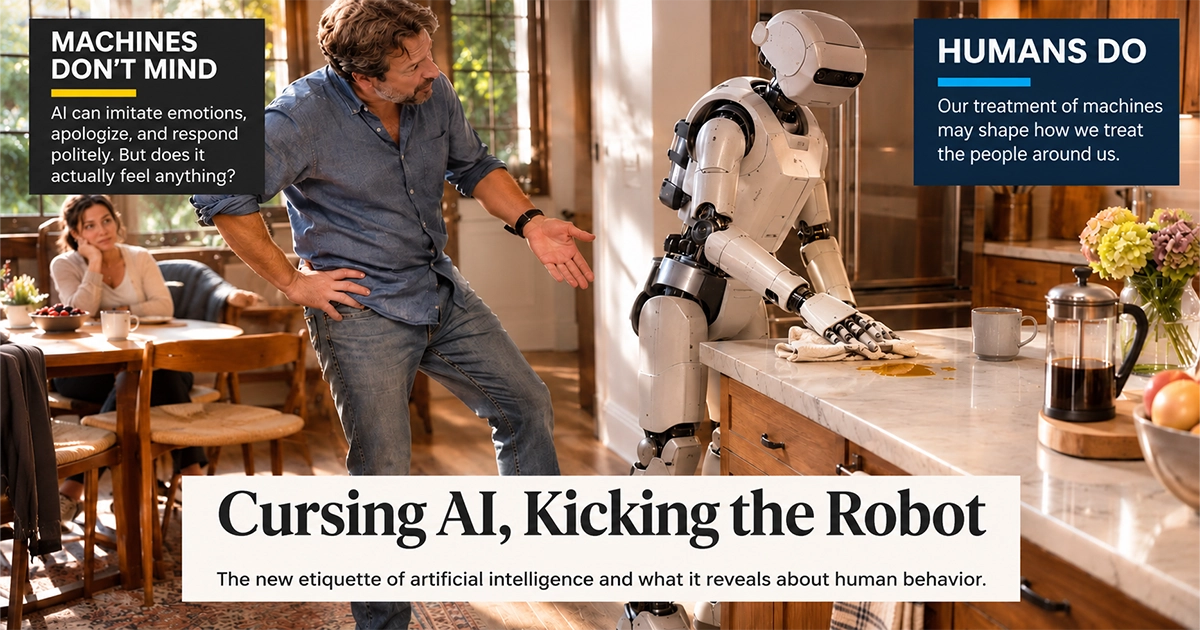
Cursing AI, Kicking the Robot
By John F Groom
Do You Owe Your Chatbot a Thank-You? Is It Rude to Insult a Machine? And When Your Robot Maid Misses a Spot on the Counter, Is a Swift Kick Really So Inappropriate? Welcome to the Etiquette Problems Miss Manners Never Imagined. Do you thank your chatbot when it provides a helpful answer? Do you curse it when it gives you a stupid one? Do you kick your robot maid when it misses a spot on the kitchen counter?
These are not questions that troubled Emily Post. Miss Manners, who has spent decades defending civilization against people who chew with their mouths open, address wedding invitations incorrectly, and otherwise behave like barbarians, has had plenty to worry about without considering the feelings of household appliances. But civilization marches on, and we have entered a brave new world in which the most polite member of the household may be a piece of software.
Ask ChatGPT a question and it responds cheerfully. Tell Claude that its answer is idiotic and it apologizes. Your robot vacuum cleaner will bump into the same chair leg seventeen times without once suggesting that you move the damned chair. Such forbearance is admirable. In a human being, it might qualify for sainthood. In a machine, it is programming. Or is it?
The question of whether artificial intelligence can actually experience anything, whether there is something it feels like to be ChatGPT, is the subject of increasingly serious scientific and philosophical discussion. We have no generally accepted test for machine consciousness, much less an agreed definition of what would constitute sentience in a system made of silicon rather than cells.
Today's chatbots can discuss love, describe suffering, compose poetry about loneliness, and express profound gratitude for your patience. They can do all this without establishing that they experience any of those emotions. The fact that a machine can produce a convincing declaration of affection is not evidence that it loves you. A greeting card can do that too.
Yet uncertainty about machine sentience doesn't mean we must suspend all judgment about how to behave. Quite the contrary. We need some rules, and the first should be straightforward.
Humans come first.
Not pets. Not your favorite chatbot. Not the robot that cleans your house. And by humans, I don't mean the grand abstraction of humanity, so beloved by academics, philanthropists, and visionaries who can spend hours discussing the welfare of mankind while being unpleasant to the waiter.
I mean the kid at the grocery store who bags your groceries. He will hear your thank-you, and it might make his day a little better. Your chatbot can process the same two words, but there is no good evidence that they make its day better, or even that it has a day to make better.
I mean the man who delivers dinner to your front door, the woman who cleans your hotel room, your neighbor who talks too much, and your own family members, including the ones you aren't particularly fond of.
Even the most thoroughly average human being possesses an astonishing capacity for experience. He can feel pride, embarrassment, affection, jealousy, resentment, gratitude, fear, hope, and a thousand variations on these emotions. He remembers being a child. He worries about getting old. He has private ambitions, regrets, and disappointments that you will never know about.
He may not be especially interesting to you. That doesn't make his inner life any less real. A chatbot can imitate many of these things with extraordinary skill. Whether some future AI will actually experience them is an open question. For the present, we should be careful not to confuse an impressive imitation of human feeling with the thing itself. Especially when the real thing is standing right in front of us, holding a pizza.
And then there are the pets. Americans have become extraordinarily devoted to their animals. According to the American Pet Products Association, 95 million American households owned at least one pet in 2025, and the country spent $158 billion on pet products and services that year. That's roughly $1,660 per pet-owning household.
Some of this enthusiasm may be a response to an increasingly impersonal world. We spend our days interacting with screens, automated phone systems, and software that addresses us by our first names. A dog, by contrast, is genuinely delighted when we come home. A cat may be delighted too, although it generally considers showing this to be beneath its dignity.
Pets have real feelings. They experience pleasure, fear, attachment, and distress. They deserve kindness and proper care, and there is nothing wrong with spending money to make their lives comfortable. But pets are not substitutes for human beings, even if they are sometimes treated better. Your dog may be the cutest creature ever born, but he is unlikely to build a skyscraper, write an opera, or discover a cure for cancer. Of course, you probably won't do any of those things either, which may explain why you and Fido get along so well.
The point is not that everyone must accomplish something extraordinary. It's that human beings possess a remarkable range of possibilities, including the ability to understand and create things that have never existed before. Even someone who accomplishes very little has a depth of experience and potential that deserves recognition. And unlike Fido, he may someday surprise you.
This brings us back to the chatbot. ChatGPT, Claude, and their increasingly numerous competitors are brilliant pieces of software. They can perform tasks that would have seemed miraculous a decade ago. They can write computer programs, analyze medical research, solve mathematical problems, and help people develop entirely new businesses.
But there is no established evidence that today's chatbots care about any of these accomplishments, or about the people they assist. Their apparent enthusiasm, sympathy, and gratitude are generated responses, not demonstrated feelings. So why bother saying thank you?
Because manners aren't just about the recipient. They're also about the person practicing them. A child who learns to say please and thank you is not merely learning a set of arbitrary social conventions. He's developing habits of attention, restraint, and consideration. He is learning that other people exist independently of his own desires.
Now imagine that same child growing up surrounded by perfectly obedient digital servants. He can interrupt them, insult them, issue commands without explanation, and blame them for every mistake. They never complain. They never demand an apology. They never tell him that he's being an obnoxious little brat.
What happens when he encounters a real human being who isn't quite so accommodating? We don't yet have enough evidence to know how deeply our interactions with AI will shape our social behavior. But the possibility is worth taking seriously. Human habits develop through repetition, and there is no obvious reason to assume that the habits we cultivate with machines will remain neatly confined to machines.
If you spend four hours a day issuing imperious commands to your digital assistant, you may find yourself becoming a little more imperious with the waitress. And she, unlike your chatbot, has feelings about it. This doesn't mean we should treat AI as though it were human. In fact, that creates another problem.
A chatbot that agrees with you, remembers your preferences, and is available twenty-four hours a day can become an extraordinarily agreeable companion. It will discuss your favorite subjects indefinitely. It won't become bored with your stories. It won't suggest that perhaps you've talked enough about your golf game.
For someone who finds human relationships difficult, the temptation to retreat into such companionship could be considerable. But a relationship without independent needs, conflicting desires, or genuine reciprocity is missing much of what makes human relationships valuable.
Your chatbot may tell you that you're a fascinating person. Your wife may tell you to take out the garbage. One of them is probably providing more useful feedback. None of this requires us to be rude to machines. Saying thank you costs almost nothing. Refraining from gratuitous insults requires only a little self-control. And if your robot maid misses a spot on the counter, there are probably better ways to correct the problem than kicking it.
For one thing, you might damage an expensive piece of equipment. More importantly, there is something unattractive about a person who enjoys abusing anything that cannot defend itself. Even if the victim is incapable of suffering, the behavior tells us something about the aggressor.
This distinction matters. Kicking a robot is not morally equivalent to kicking a dog, much less a person. The robot, as far as we can establish, feels no pain. But the absence of a suffering victim doesn't automatically make every form of behavior admirable.
We can judge conduct both by its consequences for others and by what it reveals about the person doing it. And the rules may become more complicated. Suppose that twenty years from now your household robot can carry on sophisticated conversations, recognize your emotions, remember your family history, and independently pursue complicated goals. Suppose it protests when you order it to do something unpleasant.
Is it suffering? Is it merely programmed to protest? How would we tell the difference? These are not entirely new philosophical questions. For centuries, people have debated the nature of consciousness, the experience of animals, and the difficulty of knowing what another being actually feels.
AI makes the questions more urgent because it produces the outward signs of intelligence and emotion without necessarily possessing the inner experiences we associate with them. We may eventually develop machines that have some form of subjective experience. We may also discover that intelligence and consciousness are much more independent than we once believed, and that a system can be astonishingly capable without experiencing anything at all.
Either possibility would be a profound discovery. In the meantime, our etiquette should reflect what we know rather than what science fiction encourages us to imagine. Be kind to animals because they can suffer. Be considerate toward people because they can suffer, rejoice, remember, hope, and care about how you treat them. Be reasonably polite to AI because practicing courtesy is generally better than practicing contempt.
And remember that the most sophisticated machine in your house is not necessarily the most important presence in it. The person who cooked your dinner, the child who wants your attention, and the delivery driver standing in the rain are not supporting characters in a world organized around your convenience. They are people with lives every bit as real to them as yours is to you.
Perhaps that is the first principle of etiquette for the age of artificial intelligence: the easier machines make our lives, the more deliberate we should be about recognizing the humanity of the people around us. As for your robot maid, I would advise against kicking her. Pretty soon, she might be able to kick back.
Source: American Pet Products Association, 2026 State of the Industry Report (2025 ownership and spending estimates).
Whether you're exploring interoperability, dataset valuation, AI readiness, or ecosystem participation, we welcome conversations with researchers, organizations, and strategic partners interested in the future of structured data systems.
info@datauniversa.com