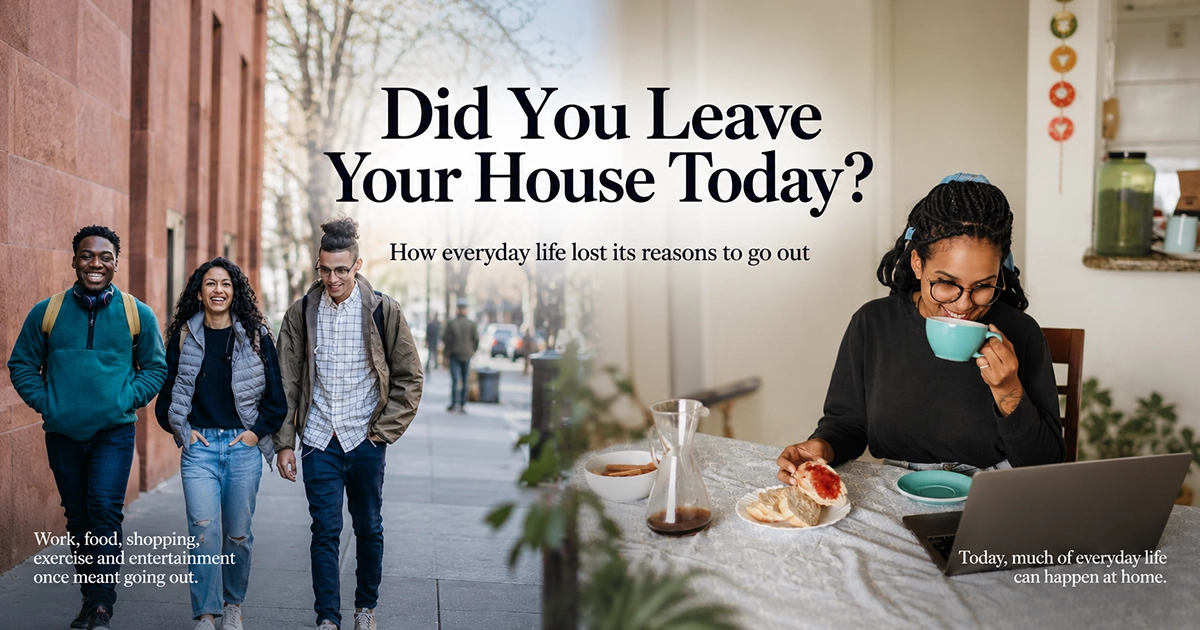
Did You Leave Your House Today?
Did You Leave Your House Today?
How Everyday Life Lost Its Reasons to Go Out
Did you leave your house today? For many people, the answer used to be built into the day. There was a job to reach, food to buy, an errand to run, a meeting to attend, or someone to see. Staying home meant leaving something undone. Today, a growing range of activities can be completed without crossing the threshold. A person can have a productive, comfortable, well-supplied day while barely moving beyond the rooms in which it began.
This is a different change from the privatization of entertainment. Watching a film at home instead of at a cinema changes where we obtain an experience. Working, shopping, and obtaining meals from home change whether we need to go anywhere at all. The emerging possibility is a house sufficient for much of ordinary life. Leaving it becomes less of a practical requirement and more of a decision.
The House Became a Better Place to Stay

Space and comfort make staying home an appealing choice.
One part of the story is simply that home became more attractive. For people who can afford them, spacious homes provide room for activities that once competed for a small shared living area. A spare bedroom can become an office. A basement can accommodate exercise equipment. Comfortable seating, heating and cooling, dependable plumbing, refrigerators, and well-equipped kitchens make domestic life easier. Large screens and good sound systems add entertainment without a journey.
The change is uneven. Many people live in cramped, expensive, or insecure housing, and larger homes are not a universal or continuously advancing trend. But an affluent household can now establish an unusually complete private environment. The Census Bureau reported that the median new single-family home sold in the United States in 2023 measured 2,286 square feet. That describes new houses sold, not the typical home occupied by every American, but it illustrates the substantial space available in one important part of the housing market. [1]
A comfortable house does not have to persuade its occupants to abandon the world. It only has to make staying seem reasonable. Why go somewhere to watch a film if the room is pleasant and the screen is excellent? Why visit a café to work if there is a quiet office upstairs? Each answer can be sensible. Together, those answers can produce a day with no reason to leave.
Exercise Came Home Too
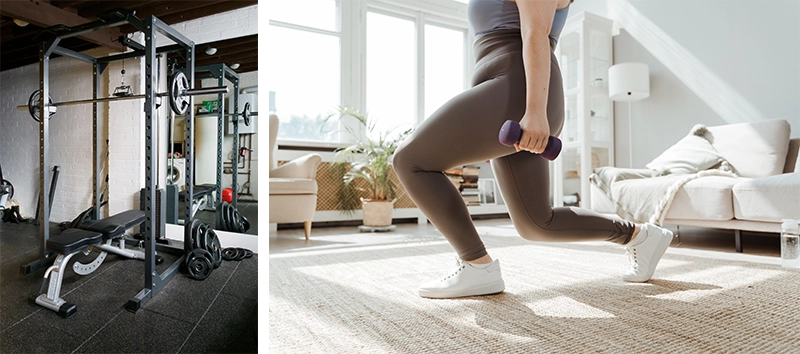
A dedicated gym or a living room workout can preserve exercise while removing the trip.
A home gym extends this process into an activity often recommended as a reason to get out. Weights, a bench, a stationary bike, or a treadmill can provide a substantial workout without a trip to a fitness center. A dedicated room is helpful but not essential. Bodyweight exercises and a few pieces of equipment can make exercise possible within a small domestic space. Online instruction adds guidance without requiring attendance at a class.
This can be an excellent use of convenience. Removing travel time and making equipment immediately available may help someone exercise more consistently. The physical effort remains real, and a person training at home may accomplish more than he would through irregular visits to a gym. The significance for this article is that even a demanding, productive activity can cease to provide a reason to leave the house.
A public gym also supplies a setting beyond the workout: familiar faces, observations of other people training, occasional conversation, and perhaps a coach or class expecting attendance. Some users value these features; others would gladly avoid them. Bringing exercise home preserves the activity while making participation in that shared setting optional. A person can finish a full working day, a serious workout, and an evening meal without going anywhere.
Work Stopped Guaranteeing an Outing

The working day can begin and end at the kitchen table.
For many adults, work has been the strongest recurring force drawing them away from home. It establishes a destination, a time to arrive, and a reason to get dressed and go. It also places the person among people whose company was not individually selected. Even an uneventful working day includes transitions: the journey, the entrance, a conversation, lunch, and the return.
Working from home removes some or all of that structure. The benefits can be substantial. Commuting costs time and money, workplaces can be distracting, and flexibility can improve a person's ability to manage the rest of life. Remote work also opens opportunities for people whose location or circumstances would otherwise restrict them. But it can eliminate the outing around which the day was organized.
The Bureau of Labor Statistics reported that 33 percent of employed people did some or all of their work at home on days they worked in 2024. This includes partial and occasional work at home; it is not a count of people who never attend a workplace. [2] The distinction matters, but so does the underlying change. For a substantial share of workers, doing work no longer automatically means leaving the residence.
Once the commute disappears, other outings can disappear with it. A person no longer picks up something on the way home, meets a colleague after work, or walks out to buy lunch near the office. Some of these activities will be replaced deliberately. Others simply cease to occur. Removing one major journey can remove several smaller occasions to be elsewhere.
The Errand Came to the Door
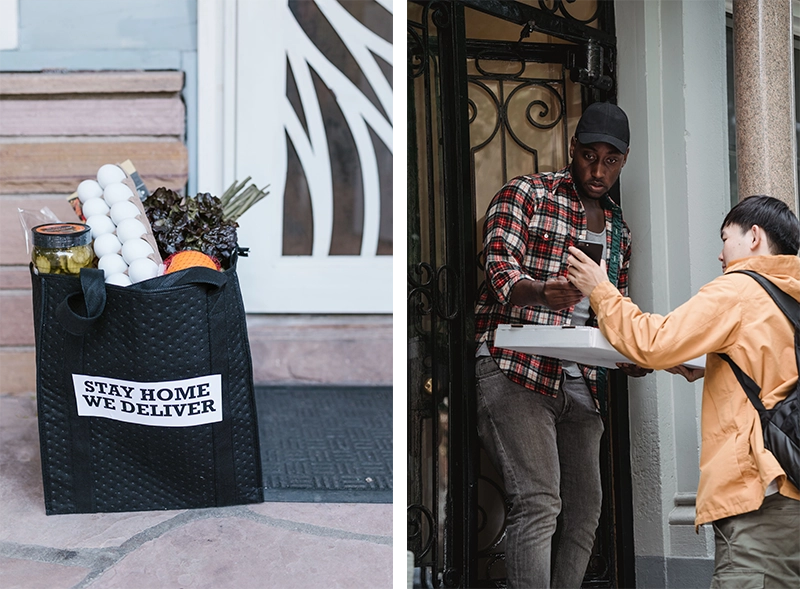
Groceries and prepared meals arrive at the threshold. The grocery bag makes the offer explicit: Stay home, we deliver.
Shopping has undergone a similar change. A purchase once commonly required a visit to a physical business. Today, many goods can be ordered from the room in which they will be used. Groceries and prepared meals can arrive at the door. Banking, bills, and numerous administrative tasks can be handled remotely. A house that offers little reason to leave for entertainment can increasingly offer little reason to leave for supplies.
Delivery is hardly a new invention. Earlier households received milk, fuel, groceries, and other goods, and wealthy people could delegate errands long before the Internet. What matters is the combination: digital ordering, extensive selection, convenient payment, and delivery across many categories. These services join remote work and home entertainment in making a day at home easier to sustain.
Each eliminated errand can be a genuine improvement. There is no special virtue in spending an hour buying an item that could arrive tomorrow. Meal delivery can help someone who is exhausted, busy, or unable to cook. The cumulative effect, however, is larger than the value of any individual transaction. Activities that previously created separate destinations become a sequence of requests from one address.
The physical labor has not vanished. Someone grows the food, stocks the warehouse, prepares the meal, and makes the delivery. The recipient's freedom to remain home depends on other people moving through the world. The house has become more sufficient from the resident's point of view while remaining deeply dependent on an external system.
Fewer Places Expect Us

A familiar gathering place supplies more than a drink. It supplies recurring company.
Practical needs are only half the story. People also leave because they belong somewhere. A pub, social club, fraternal organization, congregation, or recurring group can provide a reason to appear even when there is nothing to buy or accomplish. These places are often discussed as third places: settings beyond home and work where social life can develop.
They are not identical. A church may impose commitments and responsibilities that a café does not. A club may involve dues, rules, and organized activities. But recurring participation has a common effect. It puts someone on a schedule that involves other people. Familiar faces accumulate, and attendance becomes part of a person's life.
The weakening of these institutions is not one uniform trend across every country and category. Some gathering places thrive, and new communities form. Religious participation also requires careful measurement. Pew Research Center documents a longer-term decline in U.S. religious attendance, alongside recent stability in several measures, and warns against treating differences between telephone and online surveys as straightforward behavioral change. [3] The broader point is a mechanism: wherever recurring participation falls, one source of reasons to leave falls with it.
Membership supplies something that availability does not. Knowing that a hundred events are happening nearby is different from knowing that your group meets on Thursday and will notice whether you come. An abundance of possible destinations can coexist with a shortage of destinations where a person feels expected.
Someone who stops attending a club may still communicate with its members online. He may retain the information and some of the companionship. Yet the recurring journey has gone. The change can be almost invisible because nothing obviously essential was lost that week. Over months, it changes the physical pattern of a life.
How a Day Closes Around the House
These developments reinforce one another. A remote worker has no office journey. Delivered groceries remove the shopping trip. A meal arrives instead of an outing to a restaurant. Entertainment fills the evening. If there is no congregation, club, or regular meeting on the calendar, the day can be complete without an external destination.
This is an illustrative possibility, not the routine of every household. Many jobs require attendance, families have school and care responsibilities, and people continue to travel, exercise, and socialize. But the number of activities available from home has changed what is feasible. More people can remain there for longer stretches while meeting ordinary needs.
Patrick Sharkey's analysis of U.S. time-use data found that adults spent an average of one hour and 39 minutes more at home per day in 2022 than in 2003. The increase began before the pandemic, although COVID accelerated it. [4] This does not measure how many people never leave home. It provides evidence of a substantial shift in where time is spent, consistent with the convergence described here.
The feedback can extend beyond the individual. Fewer visits can make a local business or organization harder to sustain. Losing that destination gives remaining residents one less reason to go out. At a personal level, fewer outings can mean fewer acquaintances and invitations, leaving fewer social commitments to draw someone out next week. These are plausible reinforcing mechanisms, not a claim that every closure or friendship follows this pattern.
From Necessity to Intention
The most important change may be the burden placed on intention. An errand used to make a person walk, navigate, encounter weather, and enter another setting without first deciding that those experiences would be good for him. Work created transitions. Membership created recurrence. Ordinary obligations supplied a minimum amount of participation almost incidentally.
When those obligations disappear, the benefits require separate decisions. You can plan a walk, arrange lunch, join a group, or visit somewhere unfamiliar. But each action now asks for initiative. People can sincerely value these activities while repeatedly postponing them, especially when everything immediately necessary is already available at home.
The disappearance of a requirement is a gain in freedom. It also removes a structure that did useful work without needing daily reconsideration. Having the option to go anywhere does not guarantee that someone goes somewhere. A life can become geographically smaller even while its digital range grows.
There is no reason to manufacture pointless errands. Nor is leaving home an achievement by itself. A meaningful day of writing, learning, or conversation can take place indoors, and a frustrating commute can consume time that would have been better spent there. What deserves attention is the repeated pattern: whether convenience is helping create the life someone wants, or quietly replacing activities he still values.
What AI Adds
AI could remove still more reasons to leave. As systems become more capable of completing administrative tasks, organizing purchases, and supporting remote work, the house may become easier to operate as a center for everyday life. Adaptive conversation and generated entertainment could also fill moments that once prompted an outing. This is a possible direction of development, rather than a prediction that every task will become remote.
A personal AI could help in the opposite direction too. It could notice that the user wants more physical activity or stronger relationships, then help establish concrete commitments: a regular game, a class, a meeting with a friend, or a manageable outing. Its useful contribution would be to turn a vague intention into a destination and a time.
That would fit MU's prescriptive role. A system serving the person's wider purposes would not judge success solely by whether the immediate request was satisfied efficiently. It would consider what the saved time makes possible. If delivery and remote work free two hours, the question becomes what the user wants those hours to support.
Sometimes the answer is more time at home. Sometimes it is a relationship, a physical challenge, or a place that matters. A useful guide would help distinguish those circumstances and build recurring participation where the user wants it. One good suggestion may produce an outing; a worthwhile commitment can create reasons to leave for years.
Did You Leave Your House Today?

When the outing is optional, relationships and chosen activities can provide a reason to go.
The question is not a test of virtue. Someone who remained home may have had an excellent day. Someone who went out may have gained very little. But it is a useful question because it makes a large historical change visible at the scale of an ordinary evening.
More of what we need can arrive without our going anywhere. More work can be completed from the residence. More leisure can fill the space between tasks. The house can become increasingly comfortable and sufficient while the surrounding community becomes less necessary to the conduct of a day.
That leaves us with a choice that convenience alone cannot make. Which parts of life are improved by staying home, and which need a destination, other people, and a commitment to appear? As fewer activities require us to leave, the reasons we deliberately preserve become more important.
Did you leave your house today? If you wanted to, what gave you a reason? And if there was no reason, is there something outside worth making room for tomorrow?
Sources
[1] U.S. Census Bureau. Housing Data Show Median Price Per Square Foot by Region, June 2024.
https://www.census.gov/library/stories/2024/06/national-housing-month.html
[2] U.S. Bureau of Labor Statistics. American Time Use Survey 2024 Results, June 26, 2025.
https://www.bls.gov/news.release/archives/atus_06262025.htm
[3] Pew Research Center. Religious attendance and congregational involvement, February 26, 2025.
https://www.pewresearch.org/religion/2025/02/26/religious-attendance-and-congregational-involvement/
[4] Patrick Sharkey. Homebound: The Long-Term Rise in Time Spent at Home Among U.S. Adults. Sociological Science 11 (2024), 553–578.
https://doi.org/10.15195/v11.a20
Photograph Sources
Spacious living room. Pexels photograph 5998117.
https://www.pexels.com/photo/5998117/
Dedicated exercise equipment. Pexels photograph 4488752.
https://www.pexels.com/photo/4488752/
Living room workout. Pexels photograph 8846362.
https://www.pexels.com/photo/8846362/
Working at home. Pexels photograph 5198239.
https://www.pexels.com/photo/5198239/
Grocery delivery. Pexels photograph 7363163.
https://www.pexels.com/photo/7363163/
Meal delivery. Pexels photograph 9461645.
https://www.pexels.com/photo/9461645/
Friends at a pub. Pexels photograph 3851528.
https://www.pexels.com/photo/3851528/
Friends walking outdoors. Pexels photograph 6146941.
https://www.pexels.com/photo/6146941/
Photographs illustrate the settings discussed; they do not document changes over time. Images used under the Pexels License.
Whether you're exploring interoperability, dataset valuation, AI readiness, or ecosystem participation, we welcome conversations with researchers, organizations, and strategic partners interested in the future of structured data systems.
info@datauniversa.com