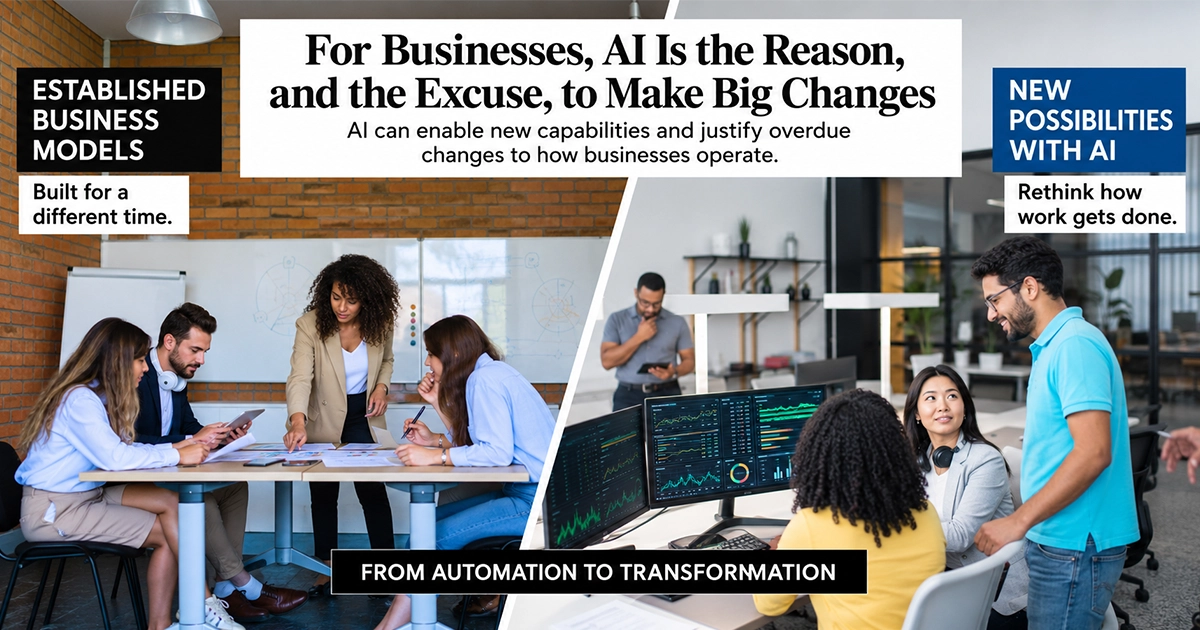
For Businesses, AI Is the Reason, and the Excuse, to Make Big Changes
By: John F Groom
Artificial intelligence is widely expected to transform business. Companies will automate activities previously performed by humans, develop new products and services, reorganize their workforces, and adopt entirely new business models. Some established businesses will become much more productive, while others will struggle to survive. New businesses will emerge to exploit capabilities that did not previously exist.
The obvious explanation for these changes is technological. AI can perform tasks that were previously impossible for machines, and it can perform many existing tasks faster, more cheaply, or more effectively. Businesses must adapt to these new capabilities, just as they adapted to electricity, automobiles, computers, and the internet. But there is another, less obvious reason why AI may produce enormous changes in business: many existing business models are already outdated. They developed in response to economic, technological, and social conditions that have gradually changed, sometimes over decades, while the businesses themselves have not necessarily changed along with those conditions.
AI provides an opportunity to reconsider these arrangements. More importantly, it provides a compelling justification for making changes that might otherwise encounter substantial resistance. AI is both the reason businesses need to change and the excuse they need to make changes that may have been overdue for years.
Business Models Are Products of Their Environments
Every business model develops in a particular environment. That environment includes the technology available at the time, the relative costs of labor and capital, access to information, communications capabilities, customer expectations, regulations, and the prevailing methods of organizing people and resources. A successful business has found an effective way to combine its capabilities with the opportunities and constraints of that environment. Its success does not necessarily mean that its organizational structure, operating methods, or relationships with customers are inherently superior. It means those arrangements worked reasonably well under a particular set of conditions.
Consider the traditional professional services firm. Large accounting, consulting, legal, engineering, and architectural firms developed when specialized knowledge was difficult to obtain, communications were relatively expensive, and coordinating complex work required substantial administrative infrastructure. Bringing professionals together within a single organization offered important advantages. Firms could share expertise, supervise employees, maintain quality standards, and establish reputations that individual practitioners would have difficulty developing independently.
Many of these advantages remain important, but the environment has changed dramatically. Information that was once difficult to obtain is now widely accessible. Professionals can collaborate across continents at negligible communications cost. Independent specialists can access sophisticated software and equipment that once required substantial corporate investment. Clients have more ways to identify and evaluate potential service providers, while digital platforms make it possible to coordinate work without necessarily employing everyone involved. These changes did not begin with AI. Most have been developing for decades.
Yet many professional services firms still resemble the organizations they were 30 or 40 years ago. They maintain large permanent workforces, elaborate management hierarchies, expensive offices, and billing arrangements inherited from an earlier economic environment. Some of these arrangements continue to serve legitimate purposes; others may survive primarily because they are familiar. The same pattern appears throughout the economy, where businesses preserve distribution networks, administrative departments, retail locations, inventory systems, pricing structures, and customer relationships that developed under substantially different conditions. In many cases, the question is not whether AI can improve the existing business model, but whether the existing business model still makes sense.
Why Businesses Don't Change When Their Environments Do
It might seem that competition would automatically eliminate outdated business practices. If a more efficient business model becomes possible, competitors should adopt it, forcing established businesses to respond. Competition does encourage adaptation, but the process is neither instantaneous nor complete.
Successful businesses accumulate investments in their existing methods of operation. They purchase facilities, develop software, train employees, establish contractual relationships, and create management systems. Employees develop careers around particular responsibilities, executives acquire authority over departments and functions, and customers become accustomed to dealing with the business in a particular way. Changing the business model threatens some of these arrangements, even when the change would improve the organization's long-term performance.
Moreover, the benefits of change are often uncertain, while the costs are immediate and visible. A company considering a radically different organizational structure must weigh potential improvements against the risk of disrupting operations that are currently profitable. Consequently, preserving an imperfect but functioning business model can be entirely rational.
This creates an important distinction between the optimal business model for a new entrant and the optimal decision for an established company. A new business can design its operations around current conditions without having to abandon existing investments or relationships. An established business must overcome its own history, creating an accumulation of organizational inertia. Over time, businesses may become increasingly dependent on arrangements whose original economic justification has weakened or disappeared. Incremental improvements can keep them competitive for years, concealing the possibility that a fundamentally different structure would perform much better.
This is particularly likely in industries where established firms retain advantages through reputation, customer relationships, regulation, or access to capital. Such advantages can protect a business even when important aspects of its operations are no longer especially efficient. The business survives, but not necessarily because its business model remains optimal.
AI Changes the Economics and the Conversation
AI introduces two distinct forces that can overcome this inertia. The first is technological. AI creates new capabilities and changes the relative costs of existing activities. Tasks that required substantial human effort may become inexpensive to automate, activities that were previously too complicated to coordinate may become manageable, and new forms of analysis, personalization, design, and production become economically feasible. These changes directly undermine some existing business models while creating opportunities for new ones.
The second force is organizational and psychological. AI establishes a widely recognized external reason to reconsider how businesses operate. A company proposing to eliminate management layers, reduce its office footprint, reorganize departments, or replace traditional employment arrangements might previously have encountered strong resistance. Employees could interpret such proposals as cost-cutting exercises, managers might regard them as threats to their authority, and investors could question why a profitable business needed radical restructuring.
AI changes the context in which these proposals are evaluated. Management can argue that the industry is entering a new technological era and that fundamental restructuring is necessary to remain competitive. Employees may be more willing to accept changes presented as adaptation to an unavoidable technological transformation. Investors may become more receptive to ambitious restructuring plans, and customers may expect businesses to adopt new methods rather than regard change as evidence of instability. The underlying proposal may be essentially the same one that could have been made ten years earlier. What has changed is the perceived legitimacy and urgency of implementing it.
This does not mean every restructuring justified by AI is economically sound. The AI label can also be used to rationalize poorly conceived cost reductions or organizational changes. But AI can overcome barriers to change that have little to do with the technology itself. In that sense, AI is not simply changing what businesses can do. It is changing what businesses are willing to consider doing.
Three Different Sources of Business Transformation
To understand the full economic impact of AI, it is useful to distinguish three categories of change. The first is genuinely revolutionary change: activities or business models that depend directly on new AI capabilities. A system capable of analyzing millions of documents, interpreting complex requests, generating sophisticated designs, or coordinating large numbers of specialized processes may enable services that were previously impractical. Without AI, the new business model might not be economically feasible.
The second category is delayed adaptation. These are changes that could have been implemented before AI but were postponed because of organizational inertia, established expectations, transition costs, or a lack of competitive pressure. Reducing unnecessary office space, eliminating redundant administrative processes, using independent specialists instead of permanent employees, or reconsidering traditional distribution arrangements may fall into this category.
The third category is combined transformation, in which AI accelerates or strengthens a change that was already becoming economically attractive. A business might have been able to operate with a smaller permanent workforce and a larger network of independent specialists ten years ago, but coordinating such an arrangement would have been difficult. AI reduces those coordination costs, making the alternative more attractive while simultaneously providing the justification for adopting it. The third category may account for a particularly large share of business transformation over the next decade.
It is also the most difficult to analyze because the technological and organizational contributions are intertwined. When a company doubles its productivity after adopting AI and reorganizing its operations, how much of the improvement came from AI performing work, and how much came from abandoning inefficient procedures? The distinction matters. Businesses that attribute every improvement to AI may fail to recognize the deeper organizational lessons. Conversely, companies that focus exclusively on automating existing tasks may overlook much larger opportunities to redesign the business itself.
The Historical Parallel: Electricity and the Factory
The history of industrial electrification illustrates the distinction. Early factories were often organized around central sources of mechanical power. Steam engines drove shafts, belts, and pulleys that transmitted power throughout the building, so the physical arrangement of machinery reflected the need to distribute energy from a central location.
When electric motors became available, factories did not immediately abandon their existing layouts. Many initially replaced steam power with electric power while retaining much of the traditional organization of production. The full benefits of electrification emerged only as factories were redesigned around the flexibility of distributed electric motors. Machines could be placed where they made the most sense for production rather than where they could conveniently receive mechanical power. Manufacturing processes could be reorganized, and new methods of production became practical.
Electricity provided a new capability, but the productivity gains also depended on reconsidering organizational arrangements inherited from an earlier technology. The internet produced a related phenomenon. Its direct technological contribution was the inexpensive exchange of information across global networks, but much of its economic impact came from changes in distribution, retailing, customer relationships, inventory management, and the role of intermediaries. Some of these changes were impossible without the internet; others represented the elimination of practices that had become increasingly inefficient as communications and computing technology improved.
AI may produce an even broader version of this process because it affects the organization of knowledge, expertise, decision-making, and coordination, activities that are central to almost every business.
What Would This Business Look Like If We Started Today?
One of the most useful questions a business can ask is also one of the least frequently asked: If we were starting this business today, with no existing employees, facilities, systems, or organizational commitments, how would we design it? This question differs fundamentally from asking how AI can improve current operations.
The conventional approach begins with the existing organization. Management identifies activities that can be automated, departments that can become more productive, and products that can incorporate AI features. The objective is to improve the current business model. The alternative begins with the desired output: What does the customer actually want? What resources are necessary to produce it? Which activities require exceptional human capabilities, and which can be performed by conventional technology or AI? Which resources should be owned, employed, contracted, or accessed temporarily, and how should they be coordinated?
Consider an architectural firm employing hundreds of professionals. A conventional AI strategy might introduce AI-assisted drafting, visualization, design analysis, and administrative tools. These improvements could substantially increase productivity while preserving the firm's existing structure. A more fundamental reassessment would ask whether a firm producing the same architectural services needs hundreds of permanent employees in the first place.
Perhaps a smaller group of highly capable architects could develop concepts and manage client relationships while drawing on networks of independent engineers, designers, technical specialists, and contractors. AI-supported systems could help assemble project teams, coordinate work, evaluate alternatives, monitor progress, and verify outputs. Such an organization would still require human expertise, professional accountability, and quality control. It might also face practical disadvantages compared with a traditional integrated firm, but it could operate with a very different cost structure and a more flexible combination of resources.
Importantly, much of this alternative was conceptually possible before generative AI. Improvements in digital design, cloud computing, and communications had already weakened some of the traditional reasons for concentrating all capabilities within a single organization. AI makes the alternative easier to implement and provides a compelling reason to attempt it.
Similar questions can be asked of consulting firms, advertising agencies, insurance companies, retailers, educational institutions, healthcare providers, and manufacturers. The appropriate answer will vary. Some industries may benefit from greater integration, while others may benefit from decentralization. The objective is not to assume that smaller, more automated, or more distributed organizations are always superior. It is to stop assuming that inherited organizational arrangements are necessarily the right starting point.
The Opportunity Extends Beyond Automation
Much of the discussion surrounding AI focuses on replacing human labor. This is understandable because labor represents a substantial portion of business costs, and AI can increasingly perform activities previously requiring human intelligence. But automation is only one way to improve a business.
A company may discover that an activity should be eliminated rather than automated. A report prepared every week might no longer serve any useful purpose. A management approval process may exist only because information once moved slowly through the organization. A distribution intermediary may no longer provide enough value to justify its cost. Automating these activities would preserve the underlying inefficiency while reducing its expense. The larger opportunity is to reconsider whether the activity should exist at all.
Other improvements may involve replacing permanent resources with temporary ones, combining functions previously handled separately, changing pricing arrangements, or creating entirely different relationships between producers and customers. AI can assist in discovering and evaluating these alternatives even when it does not perform the underlying work.
For example, a company might use AI to compare alternative production arrangements and discover that a particular task is best performed by a skilled independent contractor using conventional equipment. The economic improvement comes from matching the task to the appropriate resource, not from AI performing the task. This suggests that one of AI's most valuable functions may be helping businesses determine how to organize their activities rather than simply carrying them out.
The Advantage of New Entrants
Established companies face a particular challenge during periods of technological transformation. Their existing assets, employees, customers, and organizational structures are simultaneously sources of competitive strength and obstacles to change. A new entrant faces fewer constraints and can design its business around the current environment, selecting the combination of human capabilities, technologies, and organizational relationships that best serves its objectives. It need not preserve departments because they already exist, maintain facilities because they have already been purchased, or continue pricing arrangements because customers have historically accepted them.
This flexibility can be particularly valuable when the environment is changing rapidly. A new company does not necessarily need superior AI technology to challenge an incumbent. It may simply need to combine widely available AI capabilities with a more appropriate business model. The incumbent may possess greater expertise, stronger customer relationships, and substantially more capital, yet still operate at a disadvantage because its organization was designed for a different environment.
However, incumbents also possess advantages that new entrants cannot easily reproduce, including reputation, proprietary data, regulatory approvals, accumulated expertise, and trusted relationships. The strongest established businesses may be those that successfully preserve these advantages while abandoning outdated arrangements.
The critical competitive distinction may therefore be less between businesses that use AI and those that do not, and more between businesses willing to reconsider their fundamental models and those that merely incorporate AI into existing operations.
The Risk of Using AI as an Excuse
There is a danger in treating AI as a justification for fundamental change. Not every traditional business practice is obsolete. Some organizational arrangements persist because they solve problems that are not immediately visible. Permanent employees can provide continuity, institutional knowledge, and accountability. Management hierarchies can clarify responsibility. Physical facilities can facilitate collaboration, quality control, and customer trust.
A company that eliminates these arrangements without understanding their functions may discover that the apparent inefficiencies were providing substantial value. AI can also encourage exaggerated expectations. Management may assume that new technology can replace capabilities it cannot yet reliably reproduce, or that independent resources can be coordinated more easily than experience ultimately demonstrates.
The correct response is not to preserve existing arrangements or abandon them indiscriminately. It is to evaluate them against current conditions. For each important component of the business, management should understand why it exists, what value it provides, whether the circumstances that justified it still prevail, and whether a superior alternative is now available.
That evaluation should distinguish improvements made possible by AI from improvements that could have been made without it. The distinction helps identify where technology is essential and where the real obstacle is organizational inertia. It also prevents AI from becoming a fashionable explanation for changes that have little economic justification.
From Periodic Restructuring to Continuous Adaptation
There is a broader implication. Businesses have traditionally been relatively stable organizations operating in changing environments. They make periodic adjustments to technology, staffing, products, and processes, but their fundamental structures often persist for decades. That model may become increasingly problematic as technological and economic conditions change more rapidly.
A more adaptive business would continuously reassess the relationship between its objectives, available resources, and operating environment. It would not assume that the best way to accomplish a task today will remain the best way next year. As AI becomes more capable of discovering resources, evaluating alternatives, coordinating participants, and monitoring results, this kind of continuous adaptation may become practical on a much larger scale.
Instead of periodically undertaking major reorganizations, businesses could gradually modify their structures and operating methods as better alternatives emerge. Such organizations would be less likely to accumulate decades of outdated practices because reassessment would become part of normal operations.
This would represent a more fundamental transformation than the automation of individual tasks. It would change the relationship between the business and its environment. Rather than treating its organizational structure as relatively permanent, the business would increasingly treat that structure as one of the variables to be optimized.
The ultimate competitive advantage might lie not in possessing a particular technology or business model, but in the ability to recognize when the environment has changed and adapt the combination of human capabilities, tools, and organizational arrangements accordingly.
The Larger Economic Opportunity
The economic impact of AI is usually estimated by considering the activities it can automate, the productivity improvements it can produce, and the new products and services it can enable. These are important sources of value, but they may not capture the full opportunity.
There is also a large, difficult-to-measure stock of accumulated economic inefficiency embedded in existing business models. Some of it results from outdated technologies, some from changing costs and customer expectations, and some from organizational arrangements that have persisted long after their original justifications weakened. AI can help unlock that value in two ways: it provides new capabilities that make alternative arrangements more practical, and it creates the urgency and legitimacy needed to overcome resistance to change.
The resulting economic transformation may therefore be much larger than the direct contribution of AI technology itself. We may see companies dramatically reduce their operating costs, improve customer experiences, reorganize production, and develop new relationships with employees and suppliers. Some of these improvements will depend on AI performing tasks that humans previously performed. Others will come from eliminating unnecessary activities or adopting organizational models that could have worked years earlier.
Both types of improvement may be attributed to AI, even though their underlying causes are different. This distinction also suggests that the businesses best positioned to benefit from the AI revolution may not necessarily be those with the most sophisticated AI systems. They may be those that use the occasion to undertake the most comprehensive and intelligent reassessment of how they operate.
Conclusion: A Revolution and a Reckoning
Technological revolutions do more than introduce new capabilities. They challenge assumptions about how economic activity should be organized. AI is particularly powerful in this respect because it affects activities that were once considered inherently human: analysis, planning, creativity, communication, and coordination. Its emergence invites businesses to reconsider not only which tasks should be performed by machines, but also how people, technology, capital, and other resources should be combined.
Yet many of the arrangements now being reconsidered were becoming outdated long before AI appeared. That is why the coming transformation should be understood as both a technological revolution and an economic reckoning. AI will make genuinely new things possible, but it will also expose weaknesses in business models that have been carried forward by habit, institutional inertia, and the understandable reluctance to disturb arrangements that still appear to work. For some businesses, AI will provide the technology necessary to change. For others, it will provide the justification to make changes that were already overdue. For many, it will do both.
The most productive response is therefore not simply to ask how AI can make an existing business more efficient. It is to ask why the business operates as it does, whether those reasons remain valid, and what form the business would take if it were designed for today's environment rather than yesterday's. AI is the reason to make some big changes. It is the excuse to make many others. And the greatest opportunity may belong to businesses that understand the difference.
Whether you're exploring interoperability, dataset valuation, AI readiness, or ecosystem participation, we welcome conversations with researchers, organizations, and strategic partners interested in the future of structured data systems.
info@datauniversa.com