Four Kinds of Scarcity in the Age of AI
By: John F Groom
What an enormous book about Leonardo da Vinci can teach us about what becomes abundant, and what does not
Imagine an enormous TASCHEN art book devoted to Leonardo da Vinci. It is the sort of book that barely fits on an ordinary bookshelf, with hundreds of large-format pages reproducing paintings and drawings in extraordinary detail. The paper is heavy, the printing is elaborate, and the binding is substantial. Some editions of books like these are produced in limited quantities and sold at prices that would have seemed extraordinary for a book in an earlier era.
Now imagine producing such a book in the age of artificial intelligence. At first glance, AI would seem to threaten the value of a book like this. AI can research Leonardo, summarize centuries of scholarship, translate Italian texts, draft captions, compare paintings, organize chronologies, suggest layouts, and increasingly assist with sophisticated image analysis. Tasks that once required enormous amounts of human intellectual labor can now be accelerated by machines.
But the finished book reveals something more interesting. It contains at least four fundamentally different kinds of scarcity, and AI affects each of them differently.
1. Intellectual Scarcity: Rapidly Declining
For most of history, producing a serious book about Leonardo was an expensive intellectual undertaking. Researchers had to locate sources, scholars had to read them, editors had to organize the material, writers had to produce explanatory text, translators had to work across languages, and designers had to determine how hundreds of images and passages should fit together. Knowledge work was scarce partly because human time was scarce.
AI is changing this dramatically. A machine can now perform in seconds certain informational tasks that once consumed hours or days. It can compare sources, summarize competing interpretations, create preliminary chronologies, generate alternative captions, and reorganize enormous amounts of information. This does not mean scholarship becomes unnecessary. In some respects, expert judgment becomes even more important because someone still has to determine whether what the machine has produced is correct.
The important change is that the cost of generating plausible intellectual material is collapsing. The same phenomenon has occurred across other forms of culture. Self-publishing removed many of the barriers to publishing books. Digital music production and distribution made it easier to release music. YouTube did something similar for video, while social media lowered the barriers to publishing commentary and photography.
Generative AI removes another barrier: the cost of producing the content itself. We are consequently entering a world in which there may be essentially no shortage of things to read, watch, hear, or examine. The scarcity has moved elsewhere.
2. Physical Scarcity: The 12-Pound Book Is Still a 12- Pound Book
Now tell the AI to manufacture the Leonardo book. Here, the magic largely stops.A giant art book still requires paper. High-quality reproductions still require sophisticated printing. Pages must be cut, assembled, and bound. Covers must be manufactured, and finished books must be packaged. Once produced, thousands of pounds of books have to be placed on pallets, moved through warehouses, loaded onto trucks, ships, or aircraft, and delivered to retailers or customers. They also have to be physically stored somewhere.
AI can optimize parts of this process. Automation can make factories more efficient, better forecasting can reduce inventory, and robots can move boxes. But information technology cannot repeal physics.
A 12-pound book still requires approximately 12 pounds of physical material to exist somewhere in the world. Someone has to manufacture it, move it, and eventually put it somewhere.
This creates one of the great divergences of the AI era: bits can become almost infinitely abundant, while atoms cannot.
The digital version of an enormous Leonardo book can be copied another million times at almost no marginal cost. Producing another million physical copies is an entirely different proposition. The intellectual scarcity surrounding the book may therefore collapse while its physical scarcity remains.
3. Authentic Scarcity: There Will Never Be Another Leonardo
Then there is the subject of the book itself. AI can generate a million images tomorrow in the style of Leonardo da Vinci. It cannot generate another Leonardo.
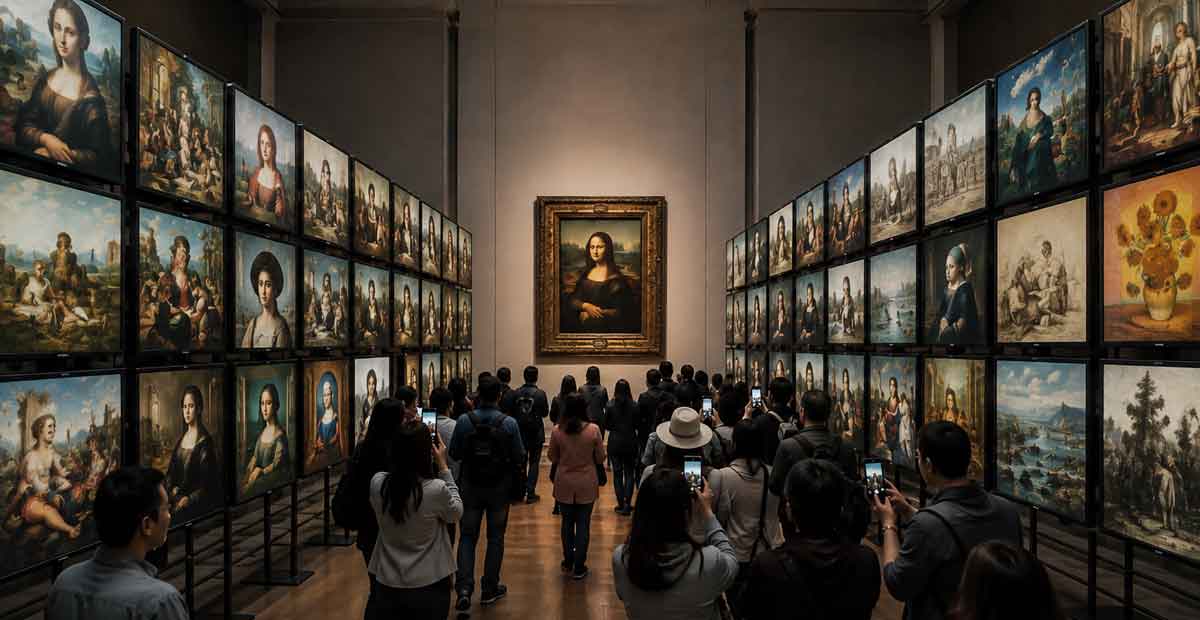
There is only one Mona Lisa and one Last Supper. There is also a finite collection of surviving drawings and paintings that can plausibly be attributed to Leonardo. That scarcity is not merely artistic. It is historical.
A genuine Leonardo is an object that physically passed through a particular sequence of events beginning more than five centuries ago. Scholars, collectors, museums, conservators, and historians have spent generations reconstructing those histories. For the most important Old Master works, provenance, attribution, materials, restoration histories, documentary references, and scholarly disputes may have been studied for decades or even centuries.
AI can produce an image that looks old. It cannot retroactively give that image 500 years of history. This distinction may become more valuable rather than less valuable in a world flooded with synthetic material.
Suppose the world eventually produces a trillion competent AI-generated images. The number of surviving Leonardo paintings does not increase from dozens to millions. It remains extraordinarily small. What changes is the ratio between authentic historical works and everything else.
The more abundant synthetic creation becomes, the more exceptional historically authenticated creation becomes by comparison. Paradoxically, AI could therefore increase the cultural or economic premium attached to certain original works.
When almost anyone can produce something beautiful, beauty itself may become less scarce. But the fact that Leonardo painted a particular object with his own hands approximately 500 years ago remains impossible to manufacture. The scarce property has shifted from appearance to history. And history cannot be generated on demand.
4. Manufactured Scarcity: We Could Make More, but We Choose Not To
Finally, consider something publishers such as TASCHEN have long understood: sometimes scarcity can be deliberately created.A publisher might produce a limited edition with only 1,000 numbered copies. Each copy could receive special binding, unusually elaborate printing, a case, a stand, a signature, or some other distinguishing characteristic.
This scarcity is fundamentally different from the scarcity of a Leonardo painting.There could be another 10,000 copies of the book. The publisher simply chooses not to make them. This is manufactured scarcity, and humans routinely value it.
Limited-edition watches, prints, automobiles, sneakers, coins, and books all demonstrate that scarcity can itself become a product characteristic. A numbered book marked 327/1,000 tells its owner something that an unlimited digital file cannot: there are only 999 other objects belonging to this particular edition.
The limitation creates differentiation. That makes this fourth form of scarcity especially interesting in an age of AI abundance. Once unlimited reproduction becomes normal, deliberate limitation may become more conspicuous and potentially more desirable.
The Four Scarcities
The giant Leonardo book therefore contains four different economic phenomena at the same time. Intellectual scarcity is declining because AI makes researching, writing, organizing, translating, and designing information dramatically easier. Physical scarcity persists because paper, printing, binding, shipping, storage, and physical space remain constrained by the material world. Historical scarcity is absolute because no technology can manufacture another object that Leonardo actually painted 500 years ago. Manufactured scarcity is voluntary because a publisher could print more limited-edition books but may deliberately choose not to.
AI affects all four differently. This distinction matters because saying that AI will create "abundance" is too simple. AI creates extraordinary abundance in certain things while leaving other constraints almost untouched.
When Creation Is No Longer the Bottleneck
There is an even larger consequence. For centuries, an important economic problem was producing enough information. Books were difficult to write, expensive to print, and costly to distribute. Music was expensive to record and distribute. Films required enormous organizations and capital. Even photographs once had a meaningful marginal cost.
Digitization progressively removed the distribution constraint. AI is now attacking the creation constraint itself. The result may be more books, images, songs, videos, essays, analyses, and explanations than any human being could possibly evaluate.
Scarcity therefore does not disappear. It moves. If ten million books can be generated, the scarce resource is no longer the ability to produce another book. It is knowing which book deserves ten hours of your life. If a billion new images can be generated every day, another attractive image has little inherent scarcity. Knowing which image is authentic, historically significant, relevant, or worth examining becomes more valuable.
If AI can generate an unlimited number of answers, generating an answer becomes cheap. Determining which answer is supported by reliable evidence becomes valuable. The economy of information consequently begins moving from creation toward discovery, verification, and selection. And this brings us back to Leonardo.
Five hundred years ago, producing an extraordinary image required an extraordinary human being, years of accumulated skill, expensive materials, and enormous amounts of labor. Tomorrow, producing an extraordinary-looking image may require little more than a sentence. But producing the Mona Lisa will remain impossible. Producing another enormous book containing reproductions of it will remain physically expensive. Producing another numbered copy after a limited edition has closed may be prohibited by the publisher. And deciding, among an effectively infinite universe of things that could occupy your attention, that Leonardo is still worth looking at may become one of the most consequential forms of scarcity of all.
AI does not abolish scarcity. It rearranges it. Understanding where scarcity moves may therefore be one of the best ways to understand where value will move next.
Whether you're exploring interoperability, dataset valuation, AI readiness, or ecosystem participation, we welcome conversations with researchers, organizations, and strategic partners interested in the future of structured data systems.
info@datauniversa.com