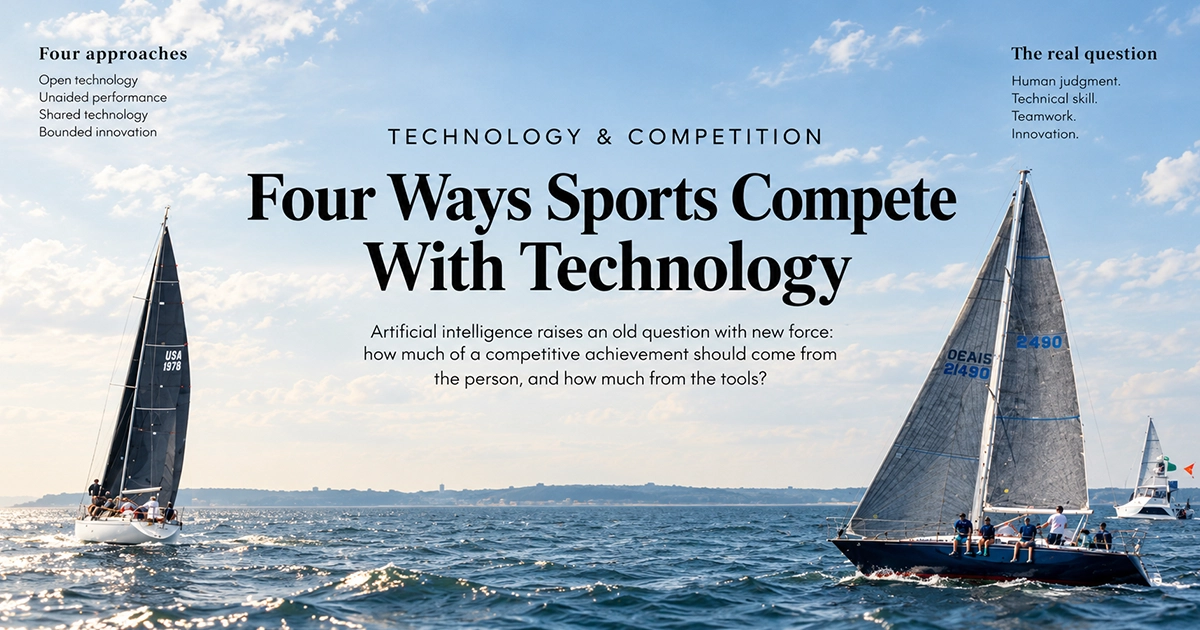
Four Ways Sports Compete with Technology
By: John F Groom
America’s Cup • Chess • SailGP • Formula One
Artificial intelligence raises an old question with new force: how much of a competitive achievement should come from the person, and how much from the tools? Sports have already developed several answers. America’s Cup sailing rewards the development of a better racing system. Chess protects unaided judgment during the game. SailGP gives competitors a common technological platform. Formula One allows engineering rivalry within detailed limits.
These arrangements reveal four useful approaches: technology can be part of the contest, excluded from the performance being measured, standardized across competitors, or permitted within boundaries. Each approach preserves a different kind of achievement. Choosing among them begins with deciding what we want the competition to measure.
The distinction matters because a tool can be legitimate in one contest and cheating in another. An AI system that helps evaluate a yacht design can contribute to the achievement the event rewards. An engine that supplies a chess player’s next move undermines the achievement the event is meant to test. Its technical capability does not settle the question. The rules and purpose of the activity do.
These four categories are useful models rather than perfectly separate boxes. America’s Cup also constrains boat design, Formula One standardizes some components, and chess players use sophisticated tools in preparation. The important distinction is where each sport places technological advantage within its definition of competition.
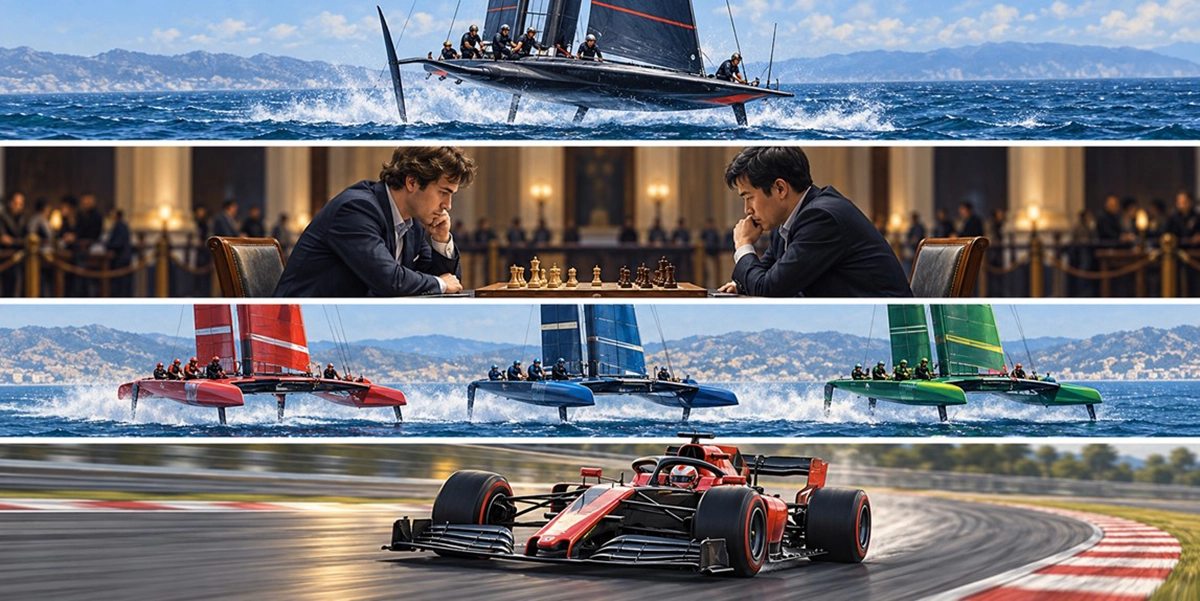
AI-generated editorial illustrations of the four sports. These are conceptual scenes, not photographs of actual events.
America’s Cup and Technology as Part of the Contest

Conceptual illustration of a foiling monohull. Design and sailing both contribute to performance.
In America’s Cup, the engineering team competes along with the sailors. The boat embodies decisions about shape, materials, foils, controls, and the interaction among them. A team that develops a faster legal boat has earned an advantage the competition is designed to recognize. Sailors still have to exploit that advantage under pressure, but the contest includes the work that happened before the starting signal.
AI fits naturally into that development process. Working with Emirates Team New Zealand before the 2021 Cup, McKinsey and QuantumBlack developed a reinforcement learning agent that sailed a virtual boat in the team’s simulator. It helped test hydrofoil designs without requiring human sailors to run every simulated trial. McKinsey reports that the bot accelerated the design process by a factor of ten during 2019 and early 2020. That is a reported result from a project participant, rather than an independent estimate of AI’s effect on the final race outcome. [1]
The relevant achievement is therefore the performance of an organization that designs, builds, and operates a racing system. Better simulation can be a legitimate advantage, just as better naval architecture can. The AI contribution described here took place in design testing; it does not mean an autonomous bot replaced the racing crew.
Calling this the open technology model does not mean anything goes. America’s Cup boats must comply with class rules, and some equipment is shared or constrained. Yet teams retain meaningful freedom to develop different solutions. Their distinct AC75 designs illustrate that freedom. The defining principle is that improving the tool is itself part of the competition. [2]
Chess and the Protection of Unaided Performance

Conceptual illustration of tournament chess. Players must make their own decisions during play.
Chess takes a different approach. In ordinary human tournament play, the player must select the moves. Consulting a chess engine would introduce a separate decision maker into a contest intended to compare the players’ own calculation, memory, and judgment. The fact that an engine can provide stronger moves gives the prohibition its purpose.
FIDE’s Laws of Chess forbid players during play from using notes, sources of information or advice, or analyzing a game on another chessboard. They also prohibit electronic devices in the playing venue unless specifically approved by the arbiter. These are restrictions on assistance during the contest, rather than a rejection of technology throughout the sport. [3]
A player can study with an engine before a game, analyze a completed game afterward, and benefit from electronic broadcasting or approved equipment. Computers help people learn chess and help audiences follow it. The boundary concerns who makes the competitive decisions while the game is being played. Training assistance and live move assistance have different effects on what a result means.
This model protects a recognizable human achievement even when machines can exceed it. There is no requirement that every competition use the strongest available method to produce its output. A tournament can deliberately ask how well a human performs under specified conditions. Banning an engine in that setting preserves the test, just as allowing one would create a different kind of contest.
The chess example is especially useful when discussing AI because it makes a limited prohibition intelligible. We can welcome a technology’s capabilities while defining activities in which participants agree to set those capabilities aside. The restriction serves a chosen purpose.
SailGP and a Shared Technological Platform

Conceptual illustration of a common foiling catamaran platform. Equal equipment preserves rivalry in operation.
SailGP embraces sophisticated technology while making the boat platform common to the competitors. Teams race F50 foiling catamarans built to a one-design specification. The league describes them as identical boats and emphasizes keeping the fleet matched. The intention is to make sailing skill, teamwork, and tactical decisions central to the outcome. [4]
This arrangement separates technological progress from exclusive access to it. The platform can improve, but improvements are introduced through the shared fleet rather than becoming a private design advantage for one team. SailGP’s description of its 2025 wingsail upgrades explicitly connects matching the boats with its commitment to even competition. [5]
Standardization does not make the event simple. A sophisticated boat still demands difficult decisions and coordinated execution. Crews must manage speed, maneuvers, and positioning while responding to rivals and changing conditions. Equal equipment can reveal differences in human performance precisely because it reduces one major source of variation.
Nor does a common boat erase every inequality. Experience, preparation, coaching, and the ability to interpret information can still differ. Conditions and equipment problems can affect outcomes. Standardization is a deliberate reduction in technological advantage, rather than a guarantee that all competitive circumstances are identical.
The corresponding AI model would give competitors the same defined AI tool and access conditions, then test how effectively they use it. That is an analogy, not a claim that SailGP currently mandates a common AI assistant. The broader principle is clear: a competition can incorporate advanced technology while preventing ownership of a superior platform from deciding the contest.
Formula One and Innovation Within Limits

Conceptual illustration of an open-wheel racing car. Teams develop different cars within common rules.
Formula One makes engineering rivalry explicit, but regulates the space in which it occurs. Teams develop different cars within common technical requirements. They must also comply with sporting and financial regulations. The result is a contest in which innovation remains valuable while the governing body controls important conditions of development and racing. [6]
Those constraints help define the kind of race spectators will see. Rules address the car’s technical characteristics and permitted systems, while financial regulations limit specified categories of spending. A cost cap does not make all organizations equally capable or cover every expense. It restricts part of the resource competition while leaving teams to decide how to use their permitted resources. [7]
For AI, the analogous arrangement allows teams to use computational tools in pursuit of a legal design or strategy while keeping the resulting system subject to the sport’s requirements. An innovative method does not exempt a car from technical compliance. Nor does the presence of AI turn a driver’s championship into an unrestricted competition among autonomous vehicles.
Formula One differs from SailGP because teams do not receive the same complete car. Their engineering choices remain a source of advantage. It differs from chess because sophisticated technological assistance is integral to the competitive system. Its closest relative in this framework is America’s Cup, which also constrains design; Formula One simply provides a particularly clear example of extensive boundaries around technical and financial rivalry.
The bounded model deliberately preserves room for invention. Too little freedom can remove an important source of interest. Too much can undermine safety, affordability, or the intended balance between engineering and driving. The rules express a judgment about how much technological variation the competition should contain.
Choosing What Competition Measures
AI does not create a single universal answer to the question of fair competition. It makes it more necessary to say what the contest is for. America’s Cup values the ability to build and sail a better system. Chess isolates human decisions during play. SailGP compares crews operating a shared platform. Formula One rewards development and driving within a regulated field.
These choices also show why allowing technology and preserving human achievement can coexist. Human skill can mean unaided calculation, intelligent use of a common tool, invention under constraints, or leadership of an entire technical organization. Each is a legitimate achievement when participants understand the conditions.
The same reasoning can guide education and work. An examination intended to assess independent reasoning may restrict AI. A competition in using AI may standardize access. A design challenge may invite any permitted tool. A regulated professional task may allow assistance while retaining requirements for verification and accountability. The appropriate rule follows from the purpose.
Before asking whether AI should be allowed, we should ask what the result is supposed to tell us. Once that is clear, we can decide which technological advantages to reward, share, limit, or exclude.
Sources
[1] McKinsey and QuantumBlack, Flying across the sea propelled by AI
[2] America’s Cup, Revealing reveals: The new AC75 launches
[3] FIDE, Laws of Chess, Articles 11.3.1 and 11.3.2
[4] SailGP, The Beginner’s Guide to the F50
[5] SailGP, SailGP upgrades F50 fleet ahead of New York event
[6] FIA, 2026 Formula 1 Regulations Hub
[7] FIA, Formula One regulations including technical and financial sections
Whether you're exploring interoperability, dataset valuation, AI readiness, or ecosystem participation, we welcome conversations with researchers, organizations, and strategic partners interested in the future of structured data systems.
info@datauniversa.com