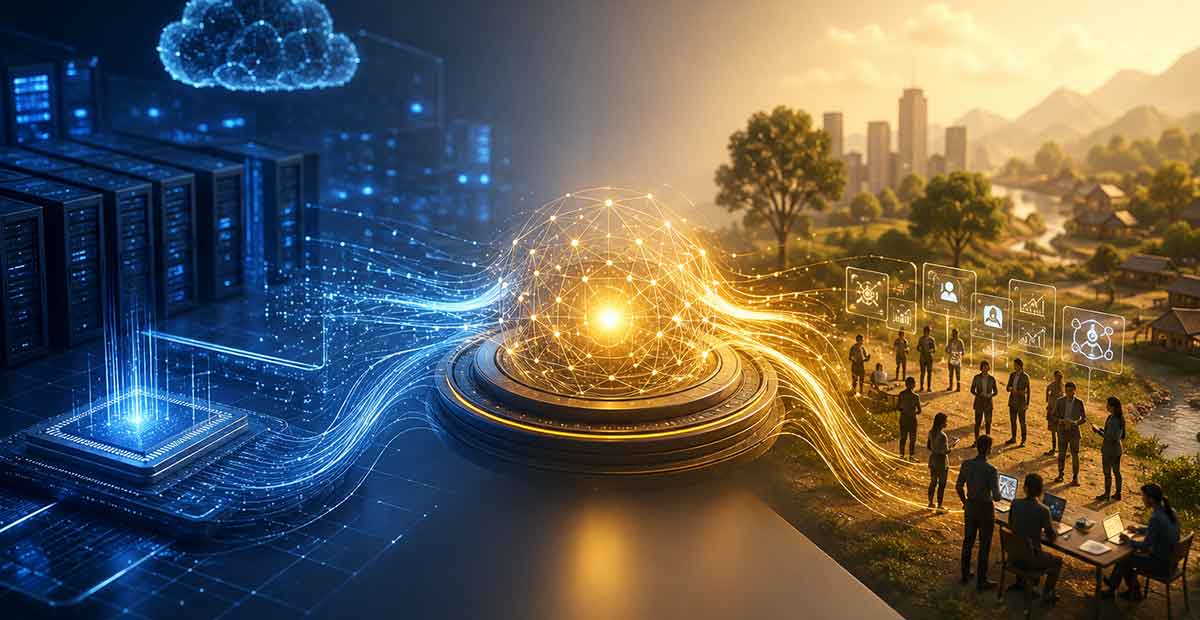
From AI Infrastructure to AI Enabling Platform
By: John F Groom
Why DataUniversa Changed Its Positioning
Version 1.0
August 2026
Executive Summary
As artificial intelligence has matured, DataUniversa has refined the way it describes its role within the AI ecosystem.
Earlier, we referred to DataUniversa as part of the AI infrastructure. While this was understandable during the early AI build-out, it no longer accurately describes what the platform is designed to do.
Infrastructure provides capacity.
DataUniversa provides capability.
Rather than building more computation, DataUniversa enables computation to produce greater value by connecting AI to high-quality human data, real-world context, measurable outcomes, and continuous adaptation.
We therefore now describe DataUniversa as an AI Enabling Platform.
This better reflects both the architecture being built today and the broader ecosystem described in our patent portfolio.
The Evolution of AI
Every major technology revolution follows a similar progression.
Phase 1 — Infrastructure
Initially the challenge is physical.
For railroads:
- tracks
- locomotives
- bridges
For electricity:
- generators
- transmission lines
- substations
For the Internet:
- fiber
- routers
- servers
- data centers
For AI:
- GPUs
- data centers
- networking
- electrical power
Infrastructure answers one question:
How do we make more capacity available?
Phase 2 — Platforms
Once infrastructure exists, a second question emerges:
How do we make that infrastructure useful?
Historically, the largest long-term companies often emerged here.
Google did not build the Internet.
AWS did not invent servers.
GitHub did not manufacture computers.
Shopify did not create e-commerce.
Instead, they enabled existing infrastructure to solve new problems more effectively.
These companies became enabling platforms.
Infrastructure versus Enabling Platforms
The distinction is important.
Infrastructure
Infrastructure primarily increases capacity.
Examples include:
- data centers
- cloud servers
- fiber
- power generation
- networking
Infrastructure scales largely by adding additional physical resources.
If demand falls, unused capacity becomes an economic concern.
Enabling Platforms
Enabling platforms increase the value created by existing infrastructure.
Instead of asking:
"How can we perform more computation?"
they ask:
"How can computation produce better outcomes?"
Their value comes from:
- organization
- integration
- coordination
- interoperability
- workflow
- context
- knowledge
rather than simply additional capacity.
Why DataUniversa Is Not Infrastructure
DataUniversa does not primarily create additional computing capacity.
Instead, it increases the effectiveness of existing AI systems.
Its architecture is designed to solve problems such as:
- fragmented data
- incompatible datasets
- uncertain provenance
- missing consent
- disconnected AI systems
- poor measurement
- lack of real-world feedback
These are enabling problems rather than infrastructure problems.
The AI Enabling Layer
DataUniversa operates between raw AI capability and real-world human use.
Rather than existing below AI models, it connects AI models to reality.
The enabling layer includes:
- data acquisition
- provenance
- consent
- interoperability
- identity
- governance
- orchestration
- longitudinal observation
- outcome measurement
These capabilities allow AI systems to operate on trustworthy human information rather than isolated datasets.
Beyond Data Platforms
Many organizations describe themselves as data platforms.
DataUniversa aims to be considerably broader.
Its purpose is not simply to organize data.
It connects:
- people
- organizations
- datasets
- AI systems
- observations
- decisions
- actions
- measurable outcomes
into one continuously improving ecosystem.
The Continuous Intelligence Loop
Most AI systems today follow a relatively simple pattern:
Data
↓
AI analysis
↓
Answer
DataUniversa expands this into a continuous adaptive loop.
Human observations
↓
Verified acquisition
↓
Provenance
↓
Interoperability
↓
AI reasoning
↓
Individual context
↓
Decision
↓
Real-world action
↓
Measured outcome
↓
Feedback
↓
Improved future recommendations
Rather than stopping at analysis, the system learns from measurable reality.
The Individual as the Beneficiary
Most information systems are organized around institutions.
DataUniversa instead organizes intelligence around the individual.
The objective is not simply producing more information.
The objective is helping individuals make better decisions within their own circumstances.
Accordingly, the system incorporates:
- personal objectives
- health
- resources
- relationships
- purpose
- preferences
- risk tolerance
before translating AI analysis into recommendations.
Interoperability Creates New Knowledge
The greatest value of interoperability is not convenience.
It is the creation of entirely new capabilities.
Each interoperable dataset increases the potential value of every existing dataset.
Examples include:
- Health + Exercise
- Exercise + Nutrition
- Education + Attendance
- Music + Child Development
- Retail + Household Economics
- Fitness + Medical Outcomes
These combinations allow AI to answer questions that could not previously be answered.
Data Acquisition as a Platform
High-quality AI depends upon high-quality data.
DataUniversa therefore includes a global Data Acquisition Marketplace (DAM).
Rather than viewing data collection as a fixed internal process, DAM creates a scalable mechanism for:
- defining deliverables
- assigning value
- verifying completion
- preserving provenance
- compensating contributors
- expanding globally
The marketplace itself becomes part of the enabling layer.
Why Outcomes Matter
Traditional AI systems often stop after generating recommendations.
DataUniversa continues.
Did the person actually follow the recommendation? What happened afterward? Did health improve? Did performance improve? Did the intervention work?
Reality becomes the final evaluator.
This continuous measurement allows future recommendations to improve over time.
Structural Capital
Unlike physical infrastructure, enabling platforms accumulate structural capital.
Examples include:
- patents
- trademarks
- interoperable datasets
- contributor networks
- provenance
- organizational relationships
- Everything Tags
- Human Observation & Solution Intelligence (HOSI)
- longitudinal observations
These assets become more valuable as additional capabilities are added.
Why This Matters for AI
As AI computation becomes increasingly available, competitive advantage is likely to shift toward:
- trusted data
- interoperability
- governance
- measurable outcomes
- human context
- continuous adaptation
These are precisely the capabilities the enabling layer provides.
The limiting factor will increasingly become not computational power, but the ability to connect that power to reality.
The Long-Term Vision
DataUniversa does not seek merely to organize data.
It seeks to create an adaptive ecosystem in which:
- human observations,
- verified data,
- AI reasoning,
- individual purpose,
- real-world decisions,
- and measurable outcomes
continuously reinforce one another.
The result is an enabling platform that allows AI to become progressively more useful because it remains connected to the people it ultimately serves.
Conclusion
The transition from describing DataUniversa as AI infrastructure to describing it as an AI enabling platform reflects an evolution in understanding rather than a change in mission.
Infrastructure creates capacity.
Enabling platforms creates capability.
DataUniversa is designed to help AI move beyond answering questions toward improving measurable human outcomes.
As AI becomes ubiquitous, the systems that create the greatest long-term value are unlikely to be those that simply provide more computation. They will be the systems that enable computation to connect intelligently, responsibly, and adaptively with the real world.
That is the role DataUniversa is being built to fulfill.
Whether you're exploring interoperability, dataset valuation, AI readiness, or ecosystem participation, we welcome conversations with researchers, organizations, and strategic partners interested in the future of structured data systems.
info@datauniversa.com