From Building Land to Building the Digital Future
By: John F Groom
The Origins of My Entrepreneurial Path
Looking backward from the age of artificial intelligence, it is easy to make a basic historical mistake: to assume that the choices available today were also available in the past. They were not.
When I was growing up in Arlington, Virginia, in the 1960s and 1970s, there was no personal computer industry, no commercial Internet, no mobile phone industry, no software startup culture, no venture-backed Internet ecosystem, and no recognizable equivalent of today's technology entrepreneur. Computers certainly existed, and IBM was already well established. Aerospace and defense technology were enormously important, particularly around Washington, while universities, laboratories, large corporations, and the federal government were developing sophisticated technologies. But that was very different from technology as an accessible entrepreneurial medium.
There was no Microsoft when I was a young child. Apple did not exist until I was a teenager, and the IBM PC did not arrive until I was 20. The World Wide Web came later still, and Netscape was not founded until 1994. There were no app developers, cloud companies, social networks, online publishers, or AI startups. There was no meaningful consumer Internet business to enter because there was no consumer Internet.
For practical purposes, the technology industry we recognize today did not exist, or anything close to it. The two successful professional worlds most visible to me were much older ones: law and real estate. Both were deeply embedded in my family and social environment, but of the two, real estate attracted me much more strongly. The reason was simple: I wanted to build something. That instinct would ultimately prove more durable than my attachment to real estate itself.
My Grandfather: J. Fuller Groom
My grandfather and namesake, J. Fuller Groom, established J. Fuller Groom Realty Company in Arlington in 1950. But he was considerably more than a real estate broker. He served on the Arlington County Planning Commission from 1953 until 1968 and was its chairman in 1961 and 1962. He participated in regional planning and was involved in planning for the enormous growth of Rosslyn during the period in which it was beginning its transformation into a major urban center.
His interests therefore sat directly at the intersection of private property, markets, government, planning, and development.
One episode captures his perspective particularly well. In 1960, he argued that the approximately 240 acres occupied by the Army Navy Country Club represented enormously valuable Arlington land receiving favorable tax treatment while remaining relatively undeveloped. He proposed that the property could instead become a high-end apartment and hotel district, a Northern Virginia equivalent of Connecticut Avenue, and dramatically increase Arlington's tax base.
The proposal went nowhere, but the underlying way of thinking is revealing. He was interested in what the land was doing at that moment, what else it could become, and how much additional value a different structure might create.
At other times, he opposed development he considered inappropriate. He became chairman of an organization opposing a major Defense Intelligence Agency expansion at Arlington Hall and testified before Congress on the issue. His philosophy was therefore not simply to develop everything. He was actively interested in how land should be used, who should control it, how private and public interests interacted, and how Arlington should evolve.
He was also a bank director, active in civic organizations and politics, and twice ran for the Virginia House of Delegates. My grandfather was close to Preston Caruthers, another important Arlington developer whom I knew growing up.
I therefore grew up with an example of someone for whom real estate, entrepreneurship, finance, government, and community affairs were not separate worlds. They constantly interacted.
My Father and the Other World Around Me: Law
Real estate was not the only successful professional world surrounding me. The other was law, which was almost inevitable in Arlington. Washington, D.C. was next door, and Arlington was home to many of the lawyers who worked in Washington's law firms, corporations, associations, and government institutions.
More importantly, law was part of my immediate family. My father graduated from Harvard Law School and built a substantial legal practice. The firm was originally known as Groom and Nordberg and later became Groom Law Group.
I therefore had an unusually direct view of the legal profession as well as real estate. I even worked part time at the firm while I was growing up, doing the kinds of entry-level jobs that existed in a professional office before documents became digital. I worked as a file clerk and messenger.
That experience matters to the story because law represented an obvious path available to me. Had I wanted to become a lawyer, there could hardly have been a clearer model. My father had gone to one of the country's leading law schools, built a substantial firm, and demonstrated that law could produce professional success, financial rewards, and an institution of lasting value.
But it did not attract me in the same way. I wanted to build something. Lawyers can certainly build firms and institutions, and my father unquestionably did. But the underlying activity of legal practice did not appeal to me as much as the developer's activity. A developer could begin with an empty or underutilized piece of land and end with something that had not previously existed: a road, a subdivision, a house, an apartment building, an office, or a community.
The result was visible, physical, and persistent. That appealed to something fundamental in me.
Growing Up Inside Somebody Else's Development
My childhood home was at 4901 North 35th Road in Arlington. The property had previously been part of the historic Falls Grove estate. In the 1960s, the Yeonas organization acquired the property, demolished the old house, and developed approximately 20 new homes.
Arlington architect Richard Malesardi, who was a family friend, tried to persuade the developer to preserve the historic Falls Grove house. He even prepared an alternative subdivision plan incorporating it. The effort failed, although the historic name survived. The new development became Falls Grove.
My father bought our house new for approximately $68,000. So real estate development was not something I first encountered in a textbook or an office. I literally grew up inside somebody else's development. There were a couple of older houses toward Williamsburg Boulevard on our side of 35th Road, but ours was the first of the new Falls Grove houses on that side. Across the street and around the cul-de-sac were houses created by the development, with additional Falls Grove houses extending onto Williamsburg Boulevard.
The transformation of land into a neighborhood was therefore physically visible to me from childhood. Someone owned a piece of land, imagined something different that could exist there, acquired control of the property, obtained approvals, arranged financing, designed the subdivision, installed infrastructure, and built houses. Families like mine then moved in. An abstract economic process had produced the physical world in which I lived. That was an understandable form of value creation.
The People Who Built Northern Virginia
The influence extended far beyond my grandfather. Many of the families around us were involved in physically building Northern Virginia. There was Preston Caruthers, who became an important Arlington developer and demonstrated precisely the kind of foresight real estate could reward. He began assembling property around future Metro stations before the economic potential of those locations was obvious to everyone. That was a particularly powerful form of entrepreneurship to observe because a successful developer did not merely build what people already knew they wanted. He tried to understand what a place was going to become.
Then there were the Offutts. Thomas J. Offutt founded Dittmar Company and became a major Northern Virginia residential, apartment, and hotel developer. Dittmar developed properties in Ballston and elsewhere as Arlington changed from a largely suburban environment into a much denser urban center.
And there were the Hitts. HITT Contracting had begun as an Arlington family construction business in the 1930s and grew across succeeding generations into a major contractor. These were not simply names I later learned from Northern Virginia business history. They were people and families I knew.
The Hitts
I went to Yorktown High School with Brett and Todd Hitt. My sister became, and remains, very close friends with Tracy Hitt, part of the third generation of the family. Our families' lives crossed in ways that had nothing to do with formal business relationships.
One of the most extraordinary examples occurred when my younger brother was playing in a pile of leaves in the Falls Grove cul-de-sac. A Hitt contracting truck drove through the leaves without knowing he was there and ran over him, including over his head. Remarkably, he survived intact. It became one of those almost unbelievable family stories, but it also illustrates how literally construction was present in the environment in which we lived.
This was not an industry that existed somewhere else. The people building Northern Virginia were our neighbors, classmates, family friends, and fellow club members. Todd Hitt would later reappear in my professional life. We both worked at Edward R. Carr & Associates. Todd subsequently pursued his own real estate investment career. Much later, his career took a very different turn and he was convicted of securities fraud and served time in federal prison.
That was Todd's story, not the story of the Hitt family or HITT Contracting. But it was part of the real development world I entered, a world involving large opportunities, large amounts of capital, significant risk, substantial successes, and sometimes serious failures.
Washington Golf and Country Club
There was also an important social institution connecting many of these people: Washington Golf and Country Club. It was very close to our home, and my family belonged. So did many of the families involved in Arlington real estate, development, and construction, including the Caruthers, Hitts, Offutts, and others.
This matters in understanding my environment. I was not occasionally meeting a developer because my grandfather happened to work in real estate. These were families we knew socially. Their children and grandchildren went to school with us. We saw them at the club and around Arlington. They were simply part of the world I knew.
And what they did for a living was unusually tangible. A child cannot easily understand what an investment banker, management consultant, or corporate strategist produces. A developer's work is different. You could see the houses someone developed, the apartments a family owned, the hotel they built, or an office building that had not existed five years earlier.
Successful developers exercised a visible form of agency over the physical world. They could look at something that existed, imagine something else, and then cause the imagined thing to become real. That appealed to me.
Law or Development
This also makes an important distinction possible. Growing up around successful developers showed me that real estate could be a path to wealth and influence. Growing up around successful lawyers showed me that there were other paths to professional status and financial success.
So my choice of development cannot be explained simply by saying that I followed whatever successful people happened to surround me. I was surrounded by both, and I had arguably an even more direct path into law because of my father.
What differentiated development was the nature of the activity itself. I wanted to create an asset rather than primarily provide a professional service. I wanted to decide what should exist, assemble the resources necessary to create it, accept the risk that my decisions might be wrong, and then see the result. I wanted to build. That orientation would prove much more durable than my attachment to any particular industry.
What Wealth Creation Looked Like
It is easy today to imagine that a young person interested in business has always faced roughly the same menu of opportunities: technology, venture capital, private equity, finance, media, real estate, and entrepreneurship generally.
That is historically wrong. When I was forming my ideas about business, the entrepreneurial technology ecosystem familiar today simply did not exist. Real estate did, and Northern Virginia was an unusually good place to observe it.
Washington's suburbs were expanding rapidly. Arlington was becoming more urban, Rosslyn was acquiring its skyline, and transportation infrastructure was changing land values. Farms and undeveloped parcels farther outside Washington became subdivisions, shopping centers, office parks, and eventually entire communities.
The successful developers I knew were not merely wealthy. They identified possibilities other people had not yet recognized, committed resources to them, overcame obstacles, and changed the physical environment. In the world I could see, that was entrepreneurship. So I followed the path that my environment had shown me.
From Environment to Career
The connection between that childhood environment and my eventual career was not merely philosophical. It became practical. As a young man, I went to work for Edward R. Carr & Associates, a Washington-area real estate organization. Todd Hitt worked there as well. More importantly for my own career, it was at Carr that I met the partners who subsequently provided the financial backing that enabled me to establish Groom Properties, Inc.
There is therefore a fairly direct chain from the Arlington real estate family and the developers, builders, and architects around me, through Edward R. Carr & Associates and the financial partners I met there, to Groom Properties.
Real estate was not a random industry I selected from a list of possible careers. It was the entrepreneurial ecosystem to which I already had access. I understood it, I had relationships within it, and I could see how people became successful in it. And I became successful in it myself.
Groom Properties and Maple Valley
One of my projects was Maple Valley Estates in Franconia, Virginia. Groom Properties developed approximately ten acres into 22 finished residential lots, which I sold to NV Homes in 1992 and 1993. There is a symmetry between Falls Grove and Maple Valley that I did not consciously appreciate at the time. I grew up in a roughly 20-home Northern Virginia subdivision created by another developer. Roughly a generation later, I developed a 22-lot Northern Virginia subdivision myself. I had gone from living inside somebody else's development to creating one of my own.
Maple Valley also provided a small lesson in the difference between immediate market preference and long-term scarcity. Some of the largest lots were heavily wooded and sloped toward the rear. I thought they were particularly attractive. Yet, somewhat to my surprise, the first houses to sell were on the smaller, more conventional, cookie-cutter lots on the opposite side of the street. Those lots were easier for buyers to understand because they were simple and predictable.
More than three decades later, the large wooded lots look particularly desirable. Mature trees and vegetation provide privacy, the houses have been improved, and substantial pieces of privately controlled open land have become increasingly difficult to reproduce in Northern Virginia.
What was initially somewhat harder to sell eventually became particularly scarce. It was a small example of something I would encounter repeatedly: what the market recognizes most easily today is not necessarily what will prove most valuable over time.
I Could Have Stayed in Real Estate
By the mid-1990s, I had already established a successful career in development. That fact is essential to understanding what happened next because I did not move toward technology because I had failed at real estate.
I could have stayed in real estate. Indeed, staying was in many respects the easier and more rational short-term choice. I had accumulated knowledge, relationships, credibility, and an understanding of the economics. I knew how deals were structured, how to evaluate land, negotiate transactions, obtain approvals, coordinate professionals, raise and deploy capital, manage risk, and turn an unrealized possibility into a completed asset.
Those advantages compound within an industry. The longer someone remains successful in a field, the greater the economic incentive to remain there.
But during the first half of the 1990s, something fundamentally different began happening. The Internet was emerging as a commercial medium. I did not know precisely what it would become, and nobody did, but it seemed increasingly clear to me that information and connectivity were going to create an entirely new arena for business. And I wanted to participate in that future.
Choosing the Future at 35
In 1996, at age 35, I established Attitude Media and began moving seriously into technology. I am particularly proud of that transition because it was much larger than it might appear today. When I started, I did not even know how to type. That sounds almost incomprehensible now, particularly for someone who would spend much of the next three decades working with Internet businesses, digital information, intellectual property, data, and eventually artificial intelligence.
But it was completely consistent with the professional environment from which I came. In the business world in which I had operated, executives did not necessarily type their own documents. You wrote something by hand, dictated it, or handed material to a secretary, who typed and formatted it. Typing was considered an administrative skill, not a prerequisite for participating in business.
So I entered the digital world without even one of its most basic mechanical skills. I had to learn. That detail matters because it illustrates the magnitude of the transition. I was not a programmer moving from one generation of computing to another, a 20-year-old entering a new industry before establishing a career elsewhere, or someone who had grown up using computers and naturally followed them into business. I was 35 years old, already successful in a completely different industry, and starting again in an unfamiliar one because I believed it represented the future.
From What My Environment Showed Me to What I Thought the Future Would Be
I see the first two phases of my career differently today. Real estate was what my environment showed me. Technology was what I believed the future was showing me. The first required recognizing and exploiting opportunities within a world I already understood. The second required recognizing that the world itself was changing.
That distinction matters because there is enormous path dependence in careers. Once people become successful, their accumulated advantages tend to keep them where they are. Their knowledge, contacts, reputation, income, and capital are all valuable within the environment they already understand. Starting somewhere else means voluntarily surrendering some portion of those advantages.
At 35, I had considerably more to lose by changing direction than I would have had at 20. But I also possessed something at 35 that I had not possessed at 20: experience recognizing value and understanding how businesses actually get built. I did not carry technological expertise from Groom Properties into Attitude Media. I carried an entrepreneurial framework.
Why I Didn't Enter Technology Earlier
It would be historically misleading to look at my later involvement with Internet businesses, intellectual property, data, and AI and ask why I had not simply started in technology. There was no "there" there when I was choosing my original career. The opportunity had to exist before it could be chosen.
Computing certainly existed, but the commercial Internet changed something fundamental. Technology became an accessible entrepreneurial medium. An individual or relatively small organization could create information once and potentially distribute it globally. A business could increasingly be constructed around digital rather than physical assets, geography mattered less, and replication could occur at extraordinarily low marginal cost. Businesses that would previously have required enormous physical infrastructure could potentially be created using computers and networks. That was genuinely new. And when it became sufficiently visible to me, I moved toward it.
Building Was the Constant
This is why I now think the deepest continuity in my career is not simply real estate followed by technology. It is building followed by building. The substrate changed. In real estate, I built by coordinating land, capital, engineering, government approvals, infrastructure, and construction. When the commercial Internet appeared, I began to see the possibility of building something else. The raw materials were no longer primarily dirt, concrete, lumber, and capital. They could be information, software, networks, and eventually data.
The finished product might not initially be something you could touch, but it could still be something that had not existed before. That was what interested me. I did not move into technology because I was fascinated by computers as machines. I was not. I did not enter because I had been programming since childhood. I had not. What attracted me was the realization that the Internet had created an entirely new medium in which things could be built. That was something I recognized.
From Developing Land to Developing Systems
Real estate development had already taught me to think about latent value. A developer looks at a parcel of land and does not merely see what exists. He asks what could exist there that does not exist now.
But recognizing the possibility is only the beginning. Ownership has to be controlled, financing must be obtained, engineering has to work, roads and utilities have to be provided, government approvals have to be secured, builders and contractors have to be coordinated, and ultimately someone has to want the finished product.
Development is fundamentally an exercise in coordination under constraints. The raw land is only a primitive. The developer creates the structure that allows its latent value to emerge. Technology entrepreneurship increasingly struck me as a more powerful version of the same underlying process. Instead of asking what could be built on ten acres of land, one could ask what could be built from information, software, networks, and eventually data. The fundamental entrepreneurial question remained the same: What valuable thing is possible here that does not yet exist, and what constraints prevent us from creating it?
Three Pieces of Land
Three properties connected to my life provide a physical illustration of this evolution. The first is Falls Grove, the Arlington subdivision where I grew up. Approximately 20 detached homes were created from the former estate in the 1960s. The second is Maple Valley, where in the early 1990s I developed ten acres into 22 finished lots for detached houses.
The third is a roughly ten-acre property I owned on Rock Hill Road in the Herndon area. I sold that property in 2023, primarily to Greystar. The site subsequently became Wyatt, a nearly 400-unit multifamily development. Compare Maple Valley and Rock Hill. Approximately ten acres at Maple Valley supported 22 detached homes, while approximately ten acres at Rock Hill ultimately supported almost 400 residences.
The land itself did not fundamentally change. What changed were the structures society was capable of coordinating around it: transportation, zoning, engineering, capital, construction technology, infrastructure, and market demand. A resource observed at one point in time should not be assumed to have reached its highest-value use. As the surrounding structure changes, previously impossible uses become possible. The same principle applies to technology.
Martin Turk: A Human Thread Through the Story
One person provides an unusual human thread through almost my entire adult relationship with Northern Virginia real estate: Martin "Marty" Turk. Marty has worked with me in real estate for essentially my entire adult life. He sold my childhood home at 4901 North 35th Road. Years later, I bought the land for Maple Valley Estates from Marty, the property Groom Properties subsequently developed into 22 finished residential lots.
When I bought my home in Manassas, Marty again served as my real estate agent. Decades later, when I sold the Rock Hill Road property in 2023, Marty was the agent on that transaction as well. One trusted real estate professional therefore connects the house in which I grew up, one of my principal residential development projects, the house in which I later lived, and the ten-acre property that eventually became a nearly 400-unit apartment development.
But Marty also almost participated in another transaction that would have connected this real estate history directly to the emergence of Northern Virginia as a physical center of the Internet.
Alibaba Wanted an Ashburn Address
Marty told me that a Chinese company working on behalf of Alibaba was preparing to hire him to acquire Northern Virginia land for a data center. Marty was directly involved in those conversations. The client's requirement was strikingly specific: the property had to have an Ashburn address. That small detail says an enormous amount about what had happened to Northern Virginia.
When I was growing up, the important geography of local wealth creation I could see was Arlington. Developers built houses, apartments, hotels, and offices. Location mattered because of proximity to Washington, transportation, schools, and desirable communities.
By the Internet era, Ashburn itself had become a globally meaningful location for an entirely different reason. Its concentration of fiber, network connectivity, and data centers had made a Northern Virginia place name relevant to one of the largest Internet companies on the other side of the world.
The representatives were not merely looking for inexpensive American land on which to place servers. According to Marty, they specifically wanted an Ashburn address.
The transaction never proceeded. Marty told me that after the Trump administration imposed tariffs on China, Alibaba became generally uncertain about its involvement in the United States and the data-center acquisition was abandoned.
I consider Marty a highly reliable source. I have dealt with him throughout my adult life, including major transactions, and in this case he was not relaying something he had heard indirectly. He was the prospective real estate agent personally involved in the discussions.
The episode creates an extraordinary intersection with my own history. The man from whom I bought the land for Maple Valley, a conventional Northern Virginia residential subdivision, was later preparing to acquire Northern Virginia land for the physical infrastructure of one of the world's largest Internet companies. He subsequently represented me when I sold Rock Hill.
Marty's career and mine had both followed the land, but what the land was for had changed.
I Thought I Was Leaving the Physical World
When I established Attitude Media in 1996, one of the extraordinary characteristics of the Internet was that it appeared to transcend many of the constraints of the physical world. A real estate developer needed land. Land was local, scarce, and expensive. Development required roads, sewer, water, engineering, approvals, financing, and construction, and every additional development required another physical site.
Information behaved differently. Create something digitally and, at least in principle, it could reach someone in California, Europe, or Asia almost as easily as someone in Virginia. Distribution no longer seemed constrained by the amount of land or physical infrastructure an entrepreneur personally controlled.
In that sense, I thought I was moving from a fundamentally physical business into a fundamentally digital one. What I could not see in 1996 was that the digital world would eventually construct an enormous physical world of its own.
The Digital Future Became Physical Again
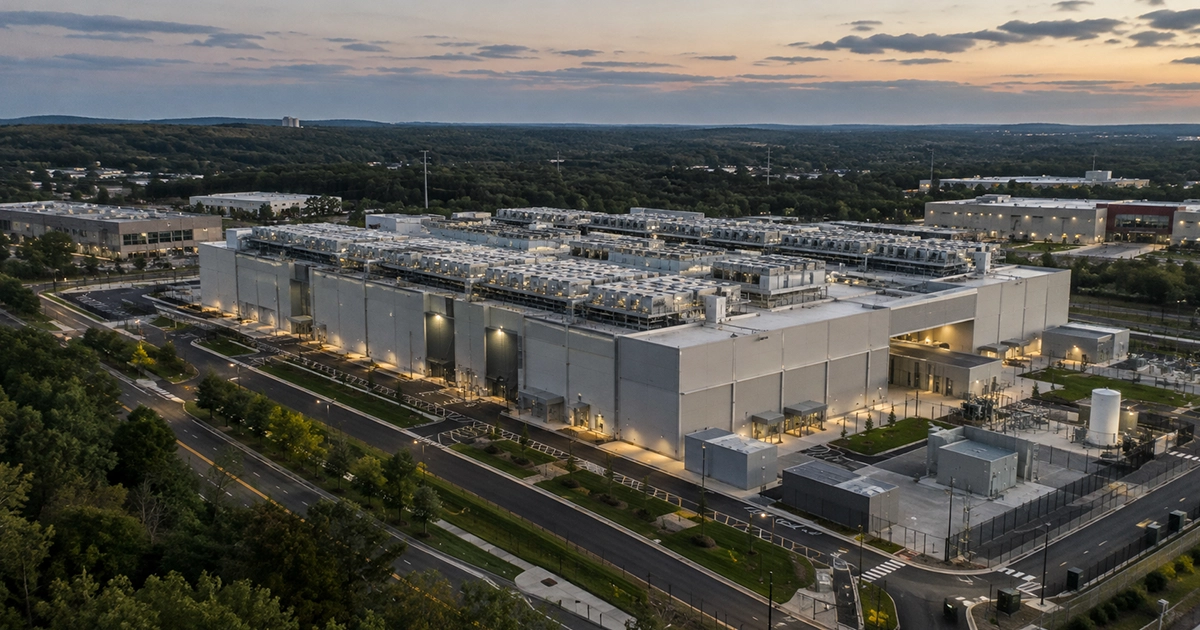
The Internet required fiber, and fiber created network hubs. Networks required servers, and servers accumulated into data centers. Cloud computing dramatically multiplied their scale. Artificial intelligence pushed the demand for computing infrastructure, electricity, and cooling still further.
And remarkably, Northern Virginia, the same place where I had grown up watching people create wealth through physical development, became one of the world's great concentrations of the physical infrastructure supporting the digital economy.
The future I chose in 1996 was digital, but the digital future eventually became intensely physical. It required land, enormous buildings, electrical infrastructure, cooling, fiber, sophisticated construction, and developers. The two worlds I had inhabited were beginning to converge.
The Hitts and the Data Center: Another Historical Circle
The Hitt family provides an almost perfect illustration of that convergence. When I was young, the Hitts were builders. Construction meant houses, offices, government facilities, and other physical structures. I went to Yorktown High School with Brett and Todd Hitt, and Todd and I later worked together at Edward R. Carr & Associates.
Today, HITT Contracting has become a major national contractor and builds data centers, including facilities in Northern Virginia. That creates a remarkable historical circle. The construction family I knew growing up in analog Arlington is now helping construct the physical infrastructure underlying the digital and AI economy.
My own path took a different route, from real estate development to the Internet, digital information, data, and AI. HITT's path remained rooted in construction, moving from traditional construction to increasingly sophisticated commercial construction and then to data centers.
The paths that once appeared to be moving in completely different directions ultimately converged. Both now participate, in different ways, in the infrastructure of information and intelligence.
Northern Virginia Made the Same Journey
In some ways, Northern Virginia itself followed a trajectory parallel to my own. The Arlington of my childhood demonstrated the economics of houses, apartments, hotels, and office buildings. Rosslyn rose, Ballston developed, and Metro changed the value of land. Then the development frontier moved farther outward.
Fairfax County filled with subdivisions, office parks, and commercial development. The Dulles corridor attracted technology and telecommunications. Fiber networks accumulated. Ashburn became synonymous internationally with data centers.
Eventually, Northern Virginia became one of the physical hearts of the global Internet and, increasingly, artificial intelligence. There is an interesting geographic progression in my own real estate history: Falls Grove in Arlington, Maple Valley in Fairfax, and Rock Hill in Herndon/Dulles. My physical real estate history moved outward from Washington in roughly the same direction that Northern Virginia's economic frontier moved. And then technology followed.
The Irony of Land
There is an irony in all of this that I appreciate today. I left Northern Virginia real estate partly because the Internet appeared capable of transcending physical land. Three decades later, I am working on AI while living amid some of the most strategically important physical real estate the Internet ever created.
And land has not disappeared from the equation. Quite the opposite. As digital activity becomes more important, certain physical locations have become extraordinarily important because they provide the combination of power, connectivity, infrastructure, and existing network concentration required to support it.
That is why the Alibaba story is so revealing. A global technology company wanted an Ashburn address. A technology whose great promise was independence from geography had created a geography of its own.
Three Generations and Three Ways of Building
There is also an interesting progression within my own family. My grandfather, J. Fuller Groom, participated in building Arlington through real estate, brokerage, planning, banking, and civic institutions. My father built something different. He built a substantial law firm.
I initially followed the physical-development path. I established Groom Properties and developed real estate. Then, in 1996, I began building in a medium that neither my grandfather's nor my father's generation could realistically have chosen when they began their careers: the commercial Internet.
That eventually led into digital information, intellectual property, data, and artificial intelligence. Seen this way, the story is not one of rejecting what came before. Each generation worked with the opportunity set available to it. My grandfather operated in the rapidly developing physical environment of postwar Northern Virginia. My father built a professional institution in the legal environment surrounding Washington. I initially developed physical property because that was the entrepreneurial opportunity I understood. Then the opportunity set changed, and I changed with it.
Why the Transition Matters to Me
I think it is important that my transition from development to technology not be smoothed over in retrospect. I did not grow up as a technologist, study computer science, spend an uninterrupted career following successive waves of computing, or enter the Internet business at 22. I came from an almost entirely physical business, and by 35, I had already succeeded in it.
Then I encountered a new medium whose basic tools I barely knew how to use. I could not even type, and I decided to learn. That transition, from the entrepreneurial world my environment had shown me to the one I believed represented the future, is one of the parts of my career of which I am most proud. I was willing to become a beginner again.
The Value of Becoming a Beginner Again
There is a tendency to think that successful people should remain within their areas of expertise. There are good economic reasons for doing so. Expertise compounds, relationships compound, reputation compounds, and capital compounds. The more successful someone becomes in one field, the greater the opportunity cost of leaving it.
But that creates a danger. A person can become exceptionally well adapted to an environment that is becoming less important while failing to adapt to the environment that is emerging. The skills that created yesterday's advantage can become the reason someone fails to pursue tomorrow's opportunity.
At 35, I did not possess the technical skills of the people already working with computers. What I did possess was a willingness to learn and an ability to recognize that the opportunity set was changing. That distinction became increasingly important throughout my career.
The Substrate Changed; the Instinct Did Not
There is a temptation to write personal history backward, to look at what someone eventually did and assume that the earlier path was somehow leading inevitably toward it. That is not how life works. Had I been born 30 or 40 years later, technology might have been an obvious entrepreneurial path from the beginning. It was not when I grew up. Real estate was.
But even then, law was available to me as another obvious and prestigious path. I chose development because I wanted to create something. That suggests that the most persistent feature of my career was never the industry itself. It was an approach: find an underutilized resource, understand what prevents it from reaching a more valuable state, gain control of the necessary inputs, coordinate people, capital, and institutions, remove the constraints, and build the structure that allows the latent value to emerge.
In the Arlington of my childhood, that resource was often land. At Groom Properties, it was land. By 1996, it could also be information. Later it increasingly became networks, intellectual property, and data. Today, it is increasingly data and intelligence, and the structures that allow human and artificial intelligence to use them productively. The substrate changed, but the underlying entrepreneurial instinct did not.
From the World I Inherited to the Future I Chose
The first part of my career was strongly shaped by the world into which I happened to be born. My grandfather was a realtor and planning commissioner. My father was a successful Washington lawyer who built a substantial law firm. I worked there as a boy, filing documents and carrying messages.
I grew up in a subdivision created by a local developer. Our family friends included developers, builders, lawyers, and architects, and our social environment included many of the people physically creating Northern Virginia. I could have pursued law. Instead, I wanted to build something physical, so I went into real estate.
I worked for a real estate company, met the partners there who backed me, established Groom Properties, and became a successful developer. There is nothing particularly surprising about that progression. It was the path my environment had made visible.
What matters more to me is what happened next. When the Internet began commercially, I saw something that appeared likely to change the future. I had no technical background, no computer science education, and did not even know how to type. I was already 35, and I moved toward it anyway.
That decision eventually led from Attitude Media into a much longer engagement with digital information, intellectual property, data, and ultimately artificial intelligence. Meanwhile, the physical world from which I had started did not disappear. It evolved.
The Hitt family that I knew through construction now builds data centers. Marty Turk, who sold my childhood home and sold me the land for Maple Valley, was nearly retained to acquire Ashburn land for an Alibaba data center. The ten-acre Rock Hill property I sold became housing for hundreds of people near the Dulles technology corridor, and Northern Virginia itself became one of the world's great physical concentrations of the Internet and AI economy.
So perhaps the distinction between my two careers was never as absolute as it appeared. Both development and technology are ultimately about creating structures that allow resources to become more valuable. One begins with land. The other may begin with information or data. Both require seeing a possibility that does not yet exist, coordinating resources around that possibility, overcoming constraints, accepting the possibility of being wrong, and adapting when reality changes.
My environment taught me that successful people could build things. Real estate gave me my first medium in which to do it. The Internet gave me another. The physical world of my childhood taught me how to build. The Internet showed me that the things worth building were changing. I began by building what the world around me taught me to build. At 35, I began building what I thought the world was becoming. And today, in Northern Virginia, those two worlds have come together again.
Whether you're exploring interoperability, dataset valuation, AI readiness, or ecosystem participation, we welcome conversations with researchers, organizations, and strategic partners interested in the future of structured data systems.
info@datauniversa.com