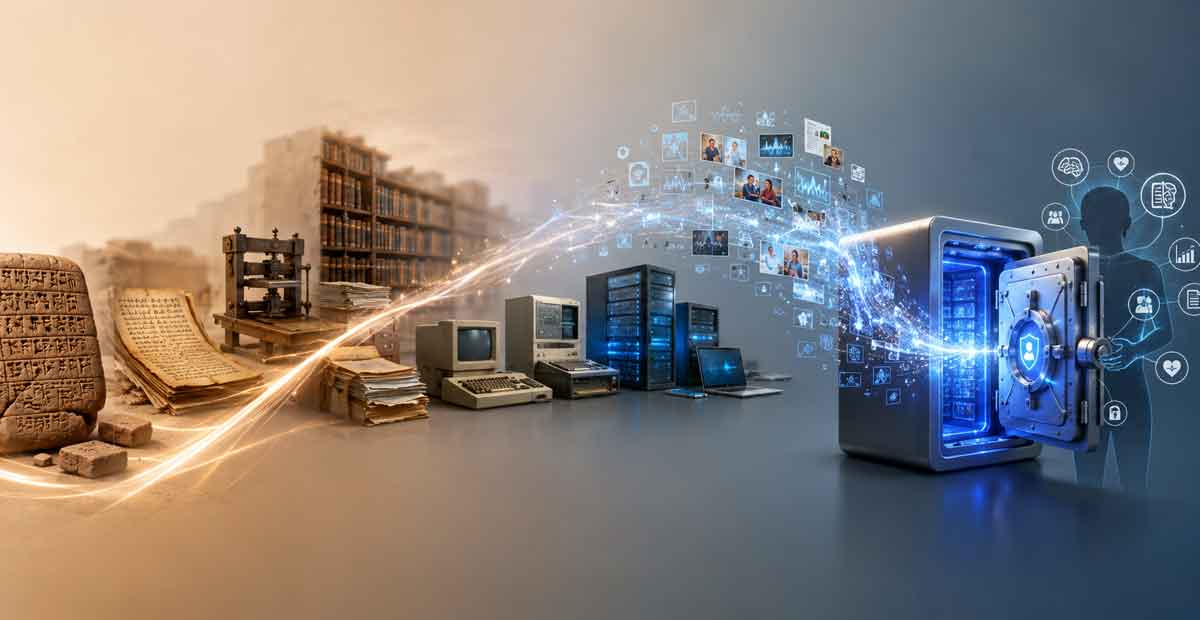
From Clay Tablets to the Personal Vault: The Long History of Making Data Useful
By: John F Groom
For most of human history, information had an obvious problem: it disappeared. A person could know how many animals he owned, where a boundary lay, what happened in a battle, or how to perform a particular task. But if that information existed only in his mind, it could be forgotten, distorted, or lost when he died.
Much of the history of information technology can be understood as humanity progressively removing a series of constraints on data. First, we learned how to record information. Then we learned how to copy it. Then we learned how to move it without moving the object on which it was recorded. Eventually, we learned how to make information available almost everywhere. Each breakthrough solved a major problem while eventually exposing the next one.
Today, we have reached a strange point. Humanity has become extraordinarily good at creating, copying, and storing data. The challenge is increasingly the opposite: making all of that information available to exactly the right people, at exactly the right time, while making it completely unavailable to everyone else.
1. The Memory Constraint: Record It
The earliest information system was the human brain. Knowledge could be passed orally from one person to another. Stories, instructions, histories, and traditions could survive for generations this way. But human memory is imperfect, and every transmission creates an opportunity for alteration or loss.
People therefore began externalizing information. Long before formal writing, humans used tally marks and physical objects to represent quantities. By roughly 3200 BCE, Mesopotamian civilizations were recording transactions, inventories, and other information on clay tablets.
This was a profound technological change because information no longer had to die with the person who knew it. Writing eventually expanded far beyond accounting. Laws, histories, religious texts, philosophy, mathematics, literature, and practical knowledge could all become durable objects.
The first great information constraint had been broken: knowledge could survive human memory. But recording information created another problem. There was usually only one copy.
2. The Copying Constraint: Reproduce It
For thousands of years, copying information was expensive because copying generally meant doing the work again. A scribe copied a manuscript by writing another manuscript. Entire institutions developed around this problem. Ancient scribes, libraries, scholars, and later monastic communities devoted enormous human effort to preserving texts by repeatedly reproducing them. A 300-page book was not simply "copied." Someone effectively had to manufacture another 300-page book.
Printing changed the economics dramatically. Movable-type printing existed in Asia before Gutenberg, but Gutenberg's development of a practical European movable-type printing system in the fifteenth century helped transform the scale at which books could be reproduced.
One prepared text could generate many copies. Yet even printing did not completely solve the copying problem. Hand someone in 1700 a handwritten document and producing another copy still required considerable work.
Photography, photostatic processes, and eventually xerographic photocopying changed that. An arbitrary document could be reproduced without someone recreating its contents. Then digitization nearly eliminated the marginal cost of copying altogether.
A digital file could be duplicated once, ten times, or a million times without anyone retyping it and without the thousandth copy being degraded relative to the first. After thousands of years in which making the copy was the problem, copying became almost trivial. That exposed another constraint.
3. The Location Constraint: Move the Information
For most of history, sending information somewhere meant sending the physical object containing it. A clay tablet traveled. A letter traveled. A manuscript traveled. A printed book traveled. The speed of information was therefore constrained by the speed of transportation.
The telegraph represented an enormous conceptual break. Information could travel much faster than the person or physical document from which it originated. Telephone networks did something similar for speech. Radio extended the principle without requiring a physical connection to the recipient, while fax machines eventually allowed representations of entire documents to be transmitted to distant locations. Digital networks generalized the principle.
Once information was represented digitally, text, photographs, financial records, sound, video, and eventually almost every other kind of information could travel through essentially the same infrastructure. The Internet ultimately made the marginal cost of sending enormous amounts of information around the world extraordinarily small. The problem was no longer simply how to get information from here to there. Increasingly, it became a question of which version of the information was where.
4. The Synchronization Constraint: Make It Available Everywhere
Personal computers initially recreated an ancient problem in digital form. Your information existed on a particular object. Instead of a clay tablet or sheet of paper, the object was now a hard drive. If a document was on your office computer and you were at home, you might not have it. People carried floppy disks, then CDs and USB drives. They emailed documents to themselves. Companies maintained network drives.
Online storage gradually changed this. Services such as Dropbox did not invent remote data storage, but they helped make an important idea intuitive for ordinary users: stop thinking constantly about which machine contains the file. Put something in a synchronized folder and the system takes responsibility for maintaining copies across machines.
Cloud-native applications pushed the concept further. With a service such as Google Docs, it becomes increasingly meaningless to ask which computer contains the "real" document. The document exists as a persistent cloud-based information object. Your laptop, desktop, tablet, and phone are simply different interfaces through which you interact with it.
That is a fundamental change. For thousands of years, humans asked, "Where is the information?" Increasingly, the answer became, "Wherever I am." But solving that problem created a much more difficult one.
5. The Access Constraint: Available to Me, Invisible to Everyone Else
The original problem with information was scarcity. There might be only one manuscript, and making another could require months of labor. The modern problem is almost exactly the reverse. Copies are nearly free. Storage is inexpensive. Networks are global. Synchronization is automatic. Information can potentially be retrieved from almost anywhere.
The central challenge increasingly becomes controlled availability: information should be available wherever and whenever an authorized person needs it while remaining unavailable to everyone else. Those two requirements pull in opposite directions.
A document locked in a safe is relatively easy to protect but difficult to access. A document available instantly from any computer or phone in the world is extraordinarily convenient but potentially exposed to unauthorized access.
Modern information systems therefore have to accomplish something historically unusual: maximize accessibility and privacy simultaneously. The ideal system is not merely a secure repository. It knows who may access what, for what purpose, under what circumstances, and for how long.
A person might want a physician to see certain medical records but not financial records. An accountant might need tax information but not personal correspondence. An AI system might be authorized to analyze a set of files without those files becoming publicly visible or accessible to unrelated systems.
Ownership, identity, permission, encryption, provenance, and access control consequently become as important as storage itself. But even solving the access problem leaves one more emerging problem.
Beyond the Five Constraints: From Stored Data to Useful Knowledge
Consider a person who has accumulated decades of digital information. There may be thousands of emails, photographs, PDFs, spreadsheets, medical records, tax returns, contracts, fitness measurements, videos, text messages, and other files scattered across computers, phones, and cloud services.
The information exists. It may be backed up, synchronized, and even highly secure. And yet, in an important sense, the person still cannot really use it. Finding one document is not the same as understanding the accumulated information. This is becoming the next major information problem: the interpretation constraint. AI potentially changes that.
Instead of merely retrieving a file, a system can begin identifying relationships among files, extracting relevant facts, constructing timelines, detecting inconsistencies, comparing information over time, and using accumulated personal data to help answer new questions. That changes the historical progression once again.
Record → Copy → Transmit → Synchronize → Control Access → Understand
This is one reason we are developing the Personal Vault and MyUniversa. The Personal Vault is intended to address both sides of the modern information problem. It provides a controlled entry point through which an individual's information can be collected and organized while preserving the individual's authority over who, or what system, is permitted to access it. MyUniversa can then address the next problem: making that authorized information useful.
The objective is not merely another place to put files. The world already has plenty of places to store files. The objective is eventually to create something closer to a coherent personal information environment: data that can be accumulated across a lifetime, organized and interpreted by AI, and made available to authorized people and systems when it creates value.
The history of information has therefore undergone an extraordinary inversion. For most of civilization, the great challenge was making information persist and making more copies of it. Today, we can create virtually unlimited perfect copies almost effortlessly. The challenge now is deciding who gets to see those copies and turning the enormous amount of information we have preserved into something we can actually understand and use.
Whether you're exploring interoperability, dataset valuation, AI readiness, or ecosystem participation, we welcome conversations with researchers, organizations, and strategic partners interested in the future of structured data systems.
info@datauniversa.com