
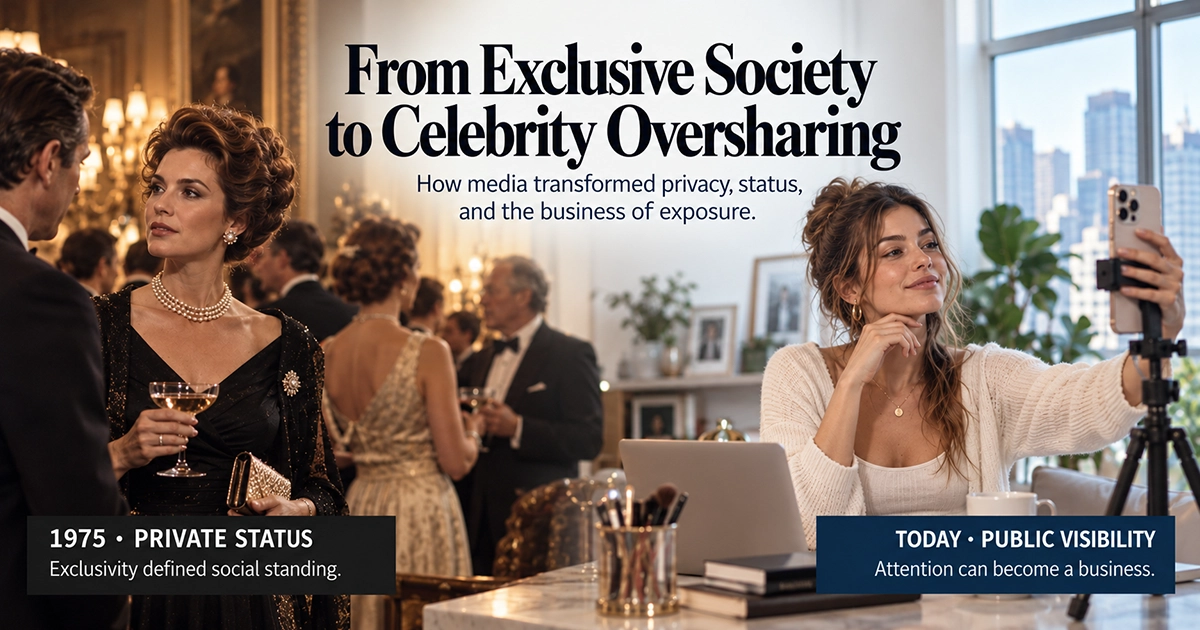
From Exclusive Society to Celebrity Oversharing
October 2026
By John F Groom
How Women’s Status Changed, and How Magazines, HBO, the Internet, and Social Media Changed the Business of Exposure
DATA UNIVERSA | CULTURE & SOCIETY | OCTOBER 26, 2026

Babe Paley
1961 White House photograph
Abbie Rowe / JFK Presidential Library, US public domain

Madonna
1990 photograph, near the era of Sex (1992)
Alan Light, CC BY 2.0

Kim Kardashian
2009 Tribeca Film Festival portrait
David Shankbone, CC BY 3.0

Lena Dunham
2012 Tribeca Film Festival portrait
David Shankbone, CC BY 3.0
In November 1975, Esquire paid Truman Capote $25,000 to publish intimate gossip about some of America’s most socially prominent women. That payment is equivalent to approximately $157,000 in September 2026 dollars. The women he wrote about, including Babe Paley, considered his disclosures a betrayal and largely shut him out of their world. Three decades later, Kim Kardashian became famous amid publicity surrounding a sex tape and helped turn continuous exposure of her private life into a major business. In between, Madonna sold an explicit $49.95 photography book, while Lena Dunham transformed candid depictions of sex, embarrassment, and relationships into an HBO series and a multimillion-dollar book deal. The change was not merely in manners. The underlying machinery of status and media economics had been rebuilt.
1975: A Closed Society and a $157,000 Story
Babe Paley was not a celebrity in the contemporary sense. The former Vogue editor was married to CBS chairman William S. Paley, and her standing rested on wealth, marriage, taste, personal connections, and acceptance within a small New York social hierarchy. The so-called Swans competed for invitations and influence in a circle whose members could recognize each other’s standing without asking the general public to vote. Their status depended partly on what outsiders were not allowed to know. A woman might endure an unhappy marriage or humiliating affair, but publishing the details was another matter.
Capote crossed that boundary in “La Côte Basque, 1965,” published in Esquire in November 1975. The story thinly disguised members of his social circle and included recognizable material about the Paleys’ marriage. Esquire paid him $25,000, then the magazine’s record price for a story. One former Esquire executive later explained that the magazine needed attention, especially from advertisers. The transaction was therefore not simply a literary fee. It was a bet that a notorious exclusive would make Esquire more visible and commercially attractive. The magazine controlled the printing presses, newsstand distribution, subscriber relationship, and national advertising inventory. Capote supplied what that machinery could not manufacture: access to secrets.
The inflation arithmetic is straightforward: the U.S. consumer price index averaged 53.8 in 1975 and reached 336.94 in September 2026. Multiplying $25,000 by 336.94/53.8 yields about $156,570. This is a purchasing-power comparison, not an estimate of what the same article could earn today. Ann Woodward, whose family tragedy was recognizable in Capote’s fiction, died by suicide shortly before the story reached readers; the precise role of the pending publication remains uncertain. The Paleys and other friends ostracized Capote. In their society, publication of intimate information destroyed trust rather than creating a personal brand.
What Is a $157,000 Magazine Story Worth Today?
A rare, explosive exclusive can still command unusual sums, so there is no honest single “current price” for Capote’s story. But the economics of a comparable long magazine feature are dramatically different. In a 2025 essay, longtime Vanity Fair writer Bryan Burrough disclosed that at his peak he earned $498,141 annually for three long articles, typically around 10,000 words apiece, which amounted to more than $166,000 per article under his contract. Today, he wrote, he is fortunate to receive $2 a word, or $20,000 for a 10,000-word piece. That is a firsthand example, not an industry-wide pay survey, and his historical contract also included compensation and employment arrangements beyond a simple freelance fee.
The comparison is nonetheless striking. Capote’s 1975 fee of $25,000 is about $157,000 in current dollars, while Burrough describes a current premium long-form assignment paying around $20,000. In inflation-adjusted terms, that is approximately an eight-to-one difference. Burrough’s own peak compensation illustrates that the old high-paying magazine model survived well into the glossy-magazine era before declining. Today, an individual writer may reach millions through a newsletter, podcast, or social account, but the magazine itself is far less able to charge advertisers a premium simply for controlling access to a national audience.
1992: Madonna Uses Television to Sell a $49.95 Book
Madonna’s Sex was published in October 1992 with a $49.95 list price, an unusually high price for a mass-market celebrity publication. The explicit photography book was released alongside her Erotica album. MTV aired the accompanying “Erotica” video, giving the project another promotional channel. The Washington Post reported that the book’s first printing exceeded one million copies worldwide; subsequent accounts put sales around 1.4 million or more, with a scholarly study estimating approximately $70 million in retail sales. This was a coordinated system: music drove attention to television, television drove publicity for the book, and controversy drove discussion of all three.
Madonna was already a star, and her musical career cannot be reduced to sexual provocation. The point is how she used the technologies and institutions of the time. MTV could repeatedly place a provocative visual identity before a huge audience, while Time Warner’s publishing and music distribution could convert that attention into purchases. Babe Paley would have viewed intimate public exposure as a loss of status; Madonna deliberately made it a commercial asset. Yet Madonna still required large companies to manufacture, distribute, and promote her products. The internet would soon loosen that dependency.
2007 Onward: Kardashian Turns a Private Life into an Owned Audience
Kim Kardashian’s rise shows what changed when celebrity met reality television and social media. The release of a sex tape in 2007 generated publicity, and E!’s Keeping Up with the Kardashians premiered later that year. The show made everyday family interactions, including arguments, romances, weddings, breakups, pregnancy, clothes, physical appearance, and beauty routines, recurring episodes of a commercial product. Instead of a journalist exposing a socialite’s secrets once, the participants helped produce a continuing stream of material about themselves. Kardashian’s body, including public fascination with the shape of her figure, became part of the brand’s recognizable imagery.
The second transformation came through Instagram and other social platforms. A television network still controlled the program schedule, advertising, and distribution, but a social-media account gave Kardashian a direct, repeatedly accessible audience. A photograph, product announcement, or personal update could be published without securing an editor’s approval or buying television airtime. Fans could respond immediately; their reactions became signals of demand, and the same accounts could direct them toward products. The old publisher sold advertisers access to readers. Kardashian could use attention to sell products in which she had an ownership interest.
The economic result is measurable, although it cannot be attributed to social media alone. In November 2025, SKIMS announced a $225 million financing round at a $5 billion company valuation. That is a valuation of the company, not Kardashian’s personal earnings, and its success also depends on design, operations, partners, distribution, and repeat customers. But it shows the scale of what an audience-centered celebrity business can become. The publicity that would have endangered a Swan’s reputation could, in a different media environment, become the first stage in building a valuable consumer brand.
2012: HBO Makes Oversharing Viable for a Smaller Audience
Lena Dunham illustrates a different business model. Her HBO series Girls premiered in April 2012 and made awkward sex, nudity, personal insecurity, and intimate relationships central to its storytelling. The series was fictional, not a literal diary, and Dunham’s writing, directing, and performance were central to its success. But its candor was also part of its identity. HBO’s technology and economics mattered: as a subscription service, it did not need to deliver a mass broadcast audience to advertisers every week. It could support a polarizing program if that program helped make a paid subscription attractive.
The ratings demonstrate the distinction. The Los Angeles Times reported that the second-season finale drew 632,000 viewers in its initial Sunday airing, but approximately 4.6 million when repeat showings, on-demand viewing, HBO Go, and recorded viewing were counted. An old-fashioned overnight rating made the show look much smaller than its actual audience. HBO could earn subscription revenue regardless of whether viewers watched at 9 p.m. Sunday or days later. That changed which kinds of intimate, unconventional programming were economically feasible.
The book market then capitalized on the attention. In 2012, Random House reportedly agreed to pay Dunham approximately $3.7 million for a book that became Not That Kind of Girl, published in 2014. The proposed subjects included work, friendship, body, sex, and love. That advance was not payment for a magazine article, and the publisher was betting on a recognizable television personality with an audience. It nevertheless creates an extraordinary contrast: Capote received about $157,000 in today’s dollars for exposing elite private lives, while Dunham’s own intimate voice became the basis of a reported multimillion-dollar publishing agreement.
The internet also supplied a revealing counterexample to the notion that disclosure is always voluntary. Dunham’s book proposal leaked online in 2012, and her lawyer sought to have material removed. Even a creator whose work embraces candor can want control over what is disclosed and when. The line between sharing one’s experiences and losing control of private material remains consequential.
What the Internet Changed, and What Social Media Changed Again
The first internet revolution undermined the magazine’s distribution advantage. A reader no longer had to buy Esquire or Vanity Fair to obtain stories about prominent people. Search engines could direct readers to thousands of competing sites, while digital advertising increasingly rewarded platforms able to target audiences and measure responses. Publishers could reach more people but often capture less money per reader. The second revolution, social media, changed who possessed the audience. The audience increasingly followed a person rather than a publication, and the person could publish directly. The third change, smartphones, made production continuous: a camera, editing tools, and global distribution traveled in a pocket.
These shifts changed the incentives for women seeking public status. In the Swans’ world, exclusivity signaled distinction: the fewer people admitted to the room, the more valuable the invitation. In the influencer economy, scale can be the prize: more followers, more views, more engagement, and more customers. Madonna used mass-media companies to sell exposure; Kardashian built direct audience relationships; Dunham benefited from a subscription platform able to profit from distinctive rather than universally popular programming. The systems are different, but none requires approval from the social gatekeepers who once decided who counted as “society.”
What Was Gained, and What May Have Been Lost
Traditional society was restrictive. A woman’s place could depend heavily on marriage, inheritance, and the judgment of a small group. Modern women can earn their own fortunes, create work on their own terms, and bypass social institutions that would once have excluded them. Madonna, Kardashian, and Dunham exercise forms of commercial or artistic agency that were less available to Babe Paley. At the same time, a system that rewards visibility can create relentless pressure to display one’s body, relationships, family, and vulnerabilities. Privacy becomes harder to preserve, particularly for people drawn into someone else’s content.
The moral distinction is worth retaining. Capote disclosed information about other people who had trusted him; Madonna and Dunham principally offered work under their own names, and Kardashian increasingly participated in constructing her public identity. None of these cases is ethically identical. Nor does publicity by itself establish merit, or its absence establish dignity. The historical change is that the marketplace increasingly rewards forms of exposure that an earlier elite regarded as disqualifying.
The Next Turn
Artificial intelligence is arriving after the collapse of the old magazine business model, not causing that original collapse. It can now reduce the cost of creating and editing images, video, and prose, and may eventually make convincing synthetic personalities common. That raises a new question: when even intimate-seeming disclosure can be fabricated cheaply, will audiences pay more for demonstrably authentic people and experiences, or will entertainment value be enough?
In 1975, Esquire paid the equivalent of $157,000 for access to a private world that its readers could not enter. Today, a celebrity can invite hundreds of millions into a carefully managed version of her life and sell them products directly. Between those two transactions lie MTV, premium cable, reality television, search engines, smartphones, and social platforms. The transformation was not merely that women began revealing more. Technology changed who controlled the revelations, who earned the money, and what kind of behavior conferred status.
Sources and Calculation Notes
-
Esquire, “The Scandalous True Story Behind Feud” (2024), Capote’s $25,000 fee: https://www.esquire.com/entertainment/tv/a46582726/feud-truman-capote-swans-true-story/
-
Federal Reserve Bank of Minneapolis, historical CPI (1975 = 53.8): https://www.minneapolisfed.org/about-us/monetary-policy/inflation-calculator/consumer-price-index-1913-
-
Bureau of Labor Statistics, September 2026 CPI-U (336.940): https://www.bls.gov/news.release/CPI.htm
-
Bryan Burrough, The Yale Review (2025), Vanity Fair compensation: https://yalereview.org/article/burrough-vanity-fair-graydon-carter
-
The Washington Post (1992), Madonna’s Sex launch and $49.95 price: https://www.washingtonpost.com/archive/lifestyle/1992/10/21/the-madonna-pornucopia/fe69f452-50a6-4f9c-8a8d-aa6047cb749f/
-
Cambridge University Press, Journal of American Studies, Sex book sales: https://www.cambridge.org/core/journals/journal-of-american-studies/article/abs/icon-and-the-text-american-book-history-and-the-construction-of-the-worlds-largestgrossing-illustrated-book-madonnas-sex-1992/A6ED7B0BCD09378F1F7C38E9D6FEEA1C
-
Los Angeles Times (2013), Girls ratings and HBO on-demand audiences: https://www.latimes.com/entertainment/envelope/la-xpm-2013-mar-18-la-et-ct-hbo-girls-ratings-20130318-story.html
-
Observer (2012), Lena Dunham’s reported $3.7 million book deal: https://observer.com/2012/10/lena-dunham-sells-book-proposal-to-random-house-for-3-7-m/
-
Goldman Sachs (2025), SKIMS $5 billion valuation: https://am.gs.com/en-sg/individual/news/press-release/2025/skims
Whether you're exploring interoperability, dataset valuation, AI readiness, or ecosystem participation, we welcome conversations with researchers, organizations, and strategic partners interested in the future of structured data systems.
info@datauniversa.com