
From Silos to Connected Intelligence
By: John F Groom
What Electricity and the Internet Teach Us About the Path to Connected AI
Introduction: AI May Be Earlier in Its Development Than It Appears
Artificial intelligence already appears extraordinarily advanced. A modern AI system can write software, interpret images, analyze documents, translate languages, conduct research, generate designs, and reason across domains at a level that would have seemed implausible only a decade ago. This creates an understandable tendency to think of AI as a mature technology whose remaining development will primarily consist of making models faster, cheaper, and more intelligent.
There is another possibility. AI may be extraordinarily capable while still being structurally primitive. The limitation is increasingly not simply what an individual AI can do. It is what the AI can reliably connect to. Much of the world's useful information remains divided among databases, applications, organizations, devices, documents, personal records, specialized AI systems, and proprietary platforms. Even when systems can technically exchange data, they frequently do not preserve the meaning, provenance, authority, permissions, identity, temporal context, and relationships necessary for that information to be used correctly elsewhere.
This suggests a developmental path:
Silos → Interoperability → Integration → Connected AI → Connected Ecosystems
There are strong historical precedents for such a progression. Two of the most consequential technologies of the last 150 years, electricity and networked computing, developed through surprisingly similar stages.
Neither achieved its ultimate importance simply because the underlying technology became better. Electricity became transformative when isolated electrical systems evolved into interoperable grids upon which thousands of other technologies could operate. Computers became transformative when isolated machines evolved through networking standards into the Internet, upon which billions of people, devices, applications, and organizations could interact.
These histories do not prove that AI will follow the same trajectory. Technological analogies never do. They demonstrate something more limited but important: the architecture being proposed for Connected AI is not historically unusual. Some of civilization's most important general-purpose technologies became vastly more valuable when they progressed from isolated capability to interoperable infrastructure and then became foundations for ecosystems that their original creators could not have anticipated.
The question may therefore be less whether today's AI is powerful enough and more whether today's fragmented AI and data environment resembles an earlier stage in transformations we have seen before.
I. Electricity: From Isolated Power to an Invisible Infrastructure
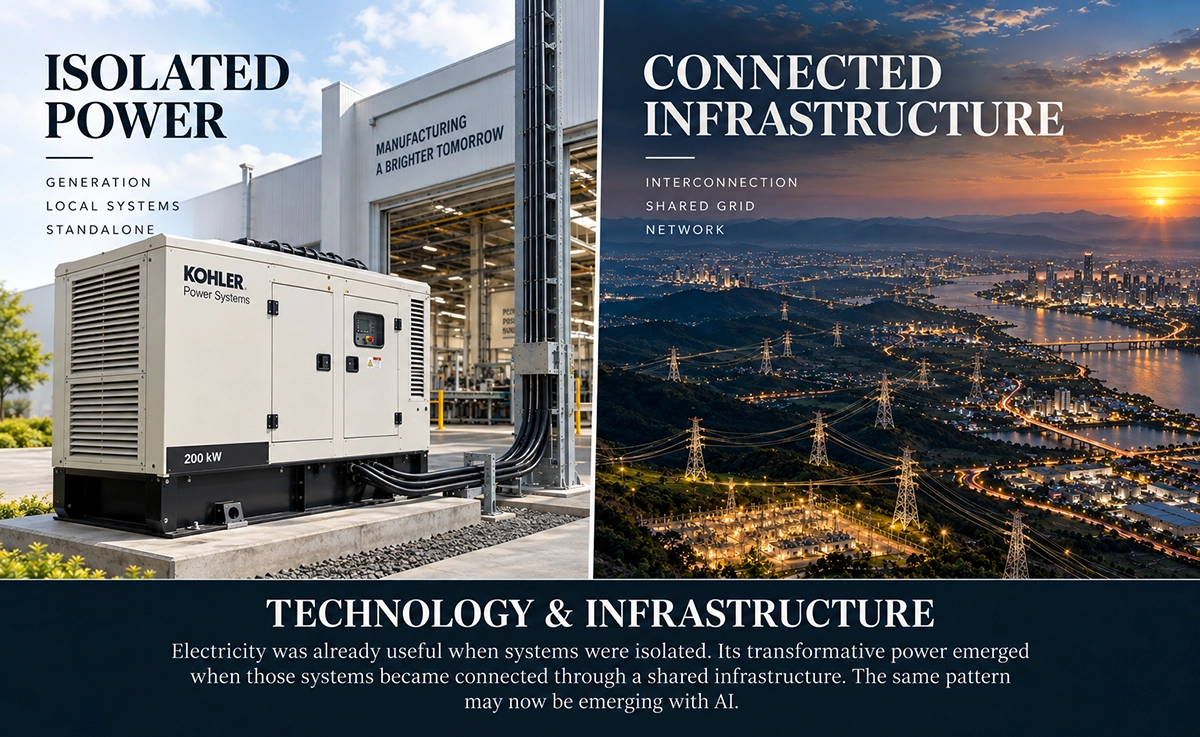
When commercial electrification began in the late nineteenth century, there was no unified electrical ecosystem comparable to what people now simply call "the grid." Electricity was produced and distributed through comparatively isolated systems. Generators served particular factories, buildings, streetcar networks, neighborhoods, or municipalities. Competing technologies used different voltages, frequencies, equipment, and methods of distribution.
Electricity was already useful. But usefulness and connectedness were different things. A factory could install a generator and use electricity to power machinery. A building could install electrical lighting. A street railway could construct its own generation and distribution infrastructure. Each demonstrated the value of electricity without creating anything resembling the integrated electrical environment that exists today.
This distinction offers the first important analogy to contemporary AI. Today's AI systems can already provide remarkable capabilities within individual environments. A company can connect an AI to its customer-service database. A hospital can deploy specialized medical systems. A person can use an AI assistant. A manufacturer can connect AI to production data. A financial institution can build proprietary models around its records. Each can produce significant value. But collectively they remain much closer to a landscape of electrified islands than to a mature interconnected infrastructure.
Standardization Changed What Electricity Could Become
The development of electrical infrastructure required much more than improvements in generators. Electrical equipment had to become sufficiently standardized that components manufactured by different organizations could participate in larger systems. Voltage, frequency, connectors, safety practices, measurement systems, transmission technologies, and equipment specifications gradually became standardized.
The objective was not to make every electrical device identical. Quite the opposite. Standardization allowed devices to become more diverse because they no longer had to recreate their own infrastructure. A refrigerator and a television have almost nothing in common as machines. Yet both can connect to the same electrical infrastructure. A hospital MRI scanner, residential lamp, industrial robot, laptop charger, elevator, and subway system can all consume electricity without needing a common purpose or internal architecture.
That is one of the central lessons for AI interoperability. The objective should not be to force every database, AI model, organization, application, or individual into a single representation of reality. The objective should be to establish enough shared infrastructure that heterogeneous systems can interact while retaining the distinctions that matter. In data systems, this requirement is considerably harder than agreeing upon voltage. The system may need to preserve not merely a value but what that value means, who produced it, when it was valid, what methodology generated it, what permissions accompany it, which source is authoritative, and under what circumstances another interpretation should supersede it. But the architectural principle remains recognizable: Standardize the ability to interact without requiring the things interacting to become identical.
II. The Grid Was More Important Than the Generator
Once electrical systems became sufficiently compatible, something qualitatively different became possible. Networks could be interconnected. Electricity generated in one location could be transmitted elsewhere. Generation could be centralized where advantageous and distributed where needed. Individual users no longer needed to understand where their electricity originated or operate their own generation systems.
The generator remained essential, but the system surrounding the generator became increasingly important. This provides a useful way of distinguishing increasingly capable AI from Connected AI. Suppose an AI model becomes ten times more capable. That would be enormously valuable. But it would still be analogous, in this particular respect, to building a substantially better generator. Its intrinsic capability has improved. Connected AI addresses a different problem. It asks what happens when AI can operate across information, systems, models, organizations, tools, devices, and eventually individuals while preserving sufficient context for those connections to remain useful.
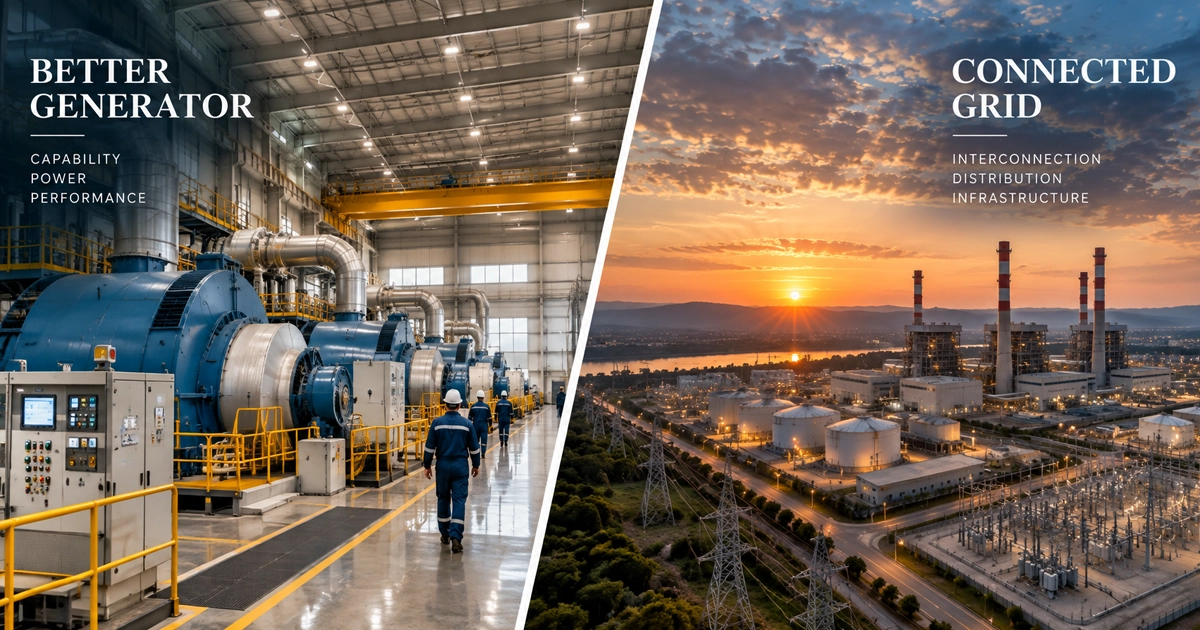
The analogy can therefore be expressed simply:
Better generator ≈ better AI model
Electrical grid ≈ Connected AI
These are complementary rather than competing developments. Better generators made electrical networks more useful. Better AI models will make Connected AI more useful. But improvements in the component and improvements in the network represent different dimensions of technological progress. A sufficiently powerful isolated system remains isolated.
III. The Most Important Electrical Innovation Happened After Interconnection
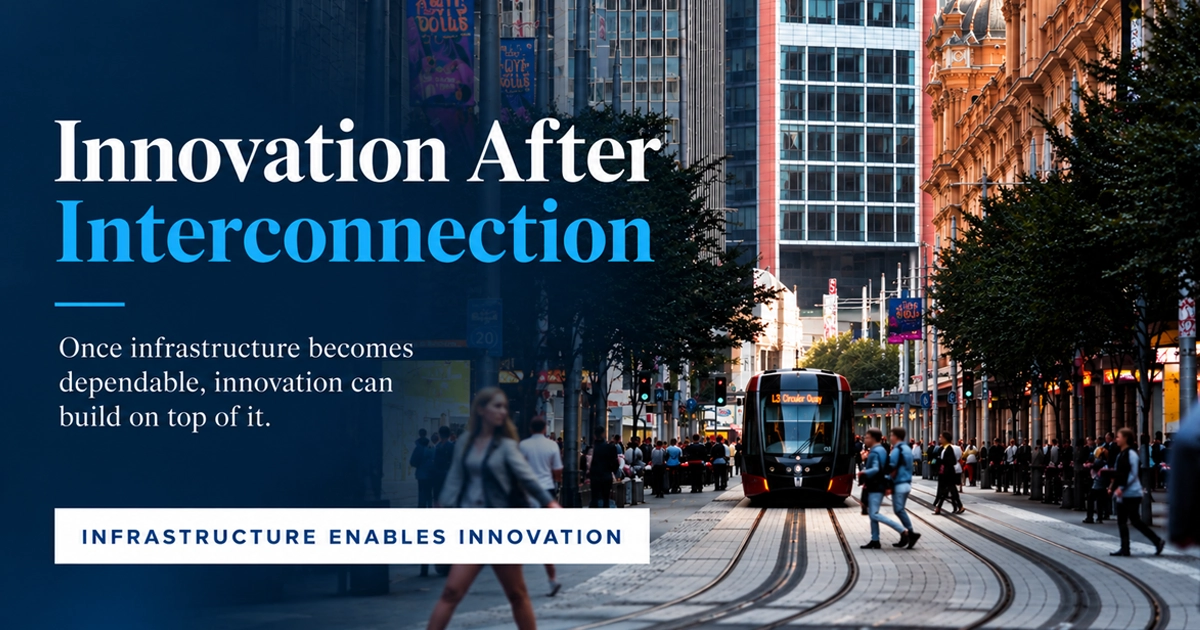
The most revealing part of the electricity analogy may not be the creation of the electrical grid. It is what happened afterward. Once dependable electrical infrastructure became widely available, inventors and businesses could assume electricity rather than create it. That radically reduced the cost of innovation. A company developing a refrigerator did not need to construct a generating station. A company manufacturing televisions did not need to establish a proprietary electrical network in every household. Manufacturers could concentrate on the new capability they were creating because another layer of infrastructure had already solved the connectivity problem.
The result was combinatorial expansion. Lighting, refrigeration, air conditioning, elevators, industrial motors, telecommunications equipment, household appliances, computing, medical equipment, entertainment systems, and eventually billions of electronic devices accumulated on top of the same basic infrastructure. This is potentially one of the most consequential parallels for Connected AI. Today, developers repeatedly reconstruct connections to information. Applications create their own profiles. Organizations maintain duplicate records. AI products establish proprietary memory systems. Data must be cleaned, mapped, interpreted, permissioned, and contextualized repeatedly.
Connected AI proposes moving some of that work downward into infrastructure. Once reliable interoperability exists, developers can increasingly assume connection rather than repeatedly reconstruct it. The consequences could resemble electrification: not merely lower costs for things that already exist, but the creation of categories of applications that are impractical when every application must independently reconstruct the information environment it needs.
IV. The Internet Repeated the Pattern in Information
Electricity provides a powerful physical analogy. The history of computing provides an even closer informational analogy. Early computers were extraordinarily useful but fundamentally isolated. Information entered a machine, was processed there, and emerged from that machine. Even after computers became common within organizations, incompatible hardware, operating systems, data formats, and networking protocols limited communication between them.

Networks began connecting machines locally, but many early networking systems remained proprietary or mutually incompatible. The revolutionary development was not merely faster computers. It was interoperable networking. The emergence and adoption of common networking protocols, most importantly the TCP/IP family, made it possible for radically different computers and networks to exchange information without becoming the same kind of computer or network. This produced one of the most important architectural ideas in technological history: Networks of networks. The Internet did not require every participant to use identical hardware or software. It established protocols through which heterogeneous systems could communicate. That is strikingly close to the challenge confronting AI and data today.
V. The Internet Did Not Create One Giant Computer
This point matters because it distinguishes interoperability from centralization. The Internet did not solve incompatibility by building one enormous database, operating system, or computer into which everything else was absorbed. Instead, it allowed heterogeneous systems to remain heterogeneous while establishing mechanisms through which they could communicate.
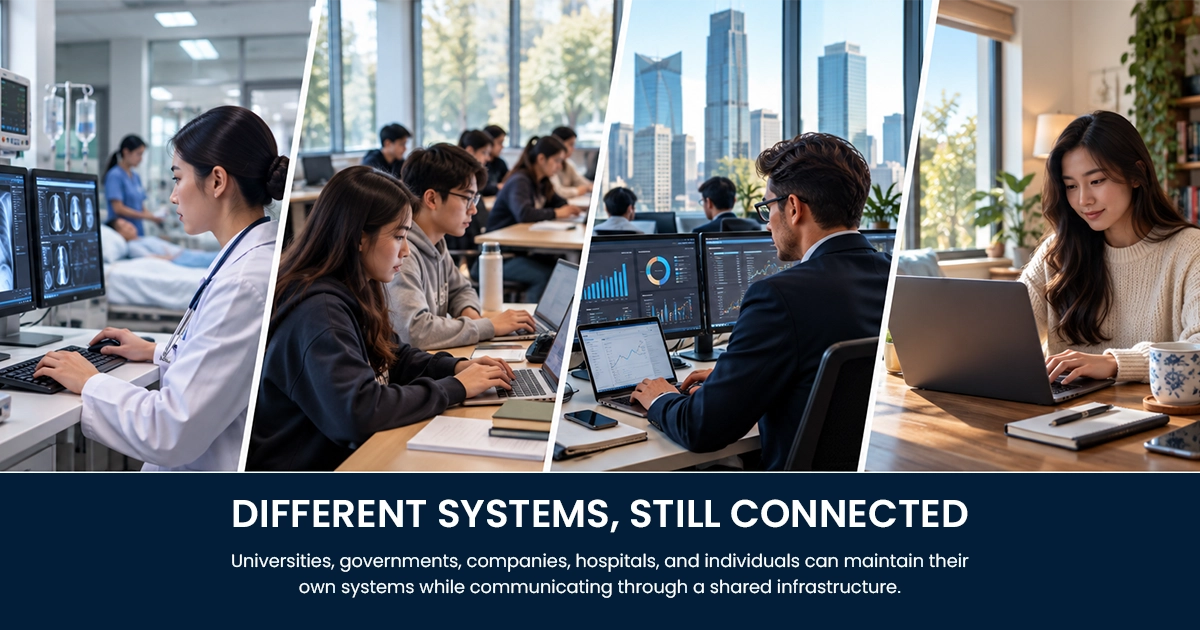
Universities could maintain their systems. Governments could maintain theirs. Companies could build proprietary infrastructure. Individuals could own personal computers. Different operating systems could coexist. New hardware could be invented. The architecture accommodated plurality. Connected AI should potentially do the same. A hospital and an insurance company may legitimately define "active patient" differently. Two businesses may use the word "customer" according to different rules. A fitness database and medical database may contain measurements that appear identical but were produced under different protocols. Two AI systems may reach different conclusions because they have different objectives or evidence.
Interoperability should not erase these differences. It should preserve enough semantic and contextual information that another system can determine what the information actually means. In this respect, Connected AI may require something more sophisticated than the early Internet. Moving packets between computers is difficult engineering. Moving meaning between intelligent systems is a different problem.
A successful architecture may therefore need to preserve not merely:
What is the information?
but also:
- Who produced it?
- When?
- Under what definition?
- Using what method?
- From what original evidence?
- With what authority?
- Under what permissions?
- For what purpose?
- And under what conditions should it be trusted?
The networking analogy remains powerful, but the payload has become richer.
VI. From the Internet to Connected AI
The Internet eventually created a global information environment containing billions of connected devices and users. Yet much of the information within that environment remains functionally siloed. Consider a single person. Their financial history may reside with banks and investment firms. Their health information may be distributed among hospitals, physicians, laboratories, pharmacies, wearable devices, and insurance companies. Their communications may reside across email, messaging applications, and social networks. Their professional history may be distributed among employers, files, calendars, project-management systems, and professional networks. Their physical performance may reside in fitness applications, gyms, wearable devices, videos, and personal records.

All of these systems may technically be connected to the Internet. Yet they do not collectively constitute a connected model of the person. That distinction identifies the potential next step. The Internet solved a major part of the problem of transport. Connected AI must increasingly solve the problem of context.
VII. Connected AI: From Access to Understanding
Today's AI systems already demonstrate how valuable connection can be. Give an AI access to a database and it becomes more useful. Give it tools and it becomes more capable. Give it persistent history and it can behave differently from a stateless model. Allow it to interact with other specialized systems and its effective capabilities expand further. But adding connections one at a time eventually encounters the same problem earlier technologies encountered: bespoke integration does not scale indefinitely. Connected AI therefore represents a transition from AI that can connect to something to AI operating within an architecture designed for connection.

That architecture could allow different models, databases, tools, applications, evidence sources, organizations, sensors, and human participants to interact without requiring every possible pair to create a bespoke relationship. The mathematical difference is important. If every system must create a unique integration with every other system, complexity grows rapidly as the number of systems increases. Infrastructure layers reduce this burden by creating shared methods of interaction. This is exactly what standards did for electricity and protocols did for networking. Connected AI would attempt to perform an analogous function for intelligent systems.
VIII. The Next Stage: Individually Connected Ecosystems
Electricity and the Internet both reveal another important pattern. Infrastructure eventually disappears into individual life. A modern household does not experience "the electrical grid" as an abstract technological achievement. It experiences lights, refrigeration, heating and cooling, televisions, computers, appliances, security systems, chargers, tools, and hundreds of other devices.
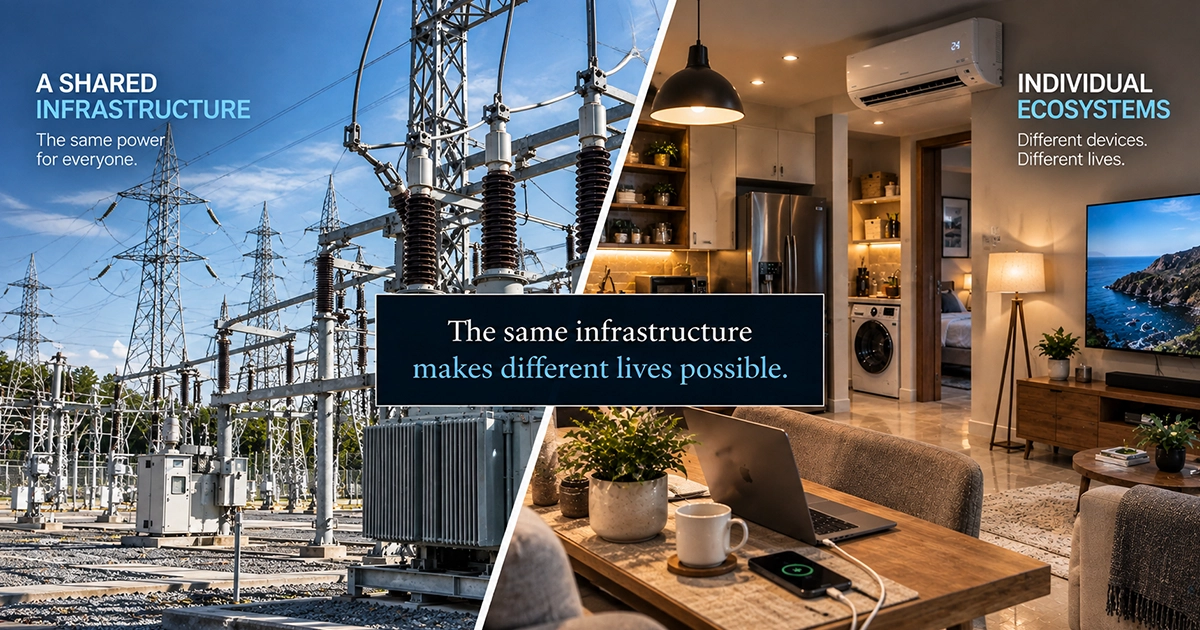
The common infrastructure is shared. The resulting ecosystem is individual. The Internet followed a similar trajectory. Billions of people use the same fundamental global network, but each person experiences a radically different collection of devices, accounts, applications, relationships, information sources, and services. Connected AI could extend this pattern much further. Instead of merely providing access to a general-purpose AI, an individual could possess a persistent information and intelligence environment organized around that person's own history, objectives, permissions, evidence, relationships, decisions, and values.
This is the conceptual role of the Personal Vault and MyUniversa (MU) within the broader DataUniversa architecture. The Personal Vault provides persistent individual context. MU can use that context to learn longitudinally rather than treating every interaction as substantially independent. Connected AI allows the individual's ecosystem to interact with external intelligence, tools, datasets, and services. The resulting architecture becomes: Common infrastructure, individual ecosystem.
That is precisely what happened with electricity. Everyone uses the electrical grid, but everyone's collection of electrical devices is different. It is also what happened with the Internet. Everyone participates in the Internet, but everyone's digital environment is different. Connected AI could make the individualization substantially deeper because the system would increasingly learn not simply what applications a person uses, but what matters to that particular person.
IX. From Personalization to Longitudinal Learning
This introduces a capability that neither electricity nor the Internet inherently possessed: learning over time. A person's ecosystem would not merely accumulate information. It could accumulate evidence about the person and about the effectiveness of previous decisions.
That creates a recursive process:
Question → Expectation → Test → Evidence → Result → Learning → Action → Next Question

Suppose a person wants to improve physical performance. The system records the initial question, the person's current expectations, what intervention was attempted, the underlying evidence, the measured result, what was learned, and what changed as a consequence. Months later, another decision can incorporate that history. Years later, patterns may emerge that neither the individual nor an isolated AI interaction would have recognized. The same architecture could apply to education, work, health, financial decisions, personal projects, relationships with institutions, or virtually any domain in which outcomes can inform future decisions. This is where an individually connected AI ecosystem becomes more than sophisticated personalization. It becomes a learning system centered on the individual.
X. Connected Ecosystems Can Learn From More Than One Person
The architecture becomes more powerful if individual learning can interact with broader human evidence without eliminating provenance or privacy. A person's experience produces one form of evidence. Other individuals facing similar problems produce another. Structured datasets provide another. Published research provides another. Organizations accumulating operational experience provide another.

Human Observation and Solution Intelligence, or HOSIs, provide another: documented real-world problems, interventions, evidence, results, and lessons that can be preserved and reused. The system could therefore reason across several levels:
- What happened to you before?
- What happened to people meaningfully similar to you?
- What has happened across larger datasets?
- What solutions have other people actually tried?
- What does formal research suggest?
- Where do these sources agree or conflict?
This resembles the Internet's ability to connect information, but adds longitudinal learning, provenance, structured evidence, and individual context. The objective is not a universal answer. It is a better-informed next action for a particular person in a particular situation.
XI. Why Silos May Eventually Become Economically Irrational
History also suggests that interoperability can change competitive incentives. Early proprietary systems often provide strategic advantages. Controlling an entire technological environment can allow a company to capture more value. But as an ecosystem expands, the economic value of participation can eventually exceed the value of isolation. An appliance manufacturer benefits from selling something that works with the existing electrical system rather than requiring customers to install a proprietary generator. A computer manufacturer benefits from Internet compatibility because its customers expect access to the larger network. Websites benefit from standard protocols because isolation would dramatically reduce their usefulness. The same pressure could eventually affect AI.

An AI that can securely interact with a person's existing information ecosystem may become more useful than one requiring the person to reconstruct their history inside another proprietary environment. A health system capable of exchanging semantically meaningful information may become more useful than one whose data cannot leave its boundaries. An application capable of contributing to and benefiting from a person's persistent AI context may offer capabilities unavailable to an isolated application. Interoperability then stops being merely a technical virtue. It becomes an economic advantage. That is one plausible mechanism by which Connected AI could emerge incrementally rather than requiring universal adoption at the beginning.
XII. Interoperability Produces Combinatorial Value
The deeper lesson from electricity and the Internet is that connection creates possibilities that are difficult to predict beforehand. No architect of nineteenth-century electrical standards needed to foresee MRI machines, semiconductor fabrication plants, smartphones, or cloud data centers for electrical standardization to be worthwhile. The designers of TCP/IP did not need to anticipate Google, Wikipedia, Netflix, social networks, smartphones, cloud computing, videoconferencing, cryptocurrency, or generative AI. Infrastructure creates optionality.

Once components can interact, entrepreneurs and users discover combinations that the infrastructure's creators never imagined. This may ultimately be the strongest argument for AI interoperability. The value of Connected AI should not be measured only by asking whether it improves applications that already exist. The more important question is: What becomes possible when information, evidence, models, tools, agents, organizations, and individuals that previously could not meaningfully interact become interoperable?
History suggests that we are particularly poor at answering that question in advance.
XIII. Where the Historical Analogies Break Down
The parallels should not be overstated. Electricity transmits a comparatively standardized physical commodity. Internet protocols primarily solve the movement of information between machines. Connected AI must deal with ambiguity, conflicting definitions, uncertain evidence, permissions, identity, privacy, trust, provenance, temporal change, and human purpose.
Those are substantially harder problems. An electrical appliance does not have to determine whether 120 volts means something different in another organization's ontology. An Internet router does not normally need to decide whether the information inside a packet is true.
Connected AI does. This makes semantic interoperability particularly important. Two systems can successfully exchange a field called "complete" while assigning completely different meanings to it. Technical interoperability has occurred while meaningful interoperability has failed.
That means Connected AI cannot simply recreate TCP/IP for AI. It requires additional layers concerned with meaning, evidence, provenance, authority, permission, context, and trust. The historical analogies therefore demonstrate plausibility of the developmental pattern, not simplicity of execution.
XIV. A Common Pattern Across Three Technological Eras
Seen together, the progression becomes striking.
| Electrical Era | Computing Era | AI Era |
| Independent generators | Standalone computers | Standalone AI/models |
| Proprietary electrical systems | Proprietary networks | AI/data silos |
| Electrical standards | Networking standards | Data/semantic interoperability |
| Interconnected grids | Internet | Connected AI |
| Electrical ecosystems | Digital ecosystems | Intelligent ecosystems |
| Individual homes/businesses | Individuals configure digital environments | Individually connected AI ecosystems |
The important pattern is not that the technologies are identical. They clearly are not. The pattern is that capability precedes connectivity, connectivity produces infrastructure, and infrastructure enables ecosystems. AI appears capable of following that progression.
XV. DataUniversa's Place in This Model
Within this framework, DataUniversa is not primarily an attempt to build another isolated AI application. Its more fundamental objective is to help create the connective architecture. That includes making heterogeneous data usable across boundaries; preserving provenance and original evidence; maintaining identity and temporal context; retaining competing semantics where no legitimate single definition exists; controlling permissions and consent; enabling recombination across datasets; allowing different AI systems and tools to participate; and creating mechanisms through which information can continue producing learning over time.
The distinction matters. If the future consists primarily of a handful of increasingly powerful isolated AI systems, interoperability infrastructure will have limited importance. If the future instead consists of enormous numbers of models, agents, databases, tools, organizations, sensors, applications, and individuals that need to interact, interoperability becomes foundational. The history of electricity and computing gives substantial reason to take the second possibility seriously.
XVI. MyUniversa as the Individual Endpoint
MU represents what happens when the common infrastructure reaches the individual.
A useful analogy is the progression:
Power plant → electrical grid → home → electrical ecosystem
followed by:
Computer → Internet → personal digital ecosystem
and potentially now:
AI model → Connected AI → personal intelligence ecosystem
The final stage is important because people do not ultimately care about infrastructure for its own sake. They care about what infrastructure enables them to do. MU therefore should not require a person to become interested in interoperability, provenance architectures, data standards, AI orchestration, or contextual enrichment any more than using a refrigerator requires understanding electrical transmission.
The infrastructure should disappear. What remains visible is the result: an AI environment that knows what the individual has chosen to preserve, understands the person's objectives and operating principles, can retrieve relevant history, can interact with appropriate external systems, can compare current decisions with previous outcomes, and can continuously learn what works. The technology becomes infrastructure for individual agency rather than an object demanding constant attention.
XVII. From "Using AI" to Simply Living With Connected Intelligence
There was a period when "electrification" itself was the product. Eventually electricity became so ubiquitous that people stopped thinking about electricity when they used electrically enabled products. Something similar happened with computing. "Computerized" was once an important description of a product. Today almost every complex product contains computing, and the adjective communicates progressively less.
AI may follow the same trajectory. Today organizations announce that they are "using AI." Software products prominently advertise AI functionality. People deliberately open AI applications to interact with models. If Connected AI matures, that distinction may gradually disappear. People will not necessarily decide to "use AI." They will decide to run a business, learn a language, improve their physical performance, investigate a question, design a building, manage their finances, educate a child, solve a community problem, or make a difficult personal decision. AI will simply be part of the infrastructure through which those things occur. That would represent AI's transition from product to infrastructure.
XVIII. The Larger Historical Proposition
Electricity did not transform civilization merely because generators improved. Computers did not transform civilization merely because processors improved. In both cases, enormous additional value emerged when isolated capabilities became interconnected systems and those systems became platforms upon which countless other things could be built.
AI may be approaching an analogous transition. Today's extraordinary models may ultimately be remembered as the generators and standalone computers of the intelligent era: revolutionary in themselves, but still early manifestations of something larger.
The next progression would be:
- Make AI powerful.
- Make information interoperable.
- Connect intelligence across systems.
- Allow connected systems to learn.
- Organize those systems around individual human beings.
- Allow each individual's ecosystem to evolve through accumulated evidence and experience.
If that progression occurs, Connected AI will not simply mean that one AI can communicate with another AI. It will mean that intelligence itself has acquired infrastructure.
And individualized connected ecosystems would be what happened when that infrastructure finally reached the person. The historical precedent does not tell us that this future must occur. Electricity and the Internet developed under different technological, economic, and institutional conditions, and AI introduces difficult questions involving meaning, trust, privacy, authority, and human control.
But history does demonstrate something important about viability. We have repeatedly seen extraordinarily valuable technologies begin as isolated capabilities. We have repeatedly built standards that allowed heterogeneous implementations to coexist. We have repeatedly connected those systems into infrastructure. And once that infrastructure existed, we repeatedly discovered that its greatest applications were not the ones its creators originally imagined.
The progression from AI silos to interoperability to Connected AI to individualized connected ecosystems is therefore not an unprecedented technological leap. It is a new instance of one of the most consequential patterns in technological history: First we invent powerful things. Then we connect them. And once they are connected, we discover what they can really do.
Whether you're exploring interoperability, dataset valuation, AI readiness, or ecosystem participation, we welcome conversations with researchers, organizations, and strategic partners interested in the future of structured data systems.
info@datauniversa.com