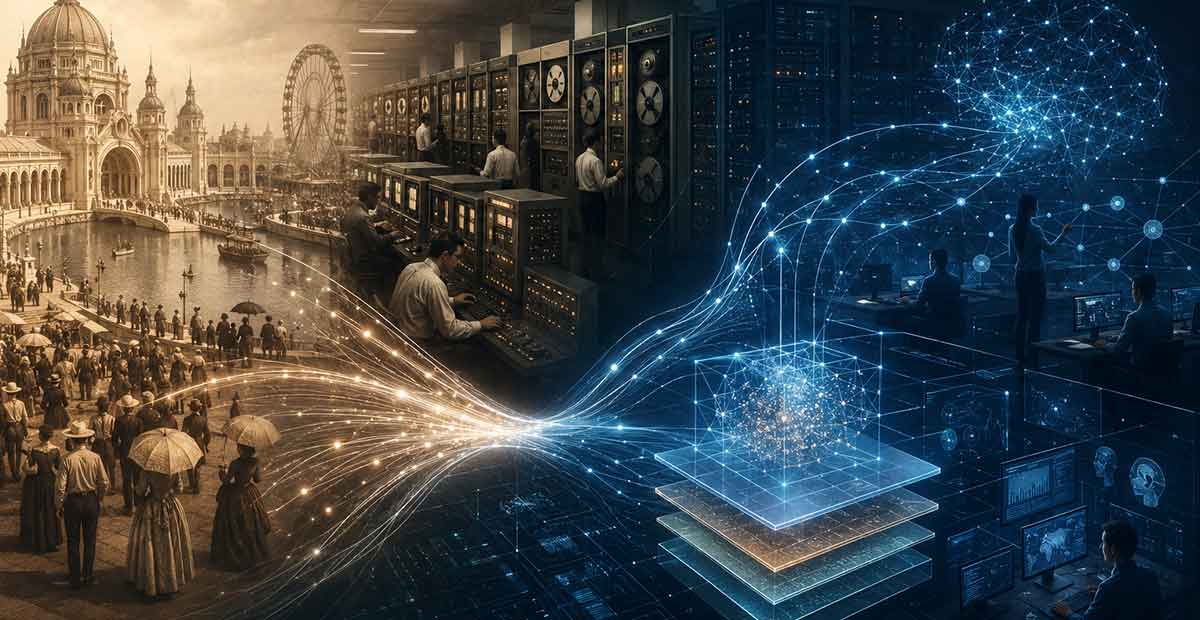
From the White City to AI Chips to DataUniversa - How the Organization of Complexity Creates Value
By John F. Groom
In 1893, Chicago accomplished something that seemed almost impossible.
On the shore of Lake Michigan, thousands of workers transformed swampland into what became known as the White City, the centerpiece of the World's Columbian Exposition. Covering more than 600 acres and containing nearly 200 major buildings, the fair welcomed over 27 million visitors and employed tens of thousands of workers. Remarkably, it was completed in only a few years using little more than paper drawings, telegraphs, railroads, and human organization.
At first glance, the achievement appears to be one of engineering.
In reality, it was something much more significant.
It was an achievement in organization.
More than a century later, the same principle has become one of the defining characteristics of artificial intelligence, modern computing, and increasingly, the future of information itself. As systems grow larger and more complex, value depends progressively less on the capability of individual components and increasingly on the way those components are organized, coordinated, and integrated into a larger whole.
That pattern appears repeatedly throughout history.
The White City: Organizing Complexity
Imagine attempting to build the Chicago World's Fair one building at a time.
Architects would complete every design before engineers began surveying. Surveyors would finish before contractors poured foundations. Electricians would wait until every structure was complete before installing wiring, while landscapers would remain idle until utilities had been finished throughout the entire site. A project of that scale would likely have required decades rather than a few years.
Instead, under the leadership of Daniel Burnham, the exposition operated as a massively parallel system. While architects designed one building, engineers surveyed another section of the site. Contractors poured foundations elsewhere, electricians installed wiring in completed structures, landscapers transformed finished areas, and exhibitors prepared displays inside buildings already ready for occupancy. Thousands of activities advanced simultaneously, each progressing independently while remaining connected to a common organizational plan.
The organizers did not reduce complexity.
They organized it.
Common standards, clearly defined responsibilities, specialized departments, standardized interfaces between teams, and centralized planning combined with decentralized execution allowed thousands of independent efforts to function as one coordinated system.
The White City demonstrated an organizational principle that remains just as relevant today as it was in 1893.
Complexity becomes manageable when independent work can proceed simultaneously while remaining structurally compatible.
The Evolution of Parallel Systems
The organizational principles demonstrated at the Chicago World's Fair did not disappear when the exposition closed. Instead, they reappeared throughout the Industrial Revolution in increasingly sophisticated forms.
Factories gradually moved away from relying on individual master craftsmen and instead organized production into specialized workstations, each responsible for a particular stage of the manufacturing process. Railroads coordinated thousands of employees across vast distances through standardized timekeeping, signaling systems, and operating procedures. As corporations grew, they became capable of coordinating the work of thousands of specialists whose individual contributions could be integrated into a single enterprise.
Although these examples span different industries and different eras, they all illustrate the same transition.
In the early stages of development, success depends primarily on individual capability. As systems grow larger and more complex, however, success increasingly depends on organizational capability. Coordination gradually becomes more valuable than individual excellence because the performance of the entire system depends on how effectively independent components work together.
Computing Repeats the Same Pattern
The history of computing follows a remarkably similar trajectory.
Early computers relied almost entirely on sequential execution. A processor completed one instruction before moving to the next, and improving performance largely meant designing a faster processor. For decades this strategy proved extraordinarily successful, with each new generation of hardware delivering substantial improvements in computational speed.
Eventually, however, engineers encountered physical limitations.
Increasing clock speeds produced more heat, consumed more power, and generated progressively smaller improvements in overall performance. The challenge was no longer how to build a dramatically faster processor. Instead, it became how to organize computation more effectively.
The solution was parallelism.
Rather than depending on a single processor to perform every task, modern computer architectures introduced multiple processing cores capable of executing different workloads simultaneously. Performance no longer depended primarily on raw processing speed. It depended on how efficiently independent processors could coordinate their work while sharing memory, communicating with one another, and combining their results.
Once again, organization replaced individual capability as the primary source of progress.
Artificial Intelligence Extends Parallelism Even Further
Artificial intelligence accelerated this transition dramatically.
Training a modern neural network requires billions—or even trillions—of mathematical operations. Attempting to perform those calculations sequentially would require impractical amounts of time, making today's most advanced AI systems impossible to build.
Instead, AI processors such as GPUs and specialized accelerators divide those computations into enormous numbers of independent operations that can execute simultaneously. Thousands of processing units perform similar calculations in parallel, dramatically reducing the time required to train increasingly sophisticated models.
Even this level of parallelism is no longer sufficient.
Today's frontier AI systems coordinate tens of thousands of processors distributed across massive data centers. While one group of processors performs calculations for part of a neural network, others update model parameters, move data across high-speed networks, load training batches into memory, optimize model performance, and manage communication between thousands of independent computational tasks.
At this scale, the challenge is no longer simply designing better processors.
It is designing systems capable of coordinating enormous numbers of processors efficiently.
The pattern should sound familiar.
Just as the Chicago World's Fair demonstrated that human complexity could be managed through organization, modern AI demonstrates that computational complexity can be mastered through exactly the same principle.
Organization, once again, becomes the dominant source of performance.
The Same Transition Is Happening with Data
The world's information systems are approaching the same organizational transition.
When an organization manages only a handful of datasets, value depends primarily on the quality of those individual datasets. A well-designed database, an accurate spreadsheet, or a carefully maintained collection of records may provide significant value on its own because the amount of information remains manageable. At that scale, collecting more data often produces proportionally more value.
As information grows into thousands, millions, and eventually billions of datasets, however, a different problem begins to emerge.
Finding information becomes more difficult. Understanding its meaning becomes more difficult. Determining provenance becomes more difficult. Combining independently created datasets becomes more difficult, and allowing artificial intelligence to use information consistently across different systems becomes increasingly complex. The challenge gradually shifts away from acquiring additional data and toward making existing information work together.
Eventually, adding more information contributes less value than organizing the information that already exists.
The bottleneck changes.
Data is no longer the scarce resource.
Coordination becomes the scarce resource.
DataUniversa: An Architecture for Organized Information
This is precisely the problem DataUniversa was designed to solve.
Rather than treating information as isolated files, disconnected databases, or independent collections of records, DataUniversa provides a common structural framework that allows independently created information to function as components of a much larger knowledge ecosystem. Its purpose is not simply to collect more information, but to organize information in a way that allows it to remain understandable, interoperable, explainable, and reusable regardless of where it originated.
That architecture is built around principles that appear repeatedly throughout the DataUniversa ecosystem, including semantic identity, provenance, interoperability, admissibility, standardized structures, shared organizational primitives, and common interfaces between independently created knowledge. Together, these principles allow information created by different people, organizations, industries, and countries to remain structurally compatible without requiring every contributor to adopt identical workflows or technologies.
The objective is not centralization.
It is interoperability.
Just as the organizers of the Chicago World's Fair established common standards that allowed thousands of independent teams to construct a single coherent city, DataUniversa establishes common structures that allow independently generated information to participate in a single coherent knowledge ecosystem. Likewise, just as modern AI processors achieve extraordinary performance by coordinating thousands of simultaneous computational operations, DataUniversa increases the value of information by coordinating thousands—and eventually millions—of independent knowledge objects.
Independent contributors remain independent.
Their information simply becomes capable of working together.
The Changing Source of Value
This reflects a broader pattern that appears repeatedly throughout technological history.
Early systems compete by building better components. Mature systems compete by building better architectures.
Factories evolve into supply chains. Computers evolve into distributed computing clusters. Individual applications become platforms. Collections of datasets become interconnected knowledge ecosystems. In every case, increasing complexity changes the source of competitive advantage.
Organization gradually becomes more valuable than individual capability.
The lesson extends well beyond technology.
As complexity grows, success depends less on producing the best individual component and increasingly on creating systems in which many independent components can interact efficiently, exchange information, and collectively produce outcomes that none of them could achieve alone.
That is the transition now taking place in the world of information.
The Organization of Complexity Creates Value
Looking across construction, industry, computing, artificial intelligence, and information management, the same organizational principle appears again and again.
The value of a complex system does not grow simply because it contains more components. It grows because those components become increasingly capable of working together. As complexity expands, the quality of the relationships between the parts gradually becomes more important than the quality of any single part.
The Chicago World's Fair demonstrated this principle through people.
Factories demonstrated it through organized production.
Modern computing demonstrated it through parallel processors.
Artificial intelligence demonstrates it through coordinated computation on an unprecedented scale.
DataUniversa applies the same principle to information.
Rather than viewing datasets as isolated assets, DU treats them as components of a much larger knowledge architecture. Every authenticated observation, document, image, video, dataset, index, and decision becomes more valuable when it can interact meaningfully with other knowledge objects while preserving its own identity, provenance, and context.
This represents an important shift in the way information creates value.
Historically, organizations competed by acquiring more data or building better individual systems. Increasingly, however, competitive advantage comes from creating environments in which independently generated knowledge can be connected, interpreted, recombined, and reused without sacrificing trust or explainability. Information that remains isolated contributes value only within its own boundaries. Information that is structurally compatible can contribute value throughout an entire ecosystem.
This is why interoperability is not simply a technical feature.
It is an organizational capability.
A General Principle for the AI Age
Taken together, the Chicago World's Fair, modern AI systems, and DataUniversa illustrate the same progression.
As systems become larger and more complex, progress depends less on improving individual components and increasingly on designing architectures that allow large numbers of independent components to function as a coordinated whole. Each generation solves a different version of the same problem. The technologies change, but the organizational principle remains remarkably consistent.
The White City demonstrated that thousands of people could work simultaneously within a shared organizational framework.
Artificial intelligence demonstrates that thousands of processors can solve extraordinarily complex computational problems by operating in parallel within a common architecture.
DataUniversa seeks to demonstrate that independently created information can achieve the same transformation. By establishing shared structures for semantic identity, provenance, interoperability, admissibility, and explainable recombination, information created anywhere can participate in a much larger knowledge ecosystem without losing its origin or independence.
That may prove to be one of the defining organizational principles of the AI age.
The organizations that create the greatest long-term value may not be those with the largest collections of data or even the most advanced individual technologies. Instead, they may be the organizations that become exceptionally good at coordinating independent people, independent systems, and independent knowledge into architectures that continuously create new understanding.
Ultimately, that is the broader vision behind DataUniversa.
The platform is not designed simply to store more information. It is designed to organize complexity itself. Just as the White City transformed thousands of independent construction activities into a functioning city, and just as AI systems transform billions of independent calculations into useful intelligence, DataUniversa seeks to transform independently created knowledge into an interoperable, explainable, and continuously evolving intelligence ecosystem.
In the AI era, the greatest source of value may no longer be the individual components we create.
It may be the architecture that allows all of those components to work together.
Whether you're exploring interoperability, dataset valuation, AI readiness, or ecosystem participation, we welcome conversations with researchers, organizations, and strategic partners interested in the future of structured data systems.
info@datauniversa.com