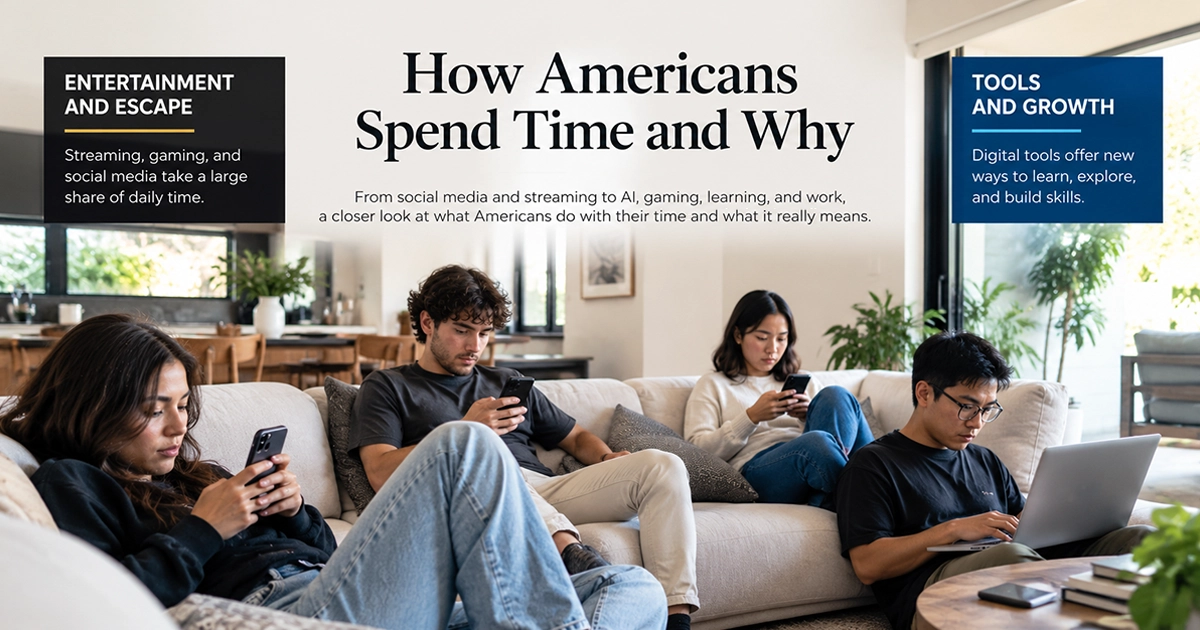
How Americans Spend Time and Why
By: John F Groom
Social Media Isn't So Social
Americans spend an extraordinary amount of time consuming information and entertainment. Television, movies, social media, books, video games, and, increasingly, artificial intelligence occupy a substantial portion of the average adult's waking hours. Yet the conventional statistics describing these activities may tell us surprisingly little about what people are actually doing.
We measure television viewing, social media usage, gaming, book reading, and AI interaction as though they were comparable activities, but they are not. Television and social media are primarily distribution mechanisms. Gaming is an interactive experience, while reading is an activity that can take place through many different media. AI can support entertainment, learning, communication, or productive work.
This distinction matters because the way we classify time influences how we understand human behavior, technological change, and the economic value of different activities. Perhaps the most misleading category is social media. Much of what Americans call social media has very little to do with being social.
Where the Hours Go
A reasonable illustrative estimate for 2026 is that the average American adult spends three hours and fifteen minutes daily watching television and movies, one hour and forty-five minutes using social media, thirty-five minutes gaming, twenty minutes reading books, and fifteen minutes interacting with generative AI.
These are approximate population-wide estimates, not figures drawn from a single standardized survey. Different studies define activities differently, some count simultaneous activities, and AI usage is particularly difficult to measure because it is increasingly embedded in other software. Nevertheless, the broad picture is clear: television and video entertainment dominate, social media accounts for a substantial additional commitment, traditional book reading occupies relatively little time, and generative AI remains a comparatively small but rapidly developing category.
Together, these activities represent roughly six hours and ten minutes daily, or 2,251 hours annually, although simultaneous activities mean the figures cannot simply be interpreted as mutually exclusive hours. The question is what those hours actually represent.
The Age Divide: Under 40 and 40+
The average conceals a substantial generational difference. For adults under 40, an illustrative daily allocation is 2 hours and 15 minutes of TV and movies, 2 hours and 30 minutes of social media, 55 minutes of gaming, 15 minutes of books, and 25 minutes of generative AI, totaling 6 hours and 20 minutes. For adults 40 and older, the corresponding estimates are 3 hours and 45 minutes, 1 hour and 20 minutes, 25 minutes, 25 minutes, and 10 minutes, totaling 6 hours and 5 minutes.
These are illustrative estimates, not precise findings from a single national age-stratified survey. The age-40 boundary is not a standard survey cut point. Yet the underlying pattern is persuasive: younger adults allocate more time to personalized, interactive media, while older adults spend considerably more time with television. The total may be more similar than the distribution.
A group aged 40 and older also conceals important variation between working-age adults and retirees. For people age 65 and older, a further rough illustration is 4 hours and 15 minutes of TV and movies, 1 hour and 5 minutes of social media, 20 minutes of gaming, 35 minutes of books, and 5 minutes of AI. These estimates should be tested rather than treated as measured averages.
Social Media and the Displacement of Television
Social media almost certainly displaced substantial traditional television viewing, particularly among younger adults. Comedy, sports highlights, music performances, celebrity coverage, news, and reality entertainment migrated from scheduled programming into short, algorithmically selected feeds. The underlying demand for entertainment often remained the same; the distribution mechanism changed.
The substitution was not one-for-one. Social media also displaced other activities and made entertainment available in short intervals that television could not easily capture. Total media consumption may therefore have expanded even as traditional television declined.
Why Social Media Isn't So Social
Consider what someone does during an hour on Instagram, TikTok, Facebook, Reddit, or another social platform. They may watch a succession of short videos, look at photographs of people they barely know, follow celebrities, read political commentary, browse product recommendations, or scroll through amusing content selected by an algorithm. They may occasionally comment on something, exchange a message, or publish material of their own.
But much of this activity involves neither meaningful social interaction nor personal expression. The typical experience increasingly resembles a personalized television channel, assembled continuously by software to maximize the probability that the viewer will keep watching. Unlike traditional television, the viewer can respond, comment, or publish, but the existence of these capabilities does not mean they dominate actual usage.
For purposes of understanding how people spend their time, we might divide social media into six broad activities: passive entertainment, following people and communities, acquiring information, communicating directly, discovering products and services, and creating original content.
A plausible illustrative allocation would assign roughly 45 percent of social media time to entertainment, 20 percent to following people and communities, 15 percent to information, 10 percent to direct interaction, and the remaining 10 percent to shopping and content creation. These proportions are hypotheses rather than measured national averages, but they illustrate the conceptual problem.
Under such a classification, perhaps only a modest minority of social media time involves genuine interpersonal communication or original expression. The rest is largely consumption. There is nothing necessarily wrong with this. Entertainment is a legitimate use of time, as is following the lives of other people. But calling all of it social media obscures the nature of the activity.
A person watching forty-five minutes of TikTok videos may be doing essentially the same thing as someone watching forty-five minutes of television. The principal differences are the length of the videos, the method of selection, and the possibility of interaction. The distinction becomes even less meaningful when traditional television content is distributed through social platforms, or when social media videos are watched on television screens. The platform changes, but the underlying activity may not.
Gaming: Active Entertainment, Not Necessarily Productivity
Gaming adds an important category to the comparison. It typically requires more active participation than television or passive social feeds, including decisions, strategy, problem-solving, coordination, and sometimes creativity. Mobile games also broaden participation well beyond console owners.
But interactive activity is not automatically productive. Some games develop transferable skills or encourage creation, while others are primarily repetitive recreation. Gaming sits between passive consumption and goal-directed creation, making it an especially interesting potential bridge to AI-assisted creative work.
The illustrative age estimates suggest 55 minutes of gaming daily among adults under 40, compared with 25 minutes among adults 40 and older. These figures are not official national means, but they highlight why a population-wide average can conceal distinct media environments.
Reading Hasn't Disappeared. It Has Changed Forms.
Book reading offers another example of the limitations of conventional measurement. When someone reads a chapter of a novel in a printed book, we classify the activity as reading. When someone reads a lengthy essay on a website, we may classify it as internet usage. When someone reads the same essay on Facebook or Reddit, it becomes social media usage. Yet the cognitive activity can be nearly identical.
Of course, there are important differences between sustained reading and the rapid consumption of short posts. Reading a complex book for an hour generally demands more continuous attention than scanning dozens of headlines. But these differences concern the depth and quality of engagement, not the medium through which words are delivered.
The more useful distinction would be between sustained reading, brief informational scanning, and passive visual consumption. Traditional statistics on book reading may therefore understate the amount of time Americans spend reading words, while simultaneously overstating the amount of sustained intellectual engagement occurring on digital platforms. Neither conclusion can be established simply by looking at the number of minutes assigned to books or social media.
Television, Social Media, and the Competition for Attention
Television and social media are often treated as separate industries, but from the consumer's perspective they increasingly compete to satisfy the same needs. Both provide entertainment, distraction, emotional stimulation, and relief from boredom. Both offer information and exposure to people, places, and experiences beyond the viewer's immediate environment.
The differences are increasingly matters of format and control. Traditional television generally offers longer, professionally produced programming, while social media offers shorter, more varied material selected through highly personalized recommendation systems. Streaming services occupy territory between these models, and the distinctions continue to blur.
Social media also introduces an additional mechanism: the continuous possibility that the next item will be more interesting than the current one. This creates an unusually effective system for retaining attention, even when individual pieces of content provide little lasting satisfaction. From an economic perspective, the competition is not simply between television networks and social media companies. It is a competition for the finite amount of time people are willing to devote to entertainment and passive consumption. The success of a platform at capturing attention tells us little about the value of the experience to the individual.
An hour spent watching a compelling documentary, an hour watching comedy clips, and an hour repeatedly scrolling through uninteresting material may all register as an hour of media consumption. Yet their effects on knowledge, satisfaction, and subsequent behavior can be quite different. Time spent is easy to measure. Value received is much harder.
A Better Way to Classify Human Time
Rather than dividing discretionary time according to the technology used, we could classify it according to the underlying activity. Four broad categories would provide a useful starting point. Entertainment and distraction would include watching movies, following sports, listening to music for enjoyment, browsing amusing videos, and other activities primarily intended to provide pleasure or occupy attention.
Information acquisition and learning would include reading books and articles, watching educational programs, researching questions, following news, and using AI to understand unfamiliar subjects.
Social observation and communication would include maintaining relationships, exchanging messages, participating in discussions, and observing the activities of friends, family, and communities. Within this category, actual interpersonal communication could be distinguished from simply observing other people. Creation and productive activity would include writing, designing, programming, producing original media, organizing projects, and using technology to accomplish specific objectives.
These categories are not perfectly exclusive. A documentary may entertain while educating. A conversation may be socially rewarding and professionally useful. A person writing music may simultaneously be creating something valuable and enjoying the experience. But this framework would tell us considerably more about how Americans actually use their time.
As an illustration, suppose we allocated the roughly 370 daily minutes associated with television, movies, social media, book reading, and AI into these four categories. We might hypothesize that 260 minutes involve entertainment and distraction, 50 minutes information acquisition, 35 minutes social activity, and 25 minutes creation or productivity. These figures are not empirical findings. They are a conceptual model that would need to be tested with detailed time-use research.
The resulting picture would nevertheless be striking: approximately 70 percent of the time devoted to these media and technologies would be classified as entertainment or distraction, with much smaller shares devoted to learning, communication, or productive creation. That would be a fundamentally different description of American life from the familiar statement that people spend several hours watching television and using social media.
Artificial Intelligence Changes the Classification Problem
Artificial intelligence makes the conventional categories even less useful. Someone might spend twenty minutes with ChatGPT researching a historical question, developing a business plan, writing a computer program, preparing a presentation, or simply enjoying a fictional conversation. All five activities would register as AI usage, yet they have very different purposes and potential value.
Unlike traditional television, AI is not primarily a content distribution medium. Unlike conventional social media, it does not require a network of other users to provide value. And unlike books, it can actively adapt its responses to the user's objectives. AI can function as an entertainment system, an information source, a tutor, a collaborator, or a productive tool.
This makes time spent with AI an especially poor standalone measure of its importance. An individual might spend ten minutes using AI to complete a task that previously required two hours. Another might spend two hours generating amusing images or engaging in recreational conversation. The second person would register twelve times as much AI usage, even though the first might have received considerably greater economic value.
Indeed, one of the most important effects of AI may be to reduce the amount of time necessary to accomplish certain activities. For technologies that primarily sell attention, more time spent is generally favorable to the provider. For technologies that improve productivity, less time spent achieving the same result may be evidence of greater value. This creates an important distinction between measuring engagement and measuring accomplishment.
Will AI Make Americans More Productive or More Entertained?
The emergence of AI creates two very different possible trajectories for how Americans spend their discretionary time. In one, AI becomes an increasingly sophisticated entertainment system. It generates personalized stories, interactive characters, music, videos, games, and other experiences tailored to individual preferences. Rather than reducing passive consumption, it makes entertainment more engaging and potentially more difficult to resist.
In the other, AI lowers the barriers to learning, creation, and productive activity. People who previously lacked the technical skills to write software, produce sophisticated media, design products, or organize businesses become capable of doing so with AI assistance. These outcomes are not mutually exclusive. Both are likely to occur. But their relative importance will depend on something that technology alone cannot determine: what people actually want to do with their time. A person who wants entertainment will find AI useful for entertainment. Someone motivated to create, learn, or build something will find that AI substantially expands what can be accomplished. The technology may make productive activity more accessible without necessarily making it more attractive.
This distinction is important because technological capability and human motivation are not the same thing. Reducing the effort required to accomplish something does not automatically create a desire to accomplish it. At the same time, AI may alter motivation indirectly. Someone who never considered creating a film, writing a book, or developing a business because the required skills seemed unattainable may become interested once the barriers are reduced. The availability of new capabilities can change what people aspire to do. Whether this effect is large enough to shift the overall allocation of American discretionary time remains an open question.
The Economics of Attention Versus Accomplishment
The way digital businesses make money adds another dimension to the issue. Many social media and entertainment businesses benefit when users spend more time on their platforms. Advertising revenue, subscription retention, and engagement-based recommendations often reward continued attention. The user's objective may be enjoyment, information, or social connection, while the platform's economic objective is frequently to extend the interaction. These interests sometimes align and sometimes diverge.
AI businesses face a more complicated incentive structure. Some may adopt advertising or engagement-oriented models that reward longer interactions. Others may charge for subscriptions, completed tasks, transactions, or measurable productive results. In those models, the value of the technology may depend less on how much time it captures than on how much useful work it accomplishes.
This creates the possibility of a fundamental shift in how digital services compete. The traditional question has been how much of the user's attention a company can capture. An increasingly important alternative may be how much of the user's objectives a company can help accomplish. The distinction is not absolute. Entertainment can be valuable, and productivity tools can encourage unnecessary usage. But it represents a meaningful difference in the economic relationship between people and technology.
Measuring the American Day More Intelligently
If we want to understand how technology changes human behavior, we need better measurements. Instead of asking only how many hours Americans spend on television, social media, reading, or AI, we should ask what they are trying to accomplish, what they actually do, and what they receive in return. How much time is devoted to passive entertainment? How much to acquiring knowledge? How much to genuine interpersonal communication? How much to creating something? How much to achieving practical objectives?
We should also distinguish voluntary enjoyment from habitual or unwanted consumption. Two people may spend the same amount of time watching videos, but one may regard the experience as deeply satisfying while the other considers much of it wasted time. Similarly, an hour of creative activity may be enjoyable, frustrating, economically productive, or some combination of all three. A useful measurement system would therefore consider not just the activity and duration, but also its purpose, the degree of active participation, and the outcome. Such a system would provide a more meaningful basis for comparing technological changes over time.
It might reveal that social media has displaced television more than it has expanded genuine social interaction. It might show that Americans read more text than conventional book statistics suggest, but spend less time in sustained reading. It might demonstrate that AI substantially increases productive output without capturing a correspondingly large share of daily attention. Or it might reveal that AI's greatest commercial success comes from making entertainment even more personalized. The point is that we cannot distinguish these possibilities with the conventional categories.
Conclusion: What Matters Is What People Do
The average American adult devotes hours every day to activities described as television, social media, reading, and, increasingly, artificial intelligence. But those labels describe technologies and distribution channels at least as much as they describe human behavior. Social media is the clearest example. A platform originally associated with interpersonal connection has evolved into a vast system for distributing entertainment, information, advertising, and commentary. Much of the time spent on it is not particularly social.
Reading, meanwhile, takes place across numerous platforms, and AI can support almost any category of intellectual or creative activity. As these technologies converge, the old classifications will become progressively less meaningful. The more important question is not whether Americans spend three hours watching television or two hours using social media. It is how much of their finite time they devote to entertainment, learning, communicating, creating, and accomplishing objectives, and how much value they receive from each.
Artificial intelligence makes this question particularly urgent because it has the potential both to transform productive activity and to create more compelling forms of passive consumption. The next major change in American time use may not be a shift from one screen or platform to another. It may be a shift in what people are capable of doing with their time. Whether they choose to use that capability is a different question entirely.
Whether you're exploring interoperability, dataset valuation, AI readiness, or ecosystem participation, we welcome conversations with researchers, organizations, and strategic partners interested in the future of structured data systems.
info@datauniversa.com