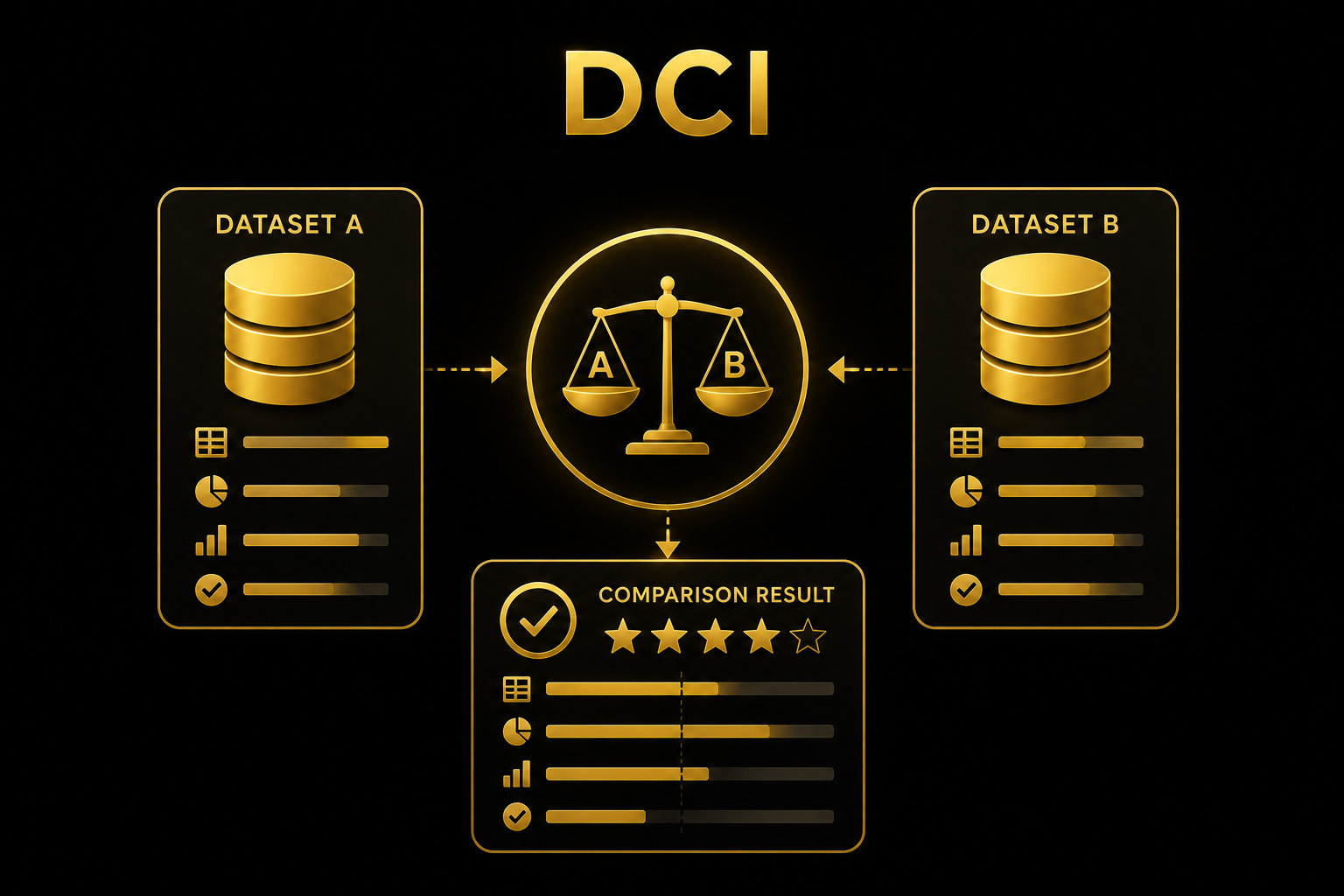
How Do I Compare Two Datasets?
By: John F Groom
Organizations compare datasets by looking at simple metrics such as record counts, file size, or the number of fields. Unfortunately, those measurements rarely answer the most important question:
Which dataset is actually more useful?
At DataUniversa, dataset comparison goes beyond volume. Two datasets may contain similar information yet differ dramatically in quality, trustworthiness, interoperability, and market relevance.
What Should Be Compared?
When comparing datasets, DataUniversa evaluates several dimensions.
Admissibility
Can the data be trusted and used?
DataUniversa scoring evaluates factors such as:
- Provenance
- Documentation
- Verification
- Measurement quality
- Structure and consistency
A dataset with stronger admissibility is often more useful than a larger dataset with weaker supporting evidence.
Provenance
Where did the data come from?
A dataset with documented origins, collection methods, and verification records is generally easier to trust than one with unknown sources. Before comparing data itself, it is often necessary to compare the credibility of the underlying records.
Interoperability
Can the datasets work with other datasets?
One of the core goals of the Global Model Intelligence Platform (GMIP) is to create structured, interoperable data assets.
GMIP outputs can be evaluated through the Data Connectivity Index (DCI), which measures the ability of datasets to connect with and generate value from other datasets.
In many cases, the most valuable dataset is not the largest dataset—it is the dataset that can participate most effectively within a larger information ecosystem.
Coverage
Datasets may also differ in:
- Number of records
- Geographic coverage
- Time span
- Frequency of updates
- Population representation
Coverage remains important, but it should be evaluated alongside admissibility and interoperability rather than in isolation.
Comparing Market Activity
Organizations often want to know more than which dataset is technically stronger. They also want to understand market demand.
This is where DatFlash becomes useful.
DatFlash tracks dataset transactions, licensing events, acquisitions, and other market signals across the data economy. When comparable information exists, DatFlash can help answer questions such as:
- Have similar datasets been sold?
- Which sectors are acquiring data?
- What categories appear to be attracting demand?
- How active is the market for datasets like these?
While market activity does not determine value on its own, it provides important context when comparing data assets.
A DataUniversa Comparison Framework
When comparing two datasets, DataUniversa typically asks:
- Which dataset has stronger provenance?
- Which dataset has higher admissibility scores?
- Which dataset is more interoperable?
- Which dataset provides broader or more relevant coverage?
- Which dataset has stronger market signals according to DatFlash?
The objective is not simply to determine which dataset is bigger. The objective is to determine which dataset is more trustworthy, more useful, and more capable of generating value.
–
Comparing datasets is about more than counting records.
DataUniversa approaches dataset comparison through admissibility, provenance, interoperability, and market intelligence.
> Dataset Scoring helps evaluate trust and usability.
> Global Model Intelligence Platform helps establish structured interoperability.
> The Data Connectivity Index (DCI) helps evaluate how effectively datasets can connect with other information sources.
> DatFlash provides visibility into market activity and comparable dataset transactions.
Together, these systems provide a more complete framework for comparing datasets than volume alone.
Whether you're exploring interoperability, dataset valuation, AI readiness, or ecosystem participation, we welcome conversations with researchers, organizations, and strategic partners interested in the future of structured data systems.
info@datauniversa.com