How Has the Movement of Knowledge Changed Throughout Human History?
By: John F Groom
The Accelerating Movement of Knowledge
One way to understand human progress is to look at how quickly knowledge moves.
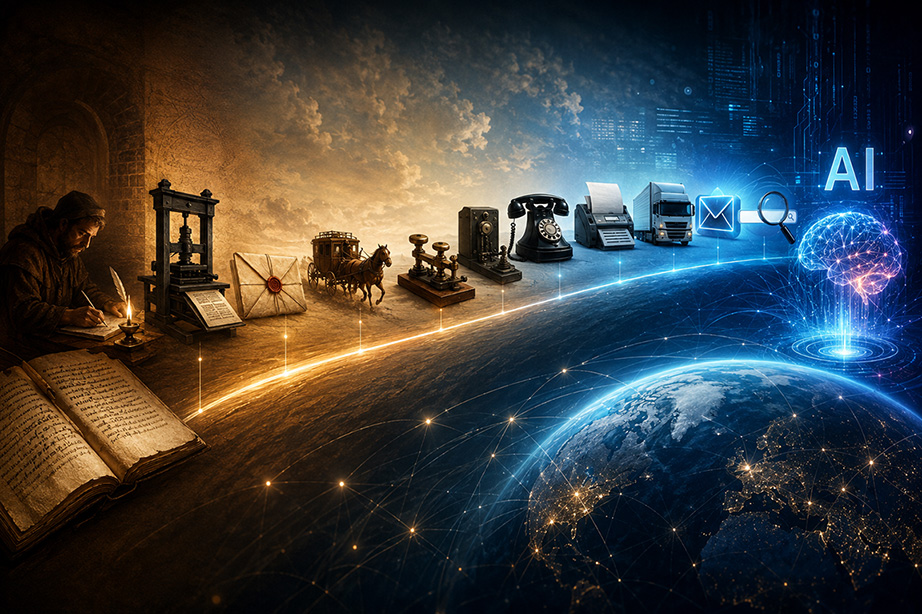
For much of history, knowledge traveled no faster than a person could write. Scribes copied manuscripts by hand, one page at a time. Books were more than collections of ideas, they were valuable physical objects that required skilled labor, specialized materials, and significant time to produce. Knowledge certainly existed, but it was difficult to reproduce, expensive to distribute, and accessible to relatively few people.
The invention of the printing press fundamentally changed that equation. It didn't suddenly make people more intelligent, but it dramatically lowered the cost of reproducing information. Once ideas could be copied efficiently, they spread far beyond the institutions that had traditionally controlled them. Religion, science, commerce, law, and politics all evolved because knowledge could finally scale.
As information became easier to reproduce, another challenge emerged: distance.
Postal systems, trade routes, and later the Pony Express made it possible for written information to travel across large regions with increasing speed and reliability. Although the Pony Express operated for only a short period, it represented an important shift in thinking. Speed itself had become valuable. The objective was no longer just preserving knowledge or copying it, it was delivering it faster than ever before.
The telegraph marked an even more significant turning point. For the first time, information no longer had to travel alongside a person, horse, ship, or train. Messages could move almost instantly across vast distances. That single breakthrough reshaped financial markets, military strategy, journalism, government, and countless other areas because people could now react to events as they happened rather than days or weeks later.
The telephone built on that transformation by making communication immediate and interactive. Fax machines later allowed entire documents to be transmitted within minutes instead of days. Companies like FedEx revolutionized reliable physical delivery, while email reduced the cost of communicating across the globe to almost nothing. Search engines addressed a different challenge altogether. They weren't focused on moving information, they helped people find it.
Looking back, each technological leap removed a different limitation.
- Scribes preserved knowledge.
- The printing press made it reproducible.
- Postal networks overcame distance.
- The telegraph eliminated transmission delays.
- The telephone enabled real-time conversation.
- Fax machines moved documents instantly.
- FedEx made physical delivery predictable.
- Email made global communication inexpensive.
- Search engines made information discoverable.
Artificial intelligence is beginning to address an entirely different bottleneck: interpretation.
Unlike earlier communication technologies, AI doesn't simply move information from one place to another. It can compare documents, summarize large volumes of content, translate languages, organize information, identify patterns, and generate new outputs based on existing knowledge. Previous technologies focused on transporting information between people. AI increasingly transforms information into something that can be understood and used.
That shift is significant because access is no longer the primary challenge. We already produce more information than any individual could reasonably consume. The real problem is determining what matters, what can be trusted, how separate pieces of information relate to one another, and what decisions should follow.
This marks the next phase of the knowledge economy.
When books were scarce, printed materials held extraordinary value. When communication networks were limited, connectivity became valuable. When finding information was difficult, search engines became indispensable.
As AI makes synthesis increasingly abundant, something else becomes scarce: trusted structure.
The easier it becomes for AI to generate, remix, and imitate content, the more valuable provenance becomes. What matters is no longer just receiving an answer. Increasingly, the value lies in understanding where that answer came from, how the underlying data was collected and transformed, what assumptions influenced the result, what evidence supports it, and whether it can be connected with other trusted sources of knowledge.
Viewed through that historical lens, systems like DataUniversa address a different challenge than simply participating in the AI revolution. They focus on the problem that widespread AI has exposed. AI accelerates the creation of knowledge. DataUniversa is designed to ensure that rapidly generated knowledge remains structured, trustworthy, comparable, and interoperable across people, organizations, and domains.
The broader pattern is remarkably consistent. Throughout history, civilization has continually increased the speed at which knowledge moves. We learned to preserve it, reproduce it, transport it, transmit it, discover it, and now synthesize it.
The next challenge is making sure we can verify it. That may prove to be one of the defining infrastructure problems of the AI era.
If every previous era focused on moving knowledge faster, the AI era may ultimately be defined by our ability to verify it.
Whether you're exploring interoperability, dataset valuation, AI readiness, or ecosystem participation, we welcome conversations with researchers, organizations, and strategic partners interested in the future of structured data systems.
info@datauniversa.com