Innovation. Revolution. Good Enough. Stop.
By: John F Groom
We tend to think of technological progress as a continuous process. Invent something. Improve it. Improve it again. Make it faster, cheaper, smaller and more powerful. Repeat indefinitely. Computing has reinforced this expectation. A computer from 1980 is primitive compared with one from 2000, and a computer from 2000 is primitive compared with what we carry in our pockets today. Artificial intelligence is currently changing so quickly that a capability demonstrated two years ago can already seem quaint. It is easy to assume that this is simply how technology works. But it isn’t.
Sometimes civilization encounters a difficult problem, experiences a burst of extraordinary innovation, and arrives at a solution that is simply very, very good. Then the revolution ends, not because innovation has failed, but because, for the purpose that matters, the technology has become good enough. Few technologies demonstrate this better than the printed book.
The Revolution
For most of human history, reproducing written information was expensive. If you wanted another copy of a manuscript, somebody essentially had to make one. Scribes copied texts by hand. Books existed, sometimes magnificent ones, but reproducing them required enormous amounts of skilled human labor.
Then printing changed the economics of knowledge. Johannes Gutenberg’s development of movable-type printing in Europe around the middle of the fifteenth century combined several existing and emerging technologies, including movable metal type, suitable inks, paper and the press, into a system capable of reproducing pages much more efficiently.
The consequences went far beyond making books cheaper. Once information could be reproduced reliably and in large quantities, ideas could travel much farther without being manually recopied. Scholars could work from substantially identical editions. Scientific observations could circulate. Religious arguments could reach enormous audiences. Political pamphlets could be reproduced rapidly. Literacy became increasingly valuable because there was vastly more material available to read.
Printing became part of the infrastructure of the Reformation, the Scientific Revolution and eventually mass education. This was not an incremental improvement in information technology. It was a revolution.
And Then We Got the Book
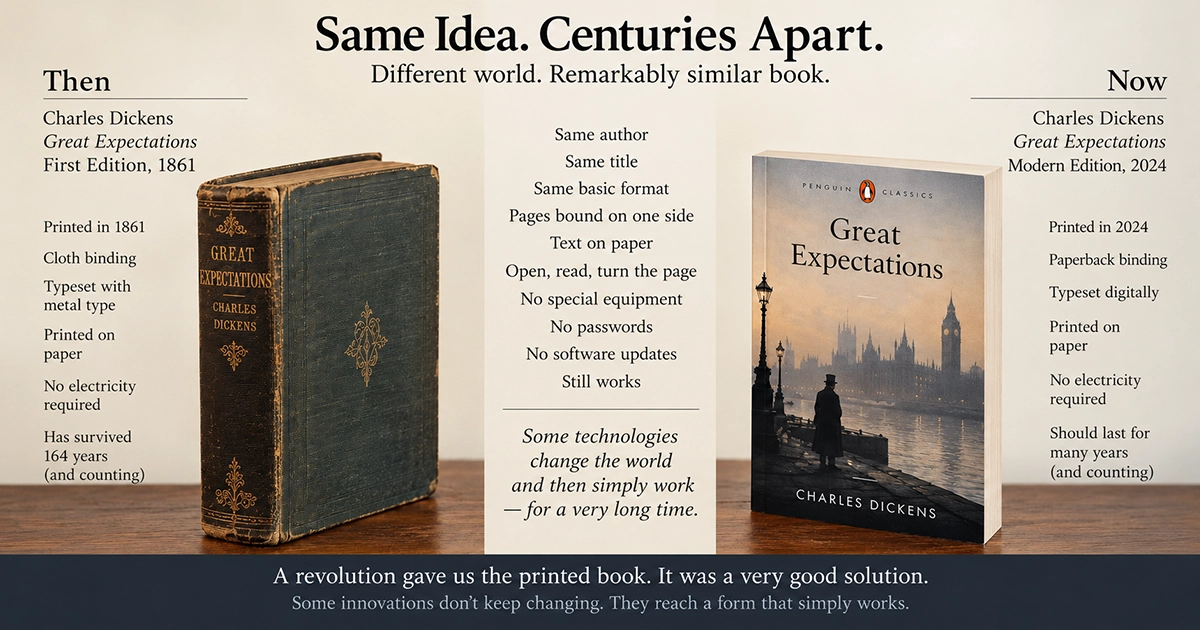
Here is the curious part. After all that revolutionary change, we arrived at something remarkably simple: a book. Sheets of paper containing printed symbols, organized into pages and bound together along one side. Open the cover, read the first page, turn it, read the next one, and repeat. Once we arrived at this arrangement, there wasn’t actually very much left that needed fixing.
Printing machinery improved enormously. Paper became cheaper. Typesetting became faster. Illustrations became easier to reproduce. Binding changed. Publishers developed inexpensive paperbacks. Offset printing transformed production. Computers transformed typesetting and composition. Print-on-demand eventually made it economical to produce even a single copy. The industrial system surrounding the book changed tremendously, but the object in the reader’s hands changed remarkably little.
My Dickens Test
I have first editions of Charles Dickens. Dickens died in 1870. The world in which those books were manufactured has almost completely disappeared. The people who printed them would have known nothing of automobiles, airplanes, radio, television, computers, the internet, smartphones or artificial intelligence.
Yet I can take one of those books off my shelf today and use it immediately. There is no adapter, no battery, no obsolete operating system, no password, no subscription and no file format that must be converted. There is no network with which it must remain compatible. I don’t need instructions. I simply open it and read.
In one sense, that is an extraordinary technological achievement. A roughly 160-year-old information device remains completely compatible with a modern human being. Try doing that with most information technologies from 40 years ago. A computer disk from the 1980s may contain perfectly intact information, yet accessing it today can require obsolete hardware, obsolete software or conversion equipment. Connections disappear. Standards change. Storage media become unreadable. Software companies disappear. My Dickens book requires none of this. The world around it changed. The human interface didn’t need to.
Good Enough Can Be Very Good Indeed
“Good enough” can sound dismissive. It shouldn’t. In engineering, reaching a stable design can represent an extraordinary accomplishment. The printed book has a remarkable collection of attributes. It is portable. It requires no external energy. It can survive being dropped. It can remain usable for centuries. It provides extremely high visual resolution. It starts instantly. It requires essentially no training. It remembers where you were if you put a scrap of paper between the pages. You can write in it. You can lend it to someone. Two people can exchange one without needing compatible technological ecosystems.
Its basic interface also maps extremely well onto human anatomy. Our hands can hold it. Our fingers can turn its pages. Our eyes can read it at a comfortable distance. We can move backward and forward through it almost instantly. We can see approximately how much we have read and how much remains simply by looking at the thickness of the pages on either side. Nobody planned all of these characteristics simultaneously in a modern product-development meeting. The form evolved over a very long period. Eventually, it became extremely difficult to improve upon for its central purpose.
Then Digital Technology Arrived
Of course, we eventually invented something radically different. Digital text has extraordinary advantages over printed text. An electronic device can hold thousands of books. A book can be transmitted across the world almost instantaneously. Digital text can be searched. Font sizes can change. Passages can be copied. Definitions can appear instantly. A library that once required an enormous building can fit on a small device.
And now artificial intelligence introduces another transformation. Instead of merely searching a book, we can increasingly ask questions about it, compare it with other books, summarize arguments, translate passages and connect its contents to an enormous external body of knowledge.
Those are revolutionary capabilities. But something interesting happened: the printed book survived. The new technology didn’t necessarily replace the mature technology. Instead, the two became good at different things. If I need to locate every reference to a particular subject across 500 books, I would vastly prefer digital technology. If I want to spend two uninterrupted hours reading Bleak House, I might still prefer a printed book.
That isn’t nostalgia masquerading as technological judgment. It reflects different optimization functions. Digital text is spectacular at storage, transmission, duplication, search and computation. The printed book remains spectacular at being a book.
The S-Curve
This suggests a different model of technological progress from the one computing has taught us to expect. Many technologies follow an S-curve. At first, progress is slow. The problem is difficult and nobody quite knows how to solve it. Then a breakthrough occurs, and progress accelerates dramatically. Many competing designs appear. Engineers solve obvious weaknesses. Costs collapse. Performance improves rapidly. The technology spreads.
Eventually, something else happens. The basic architecture becomes very good. The easiest improvements have already been made. Standards develop. Infrastructure grows around the technology. Users become familiar with it. Physical and economic constraints begin to dominate. Progress continues, but increasingly around the edges. The curve flattens.
Innovation. Revolution. Good Enough. Stop.
“Stop” doesn’t literally mean that nobody innovates anymore. It means the fundamental architecture stops changing very much.
Airplanes Do This Too
Commercial aviation provides another striking example. In 1903, the Wright brothers flew 120 feet on their first successful powered flight. By the end of the 1950s, commercial jetliners were carrying ordinary passengers across oceans at roughly 550 miles per hour.
In a little more than half a century, humanity went from being unable to fly at all to something recognizably similar to today’s commercial aviation system. That was the revolution. More than six decades later, commercial aircraft are dramatically safer, quieter, more efficient and more sophisticated. But passengers still fly at roughly 550 miles per hour. We still travel to large airports, board tube-shaped aircraft, sit in rows, climb to around 35,000 feet and land at another large airport.
Again, this isn’t failure. The original solution was extremely good. So improvements increasingly occur within the architecture rather than replacing it. The Boeing 787 is an extraordinary technological achievement, but it does not represent the kind of transformation from the Boeing 707 that the 707 represented from having no commercial jet transportation at all. The S-curve flattened.
We Shouldn’t Confuse Maturity With Failure
This distinction matters because otherwise we can misunderstand technological stagnation. If the basic design of something hasn’t changed in 100 years, our instinct may be to ask why innovators have failed to improve it. Sometimes that is the right question. But sometimes the better question is: What if they already solved it?
Consider a drinking glass, a fork, a hammer, a chair, a pencil, a bicycle and eyeglasses. The details continue to change. Materials improve. Manufacturing gets cheaper. Specialized versions appear. But somebody transported from a century or two ago would understand immediately what most of these objects are and how to use them.
That can be evidence of technological maturity rather than technological backwardness. There are only so many ways to design an object that must interact with a human hand, mouth, eye or body. Human anatomy isn’t doubling in capability every two years. Once an object fits the human problem extremely well, radical redesign can actually make it worse.
The Human Being Is Often the Constant
This may explain why information technology changes so much faster than some physical technologies. Computers can become a thousand times more powerful. Human fingers don’t become a thousand times more dexterous. Computer storage can increase by a factor of a million. Human eyes don’t become a million times better at reading. A processor can perform billions of operations per second. A person still reads prose at roughly human speed.
Technology can therefore race forward until it encounters something that isn’t changing exponentially. Often, that something is us. The physical book sits directly at that boundary. Everything behind the book can change dramatically. Artificial intelligence can help write it. Computers can typeset it. Automated presses can print it. Robots can move it through warehouses. Algorithms can recommend it. A global logistics network can deliver it tomorrow. And after all of that technology has done its work, what arrives at my house? A stack of paper bound along one edge, because that part still works remarkably well.
What Changes, What Doesn’t
Technology therefore presents us with an interesting paradox. The most revolutionary technology isn’t necessarily the technology that changes forever. Sometimes the opposite is true. A truly successful period of innovation can produce a design so well adapted to its purpose that further radical change becomes unnecessary.
Printing changed civilization. The printed book that emerged from that revolution proved extraordinarily durable. Centuries later, I can hold a Dickens first edition in my hands and use it exactly as its first owner did. Almost everything surrounding that book has changed. The machines that manufacture books have changed. The systems that distribute them have changed. The ways we discover them have changed. The alternatives to them have changed beyond recognition.
But the book itself remains remarkably familiar. That shouldn’t make us think less of it. It should make us appreciate just how successful the original innovation was. Sometimes civilization encounters a difficult problem, experiences a burst of extraordinary innovation, and arrives at a solution that is simply very, very good. Then the revolution ends. Not every technology needs another revolution. Sometimes “good enough” really means: we got this one right.
Whether you're exploring interoperability, dataset valuation, AI readiness, or ecosystem participation, we welcome conversations with researchers, organizations, and strategic partners interested in the future of structured data systems.
info@datauniversa.com