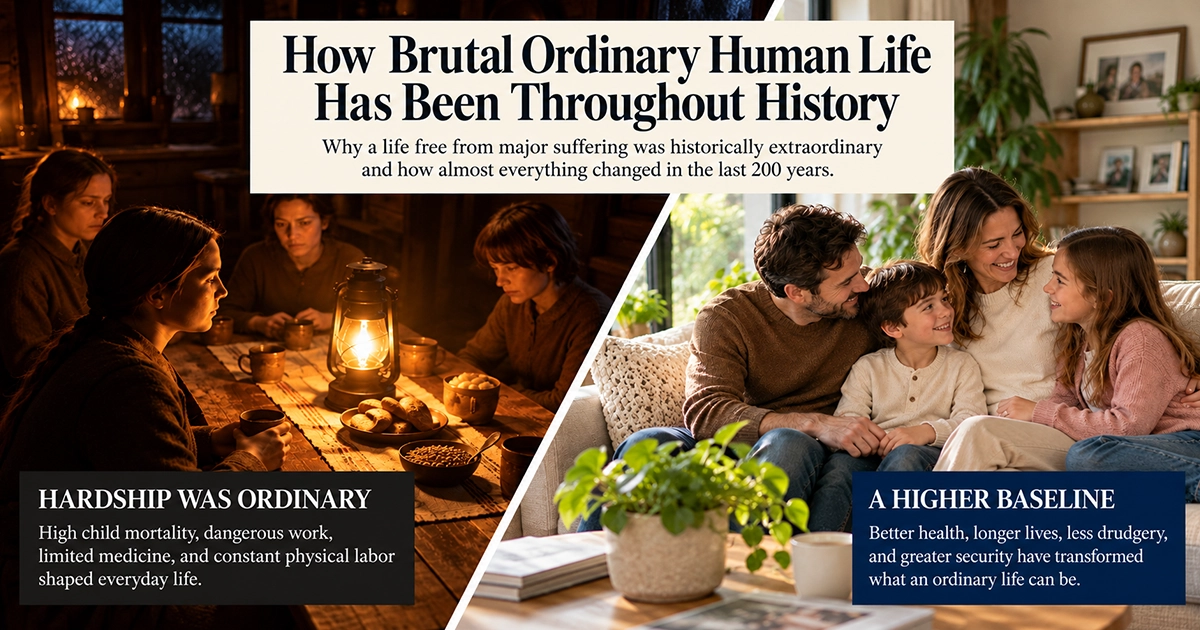
One in 3,000: How Brutal Ordinary Human Life Has Been Throughout History
By John F Groom
Why a Life Free from Major Suffering Was Historically Extraordinary, and How Almost Everything Changed in the Last 200 Years
AST | Society, Technology, and the Structure of Human Life
For nearly all of human history, the ordinary human life was one that most people living in an advanced economy today would consider intolerable. Children died in large numbers. Injuries that could now be treated in an emergency room resulted in lifelong disability or death. Women spent hours washing clothes, preparing food, and carrying water. Men worked in fields, mines, factories, and workshops under conditions that would now violate elementary workplace safety standards. Hunger was a recurring threat, serious physical violence was common, and medical treatment was often ineffective or unavailable.
These conditions were not confined to slaves, prisoners, or the poorest members of society. They affected farmers, merchants, craftsmen, soldiers, servants, and families that would have been considered relatively prosperous by the standards of their time. A person might escape one form of hardship only to experience several others. Someone who never went hungry might lose three children. Someone who escaped war might spend forty years performing exhausting agricultural labor. Someone who enjoyed financial security might nevertheless die from an infection that a modern course of antibiotics could cure.
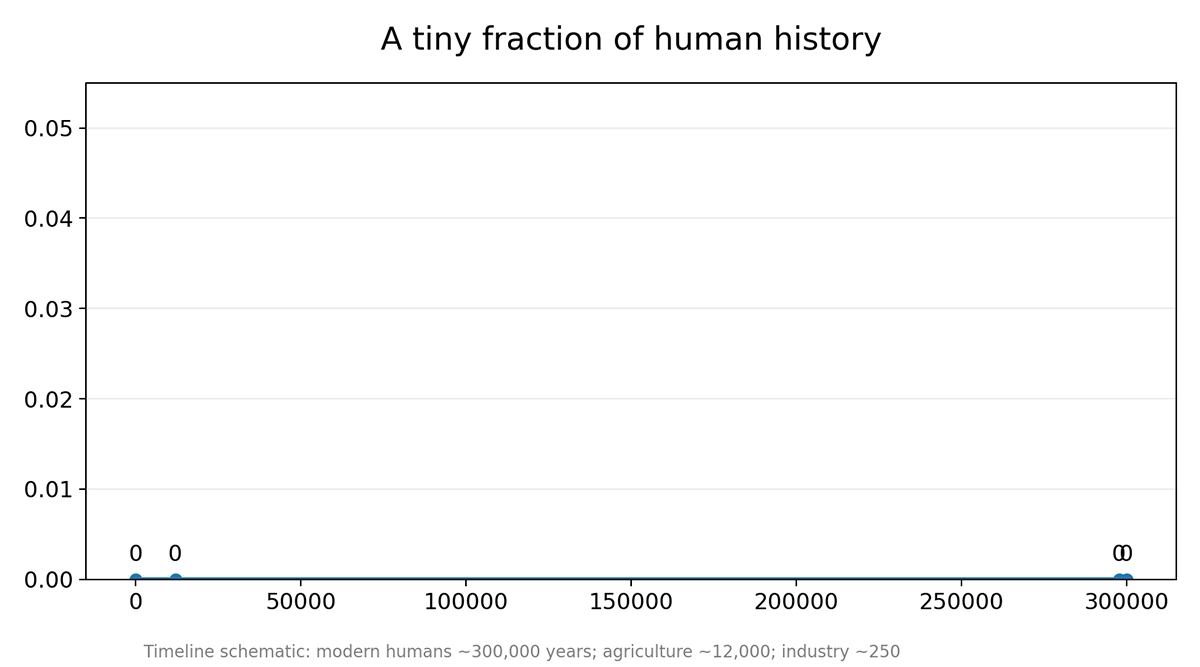
The extraordinary fact is how recently much of this changed. Humans have existed in their anatomically modern form for approximately 300,000 years. Agriculture emerged roughly 12,000 years ago, while the Industrial Revolution began only about 250 years ago. Modern sanitation, widespread electrification, antibiotics, mass vaccination, mechanized domestic appliances, and large-scale reductions in extreme poverty are overwhelmingly developments of the last 150 years, and many became widely available only within the last 75.
A person born in an affluent country in 1960 has witnessed changes in ordinary living conditions that would have been difficult to imagine for almost every preceding generation. Yet modern people rarely evaluate their lives against the historical experience of humanity. Instead, they compare themselves with neighbors, coworkers, celebrities, and contemporaries who possess slightly more money, freedom, status, or convenience. This creates a remarkable inversion: what would have constituted extraordinary good fortune across most of human history has become the minimum standard of an acceptable life.
1. Childhood: When Losing a Son or Daughter Was Ordinary
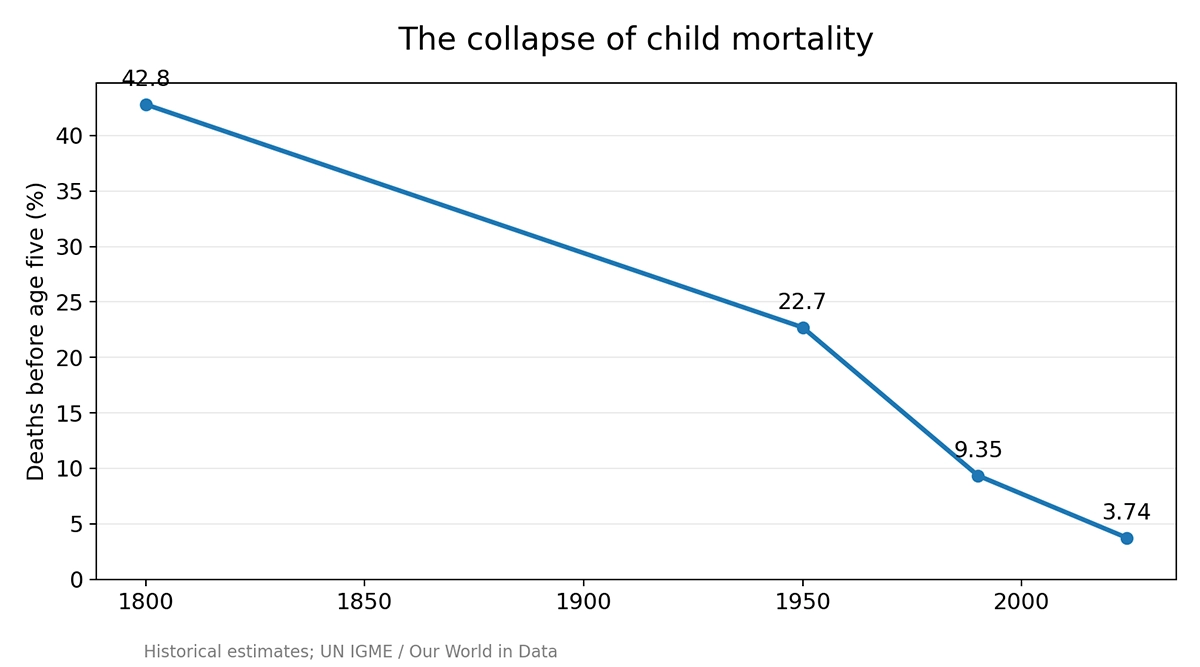
In approximately 1800, an estimated 43% of children worldwide died before their fifth birthday. By 1950, the proportion was still about 23%. In 1990, it had fallen to approximately 9.4%, and by 2024 it was 3.7%. The decline from 1800 to 2024 represents a reduction of more than 90% in the probability that a newborn would die before reaching five. The consequences for family life were enormous. Consider a woman who gave birth to six children in a society where 40% died before age five. If the children's outcomes were independent, the probability that at least one would die would be approximately 95%. In reality, mortality risks were not independent. Epidemics, contaminated water, malnutrition, and famine could kill several children in the same household. Families sometimes buried two or three children within a matter of weeks.
Modern parents generally assume that a healthy newborn will survive childhood. In much of the world, that assumption became reasonably safe only in the twentieth century. In many affluent countries, under-five mortality is now well below 1%. A family losing a young child is treated as an extraordinary catastrophe, not an expected risk of parenthood. The psychological difference is difficult to overstate. Imagine raising four children while knowing that one or two might die before starting school, with almost no effective means of preventing it. Parents in earlier centuries undoubtedly loved their children, but they lived with a degree of uncertainty that most modern parents have never experienced.
The change is continuing. Rwanda's under-five mortality fell from approximately 184 deaths per 1,000 live births in 2000 to 38 in 2024, a reduction of almost 80% in just 24 years. A Rwandan parent raising children today faces a radically different statistical reality from a parent raising children at the beginning of this century.
2. Medicine: A World in Which Ordinary Injuries Could Become Permanent Tragedies
Until the twentieth century, a relatively minor injury could initiate a chain of events that ended in amputation or death. A farmer cut his hand on a tool. A carpenter drove a splinter into his finger. A woman developed an infection after childbirth. A child contracted pneumonia. Without effective antibiotics, a localized bacterial infection could spread through the bloodstream and become fatal.
Alexander Fleming discovered penicillin's antibacterial properties in 1928, but the drug was not manufactured in substantial quantities for medical treatment until the 1940s. During the Second World War, penicillin became an important treatment for infected wounds and bacterial disease. Widespread civilian availability followed. One of the most consequential medical advances in human history became broadly useful within the lifetime of people who were still alive in the early twenty-first century.
Smallpox killed many of those it infected and left some survivors blind or permanently scarred. Edward Jenner demonstrated vaccination against smallpox in 1796, but eradication required nearly two more centuries of scientific development, manufacturing, logistics, and international cooperation. The World Health Organization declared smallpox eradicated in 1980. A disease that had afflicted humanity for millennia disappeared from natural circulation less than fifty years ago.
Childbirth was another major source of suffering and death. Even today, with modern obstetrics, approximately 260,000 women died from pregnancy-related causes in 2023, with roughly 92% of those deaths occurring in low- and lower-middle-income countries. Between 2000 and 2023, the worldwide maternal mortality ratio declined from 328 to 197 deaths per 100,000 live births, a 40% reduction within just 23 years.
The transformation is not limited to survival. Cataract surgery can restore sight to someone who would otherwise remain blind. Hip replacements can restore mobility to people who would once have spent their final decades in pain. Dental anesthesia makes procedures tolerable that earlier generations endured without effective pain relief. Modern trauma surgery allows victims of accidents to recover from injuries that would once have killed or permanently disabled them. None of these developments eliminates suffering, and access remains highly unequal. Nevertheless, the change in what medicine can accomplish is so substantial that a reasonably equipped modern hospital would have appeared almost miraculous to a physician practicing in 1850.
3. Hunger and Material Insecurity: When Having Enough Was Never Guaranteed
In 1820, the overwhelming majority of the world's population lived in poverty by modern standards. Historical reconstructions differ in their exact thresholds and estimates, but they consistently describe a world in which access to food, adequate shelter, fuel, clothing, and other necessities consumed most household resources. Many families had little capacity to withstand a poor harvest, prolonged illness, unemployment, or the loss of a working animal.
The difference between poverty and destitution could be a single event. A subsistence farmer whose crop failed might be forced to sell livestock, borrow at unfavorable terms, reduce meals, or surrender land. An urban laborer who broke his leg might lose the income necessary to feed his children. A widow without property or family support might have few means of survival other than poorly paid labor, charity, or institutional assistance. Poverty has not disappeared. The World Bank's March 2026 update estimates that 10.4% of the global population lived in extreme poverty in 2024. Yet this represents an enormous historical departure from a world in which extreme material deprivation affected most people.
The important distinction is not merely the amount of money people possess. It is the reliability with which they can obtain necessities. A modern household in an advanced economy can usually purchase food produced thousands of miles away, store it safely in a refrigerator, cook it with the turn of a dial, and obtain clean drinking water from a tap. A crop failure in the surrounding countryside ordinarily does not threaten the family's survival.
For much of history, none of these protections existed. Food was more seasonal, preservation was difficult, transportation was expensive, and local harvests mattered enormously. Even families with adequate food in ordinary years might face severe deprivation when weather, disease, or warfare disrupted production. The modern supermarket is more than a convenient retail establishment. It is the visible endpoint of a system of mechanized agriculture, refrigeration, transportation, electricity, food processing, commercial coordination, and purchasing power. Its abundance would have been extraordinary even to many wealthy people living two centuries ago.
4. Drudgery: The Disappearance of Work That Consumed Entire Lives
One of the least appreciated improvements in human life is the reduction of repetitive physical labor. Historically, people did not merely work longer hours. Much of their work was physically exhausting, monotonous, and unavoidable. Agricultural workers dug, planted, weeded, harvested, carried, and processed crops by hand. Domestic servants scrubbed floors, emptied waste, washed clothes, hauled water, and maintained fires. Factory employees could spend ten or twelve hours repeating the same movement beside dangerous machinery.
The reduction in paid working hours is substantial. In Germany, annual working hours fell from more than 3,000 in the late nineteenth century to fewer than 1,500 in the 2010s. Britain experienced a decline of approximately 40% over a similar long period. These figures are not perfectly comparable across all occupations, but the broad trend is unmistakable.
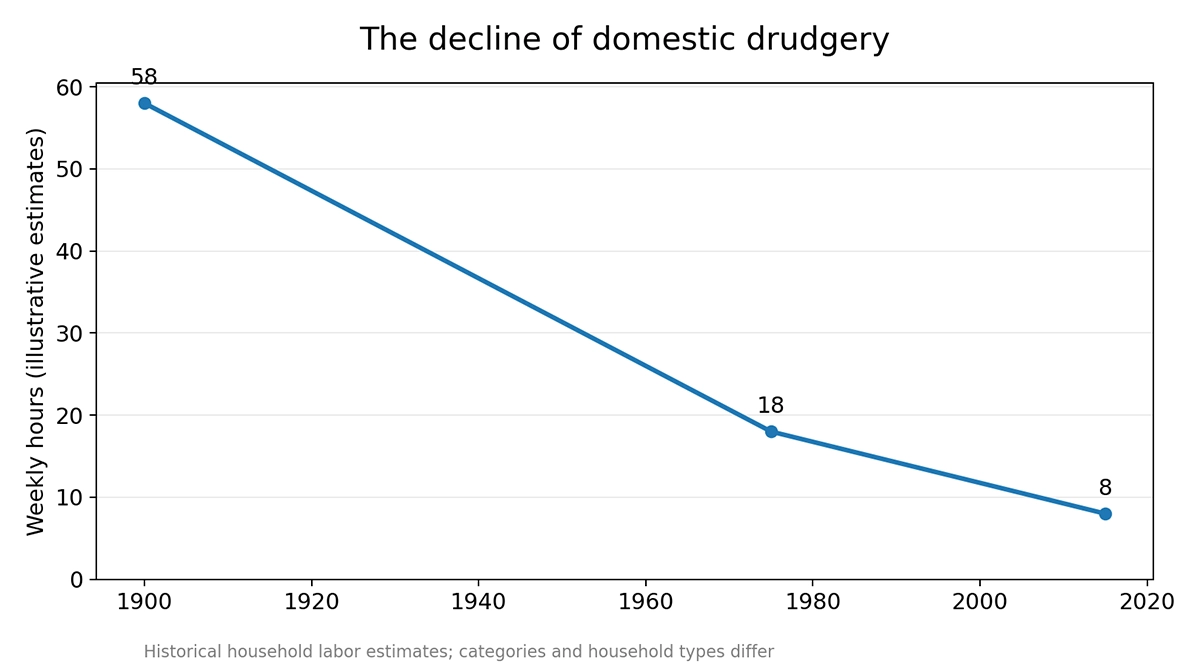
Domestic work may be even more revealing because it was largely unpaid and frequently omitted from traditional economic accounts. One historical reconstruction estimates that an American household in 1900 spent approximately 58 hours per week preparing meals, washing clothes, and cleaning. By 1975, the figure had fallen to approximately 18 hours. A later estimate for a two-adult household in 2015 was under eight hours for those same categories of chores. These estimates depend on the precise activities counted, but they illustrate a dramatic reduction in routine household labor.
Consider laundry in 1900. Clothes and bedding might have to be soaked, boiled, scrubbed, rinsed, wrung, carried, dried, and ironed. Water often had to be heated manually. The work could occupy much of a day, especially in a large household. A modern washing machine performs most of the repetitive physical operations automatically. A dryer eliminates dependence on outdoor drying conditions, and modern fabrics often require little or no ironing.
Cooking underwent a similar transformation. Earlier households had to obtain fuel, maintain fires, prepare raw ingredients, preserve perishable food, and clean equipment without modern detergents or plumbing. Today, refrigerated ingredients, electric appliances, prepared foods, dishwashers, and reliable energy supplies eliminate much of that labor. A meal that once required hours of preparation and cleanup can now require twenty minutes.
These innovations did not simply increase household productivity. They returned enormous quantities of human time to the people who would otherwise have spent it performing compulsory maintenance work. A person who spends an hour preparing an elaborate meal because cooking is a hobby is engaged in a fundamentally different activity from someone who must spend four hours preparing food because there is no other practical way to feed the household. The physical actions may overlap, but the freedom to choose makes the experiences different.
The agricultural transformation was equally consequential. Mechanized tractors, combines, irrigation systems, fertilizers, and transportation networks allowed a much smaller proportion of the population to produce food for everyone else. In the United States, agricultural employment fell from a large share of the workforce around 1900 to a small minority today.
Not all manual work is drudgery. A skilled cabinetmaker, gardener, or farmer may find deep satisfaction in physical craftsmanship. The relevant distinction is between chosen, rewarding work and repetitive labor that must be performed for years simply to maintain basic existence.
5. Violence: When Physical Coercion Was Part of Ordinary Life
Violence has always varied enormously by place and period. Some societies were comparatively peaceful, while others endured chronic warfare, raiding, slavery, harsh corporal punishment, and arbitrary detention. It would be inaccurate to describe every earlier society as equally violent. Nevertheless, many historical populations experienced levels of physical coercion that would be considered extraordinary in advanced economies today.
Research on European homicide records suggests that murder rates in parts of Western Europe during the thirteenth and fourteenth centuries often exceeded 10 deaths per 100,000 people annually. Some Italian estimates reach approximately 70 per 100,000. Contemporary rates in several of those European countries are around one per 100,000. The medieval estimates are uncertain and debated, but the evidence points toward major long-term declines in lethal interpersonal violence in many regions.
Homicide is only one measure. Historically, a person could experience severe violence without appearing in any mortality record. Soldiers might survive battle with permanent injuries. Prisoners could be beaten or confined in dangerous conditions. Apprentices and servants might face corporal punishment from masters or employers. Children could endure severe beatings at school or repeated substantial physical punishment at home. People were also injured by dangerous machinery, mine collapses, construction falls, livestock, wild animals, and serious dog attacks. Slavery was a separate and categorical form of coercion. Anyone ever held as a slave is excluded from our hardship-free category, whether or not an individual beating, injury, or imprisonment can be documented. Enslavement itself deprived a person of basic liberty and exposed them to compulsory labor and the threat of force.
This exclusion covers chattel slavery, hereditary bondage, forced enslavement in war, and other situations in which a person was held as property or compelled to serve under an owner's coercive control. It does not require that the person remained enslaved for life: even someone subsequently emancipated fails this particular test. Slavery also overlaps with the drudgery and material-security categories, so it must not be counted multiple times as though the risks were independent. The modern prohibition of many forms of corporal punishment and coercion is itself historically recent. Legal restrictions, professional policing, changing social expectations, and institutions for protecting individual rights developed unevenly across countries. In many places, enforcement remains weak.
War provides a further qualification to any simple narrative of continuous progress. The twentieth century produced two world wars, the Holocaust, mass political killings, and other catastrophes on an enormous scale. Technological progress made possible not only better medicine and greater abundance, but also unprecedented capacities for organized destruction.
Forced emigration must also be distinguished from voluntary migration. Expulsion under threat, forced marches, dangerous deportation journeys, and deaths during compelled displacement belong in the same category of severe historical adversity. A person who survived these experiences would fail the violence-and-coercion filter even if they were never personally beaten. Someone who died during forced emigration would already fail the age-65 requirement; the death of their child would also disqualify a surviving parent under the separate family-loss condition. Even so, for someone living in a relatively peaceful modern society, the probability of being conscripted into battle, subjected to routine workplace beatings, or imprisoned by a local ruler is far lower than it was in many historical settings. The improvement is real, even though it is neither universal nor irreversible.
6. Clean Water and Sanitation: The Revolution People Rarely Notice
A person in an affluent country today can drink a glass of tap water, flush a toilet, wash their hands, and take a hot shower without giving much thought to the systems that make these activities possible. Yet for most of human history, each involved either substantial labor or serious health risks. Water had to be collected from wells, rivers, springs, or communal sources. Where water was distant, carrying it could consume hours, often placing a disproportionate burden on women and children. Human waste frequently contaminated local environments and drinking-water supplies. Cholera, dysentery, typhoid, and other waterborne diseases could kill large numbers of people, particularly infants.
Modern water treatment, underground pipes, sewage networks, and indoor plumbing were among the most consequential technological developments of the nineteenth and twentieth centuries. Their effects extended beyond disease prevention. They eliminated labor, reduced unpleasant living conditions, and made cleanliness a routine possibility rather than an expensive or exhausting undertaking.
The transformation is still underway. According to WHO and UNICEF, between 2000 and 2024 approximately 2.2 billion people gained access to safely managed drinking water, while 2.8 billion gained access to safely managed sanitation. As recently as 2024, approximately 2.1 billion people still lacked safely managed drinking water and 3.4 billion lacked safely managed sanitation.
This illustrates both the scale of progress and its uneven distribution. In a modern American suburb, indoor plumbing is so unremarkable that its absence would make a house virtually unmarketable. In parts of rural Africa and Asia, obtaining clean water remains a major daily activity. What one society considers a basic requirement of civilization, another is still working to achieve.
7. The Chronology: Almost Everything Changed Yesterday
The most extraordinary feature of these developments is their timing. Humans have existed for hundreds of thousands of years, but the technologies that make modern living conditions possible arrived within an extremely short interval. Before 1750, most production depended on human and animal muscle, wood and other traditional fuels, and relatively simple machinery. Between 1750 and 1850, steam power, mechanized textile production, railways, and industrial manufacturing began transforming output and transportation, initially in a limited number of countries.
Between 1850 and 1900, germ theory, antiseptic surgery, urban sewer systems, improved water treatment, electricity, and industrial food production laid foundations for modern public health. Between 1900 and 1950, automobiles, tractors, electrical appliances, vaccines, refrigeration, and antibiotics began changing daily existence on a mass scale. From 1950 to 2000, mechanization, mass electrification, modern medicine, improved agriculture, international trade, and rising incomes spread to much larger populations. Since 2000, hundreds of millions have escaped extreme poverty and billions have gained improved water and sanitation, while mobile communications and digital infrastructure have reached much of the developing world.
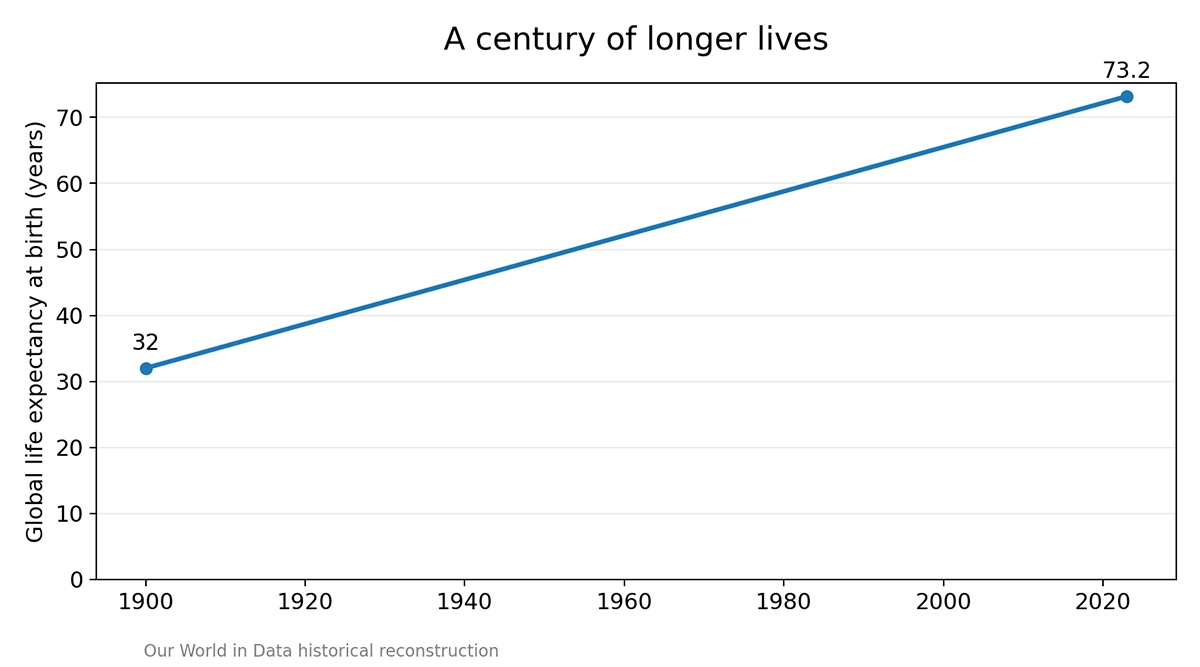
The 250 years since 1776 represent approximately 0.083% of a 300,000-year history of Homo sapiens. The 76 years since 1950 represent approximately 0.025%. Even the entire period since the beginning of agriculture represents only about 4%. In 1900, global life expectancy at birth was approximately 32 years. By 2023, it had reached 73.2 years. That increase of more than forty years occurred in roughly four generations. It was driven not only by the survival of more children, but also by declining mortality among adults.
A middle-class family in a developed country today typically possesses running water, indoor sanitation, electric lighting, refrigeration, central heating or cooling, a washing machine, rapid transportation, access to effective medicines, and an abundance of food. A king living in 1700 could command servants and enjoy extraordinary luxury, but could not purchase antibiotics, a modern anesthetic, a safe blood transfusion, or reliable protection against smallpox. Money could buy labor, land, and status. It could not buy technologies that had not yet been invented.
8. The One-in-3,000 Calculation: Defining a Life Free from Major Hardship
To appreciate the cumulative significance of these improvements, consider a deliberately modest standard for a hardship-free human life. Suppose we ask whether a person could reach age 65 having avoided five experiences: prolonged debilitating illness or disability; the death or permanent disability of a child; serious material deprivation; serious violence, coercion, enslavement, incarceration, or forced displacement; and years of compulsory drudgery. Any period of enslavement disqualifies the person, even if followed by emancipation and decades of security.
We do not require the person to fall in love, enjoy a satisfying marriage, have close friends, find rewarding work, accumulate great wealth, raise happy children, achieve anything exceptional, or even feel particularly happy. A person could reach 65 without any of these positive experiences and still belong to our tiny fortunate category, solely because none of the specified terrible experiences occurred. The test measures the absence of severe adversity, not the presence of fulfillment. That is what makes its small illustrative result so striking.
Imagine a person whose work was tolerable but uninspiring, who never experienced romantic love, whose children were healthy but unhappy, who had few friends and no notable accomplishments, and who never accumulated wealth beyond a secure livelihood. If that person escaped debilitating illness, the loss or permanent disability of a child, material deprivation, serious violence or coercion, including enslavement, and prolonged drudgery, the person would pass every one of our filters. We would not have demonstrated that this was a happy or admirable life. We would merely have identified a life unusually free from catastrophe.
We do not require the person to be rich, famous, educated, exceptionally healthy, happily married, intellectually fulfilled, or professionally successful. We do not even require that the person be particularly happy. We ask only whether the individual avoided several categories of hardship that modern affluent societies increasingly regard as unacceptable.
An exploratory calculation illustrates the question. Starting with an assumed 17.5% of all people ever born reaching age 65, we successively apply estimates for the proportion avoiding each additional hardship. The result is approximately one person in 3,000. Applied to the Population Reference Bureau's estimate of roughly 117 billion human births through 2022, this would represent about 39 million people.
This figure is not a validated historical statistic. It is the mathematical result of illustrative assumptions, several of which are highly uncertain. Reliable historical data do not exist for the lifetime prevalence of all five conditions, much less their joint distribution. Furthermore, the experiences are correlated: people who enjoy material security are also more likely to avoid some forms of illness, violence, and drudgery. We cannot establish that one in 3,000 is the true historical frequency.
The illustrative 70% pass rate for the violence-and-imprisonment filter was chosen before explicitly adding serious animal attacks, school beatings, repeated substantial parental punishment, and serious industrial or occupational accidents. We retain it for continuity, not because it has been validated for the expanded definition. The broader criteria could lower the resulting one-in-3,000 estimate. The expanded violence definition has not been assigned a new historical rate: the 70% conditional survival assumption remains a placeholder, not an evidence-based estimate. The additional exclusions could lower the qualifying fraction, but no defensible numerical revision is possible without better data.
The precise number is less important than the question it raises. How many people, across the entire span of human existence, enjoyed what a contemporary middle-class person would consider an acceptable minimum standard of living throughout their first 65 years? The exercise exposes the cumulative character of human suffering. An individual could escape starvation but endure violence. Another could avoid violence but lose children. A third might enjoy family security but spend forty years performing exhausting labor. Avoiding one serious hardship did not imply avoiding the others.
An Illustrative Calculation
|
Qualification |
Assumed share passing this step |
Calculation |
|
Reach age 65 |
17.5% |
100% × 0.175 |
|
No major prolonged personal disability |
30% |
17.5% × 0.30 |
|
No child dies or suffers permanent disability |
20% |
5.25% × 0.20 |
|
Continuous basic material security |
30% |
1.05% × 0.30 |
|
No serious violence, enslavement, persecution, imprisonment, forced displacement, animal attacks, severe punishment, or industrial accidents |
70% |
0.315% × 0.70 |
|
No prolonged serious drudgery |
15% |
0.2205% × 0.15 |
How to read the table: Each percentage in the second column is the assumed share of people who already passed all earlier conditions and also pass the new condition. The percentages are multiplied, not subtracted. Thus 17.5% × 30% × 20% × 30% × 70% × 15% = 0.033075%, or approximately 1 in 3,023. All six rates are assumptions for an illustrative model, not measured historical conditional probabilities.
9. The Modern Paradox: Extraordinary Conditions, Ordinary Expectations
The typical resident of an advanced economy does not wake up thinking about the hundreds of generations who lived without antibiotics, refrigeration, safe drinking water, or mechanized agriculture. They think about their mortgage, job, relationships, health, retirement savings, and whether their circumstances compare favorably with those of other people. These concerns are understandable. People experience life in the present, not as a statistical comparison with history. A person suffering from depression does not feel better merely because nineteenth-century people faced greater material hardships. Someone struggling with chronic pain does not stop suffering because surgery and medication have improved.
But the historical perspective remains important because it reveals how dramatically the baseline of expectation has changed. A household in which every child survives to adulthood, no one experiences serious hunger, basic medical care is available, and domestic chores occupy relatively little time would have represented extraordinary good fortune for much of human history. In a modern affluent society, those circumstances may be regarded as the minimum acceptable standard.
A delay of several hours in airline travel can provoke intense frustration, even though the journey would have required weeks or months by earlier means of transportation. A temporary interruption in electrical service is considered a serious inconvenience, although continuous household electricity is a comparatively recent achievement. Waiting several days for a nonemergency medical appointment can seem unacceptable, even though effective treatment for the condition might not have existed a century ago. These reactions are not necessarily irrational. Once reliable electricity becomes normal, an outage imposes genuine costs because homes, businesses, hospitals, and communications systems depend upon it. Yet there is a difference between recognizing a modern inconvenience and losing perspective on the magnitude of historical progress.
One reason for the disconnect is that much of the improvement is invisible. A person does not experience the smallpox infection they never contract, the contaminated water they never drink, the child who does not die from pneumonia, or the years of compulsory labor eliminated by household appliances. The benefits appear as an absence of events rather than as memorable accomplishments. This makes them easy to take for granted.
10. The Real Achievement of Modern Civilization
Modern civilization is frequently evaluated by the things it produces: automobiles, aircraft, computers, medicines, skyscrapers, satellites, and artificial intelligence. Economic performance is measured through output, income, productivity, and consumption. These are useful measures, but they can obscure the deeper significance of technological and institutional progress. A more fundamental measure is the extent to which civilization has eliminated forms of suffering that human beings previously had little practical ability to avoid.
Antibiotics allow a person to recover from an infection that might once have killed them. A washing machine eliminates hours of repetitive physical labor every week. Modern agriculture makes it possible for a small share of the population to produce enough food for everyone else. One reduces the risk of death and disability. Another returns time to its owner. The third releases people from the necessity of spending most of their working lives producing food. This is not simply an increase in consumption. It is a transformation of the conditions under which people live. Nor was the transformation automatic. It required scientific discovery, entrepreneurship, capital investment, engineering, industrial organization, trade, infrastructure, and institutional arrangements that allowed new capabilities to be developed and distributed. Scientific knowledge alone did not put antibiotics into hospitals or washing machines into homes.
This is particularly relevant to understanding the structural nature of progress. A new technology can dramatically improve an individual's circumstances, but its full social impact depends upon the systems that make it widely available. The discovery of penicillin was a scientific achievement. Producing it cheaply, distributing it globally, and making it accessible to ordinary patients required a much larger structure. The same is true of clean water, electricity, food, and transportation. Much of modern civilization's success lies not merely in inventing extraordinary things, but in making them ordinary.
11. A Revolution That Remains Unfinished
The historical transformation should not be mistaken for universal success. In 2024, approximately 4.9 million children worldwide still died before their fifth birthdays. Hundreds of thousands of women continue to die from pregnancy-related causes annually. Billions lack safely managed sanitation, and hundreds of millions remain in extreme poverty. In many parts of the world, the conditions that affluent societies now regard as historical are still present. Children carry water. Families cook over smoky fires. Agricultural workers perform tasks by hand that machines perform elsewhere. Patients suffer from treatable illnesses because they cannot obtain affordable care.
The global comparison therefore serves two purposes. It reminds residents of advanced economies how exceptional their circumstances are, and it identifies the enormous potential value of extending established technologies and institutions to people who still lack them. The remaining improvements need not all involve revolutionary inventions. Sometimes the most valuable intervention is a pair of prescription glasses, a reliable water supply, a vaccine, an inexpensive surgical procedure, or access to an existing machine that eliminates hours of labor.
There is also no guarantee that progress will continue uninterrupted. Wars, epidemics, institutional failures, economic collapse, and technological misuse can reverse improvements. The historical record includes many examples of societies losing prosperity, security, and freedom. Nevertheless, the accomplishments of the last two centuries demonstrate that conditions once accepted as permanent features of human existence can be changed on an enormous scale.
Conclusion: The Exceptional Life Has Become the Ordinary One
Across most of human history, the typical person faced serious risks of premature death, disease, hunger, physical violence, and prolonged compulsory labor. These were not occasional departures from an otherwise comfortable existence. They were recurring elements of ordinary life. The transformation of these conditions has occurred with astonishing speed. The worldwide decline in childhood mortality, the emergence of effective medicine, the mechanization of labor, the expansion of material abundance, and the development of modern sanitation have overwhelmingly taken place within the last two centuries. Many of the most dramatic improvements occurred after 1950.
For most of human history, a life free from major illness, the loss of children, serious material deprivation, enslavement, physical violence, coercion, and years of exhausting drudgery was an extraordinary privilege. The person need not have enjoyed love, friendship, fulfilling work, wealth, or happy children to qualify. In the most advanced societies, much of that freedom from catastrophe has become an ordinary expectation. The implication is not that modern people should stop complaining, abandon ambition, or accept preventable suffering. Quite the opposite. Understanding the historical scale of improvement should strengthen our appreciation of what further technological and institutional progress can accomplish.
The achievement of modern civilization is not simply that people have more. It is that enormous numbers of people have been liberated from forms of suffering that once defined human existence. And in the context of 300,000 years of human history, almost all of it happened yesterday. Research note: Figures are rounded and based on historical estimates and published data from the Population Reference Bureau, Our World in Data, WHO, UNICEF, and the World Bank. The cumulative one-in-3,000 calculation is hypothetical and should not be presented as a measured historical probability.
Selected sources: populationreferencebureau.org; ourworldindata.org/child-mortality; ourworldindata.org/life-expectancy; who.int; data.unicef.org; worldbank.org.
Whether you're exploring interoperability, dataset valuation, AI readiness, or ecosystem participation, we welcome conversations with researchers, organizations, and strategic partners interested in the future of structured data systems.
info@datauniversa.com