
One Writer, Three Very Different Eras
By: John F Groom
DU Technology & Society | John F. Groom
One Writer, Three Worlds
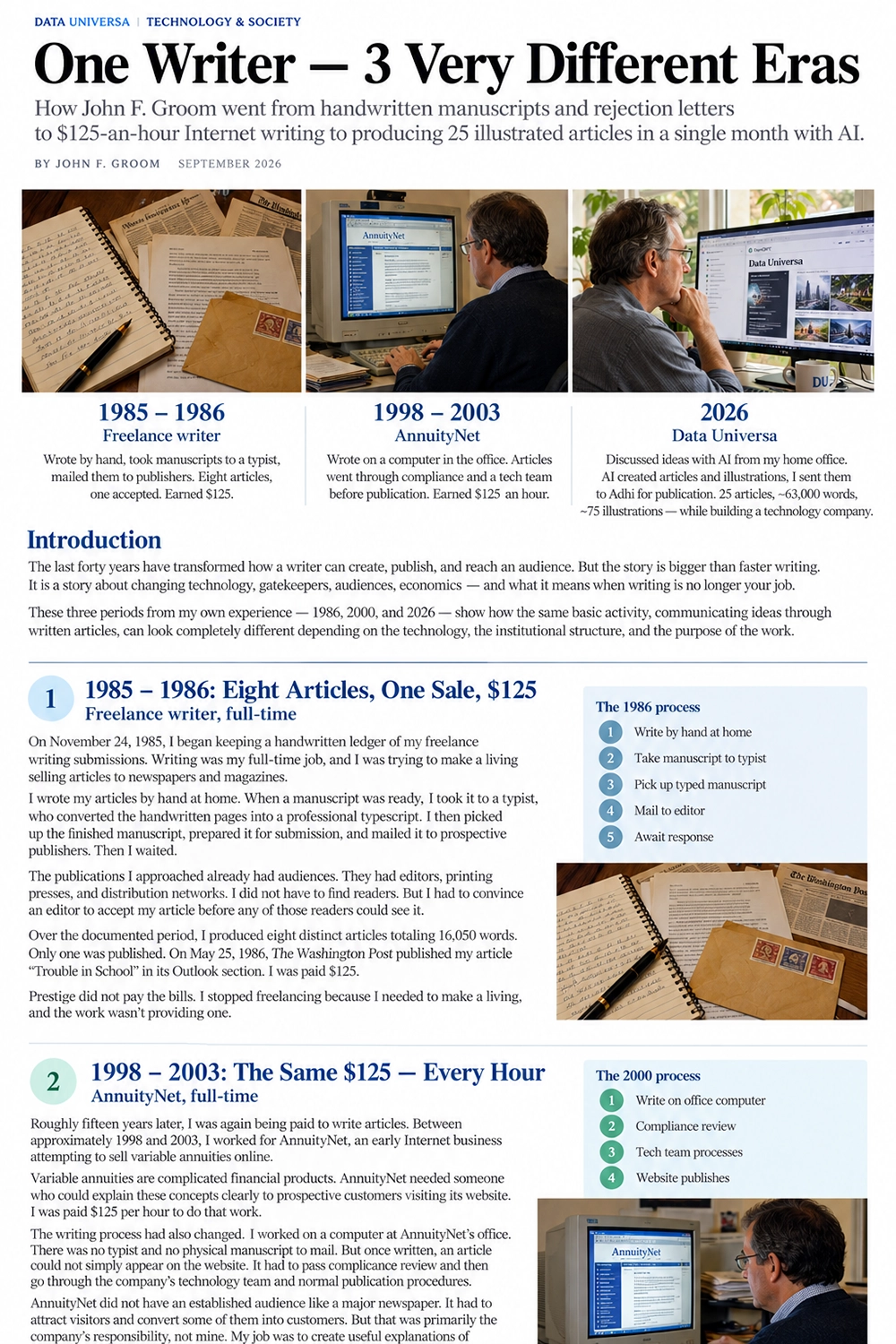
On November 24, 1985, John F. Groom began a handwritten record of freelance writing submissions. Around 2000, he wrote financial explanations for AnnuityNet. In September 2026, he published 25 illustrated articles on DataUniversa. The same person performed essentially the same intellectual activity in three radically different systems. Yet one difference dwarfs the others: in the first two eras, writing was his full-time job. In 2026, writing occupied very little of his time. His main work was building DataUniversa into what he hopes will be a major technology company.
1985–1986: Handwriting, a Typist, and the Post Office
Groom wrote articles by hand at home, physically took them to a typist, returned to pick up the typed manuscripts, and mailed them to newspapers and magazines. He tracked editors, submissions, rejections, acceptances, expenses, and payments in a handwritten ledger. Eight distinct articles totaled 16,050 words. Only one was published: “Trouble in School,” in The Washington Post Outlook section on May 25, 1986. He was paid $125.
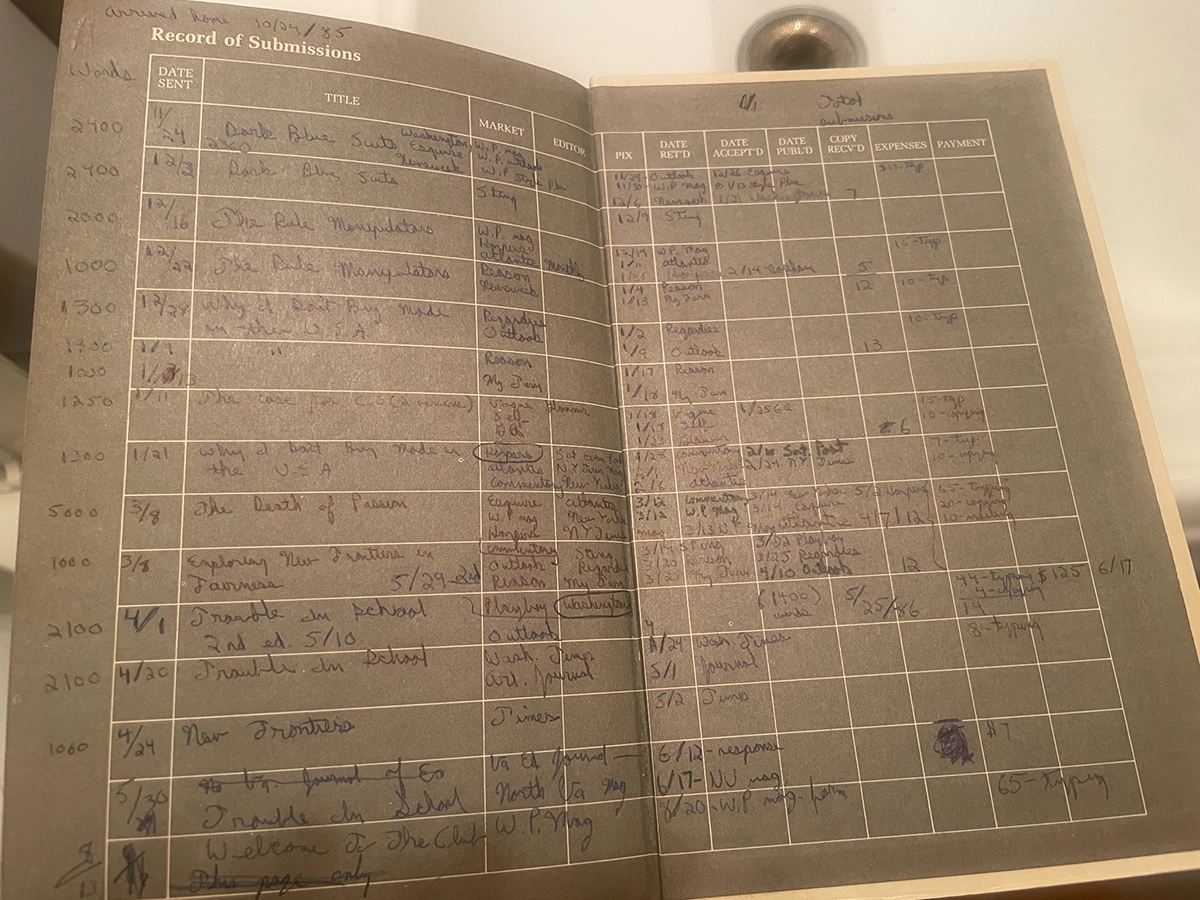
The publications already had audiences. Groom did not need to find readers; he needed an editor to grant him access to them. Publishers were simultaneously customers, gatekeepers, and distributors. He stopped freelancing because he needed to make a living and was unsuccessful. The prestige of publication in a major newspaper did not compensate for the many articles that earned nothing.
1998–2003: $125 an Hour at AnnuityNet
Roughly fifteen years later, Groom again wrote full-time, this time at AnnuityNet, an early Internet company seeking to sell variable annuities. He wrote explanations of financial concepts on a computer in the company office. His compensation was $125 an hour: one hour earned what his entire documented freelance effort had brought in.
The typist and postal mail were gone, but the articles still required compliance approval before going through the technology team's normal process for adding content to the website. Unlike the newspapers of 1986, AnnuityNet had to acquire its audience. But that was the company's job, not Groom's. The article was no longer itself the product for sale; it was a tool to help sell financial products.
September 2026: Twenty-Five Articles, but Writing Was Not the Job
Groom's principal occupation was building DataUniversa, developing technologies and market mechanisms for data, intellectual property, processes, and interoperability. Writing was a small side activity. From his home office, he discussed ideas with ChatGPT, which produced article drafts and illustrations. Groom directed and evaluated the results, then sent the finished articles to Adhi in Indonesia, who posted them directly to DU's website.
In September, DU published 25 articles. A rough extrapolation from recovered drafts suggests about 63,000 words and 75 illustrations. Topics included connected AI, economic displacement, adaptability, and a comparison of technological change in 1904 and 2026. These estimates need not be exact to make the point: nearly four times the entire 1985–1986 word count was produced in one month, while Groom spent comparatively little of his time on the writing. There was no outside editorial gatekeeper.
Who Found the Audience?
In 1986, the publications had readers, but editors controlled access. At AnnuityNet, the company needed to attract customers and readers, but Groom was not responsible for that. At DU, Groom and his team controlled publication and also had to find an audience. DU uses Google Ads to acquire visitors. Google has policies, pricing, and algorithms, but it is not an editor deciding whether DU may publish an article.
The bottleneck shifted over time. First, it was access to someone else's established audience. Next, it was a corporate publishing process within a company building its own audience. Finally, it was no longer production or permission, but earning attention for material that could be published immediately.
The Economic Structure Changed More Than the Skill
In 1986, Groom was selling articles and carrying the risk of rejection. At AnnuityNet, he was selling a writing service for a predictable hourly rate. At DU, the articles had no direct fee: they were intellectual and communication assets supporting a technology enterprise. They explained ideas, preserved arguments, built credibility, and could help develop interest in DU's larger systems.
The same underlying ability to communicate ideas therefore yielded $125 for one accepted article, $125 per hour for corporate writing, and a much larger volume of published material without direct article compensation. Ownership, distribution, gatekeeping, audience acquisition, and commercial purpose were at least as important as writing skill.
The Deeper Revolution
The first transformation removed physical friction: handwriting, trips to the typist, and the postal system. The second digitized production but retained institutional approval. The third shifted much of sentence construction and illustration to AI, leaving Groom to supply ideas, judgment, direction, and editorial choices. Adhi handled the final website posting.
This is more than increased productivity within a profession. AI allows a person to undertake substantial intellectual activities outside his principal occupation. In 1986 and 2000, Groom devoted his working life to writing. In 2026, he devoted it primarily to building a technology company, yet could still direct an extensive illustrated publishing program. The most consequential change was not simply that writing became easier. It was that writing no longer had to be his job.
Editorial note: 2026 word and image totals are approximate extrapolations, not audited counts.
Whether you're exploring interoperability, dataset valuation, AI readiness, or ecosystem participation, we welcome conversations with researchers, organizations, and strategic partners interested in the future of structured data systems.
info@datauniversa.com