Provenance and the Reversibility of Value
By John F. Groom
One of the most common misunderstandings about provenance is that it exists primarily to protect things that are already valuable. In reality, history suggests almost the opposite. Provenance matters because humanity repeatedly discovers that it was wrong about what was valuable in the first place. Objects, documents, ideas, and creative works that once appeared ordinary—or were even ignored or discarded—have often become priceless generations later. Provenance preserves the historical continuity that allows society to revisit those earlier judgments while retaining confidence that the objects being rediscovered are genuine.
This idea reveals a broader purpose for provenance. It is not simply a mechanism for authentication, nor is it reserved for rare works of art or famous historical artifacts. Instead, provenance preserves civilization's ability to continually reassess the significance of the past without losing confidence in what is authentic. Every generation evaluates the world according to its own priorities, but history repeatedly demonstrates that those priorities change. Provenance ensures that when they do, the evidence needed to support those new conclusions still exists.
Botticelli: Fame Lost, Value Preserved
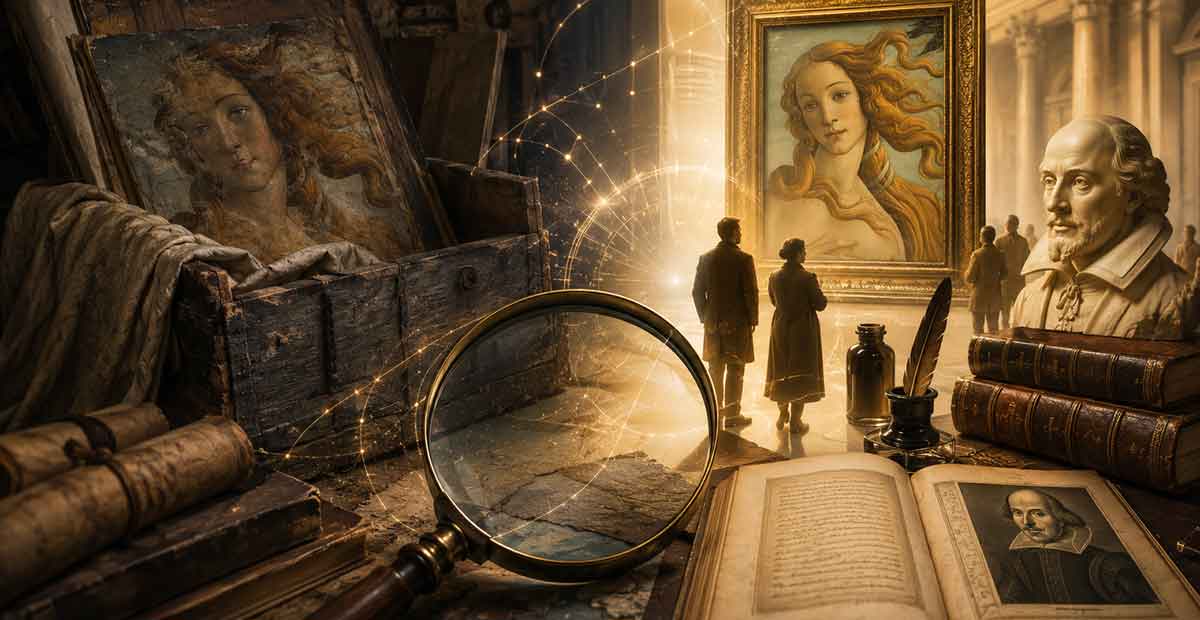
Few examples illustrate this more clearly than the career of Sandro Botticelli.
Today, paintings such as The Birth of Venus and Primavera rank among the most recognizable works in Western art, attracting millions of visitors to Florence every year. It is easy to assume that Botticelli was always regarded as one of history's greatest painters, yet the historical record tells a very different story. After the rise of Leonardo da Vinci, Michelangelo, and Raphael, Botticelli's artistic style gradually fell out of favor. By the time of his death in 1510, he had largely faded from prominence, and for centuries many of his paintings attracted relatively little scholarly attention.
What makes Botticelli remarkable is not simply that his reputation recovered.
It is that approximately 140 of his paintings survived long enough for that recovery to become possible.
Those works were not preserved because later generations already knew they would become masterpieces. They survived because they remained physically identifiable and connected to institutions, collections, and historical records that maintained their identities even during periods when Botticelli himself was no longer considered among the greatest artists of the Renaissance.
Centuries later, art historians reassessed his work and reached a different conclusion.
Because the paintings survived with their identities intact, Botticelli's reputation could be restored. Had that continuity been lost, many of those paintings might simply have become anonymous Renaissance works, disconnected from the artist who created them. Their historical significance was not created by provenance, but it could only be rediscovered because provenance preserved the connection between the objects and their authentic origins.
Shakespeare Was Not Yet Shakespeare
The same pattern appears in literature.
When William Shakespeare died in 1616, his plays were certainly appreciated, but they were not yet regarded as the untouchable cultural treasures they are today. The First Folio, published in 1623, was simply a printed collection of plays. Many copies disappeared over the centuries, some were damaged through ordinary use, and others were even broken apart because individual plays could be sold separately.
Few people at the time could have imagined that surviving First Folios would one day become some of the most valuable books in existence.
Their extraordinary value emerged centuries after they were printed.
That value depends not merely on the words they contain, but on provenance. We know which copies survived, where they have been, how they changed hands, and which ones are authentic. Because those histories were preserved, the world can confidently distinguish an original First Folio from every later reproduction, allowing future generations to recognize a value that earlier generations never anticipated.
The Future Rarely Values What the Present Values
The stories of Botticelli and Shakespeare are not unusual. They illustrate a pattern that has repeated throughout history.
Scientific notebooks that once sat forgotten in drawers later become foundational historical records. Personal letters become primary evidence for understanding entire eras. Early photographs evolve into national archives. Prototype machines become museum pieces. Original software source code, once viewed as little more than working documentation, becomes part of our technological heritage.
In nearly every case, the people living at the time could not accurately predict what future generations would consider important.
That uncertainty presents a fundamental challenge.
Every generation believes it understands what deserves to be preserved, yet every generation eventually discovers that some of its assumptions were incomplete. Objects dismissed as ordinary become extraordinary. Other things that once appeared immensely important gradually lose their significance. The problem is not that society makes poor decisions. Rather, it is that historical value changes as knowledge, culture, and perspective evolve.
This is why provenance should not be viewed as a system for protecting only today's most valuable objects.
It is a system for preserving tomorrow's opportunities for rediscovery.
Provenance as Reversible Valuation
Thinking about provenance in this way leads to a very different understanding of its purpose.
Traditionally, provenance is associated with authentication. It tells us where an object came from, who created it, who owned it, and how it moved through history. Those functions remain essential, but they are only part of the story.
Equally important is provenance's ability to preserve what might be called reversible valuation.
Every society assigns value according to the knowledge, priorities, and cultural assumptions of its own time. Future generations inevitably reach different conclusions. Provenance preserves enough historical continuity that those new judgments can still be attached to authentic people, authentic objects, and authentic events.
Without provenance, those future reassessments become far more difficult.
History is replaced by uncertainty.
Imagine discovering a Renaissance painting of extraordinary quality but having no reliable way to determine who created it. Imagine finding what appears to be one of Shakespeare's manuscripts without any evidence connecting it to Shakespeare himself. Imagine uncovering an early scientific notebook containing revolutionary ideas but possessing no reliable history establishing its origin or authenticity.
In each case, the object survives.
Its identity does not.
Provenance protects something more fundamental than current market value.
It preserves the ability for future generations to change their understanding of the past without losing confidence in what is genuine.
The AI Era Makes This Challenge Even Greater
Artificial intelligence dramatically expands both the scale and the urgency of this problem.
The cost of creating information is approaching zero. Every day billions of images, videos, conversations, software versions, engineering documents, scientific observations, datasets, and design iterations are generated around the world. Never before has humanity created so much information so quickly.
At first glance, the obvious response seems to be preserving only the things that appear valuable today.
History argues strongly against that approach.
Botticelli was once unfashionable.
The First Folio was once an ordinary printed book.
Scientific notebooks often remained unread for decades before their significance became apparent.
The same pattern may unfold throughout the AI era. Today's obscure training dataset, engineering notebook, medical observation, prototype model, software experiment, or independent creator's work may eventually become an essential historical artifact.
The difficulty, of course, is that we cannot identify those future artifacts in advance.
That uncertainty is precisely why provenance matters.
It allows us to preserve authenticated history without requiring perfect foresight about what future generations will value.
Provenance Is Insurance Against Our Own Ignorance
Viewed this way, provenance serves a very different purpose than most people imagine.
It is not simply a method of authenticating valuable objects after they have already become important. It is civilization's insurance policy against its own inability to predict the future. Rather than asking, "Which things deserve provenance?" we should be asking a different question: "Which things might one day become important enough that we would regret not having preserved their histories?"
History strongly suggests that the answer is much broader than our current systems assume.
Every generation overlooks people, ideas, discoveries, and creative works that later prove to be far more significant than anyone recognized at the time. The challenge is not that we consistently make poor decisions about value. The challenge is that value itself changes as knowledge expands, cultures evolve, and future generations ask different questions than we ask today.
The purpose of provenance, therefore, is not to predict which objects will become valuable.
It is to preserve the possibility that future generations can make those discoveries for themselves.
DataUniversa and Universal Provenance
This philosophy is one of the reasons DataUniversa treats provenance as a universal property rather than a feature reserved for rare or expensive objects.
Every authenticated object, dataset, observation, creative work, decision, or human activity carries the possibility that future generations will assign it a significance we cannot currently foresee. Most will never become historically important. Some inevitably will. The difficulty is that there is no reliable way to distinguish between them in advance.
Rather than attempting to predict future value, DataUniversa focuses on preserving authenticated identity and the relationships that give observations meaning. Every record remains connected to its origin, the evidence supporting it, the people involved, the context in which it was created, and the events that shaped its history. As those records evolve, their provenance evolves with them, ensuring that future knowledge remains connected to the observations from which it emerged.
This approach shifts the emphasis away from today's judgments about importance and toward something much more durable: preserving the evidence that allows tomorrow's judgments to remain trustworthy.
Authenticity Is Not Reversible
History repeatedly demonstrates that value is reversible.
Authenticity is not.
A forgotten artist can become celebrated centuries later. An overlooked scientific notebook can become a landmark of discovery. A discarded engineering prototype can become a museum piece. A little-known dataset can become foundational to future artificial intelligence research.
Those changes in value remain possible because authentic objects survived long enough to be rediscovered.
Once authenticity is lost, however, no future reassessment can recover it. A painting with no reliable identity can never be connected with certainty to the artist who created it. A document whose origin cannot be established becomes permanently separated from the historical context that gave it meaning. An observation without provenance may still exist, but its ability to contribute confidently to future knowledge has been fundamentally diminished.
This is why provenance ultimately preserves something more fundamental than value itself.
It preserves civilization's ability to continually rewrite its understanding of what matters without losing confidence in what is genuine.
That idea lies at the heart of DataUniversa's approach to provenance. The objective is not to decide what future generations should value, nor to preserve only the things we currently believe are important. Instead, it is to maintain the authenticated connections that allow future generations to discover value for themselves.
History has repeatedly shown that our understanding of importance changes.
Provenance ensures that when it does, authenticity does not.
Whether you're exploring interoperability, dataset valuation, AI readiness, or ecosystem participation, we welcome conversations with researchers, organizations, and strategic partners interested in the future of structured data systems.
info@datauniversa.com