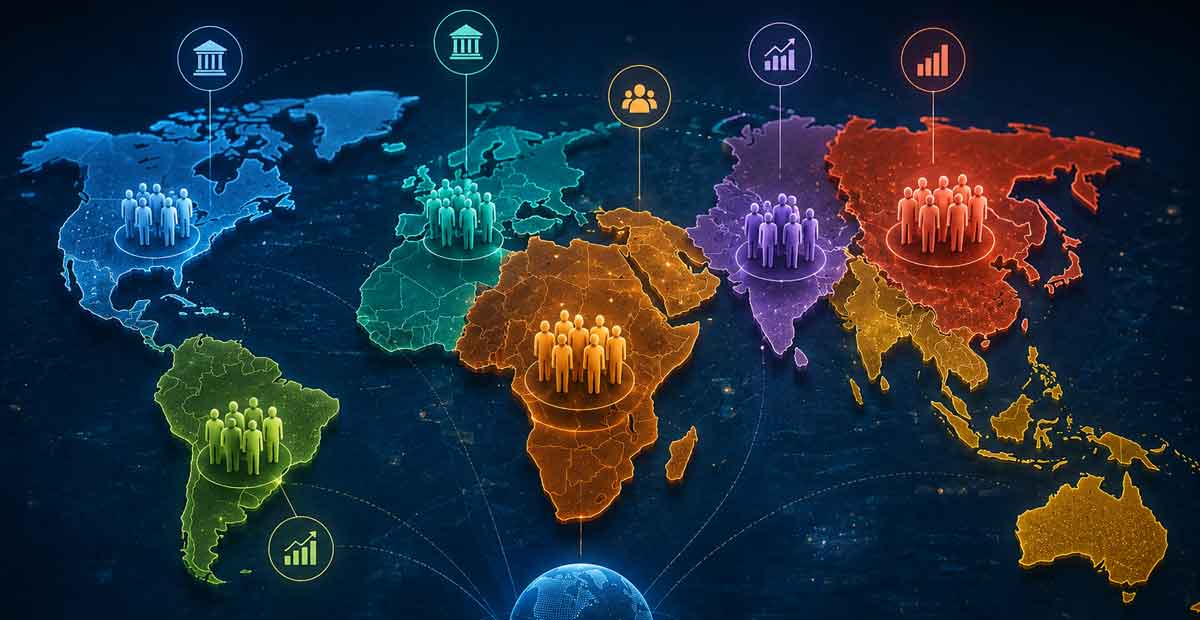
Rethinking Global Geographic Groupings for Data Analysis
By: John F Groom
Why DataUniversa Uses a Different Regional Framework
By John F. Groom, Founder, DataUniversa
Executive Summary
Most global organizations divide the world into geographic regions using historical or political conventions. Examples include the United Nations geoscheme, the World Bank regions, the World Health Organization regions, and continental groupings commonly used in education and the media.
These systems are appropriate for many purposes, particularly diplomacy, administration, and historical reporting. However, they are not necessarily the most useful framework for analyzing global human behavior, health, fitness, consumer activity, or large-scale data ecosystems.
DataUniversa therefore adopts a different regional framework. Our objective is not to reflect geography for its own sake, but to create groupings that maximize analytical usefulness while remaining simple enough for global reporting.
The Principle
The purpose of a classification system should determine its structure.
If the purpose is diplomacy, countries should be grouped politically. If the purpose is logistics, geography may dominate. If the purpose is economics, trade relationships may matter most. If the purpose is understanding human populations through large-scale data, neither political borders nor continents necessarily produce the most informative comparisons.
DataUniversa therefore groups regions according to a combination of:
- population scale
- institutional similarity
- economic characteristics
- cultural coherence
- practical analytical value
rather than geography alone.
The Problem with Continental Groupings
Traditional continental divisions are familiar but uneven.
For example:
- Europe contains approximately 740 million people.
- Africa contains approximately 1.6 billion.
- Asia contains over 5.8 billion.
Treating "Asia" as a single analytical unit combines countries as different as:
- China
- India
- Japan
- Indonesia
- Pakistan
- Bangladesh
- Vietnam
- Singapore
- Mongolia
These countries differ dramatically in:
- language
- religion
- political institutions
- healthcare systems
- economic development
- demographics
- technology adoption
- consumer behavior
As a result, many meaningful differences disappear inside an "Asian average."
Why India and China Stand Alone
India and China together account for roughly one-third of humanity.
Each possesses:
- more than 1.4 billion people
- unique languages
- distinct legal systems
- different political structures
- separate technology ecosystems
- independent economic trajectories
Neither country is simply another member of a broader Asian category.
Their scale alone justifies independent analysis.
In many datasets, variation within China or within India is greater than variation across many entire continents.
Why Africa Stands Alone
Africa is no longer a small developing region.
With approximately 1.6 billion people and the world's fastest population growth, Africa is becoming one of the defining demographic regions of the twenty-first century.
Combining African countries with Middle Eastern countries or dividing Africa into multiple reporting regions often obscures global comparisons.
For many health, fitness, demographic, and economic analyses, Africa deserves recognition as its own primary global unit.
Why the Anglosphere is Grouped Together
DataUniversa groups:
- United States
- Canada
- Australia
- New Zealand
into a single reporting region.
This is intentionally not a geographic grouping.
Instead, it reflects strong similarities in:
- legal traditions
- language
- healthcare systems
- educational systems
- consumer markets
- technology adoption
- research participation
- fitness culture
- regulatory environments
Although geographically separated, these countries often resemble one another more closely than they resemble neighboring countries.
For many forms of comparative analysis, institutional similarity provides more explanatory power than geographic proximity
Latin America as a Distinct Region
Mexico, Central America, South America, and the Caribbean share many characteristics that make them analytically useful as a single reporting region.
These include:
- related colonial histories
- dominant Romance languages
- similar demographic transitions
- regional trade relationships
- comparable health and development challenges
This grouping is more informative than splitting the region strictly by continent.
Europe
Europe remains a useful analytical region because of:
- extensive economic integration
- comparable levels of development
- common regulatory frameworks
- high research participation
- extensive cross-border mobility
Although culturally diverse, Europe functions as a relatively coherent statistical region for many global comparisons.
Middle East
The Middle East occupies a distinctive position because of shared geopolitical, cultural, religious, and energy-related characteristics.
Grouping these countries separately often reveals patterns that disappear when they are divided between Asia and Africa.
Other Asia
After separating India and China, the remaining Asian countries form a more coherent analytical category.
This includes:
- Japan
- South Korea
- Southeast Asia
- Pakistan
- Bangladesh
- Sri Lanka
- Nepal
- Central Asia
- Mongolia
Although diverse, these countries no longer compete statistically with two populations exceeding one billion each.
This allows regional averages to become substantially more meaningful.
Comparison with Conventional Systems
| System | Primary Principle | Advantages | Limitations |
| Continents | Geography | Familiar and intuitive | Asia becomes too large and internally diverse. |
| United Nations Geoscheme | Political geography | Standardized international reporting | Designed for administration rather than analytical similarity. |
| World Bank Regions | Development and lending | Useful for economic policy | Optimized for institutional programs, not global comparison. |
| WHO Regions | Public health administration | Effective for disease surveillance | Boundaries reflect organizational needs rather than population structure. |
| DataUniversa Regions | Analytical usefulness | Better reflects population scale, institutional similarity, and comparative behavior | Less familiar initially; requires explanation. |
Current Global Coverage
Regional assignment is based on nationality, not the location where data are collected.
For example, a Kenyan living in Canada remains part of the Africa region, while a Canadian participating in Kenya remains part of the Anglosphere Developed region.
The following statistics include all submissions currently contained within the GFF and DataUniversa databases, regardless of whether supporting video is available.
| Region | Countries in Your Dataset | GFF Standard | GFF Pro | LR |
| Anglosphere Developed | United States, Canada, Australia | 35 | 11 | 1704 |
| Latin America | Chile | 0 | 0 | 3 |
| Europe | England/United Kingdom, Netherlands, Serbia | 0 | 8 | 0 |
| Africa | Nigeria, Kenya, Uganda, Sudan, South Africa, Sierra Leone, Egypt, Eritrea | 1803 | 731 | 7006 |
| Middle East | Israel, Syria, Jordan | 0 | 3 | 0 |
| India | India | 758 | 351 | 3082 |
| China | China, Hong Kong* | 25 | 118 | 1448 |
| Other Asia | Indonesia, Thailand, Philippines, Taiwan, Laos, Maldives, Malaysia | 1125 | 320 | 464 |
DataUniversa Regional Framework
| Region | Approximate Population |
| Anglosphere Developed | ~415 million |
| Latin America | ~670 million |
| Europe | ~740 million |
| Middle East | ~500 million |
| Africa | ~1.6 billion |
| India | ~1.45 billion |
| China | ~1.40 billion |
| Other Asia | ~1.55 billion |
Design Philosophy
DataUniversa generally prefers classifications that maximize explanatory value rather than historical convention.
A classification is not "correct" because it has been used for decades. It is useful if it helps reveal meaningful differences, supports better prediction, and improves decision-making.
Our regional framework is therefore adaptive rather than fixed. As populations, economies, and institutions evolve, regional classifications may also evolve.
The goal is not to preserve tradition.
The goal is to organize information in the way that produces the clearest understanding of reality.
Conclusion
No geographic classification is objectively correct for every purpose. The optimal grouping depends on what one wishes to understand.
For diplomacy, existing international systems remain appropriate.
For large-scale human data analysis, however, treating India and China as independent analytical units, recognizing Africa as a demographic region of comparable scale, and grouping institutionally similar developed Anglosphere nations together produces a framework that is more balanced, more informative, and more useful for comparative analysis.
DataUniversa adopts this framework because it better reflects the structure of the populations and systems we seek to measure, rather than simply the geography they occupy.
Whether you're exploring interoperability, dataset valuation, AI readiness, or ecosystem participation, we welcome conversations with researchers, organizations, and strategic partners interested in the future of structured data systems.
info@datauniversa.com