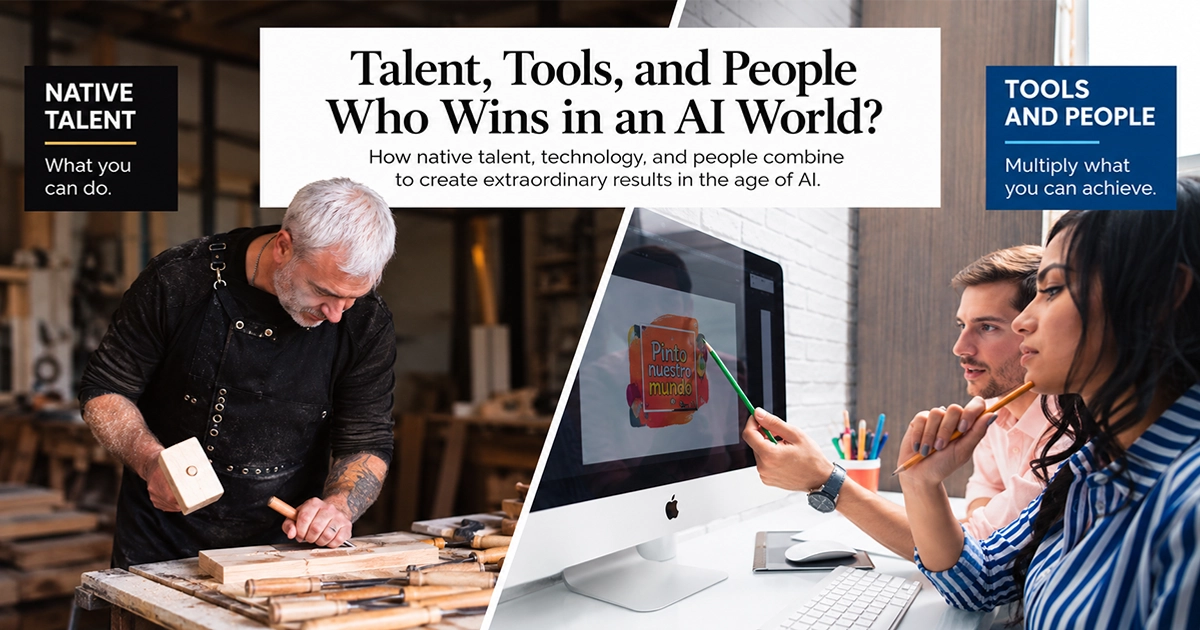
Talent, Tools, and People: Who Wins in an AI World?
By: John F Groom
Throughout history, some people have been vastly more productive than others. A few athletes perform at levels that millions of equally dedicated competitors cannot approach. Some scientists make discoveries that transform entire fields, while certain entrepreneurs build enterprises that accomplish more than organizations with vastly greater resources. Musicians, inventors, military leaders, and political figures sometimes achieve results that seem wildly disproportionate to their individual capabilities.
What accounts for these differences? Intelligence, determination, education, and luck all matter, but they do not adequately explain why certain individuals accomplish so much more than others.
A useful way to understand exceptional human productivity is to identify four distinct capabilities: native talent, the ability to use tools, the ability to organize and influence other people, and the ability to match these capabilities to the opportunities and constraints of the surrounding environment. These four capabilities have always mattered, but their relative importance has changed throughout history. The emergence of artificial intelligence is now transforming the first three at extraordinary speed, potentially making the fourth, the ability to recognize and exploit productive combinations of capabilities and circumstances, more important than ever.
The question is not simply who possesses the greatest talent, who has access to the best technology, or who commands the largest organization. Increasingly, it is who can recognize how these resources should be combined in a world where the possibilities are changing almost continuously.
1. Native Talent: What Can You Do?
The most direct source of exceptional productivity is an individual's own capabilities. Usain Bolt could run faster than almost anyone who has ever lived. A great singer possesses an unusual combination of vocal physiology, musical perception, and expressive ability. An exceptional mathematician may recognize relationships that other highly trained mathematicians cannot see. Some people possess extraordinary memories, physical coordination, imagination, aesthetic judgment, or interpersonal intuition.
These capabilities may be partly innate, partly developed through training, and frequently the result of interactions between the two. What matters is that the individual can perform at an exceptional level without depending primarily on technological or organizational leverage. Native talent has been important throughout human history. Before sophisticated tools and large organizations became available, it often determined the limits of what an individual could accomplish. The strongest hunter, the most skillful craftsperson, the most persuasive storyteller, or the most perceptive strategist could achieve advantages that others could not readily reproduce.
Even today, certain activities remain dominated by native capability. No amount of artificial intelligence can make an ordinary person run 100 meters as fast as an Olympic champion. Technology can improve training, equipment, and performance analysis, but the athlete's underlying physical abilities remain decisive.
Yet the economic value of native talent depends on the environment in which it is exercised. An exceptional singer living in an isolated community centuries ago might have been admired by a few hundred people. A similarly talented singer today can reach hundreds of millions through recording, broadcasting, and digital distribution. The underlying talent may be comparable, but the productive and economic possibilities are radically different.
Conversely, capabilities that were once scarce and valuable can become less economically important when technology makes their outputs easier to reproduce. This distinction between possessing a capability and realizing its productive value becomes especially important in the age of AI.
2. Tools: Multiplying Individual Capability
The second source of exceptional productivity is the ability to use tools. A person with a hammer can accomplish more than someone working with bare hands. A farmer operating a tractor can cultivate far more land than someone relying on manual labor. A mathematician with a computer can perform calculations that would otherwise require years of effort. But access to tools does not make everyone equally productive. Some people are unusually skilled at recognizing what tools can accomplish, learning how to use them, adapting them to unfamiliar purposes, or combining multiple technologies into more powerful systems.
Jimi Hendrix illustrates the interaction between native talent and technological leverage. His musical abilities were extraordinary, but his distinctive achievements depended heavily on the electric guitar, amplification, distortion, feedback, and recording technology. He recognized expressive possibilities in those tools that many equally experienced musicians had not discovered. The technology was available to others. Hendrix's advantage was not merely that he possessed it, but that he could combine it with his own capabilities in unusually productive ways.
Throughout history, major technological changes have repeatedly altered which combinations of native talent and tools are most valuable. The printing press expanded the productive reach of writers and publishers. Industrial machinery multiplied the output of skilled workers. Computers transformed the productivity of scientists, engineers, accountants, and designers. The internet dramatically reduced the cost of communication and distribution.
AI represents another major expansion of tool leverage, but with an important difference. Traditional tools generally extend human physical abilities, computational capacity, or access to information. AI increasingly performs activities previously regarded as distinctively cognitive, including writing, programming, analyzing, designing, reasoning through alternatives, and carrying out complex sequences of tasks.
A person using AI may accomplish work that previously required several specialists. Someone with modest programming ability can potentially build software that would once have demanded substantial technical expertise. A small research team can investigate possibilities that previously required a much larger organization. The implications extend beyond making existing tasks faster. AI can change which tasks individuals can realistically undertake at all. As AI capabilities continue to improve, the most productive individuals may not be those who are best at performing particular tasks unaided, but those who are best at determining which tasks should be delegated to technology, how the resulting outputs should be evaluated, and how different technological capabilities should be combined.
3. People: The Power of Human Leverage
The third source of exceptional productivity is the ability to persuade, motivate, organize, and coordinate other people. Much of human civilization has been built through this form of leverage. A military commander may achieve objectives that would be impossible for any individual soldier. An entrepreneur may assemble engineers, designers, financiers, manufacturers, and salespeople into an enterprise capable of creating products no single participant could produce independently. A political leader may persuade millions of people to support a common objective.
The exceptional capability is not necessarily technical expertise in the underlying work. It is the ability to bring together people with complementary skills and direct their efforts toward a coherent purpose. Steve Jobs did not personally perform most of the engineering, software development, manufacturing, or distribution required to create Apple's products. His contribution depended heavily on recognizing opportunities, assembling talented people, setting objectives, making consequential decisions, and maintaining coherence across extraordinarily complicated activities. Human leverage can produce enormous results because it allows individuals to mobilize capabilities they do not personally possess.
But it also introduces substantial costs. People must be recruited, trained, compensated, motivated, supervised, and coordinated. They may misunderstand objectives, disagree about priorities, or pursue competing interests. Large organizations develop administrative structures to manage these problems, sometimes becoming so complex that coordination consumes a substantial portion of their resources.
Historically, the ability to organize large numbers of people has therefore been a major competitive advantage. Access to capital, institutional authority, professional networks, and managerial expertise often determined who could undertake ambitious projects. AI may substantially change this relationship. If intelligent systems can perform increasing portions of the work traditionally assigned to human specialists, the number of people required to achieve a particular objective may decline dramatically. A small organization may become capable of producing outputs that previously required hundreds of employees. Individuals may coordinate networks of AI systems performing specialized tasks, while employing human contributors only where their capabilities remain particularly valuable.
This does not eliminate human leverage. It changes its character. Human relationships will continue to matter in establishing trust, exercising judgment, negotiating interests, developing ideas, motivating participation, and securing access to resources. But the most productive organizations may increasingly be distinguished by how effectively they combine human and artificial capabilities, rather than by the number of people they employ. The ability to coordinate people remains important, but the optimal number, composition, and roles of those people may change substantially.
4. Matching Capabilities to the Environment
The fourth source of exceptional productivity is the ability to recognize which capabilities are valuable in a particular environment and how they can most effectively be deployed. This includes recognizing one's own advantages, understanding the opportunities and constraints of the surrounding world, identifying useful tools, and determining which other people must be persuaded, recruited, or coordinated to accomplish an objective. It also includes recognizing when existing capabilities are insufficient and identifying which additional capabilities can realistically be acquired or developed. This is not simply strategic thinking or choosing worthwhile goals. It is the ability to match available and attainable capabilities to actual circumstances.
Consider someone with exceptional physical attractiveness. That person possesses a native characteristic that may provide advantages in modeling, entertainment, marketing, or other activities where appearance influences outcomes. But the productive value of that characteristic depends on the environment. An attractive individual living in a remote community without access to commercial media may have relatively few opportunities to capitalize on appearance. In a society with global digital distribution, that same individual might reach an enormous audience.
Even then, appearance alone is insufficient. The person must recognize the opportunity, select an appropriate market, use available technology, establish relationships, and persuade the relevant audiences or intermediaries. The exceptional capability lies in recognizing the realistic match between personal characteristics and external opportunities, then identifying the tools and human relationships necessary to exploit it.
The same principle applies to intellectual and creative abilities. An exceptional mathematician may find that theoretical research offers the best opportunity to exercise native talent in one environment, while quantitative finance, computer science, or AI development offers greater productive opportunities in another. A gifted organizer might be extraordinarily effective in a rapidly growing industry but achieve comparatively little in a mature organization where authority is rigidly distributed and opportunities for change are limited. A skilled craftsperson may prosper when demand for handmade goods is high, struggle when mass production becomes dominant, and discover new opportunities when consumers begin placing a premium on verified human craftsmanship.
The individual's capabilities need not change. What changes is the environment and the relationship between those capabilities and available opportunities. People who are exceptionally good at capability-environment matching recognize these relationships more accurately, often earlier than others, and act on them more effectively. They understand not only what they can do, but what is worth doing, what is realistically possible, and how the necessary combination of talent, tools, and people can be assembled.
5. Why the Rate of Change Matters
All four capabilities have always influenced human productivity. What changes during major technological transitions is their relative importance. In a stable environment, an individual can discover a productive combination of capabilities and spend decades improving it. A skilled professional may refine a particular method of working, a manufacturer may optimize a production process, or an entrepreneur may build an organization around an established business model. Over time, experience, accumulated knowledge, and established relationships reinforce the advantages of these arrangements.
In such circumstances, the ability to execute an existing approach exceptionally well may be more valuable than the ability to continually reconsider it. But rapidly changing environments create a different competitive dynamic. When technology changes, the economic value of native capabilities changes. New tools become available, existing tools become obsolete, and the most effective division of labor between people and machines shifts. Organizational structures that were once efficient may become unnecessarily expensive or cumbersome. As a result, combinations of capabilities that were highly productive only a few years earlier may become uncompetitive.
A professional who was exceptionally productive using traditional methods may be overtaken by someone with less native expertise but a better understanding of new technological possibilities. A large organization with highly skilled employees may be outperformed by a much smaller competitor that has developed a more effective combination of human and artificial capabilities. A business built around a scarce technical skill may discover that the skill is no longer scarce, while previously secondary capabilities such as judgment, customer relationships, creativity, or distribution become more important.
The critical advantage shifts toward the ability to recognize these changes and adapt. This suggests a general relationship: the more rapidly the productive value of talent, tools, and human organization changes, the more important the ability to match those capabilities to the environment becomes. There are limits to this proposition. Some environments change too unpredictably for accurate matching, and constant adaptation can itself become wasteful. But during sustained technological transitions, the ability to identify and implement new productive combinations can become extraordinarily valuable.
6. AI Changes All Three Inputs Simultaneously
What makes the current AI transition particularly significant is that it is changing all three traditional sources of productivity at the same time. Native capabilities are being revalued. Some intellectual skills that once commanded substantial premiums may become easier to reproduce with AI. Other human characteristics may become more valuable precisely because they remain difficult to automate or because AI makes it easier to exploit them at scale.
Tool leverage is expanding rapidly. Individuals can access increasingly sophisticated capabilities without making comparable investments in education, equipment, or specialized staff. Human leverage is also changing. Activities that once required recruiting and coordinating multiple specialists may increasingly be performed by AI systems, while human contributors concentrate on areas where their participation creates the greatest value.
These changes interact. A new AI capability may reduce the value of a particular native skill, eliminate the need for certain employees, create opportunities for new products, and increase the value of entirely different human capabilities. The consequences cannot be understood simply by asking which jobs AI will replace. The more useful question is how AI changes the optimal combinations of human abilities, technology, and organizational resources required to accomplish different objectives. And because these combinations are changing so quickly, the answers that are correct today may not remain correct for long.
7. Why Previous Success Can Become a Disadvantage
One of the paradoxes of major technological transitions is that people who have been exceptionally successful under existing conditions may be particularly reluctant to adapt. Their success often depends on having discovered and refined a highly productive combination of capabilities. They have invested years developing expertise, acquiring tools, establishing relationships, and building organizations around that combination. Changing it may require abandoning investments that have previously generated substantial rewards.
An accomplished programmer may resist delegating work to AI because programming expertise has been central to their professional identity and success. An executive who has built a large organization may be reluctant to consider that many of its functions could be performed with fewer people. A professional services firm may hesitate to adopt technologies that undermine the traditional relationship between employee hours and revenue.
These responses are understandable. Existing capabilities and organizational structures represent accumulated investments, and new technologies frequently fail to deliver their promised benefits. But there is a difference between appropriately questioning a new technology and assuming that previously successful arrangements will remain optimal.
During periods of rapid change, the ability to recognize when an established advantage is losing value becomes especially important. The most adaptable individuals are not necessarily those who abandon old methods most quickly. They are those who can accurately determine which established capabilities remain valuable, which should be augmented, and which should be replaced. Successful adaptation requires realism rather than enthusiasm for novelty.
8. AI May Also Democratize the Ability to Match Capabilities
AI is not merely changing the capabilities that people must match to their environments. It can also help them perform the matching itself. Historically, recognizing productive opportunities required knowledge, experience, access to information, and often an extensive network of knowledgeable people. Someone considering a new business might need to consult technical specialists, market researchers, lawyers, accountants, and experienced entrepreneurs before understanding whether the opportunity was realistic.
AI can increasingly assist with many of these activities. An individual can describe their skills, resources, interests, and constraints, then use AI to investigate possible opportunities, evaluate alternatives, estimate requirements, identify missing capabilities, and develop preliminary plans. AI can help identify technologies that complement existing skills, suggest potential collaborators, compare production methods, and explore how changes in the environment affect the attractiveness of different objectives.
This assistance is not infallible. AI can misunderstand circumstances, overestimate feasibility, overlook important constraints, and produce persuasive but inaccurate assessments. Real-world experimentation and independent verification remain essential. Nevertheless, the cost of exploring possible combinations of capabilities and opportunities is falling substantially.
That could be especially consequential for people who possess useful talents but lack the experience, information, or social connections necessary to recognize how those talents might be productively employed. Someone in a developing country with limited access to formal employment may be able to identify opportunities to serve international markets. An older professional may discover that decades of specialized knowledge can be combined with AI to create services that were previously impractical. A person with modest technical skills but strong organizational abilities may find that AI allows them to coordinate projects that once required substantial capital.
In each case, the technology may help bridge the gap between possessing capabilities and recognizing how to exploit them. The opportunity is not simply to make people better at their existing activities. It is to help them discover activities for which their particular combination of characteristics and circumstances provides an advantage.
9. Who Wins in an AI World?
The answer is unlikely to be a single type of person. Exceptional native talent will remain valuable, particularly where human abilities are difficult to reproduce or where authenticity, originality, and human participation matter. Exceptional tool users will benefit from AI's expanding capabilities, especially if they can integrate multiple systems and apply them to increasingly complex objectives. Exceptional organizers will continue to create value by bringing together people, resources, and institutions, although the structures and scale of their organizations may change.
But during a period of rapid technological change, people who excel at matching capabilities to the environment may enjoy an unusually large advantage. They need not possess the highest intelligence, the strongest technical skills, the greatest wealth, or the largest organizations. Their advantage lies in understanding what they and others can realistically accomplish under current conditions, recognizing when those conditions change, and identifying more productive combinations of available capabilities.
They may discover that a native talent previously considered unimportant has suddenly become valuable. They may recognize that an emerging tool makes a previously impossible objective feasible. They may see that a project once requiring a large organization can now be undertaken by a small team, or that a new opportunity requires assembling a very different combination of people. Just as importantly, they may recognize when a seemingly attractive opportunity is unrealistic given the capabilities and resources available.
This ability is not confined to entrepreneurs or technological specialists. It applies to individuals making career decisions, students choosing what to learn, professionals adapting their practices, artists developing new forms of expression, and organizations deciding how to allocate resources. It also suggests that education and professional development should place greater emphasis on understanding capabilities in context, rather than concentrating almost exclusively on developing isolated skills. Learning to perform a task remains valuable. Learning to determine when, why, and how that task should be performed, and by whom or by what, may become increasingly important.
10. From Exceptional Individuals to Exceptional Combinations
The history of human productivity is often presented as the history of exceptional individuals: great inventors, scientists, entrepreneurs, artists, and leaders. But exceptional results frequently emerge from combinations rather than isolated abilities. A talented scientist becomes extraordinarily productive when equipped with appropriate instruments and supported by capable collaborators. A gifted musician reaches a global audience through recording and distribution technologies. An entrepreneur combines a market opportunity with technology, capital, and specialized human contributions.
The individual remains important, but the scale of the achievement depends on the productive arrangement of multiple capabilities. AI makes these combinations more varied, more accessible, and potentially more powerful. It also makes them less permanent. The tools available next year may substantially exceed those available today. The number and type of people required for a project may change. Skills that once provided competitive advantages may become commonplace, while other abilities acquire unexpected value. In this environment, exceptional productivity may depend increasingly on the ability to continually reconstruct the relationship between talent, tools, people, and opportunity.
This does not mean that native talent, technological proficiency, or organizational ability become unimportant. On the contrary, they remain the fundamental sources of productive capacity. What changes is the premium placed on understanding how those sources should be combined. For much of history, exceptional productivity has been associated with doing something unusually well, possessing superior tools, or commanding the efforts of other people. Those advantages will persist. But in an AI world, the greatest winners may increasingly be those who recognize, earlier and more accurately than others, which combination of talent, tools, and people makes sense in the environment that exists now, not the environment in which they originally learned to succeed.
Whether you're exploring interoperability, dataset valuation, AI readiness, or ecosystem participation, we welcome conversations with researchers, organizations, and strategic partners interested in the future of structured data systems.
info@datauniversa.com