Technology Built the City. The City Built Technology.
By: John F Groom
For most of human history, cities were small. Humans began forming settlements that we would recognize as urban thousands of years ago. Jericho was occupied by roughly 9000 BCE, and cities such as Uruk emerged in Mesopotamia several thousand years later. Yet after roughly 10,000 years of increasingly sophisticated urban life, humanity had produced remarkably few truly enormous cities.
By around 1850, only a handful of cities could plausibly be placed at or above the extraordinary threshold of one million inhabitants. London, by then the world's dominant industrial metropolis, had well over two million people. Beijing had been one of the world's largest cities for centuries and was generally estimated to have more than one million inhabitants around this period. Paris was approaching or passing the million-person level, while Constantinople, now Istanbul, may also have been around that size, although its population is considerably more uncertain.
The exact list depends on how a "city" is geographically defined and on the necessarily imperfect population estimates available for the nineteenth century. But the larger point does not depend on whether the correct number was three, four, or five. After thousands of years of urban civilization, million-person cities were still exceptional.
Today there are more than 500. That extraordinary change roughly tracks another transformation: the acceleration of technology. This is not simply a coincidence. Technology and urbanization are not independent trends that happened to develop at the same time. They form a reinforcing dynamic. Technology makes larger and more complex cities possible, while larger and more complex cities accelerate the creation and adoption of technology. Technology builds cities. Cities build technology.
Why Didn't Ancient Cities Just Keep Growing?
Consider the problem from the perspective of ancient Rome, Chang'an, Baghdad, or Tenochtitlan. Suppose another 100,000 people wanted to move into the city. Where would their food come from? How would it get there? Where would they obtain clean water? Where would their waste go? How would they travel through crowded streets? How would information move across the city? How would governments administer them? And what would happen when an infectious disease entered such a densely populated environment?
These weren't abstract problems. They imposed physical limits on urban growth. A million people consume an enormous quantity of food every day. For most of history, agriculture relied overwhelmingly on human and animal power. Food was transported by people, carts, pack animals, and boats. Transportation was expensive and slow, while much food spoiled quickly.
A city therefore depended heavily on the productivity of the surrounding countryside and on whatever waterways happened to be available. Technology gradually broke those constraints.
First, Produce More Food
Agricultural improvements allowed fewer farmers to produce food for more people. Mechanization eventually transformed that relationship. Tractors, harvesters, artificial fertilizers, irrigation systems, improved plant varieties, pesticides, and increasingly sophisticated agricultural science enormously increased agricultural productivity.
This produced two effects simultaneously. Farmers could feed much larger urban populations, while fewer people were required to remain on farms. Millions of people were therefore freed to move into cities at exactly the time agriculture became increasingly capable of feeding them there.
The growth of cities was not simply a matter of people deciding to leave the countryside. It depended on an agricultural system capable of supporting a growing population with a progressively smaller share of the workforce.
Then Move the Food
Producing the food wasn't enough. It still had to reach the city. Here technology intervened again. Canals dramatically reduced transportation costs. Railroads connected agricultural regions to urban markets. Steamships moved food internationally. Refrigerated railcars and ships allowed meat, dairy products, and produce to travel distances that would previously have been impractical.
Later came trucks, highways, containerization, commercial aviation, and enormous logistics networks. A resident of modern London can eat grapes from South Africa, avocados from Peru, coffee from Colombia, and rice from India. The geographic area effectively supporting London is no longer the countryside surrounding London. It is much of the planet.
Water In. Waste Out.
Another fundamental constraint was sanitation. Dense concentrations of humans produce dense concentrations of human waste. Nineteenth-century cities demonstrated the consequences dramatically. Cholera and other diseases could sweep through crowded populations, and London suffered devastating cholera outbreaks, including major epidemics in 1848 to 1849 and 1853 to 1854.
Technology changed the equation again. Municipal sewer systems, water filtration, chlorination, and modern plumbing eventually made it possible to provide enormous populations with relatively safe water while removing their waste.
Medicine and public health improved as well. Cities that had once been unusually dangerous places to live could become relatively safe ones. Another constraint on urban size had been weakened.
Build Up Instead of Out
There was also a simple geometric problem. If everyone lives in a two- or three-story building, accommodating millions of people requires enormous amounts of land. Steel-frame construction changed that. But tall buildings created another problem. People could not conveniently walk up 30 or 50 floors.
The elevator helped solve it. Electricity made high-rise buildings much more useful. Electric lighting made enormous indoor workplaces practical. Pumps moved water upward. Eventually, air conditioning made high-density development practical even in extremely hot climates.
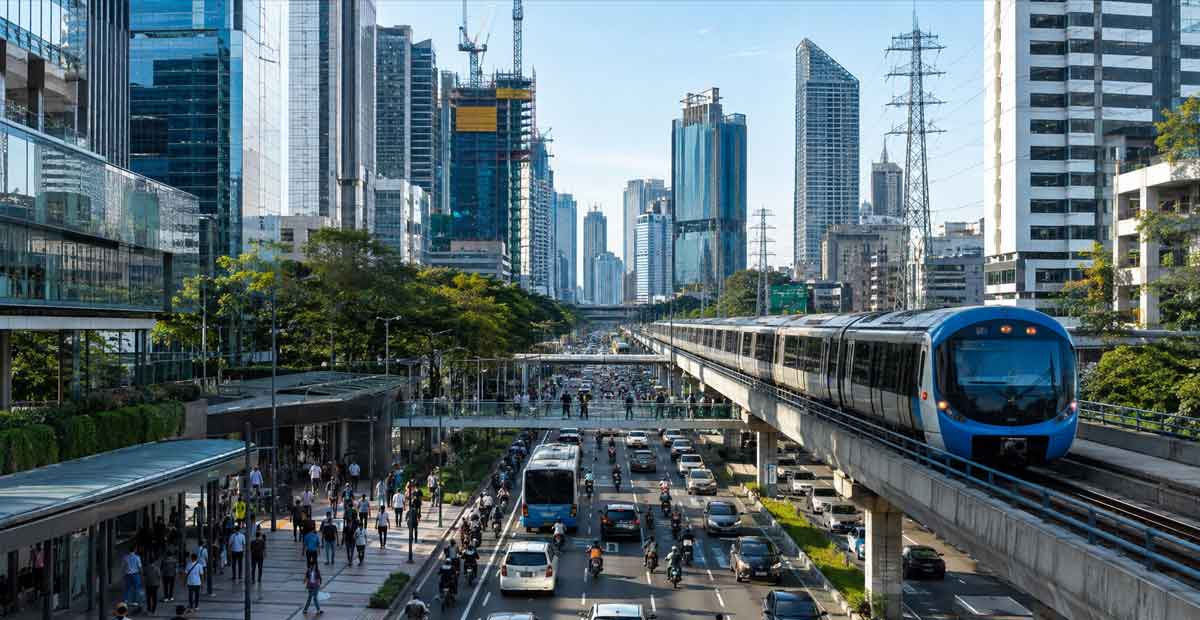
The modern skyline is therefore not the result of a single invention. It is the visible consequence of multiple technologies interacting. Remove steel, elevators, electricity, pumps, and modern water systems, and the skyscraper largely ceases to work.
Moving Millions of People
A million people also have to move. Walking works remarkably well for a small city. It does not work nearly as well when someone's workplace is 15 miles from home. Railways expanded the practical radius of cities. Streetcars extended it further. Subways allowed enormous numbers of people to move through dense urban centers without occupying additional surface space.
Then came automobiles, buses, highways, and commuter rail. The physical city could expand because transportation technology expanded the distance across which people could realistically participate in it. A "city" increasingly became not simply a collection of buildings, but a network connected by transportation technology.
Communicating Across the City
The same problem existed for information. Managing a village requires relatively little communications infrastructure. Managing millions of people, thousands of businesses, government agencies, hospitals, transportation networks, and financial institutions requires something very different.
The telegraph accelerated information. The telephone allowed immediate person-to-person communication. Radio and television created mass communication. Computers allowed enormous organizations to process information. The internet connected virtually everything. The smartphone put that network into the pocket of nearly every urban resident. The technological infrastructure underneath a modern city is therefore almost unimaginably complicated. But something else was happening.
Cities Started Building Technology
If the story ended with technology enabling larger cities, we could simply say: Technology caused urbanization. But that isn't what happened. The causation began running in the opposite direction as well. Cities became extraordinarily effective environments for producing new technology. Consider what happens when you put a million people together.
An inventor can find an engineer. The engineer can find a machinist. The machinist can find a supplier. The entrepreneur can find employees. The company can find customers. The scientist can meet another scientist working on a related problem. The investor can encounter the inventor.
The worker who learns something at one company can leave and take that knowledge to another. A specialist working in an extremely narrow field can find enough customers or employers to make specialization economically viable. And all of them encounter ideas they otherwise might never have encountered. Cities don't merely concentrate people. They concentrate interactions.
London Shows the Feedback Loop
London around 1850 is an especially useful example because it was simultaneously a product and a producer of the Industrial Revolution. Industrial technology helped London grow. But London also concentrated capital, engineers, merchants, scientists, manufacturers, workers, publishers, financial institutions, and international trade.
Those concentrations helped finance, improve, commercialize, and distribute additional technologies. Better technology made London larger. A larger London created more opportunities for technological development. The process reinforced itself.
The Loop
The basic mechanism therefore looks something like this: Better technology → greater agricultural productivity → better transportation → larger sustainable populations → larger cities → greater specialization → more interactions among skilled people → faster innovation → better technology And then the cycle begins again. Once such a feedback loop becomes sufficiently powerful, change doesn't merely continue. It accelerates.
From Four to More Than 500
This is why the million-person-city comparison is so revealing. Humanity spent something on the order of 10,000 years developing urban civilization before reaching a world in which perhaps four cities, London, Beijing, Paris, and Constantinople, could plausibly be described as million-person cities around 1850.
Then, in roughly 175 years, humanity went from about four to more than 500. That is an increase of well over 100-fold. World population grew enormously during that period, but nowhere near 100-fold.
Something more fundamental happened. Humanity became dramatically better at organizing large numbers of people in small geographic areas. Technology made that possible. But those enormous concentrations of humans then helped produce still more technology.
Now the Relationship May Be Changing Again
For thousands of years, there was another constraint that we rarely think about: To bring minds together, we generally had to bring bodies together. If you wanted access to specialized knowledge, capital, sophisticated manufacturing, unusual skills, or large markets, it helped enormously to be in places such as London, Paris, New York, Tokyo, or, much later, Silicon Valley and Shenzhen.
Geographic density created intellectual density. The internet began breaking that connection. An engineer in Nairobi can collaborate with a programmer in Bangalore, a designer in Bali, and an investor in Virginia without any of them moving.
AI potentially takes this much further. A person living in a small town can increasingly obtain immediate access to programming assistance, translation, scientific information, legal information, design capabilities, tutoring, and analytical capacity that once required proximity to many different specialists.
The important measure of concentration may therefore gradually shift from: people per square mile toward: useful intelligence accessible per person. That would be another profound technological change.
The City as a Technology
We normally think of technologies as things: the steam engine, automobile, telephone, computer, or AI. But the city itself can be understood as a kind of technology. It is a system humans developed for increasing the number and variety of interactions among people. For most of history, the effectiveness of that system was severely constrained by food, transportation, disease, sanitation, construction, energy, and communications.
One by one, other technologies weakened those constraints. Cities became larger. Larger cities created more interactions. More interactions generated more ideas, specialization, capital formation, and experimentation.
Those produced better technologies. And better technologies allowed still larger cities. That is why the history of technology and the history of urbanization roughly track each other. They aren't two independent stories. They are parts of the same reinforcing system.
Humanity spent thousands of years getting to its first handful of million-person cities. It needed less than two centuries to produce the next 500. The most interesting question now is whether AI and global digital connectivity are beginning another phase of the same process, one in which the productive density once created primarily by cities can increasingly exist everywhere.
Whether you're exploring interoperability, dataset valuation, AI readiness, or ecosystem participation, we welcome conversations with researchers, organizations, and strategic partners interested in the future of structured data systems.
info@datauniversa.com