The Accidental Digital Landlords: How Tiny Countries Came to Own Pieces of the Internet
By: John F Groom
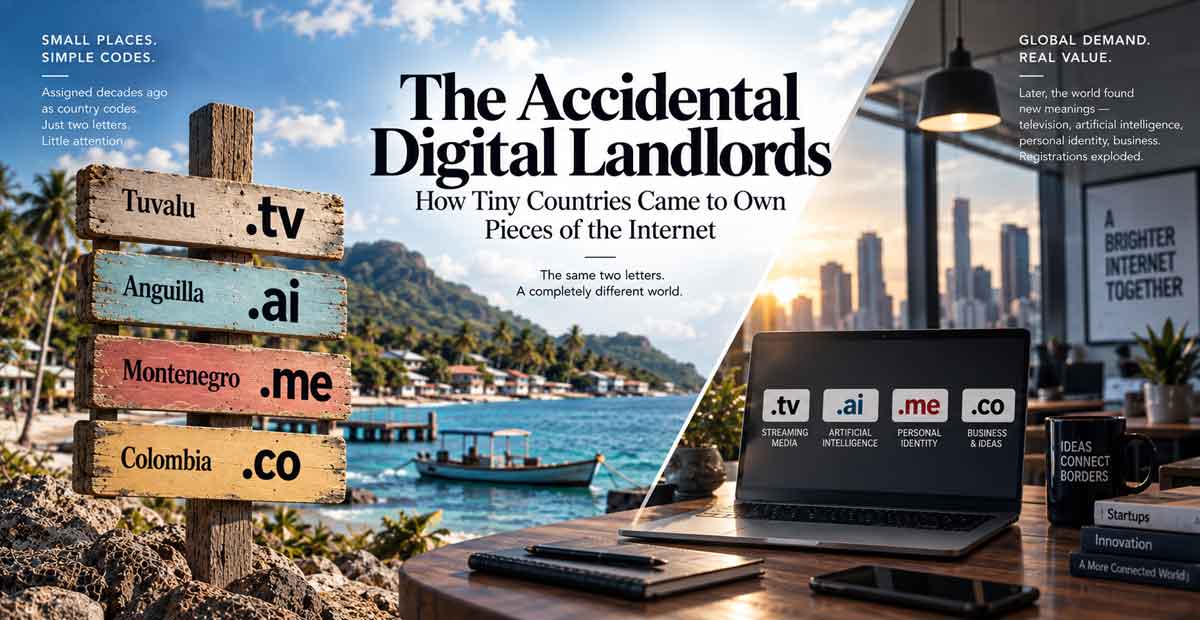
Some of the most valuable pieces of Internet real estate were not invented by technology companies, purchased by venture capitalists, or created by governments pursuing sophisticated digital strategies. They were assigned decades ago as administrative abbreviations. Tuvalu got .tv. Anguilla got .ai. Montenegro got .me. Colombia got .co.
At the time, these were simply country codes. Today, some have become globally valuable digital assets because the world subsequently discovered entirely different meanings for the same two letters.
The story is interesting in itself, but it also illustrates a larger principle about technology and value: an asset can exist long before anyone understands what the asset is worth. Technology can create enormous value simply by changing the environment surrounding something that already exists.
The Internet Needed an Address Book
Every website ultimately needs to be located. Computers accomplish this through numerical Internet Protocol addresses, but numbers are inconvenient for humans. The Domain Name System created a hierarchical naming system that allowed people to use names instead.
At the highest visible level are top-level domains, or TLDs. There are now roughly 1,500 of them. Some are generic, such as .com, .org, .net, .app, .shop, and .tech. Others are country-code top-level domains, usually consisting of two letters, such as .uk for the United Kingdom, .de for Germany, and .jp for Japan.
The country codes were not primarily designed as brands. The Internet's country-code system drew upon the two-letter codes established under the ISO 3166 standard. That produced some extraordinary accidents.
Tuvalu, a tiny Pacific island country, happened to have the code TV. Anguilla, a small British Overseas Territory in the Caribbean, happened to have AI. Colombia had CO. Montenegro, after becoming independent in 2006, received ME.
Nobody had to invent those combinations as Internet marketing concepts. Geography and an administrative coding system had already done it. Then technology changed what the letters meant.
Tuvalu Accidentally Owned Television
The abbreviation "TV" had meant television long before the Internet became commercial. When .tv became Tuvalu's Internet country code, therefore, the potential secondary meaning was relatively easy to recognize. What was much harder to foresee was how valuable Internet domain names themselves would become.
As commercial activity moved online, a domain name became more than a technical address. It became branding, identity, and marketing. A television network, video company, streaming service, or individual creator could immediately communicate something by putting .tv after its name. Tuvalu had therefore acquired something peculiar: a globally meaningful digital resource whose value had little relationship to Tuvalu itself.
A company registering something.tv did not need to operate in Tuvalu. Its customers did not need to live there. Its servers did not need to be there. Indeed, a .tv website could be hosted in Virginia, Singapore, or Frankfurt and have essentially no technical relationship with Tuvalu during the ordinary processing of a user's visit. Tuvalu's valuable asset was the name.
Then Anguilla Won the Lottery
Anguilla's case is even more striking. Artificial intelligence was certainly not unknown when .ai was delegated in 1995. The academic field was already about forty years old. But almost nobody could have predicted what those two letters would mean commercially thirty years later.
For years, .ai was simply the country-code domain for a small Caribbean territory with a population of roughly 15,000 people. Then artificial intelligence exploded. Machine learning became commercially important. Generative AI arrived. Thousands of startups wanted to identify themselves instantly as AI companies. Investors, developers, and consumers all understood the abbreviation.
Suddenly .ai was not merely Anguilla. It was artificial intelligence. The territory had not developed the large language model. It had not manufactured GPUs. It had not built a Silicon Valley venture-capital ecosystem. It had not predicted the generative AI revolution in 1995.
It simply possessed two letters that the revolution suddenly wanted. Registrations subsequently exploded, and .ai domain revenue became significant enough to represent a remarkable source of public revenue for such a small territory. This is technological value creation in an unusually pure form. The asset barely changed. The world surrounding the asset changed enormously.
Montenegro Got "Me"
Montenegro provides another version of the same phenomenon. After Montenegro became independent in 2006, its country code became ME, and .me was subsequently established as its Internet domain. When registrations were opened internationally in 2008, the obvious English-language interpretation became part of its appeal.
.me could mean the individual. about.me, contact.me, join.me. That became particularly useful as the Internet became increasingly personal. Social media, personal profiles, creator businesses, and individualized services all made "me" a meaningful digital concept.
And it may become more meaningful still. An Internet increasingly populated by personal AI agents, personal data stores, individualized software, and persistent digital identities makes .me almost uncannily appropriate. Montenegro did not have to predict that development. It merely had to possess the namespace when the environment evolved around it.
Colombia Had a Near-Miss With .com
Colombia's .co illustrates another form of linguistic luck. To a computer, .co is Colombia's country-code domain. To a human, however, "co" naturally suggests "company," "corporation," or simply a shortened version of .com. That makes it commercially useful far beyond Colombia.
The difference between .co and .com also demonstrates the peculiar structure of Internet property. .com isn't the country code of some extraordinarily fortunate country called "Commercial." It is a generic top-level domain. .ai, .tv, .me, and .co, by contrast, exist because particular countries or territories received those letter combinations. That historical distinction now has substantial economic consequences.
The Websites Don't Even Have to Be There
Perhaps the strangest aspect of the entire arrangement is that controlling the namespace does not mean processing the traffic. Suppose an American AI company operates example.ai. Its DNS and security services might be provided by Cloudflare. Its application might run on Amazon Web Services. Its servers might be located in Northern Virginia. Its customers might overwhelmingly be American and European.
Someone entering example.ai does not send all of that website traffic to Anguilla and then wait for Anguilla to send it back. Anguilla controls an important part of the naming hierarchy. It does not need to provide the computational infrastructure underneath every .ai website.
The distinction is fundamental. The registry controls scarcity. Other people provide the computation. That makes a successful country-code domain a remarkably capital-light asset. The country does not have to construct a factory for every customer. It does not have to manufacture another .ai every time somebody buys one. It does not have to process all of the customer's business.
It controls the right to issue names within a finite and desirable namespace. This resembles land in one important respect. The value of a Manhattan address does not arise primarily from the physical ink used to write the address. It arises because many people want to occupy a scarce location. Internet namespaces manufacture a digital version of location.
About 1,500 Neighborhoods at the Top of the Internet
There are roughly 1,500 top-level domains in today's Internet root, including hundreds of country-code domains and more than a thousand generic domains. But they are emphatically not equally valuable. Technically, many can perform essentially the same function. Semantically, they are completely different.
company.com, company.ai, company.tv, and company.me can ultimately point toward exactly the same servers. They can deliver exactly the same bytes. Their underlying websites can perform exactly the same calculations. Yet humans interpret them differently.
That difference is valuable because human meaning has been layered on top of technical interchangeability. This is an important recurring feature of technology. Engineers naturally concentrate on functional differences. Markets frequently assign enormous value to semantic differences.
Value Can Arrive After the Asset
There is a broader lesson here. We usually imagine asset creation occurring in a straightforward sequence. Someone recognizes a need, invents something to satisfy it, builds the asset, and then captures the resulting value. But sometimes the sequence runs backward. Asset first. Value later. Anguilla possessed .ai before generative AI existed. Tuvalu possessed .tv before streaming video transformed Internet media. Montenegro possessed .me before today's emerging world of individualized AI systems. The asset was waiting for its use case.
This happens outside domain names as well. Land beside an obscure road becomes immensely valuable when a highway interchange appears. Mineral rights that were nearly worthless become valuable after a new extraction technology is developed. Spectrum once considered undesirable becomes strategically important when communications technology changes. A dataset collected for one purpose can become enormously valuable when AI makes previously impossible analysis practical.Nothing magical necessarily happened to the underlying asset. Something happened to everything around it.
Technology Constantly Reprices the Past
This suggests a useful way to think about technological revolutions. We naturally look forward and ask what new things the technology will create. But transformative technologies also look backward. They continuously reprice things that already exist. AI is doing this now.
Old archives can become training data. Previously unimportant human observations can become ground truth. Proprietary datasets can become strategic resources. Electrical capacity near data centers can become dramatically more valuable. Skills that were difficult to scale can become scalable when combined with AI. Conversely, assets and capabilities that once commanded premiums can rapidly lose them.
Anguilla's .ai is simply an unusually clean demonstration because almost all the variables disappear. A tiny Caribbean territory was assigned two letters. For decades, they meant relatively little economically. Then the world changed.
The letters did not. Their value did. That is one of technology's least appreciated powers. Innovation doesn't merely create new assets. It continually changes the value of assets we already have, and occasionally reveals that something we thought was almost meaningless was valuable property all along.
Whether you're exploring interoperability, dataset valuation, AI readiness, or ecosystem participation, we welcome conversations with researchers, organizations, and strategic partners interested in the future of structured data systems.
info@datauniversa.com