The Aircraft That Never Goes to the Hangar
By: John F Groom
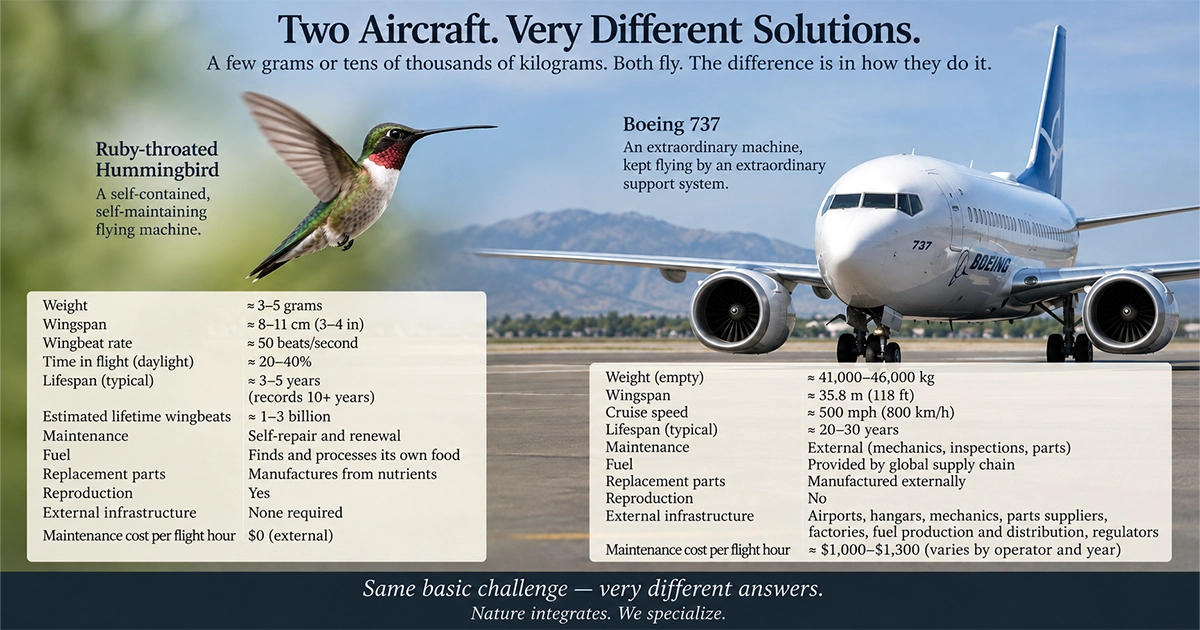
A hummingbird weighs only a few grams. Within those few grams are an aircraft, propulsion system, navigation system, computer, vision system, fuel system, fuel-acquisition system, temperature-control system, structural framework, maintenance system and reproductive system. Depending on the species, its wings commonly beat dozens of times per second, and observational research suggests that hummingbirds may spend a substantial portion of their daylight hours either flying forward or hovering. The exact percentage varies with species, season, food availability, temperature and behavior, but an activity budget of roughly 30 percent of daylight time in flight is a reasonable figure for thinking about the scale involved.
Consider a hummingbird that manages to live for ten years. Assume an average of twelve hours of daylight per day, 30 percent of those daylight hours spent flying or hovering, and an average of 50 wingbeats per second while airborne. The result is approximately 2.4 billion wingbeats during its lifetime. This is only an estimate. No one has attached a lifetime wingbeat odometer to a wild hummingbird, and changing the assumptions can move the number substantially. But the important conclusion survives almost any reasonable assumptions: a long-lived hummingbird can plausibly execute something on the order of billions of wingbeats during its life.
That number becomes more remarkable when we remember that flight is not an optional feature for a hummingbird. A human can injure an arm and continue eating and moving around while it heals. An automobile can sit in a garage for a month awaiting a replacement transmission. A hummingbird that loses the ability to fly has a much more immediate problem. Its ability to obtain food, escape predators and perform many of the ordinary functions necessary for survival depends upon keeping its flight system operational.
Commercial aircraft offer an interesting comparison because they are among the most impressive machines humans have ever constructed. A modern Boeing 737 or Airbus A320 can repeatedly carry roughly 150 to 200 people hundreds or thousands of miles at around 500 miles per hour and can remain in commercial service for decades. Modern commercial aviation has also achieved an extraordinary safety record. There is no need to diminish human engineering to make the comparison with a hummingbird interesting. The difference lies largely in how the two systems achieve reliability.
A commercial airplane survives repeated use because an enormous external maintenance system surrounds it. Aircraft undergo scheduled inspections and unscheduled repairs. Mechanics inspect components, replace tires and brakes, service engines, search for fatigue and corrosion, troubleshoot electronics and replace parts that have reached specified limits. Engines can be removed from the aircraft and sent to specialized facilities for major maintenance. Airlines maintain inventories of replacement components and sophisticated computer systems for tracking the condition and maintenance history of their fleets. Regulators establish mandatory inspection and maintenance requirements, manufacturers issue technical instructions, and thousands of highly trained people participate in keeping the system operating.
All of this is expensive. Precise costs vary enormously by aircraft type, age, engine, utilization and accounting method, but industry estimates have put direct aircraft maintenance costs at roughly $1,000 or more per flight hour, with some estimates around $1,200 to $1,300 per hour. That does not mean someone performs $1,300 worth of work every time an airplane spends an hour in the air. Much of the expense accumulates toward inspections, component replacements and major maintenance performed later. But averaged across the operation of an aircraft, maintenance represents a substantial continuing cost.
The hummingbird also requires maintenance. Describing it as “maintenance-free” would actually understate the sophistication of the system. Living tissues are constantly being maintained. Cells replace damaged components. Bone remodels. Wounds can heal. Immune systems respond to biological threats. Proteins are continually manufactured and replaced. Feathers deteriorate and are periodically replaced through molting. The hummingbird's wings are therefore not indestructible structures capable of surviving billions of cycles unchanged. Nature has developed something considerably more interesting: a flight system capable of maintaining and renewing itself while remaining part of an operating organism.
Imagine the equivalent capability in a commercial aircraft. A Boeing 737 would detect microscopic structural deterioration, manufacture appropriate replacement material internally, transport it to the affected location and perform much of the repair itself. When an aerodynamic surface became worn, the aircraft could gradually manufacture a replacement from raw materials it had acquired during ordinary operation. It would monitor its own condition continuously, respond to damage and replace aging components without needing a hangar full of mechanics. We would not call such an airplane maintenance-free. We would regard its internal maintenance capabilities as an extraordinary technological breakthrough.
The comparison becomes even more striking when we consider what we normally exclude from the boundaries of a machine. When we say that a Boeing 737 weighs tens of thousands of kilograms, we are counting the airplane. We do not count the hangar required to maintain it, the mechanic's tools, the diagnostic computers, the inventories of spare parts, the replacement engines, the factories producing those parts, the transportation network delivering them, or the schools and training systems that produce qualified mechanics and engineers. Nor do we count Boeing's factories, the manufacturers supplying thousands of specialized components, or the mines and processing facilities supplying the materials from which those components are made.
This is perfectly reasonable when discussing aircraft weight, but it can obscure how dependent the machine is upon an external technological civilization. Remove the mechanics, spare parts, factories, diagnostic equipment and industrial supply chain, and even the world's finest commercial aircraft eventually become unusable. The airplane is only one visible component of a much larger operating system.
The hummingbird draws the system boundary differently. A remarkable proportion of the infrastructure necessary to keep the aircraft operating travels with the aircraft. The maintenance facility is inside the hummingbird. So is the flight-control computer. So are the sensors. So is the energy-conversion system. So is much of the manufacturing machinery necessary to replace worn biological components. The whole package weighs a few grams and can sit on a twig.
Fuel provides another revealing comparison. A commercial airplane does not locate or produce its own fuel. Humans explore for petroleum, drill wells, transport crude oil, operate enormous refineries, distribute jet fuel through pipelines, ships and trucks, store it at airports and pump it into aircraft. The airplane itself begins participating only near the end of this enormous process, when the finished fuel reaches its tanks.
A hummingbird handles its corresponding problem almost entirely by itself. It observes its environment, identifies possible food sources, remembers productive locations, navigates to them and extracts food. Its digestive system processes that food and converts it into usable energy and raw materials. When energy reserves decline, the hummingbird changes its behavior and searches for additional resources. The pilot, navigation system, fuel-procurement department, fuel-processing facility and aircraft are all part of the same organism.
The same principle applies to replacement parts. When a component on a commercial aircraft fails, a highly developed supply chain may be required to replace it. The replacement could contain materials mined in one country, processed in another and manufactured into a specialized component somewhere else before being transported to the aircraft. A hummingbird obtains comparatively ordinary biological raw materials from its surroundings and reorganizes them internally. Food becomes blood, muscle, enzymes, connective tissue and eventually new feathers. Nature has compressed an astonishing amount of manufacturing capability into the organism itself.
Then comes the capability that makes almost every comparison with human technology seem inadequate. A Boeing 737 cannot manufacture another Boeing 737. Producing another aircraft requires factories, thousands of workers, enormous amounts of energy, global supply chains, sophisticated machine tools and the accumulated engineering knowledge of an advanced industrial civilization. Two hummingbirds can initiate a process that produces another hummingbird. The offspring develops a skeleton, muscles, heart, lungs, brain, eyes, digestive system, nervous system and feathers, and eventually leaves the nest as another autonomous flying machine capable of finding its own fuel and maintaining itself. There is no hummingbird factory because, in an important sense, the factory is distributed through the hummingbirds themselves.
This suggests an interesting way of thinking about the relative sophistication of technologies. We usually measure the capabilities of the object in front of us while treating the infrastructure supporting it as something separate. Perhaps another useful measure would be capability relative to dependence on external resources. By that measure, biological systems become astonishing. A hummingbird does not merely fly. It flies while carrying the systems required to navigate, find energy, process fuel, maintain its structure, replace components, respond to damage and reproduce.
Artificial intelligence presents a similar boundary problem. AI can appear almost immaterial from the user's perspective. A person types a question into a box and an intelligent answer appears seconds later. Yet behind that simple interaction may be enormous data centers, advanced semiconductor fabrication plants, electrical generation, cooling systems, fiber-optic networks, mining, chip-design software, engineers and billions of dollars of capital investment. AI is genuinely extraordinary, but its apparent simplicity partly results from the fact that almost all of its physical infrastructure is somewhere else.
A hummingbird provides a very different model of technological integration. Its intelligence, sensors, propulsion, fuel processing, structural maintenance and reproductive machinery all travel together. The entire system weighs a few grams. A long-lived individual may subject its wings to something on the order of billions of operating cycles, yet the organism continuously maintains itself and periodically renews critical components using materials it acquires from its environment.
None of this means that a hummingbird is simply a superior version of a commercial airplane. They serve radically different purposes. A hummingbird cannot carry 180 passengers across the Atlantic at 500 miles per hour, and a Boeing 737 does not need to reproduce. As with any discussion of efficiency, the relevant measure depends upon purpose. Commercial aviation solves one extraordinary problem exceptionally well, while biological evolution has solved a very different collection of problems.
But the hummingbird demonstrates capabilities that should expand our conception of what technology might eventually become. Systems can theoretically acquire their own energy, diagnose themselves, repair themselves, replace worn components, adapt to changing conditions and manufacture much of what they need from locally available materials. We know these things are physically possible because biological systems already do them.
Our commercial aircraft are technological marvels precisely because we have learned to keep extraordinarily complicated machines operating safely for decades through an equally extraordinary external system of human maintenance and industrial support. The hummingbird achieves reliability through a radically different architecture. Much of the support infrastructure that surrounds one of our airplanes has, in the hummingbird, been miniaturized, integrated and brought aboard.
A commercial aircraft periodically returns to the maintenance facility because the aircraft and the maintenance facility are separate things. The hummingbird never has to go to the hangar.
The hangar is inside the bird.
Whether you're exploring interoperability, dataset valuation, AI readiness, or ecosystem participation, we welcome conversations with researchers, organizations, and strategic partners interested in the future of structured data systems.
info@datauniversa.com