The Digital Reconstruction of Daily Life
By: John F Groom
The Innovations Were Only the Beginning
In 15 Mini-Revolutions That Changed Daily Life, I looked at the technological developments that have most changed ordinary life during my lifetime: personal computing, the Internet, email, mobile phones, search, texting, digital photography, GPS, smartphones, social media, streaming, video communication, digital platforms, and, most recently, generative AI. But there is another way of looking at the same history.
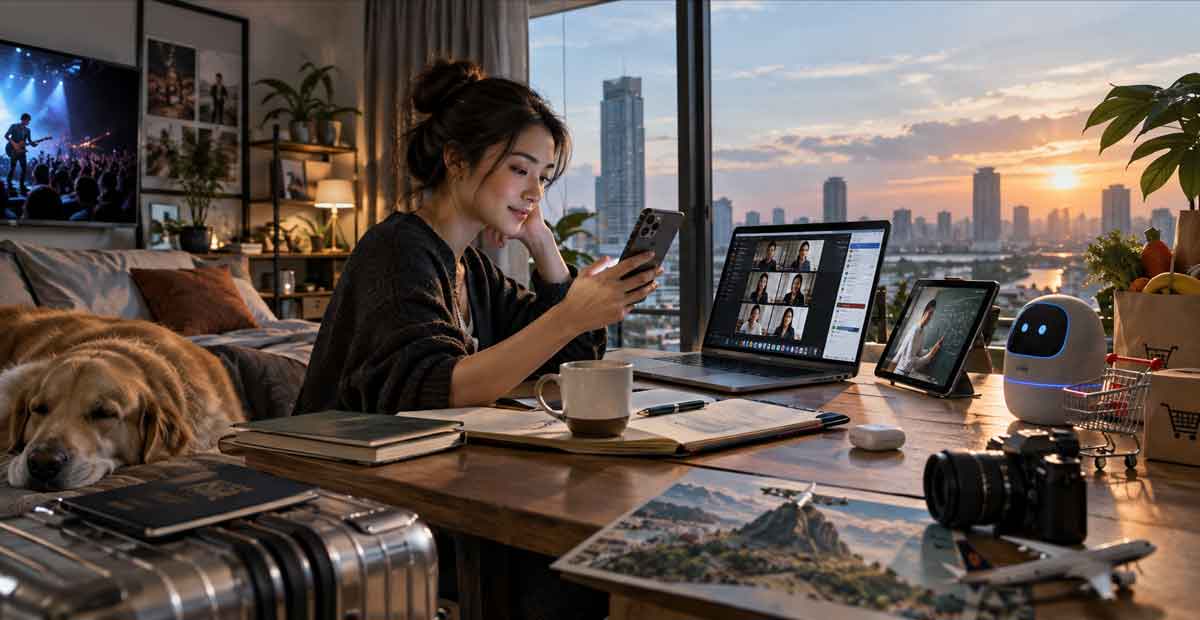
The innovations themselves are only the first stage. A smartphone is a technology. GPS is a technology. Digital payments are a technology. Search is a technology. But travel is an activity. When search, smartphones, GPS, reviews, digital payments, electronic tickets, online booking, Uber, and Airbnb are combined, they do not merely make one part of travel more efficient. They reconstruct the experience of traveling.
The same thing happened to shopping, investing, entertainment, and communication. So rather than asking which technologies have been most important, this companion article asks a different question:
Which areas of ordinary life have been changed most comprehensively by the technological revolutions of the past 65 years? This is not an attempt to determine whether those changes have been good or bad. In many cases, they have clearly been both. It is simply an attempt to measure the extent of the transformation.
1. Communication
Perhaps no activity has changed more completely. When I was born in 1961, ordinary personal communication consisted primarily of face-to-face conversation, letters, and landline telephones. Each had strong constraints. A telephone was attached to a place. A letter physically traveled between locations. International communication was expensive. Visual communication over long distances was largely unavailable to ordinary people.
Now communication is continuous and multimedia. Email, texting, group messaging, social media, photographs, recorded video, and live video calls have progressively removed the relationship between communication and location. We have gone from calling someone's house and hoping he was home to carrying a device through which that person can potentially be reached almost anywhere on Earth. This is not simply an improved telephone system. It is a fundamentally different communications environment.
2. Shopping
Shopping may be the clearest example of an entire activity being digitally reconstructed. The traditional process was geographically constrained. You went to stores and examined whatever those stores happened to carry. You obtained information from packaging, advertisements, and salespeople. Comparing prices required visiting or calling multiple stores. Purchases then had to be transported home.
Now almost every step can occur digitally: search, comparison, reviews, selection, payment, tracking, and home delivery. The consumer can access inventories vastly larger than any physical store could hold, along with opinions from hundreds or thousands of previous buyers. The physical product remains physical. Almost everything surrounding it has become information.
3. Travel
Travel has undergone an equally comprehensive transformation. Consider planning an international trip several decades ago. You might use a travel agent to find flights and hotels. Tickets were physical. Guidebooks provided information about destinations. Travelers carried paper maps. Foreign-language difficulties required phrase books or human assistance. Taxis were found at taxi stands or hailed on streets. International communication with home could be difficult or expensive.
Compare that with travel today. You can search for destinations, compare hundreds of flights, read thousands of hotel reviews, book a room, rent someone else's apartment, check in remotely, receive a boarding pass on a phone, track a flight, navigate through an unfamiliar city with GPS, summon a car to your exact location, translate foreign text through a camera, find nearby restaurants and see what previous customers thought of them, pay electronically, and video-call someone thousands of miles away. The airplane is still an airplane and the hotel room is still a room. But almost the entire informational and coordination layer surrounding travel has been rebuilt.
4. Work
The physical office of 1961 and the digital workplace of 2026 may perform many of the same basic functions, but the mechanisms are almost unrecognizable. Typewriters became word processors. Paper ledgers became spreadsheets. File cabinets became databases and cloud storage. Internal memoranda became email and messaging. Reference libraries became search engines. Calendars became scheduling systems. Long-distance meetings became video calls.
Some business travel became unnecessary, and entire teams became geographically distributed. Now AI is beginning to participate directly in writing, research, programming, analysis, and decision support. Technology first changed the tools of work. Then it changed where work could occur. AI may increasingly change who, or what, does particular components of the work.
5. Media and Entertainment
Media was once defined by scarcity and schedules. A television network decided what appeared at 8:00 PM. A movie theater determined which films could be watched locally. A radio station chose the music. A record collection was limited by the records someone had purchased. A newspaper appeared once or twice a day.
Today, enormous libraries of music, film, television, video, podcasts, books, games, and news are continuously available. The transformation is not simply from analog to digital. It is from limited selection and scheduled distribution to enormous selection and on-demand access. The economics of creation changed as well. Someone with a smartphone can now potentially reach an audience larger than many television stations once could.
6. Banking and Payments
Banking was once closely associated with a physical institution. People visited branches, interacted with tellers, wrote checks, mailed bills, received paper statements, and manually balanced checkbooks. Increasingly, the bank has become software.
Balances are continuously accessible. Checks can be deposited photographically. Bills can be paid automatically. Money can be transferred electronically. Purchases can be made without physical currency. The transformation is easy to overlook precisely because it has become so routine. Money itself increasingly moves as information.
7. Investing and Trading
Investing deserves to be separated from banking because technology did more than digitize an existing administrative process. It changed participation. Investing was historically mediated much more heavily by professional brokers. Obtaining information took effort, and executing transactions involved friction and meaningful transaction costs.
Online brokerage changed that. Then commissions fell dramatically. Trading moved onto smartphones, and social media entered the equation. The result has been not merely easier long-term investing but entirely new patterns of behavior: day trading, frequent trading, widespread retail options trading, real-time portfolio monitoring, cryptocurrency speculation, online investment personalities, and large communities of individual investors exchanging ideas.
Reddit investment groups and phenomena such as meme stocks demonstrate how far the transformation has gone. Markets themselves became social-media subjects. The individual investor moved from being primarily a customer of a financial intermediary toward becoming a direct participant in an enormous real-time information network.
8. Photography and the Recording of Life
Photography was once an occasional activity. Film cost money. The number of exposures was limited. Developing photographs required time and additional expense. Video required separate and relatively cumbersome equipment. Now billions of people carry cameras continuously.
That has changed much more than photography. Children grow up with extraordinarily detailed visual records of their lives. Accidents are documented. Police encounters are recorded. Wars are filmed by participants. Products arrive with photographic evidence of damage. Medical conditions can be photographed remotely. Work can be documented across continents. Ordinary people continuously produce primary-source historical evidence. The human experience has become vastly more recordable.
9. Navigation and Our Relationship With Place
Getting somewhere unfamiliar once required knowledge. People memorized routes, asked for directions, used landmarks, and carried maps. GPS changed the relationship between information and physical space. A person can arrive in a city he has never visited and immediately know where he is, what businesses surround him, how other people rate them, how to reach a destination, and approximately how long the trip will take.
This extends far beyond personal navigation. Modern logistics, delivery services, ride-hailing, fleet management, and location tracking all depend upon machines having increasingly precise knowledge of where things are. The physical world acquired a digital information layer.
10. Finding and Trusting Strangers
This may be one of the largest transformations without an obvious name. Historically, geography and existing relationships determined much of whom we dealt with. Need a plumber? Ask a neighbor or look in the Yellow Pages. Need an employee? Place a classified advertisement.
Need a date? Meet someone through friends, work, school, church, a bar, or another physical social setting. Need a freelancer? Ask your professional network. Need a taxi? Call a taxi company. Need a hotel room? Deal with a hotel.
Digital networks made strangers searchable. Reviews, profiles, transaction histories, and reputation systems then helped address the second problem: Can I trust this stranger? That combination underlies enormous parts of the modern economy.
11. Dating and Relationship Formation
Romantic relationships are intensely personal, but the mechanisms by which people initially find one another have been profoundly affected by technology. The available pool was once heavily determined by geography and social networks. Personal advertisements provided an early workaround. Then came dating websites, followed by smartphone dating applications.
The potential pool of partners became searchable at a scale that would have been impossible through traditional social interaction alone. Whatever one thinks of the results, technology changed one of the most basic processes in human society: how people find potential mates.
12. Sex and Adult Entertainment
Adult entertainment provides an unusually stark illustration of technological change. Consider the transition from Playboy magazine to today's Internet. Adult content moved from relatively scarce physical media produced and distributed by specialized businesses to websites, essentially unlimited digital photography, streaming video, smartphones, live interaction, and direct-to-consumer creator platforms.
The change has been enormous in availability, privacy, variety, distribution, and the relationship between producer and consumer. Adult entertainment has also repeatedly been an aggressive adopter of new media and distribution technologies. Strong demand encouraged experimentation with online subscriptions, digital payments, streaming video, affiliate systems, and direct digital distribution.
The point here is not whether this transformation has been socially beneficial. The point is that it happened, on an enormous scale, and any history of how digital technology changed everyday human behavior that omitted sex would be incomplete.
13. Finding Local Businesses and Services
The Yellow Pages were once an extraordinarily important technology. Their disappearance tells us something. Finding a restaurant, mechanic, doctor, plumber, store, or other local service once depended heavily upon physical directories, advertisements, proximity, and personal recommendations.
Today the process is increasingly digital: search, location, reviews, comparison, contact or booking, navigation, and payment. The local business remains physical. The mechanism through which customers discover and evaluate it has largely become digital.
14. Education and Learning
Formal education has changed more slowly than information access. But learning itself has changed enormously. A curious person once depended primarily upon books he could obtain, teachers he could access, libraries he could visit, and experts he happened to know.
Search engines radically expanded access. Digital books expanded libraries. Online video made demonstrations and lectures globally available. Online courses weakened geographical constraints.
And now generative AI introduces something different again: an information system that can interact with the learner, answer follow-up questions, explain something differently, and potentially adapt to the individual. The institution of education has not yet been completely reconstructed. The individual's ability to learn independently arguably has.
15. The Organization of Economic Activity
Uber, Airbnb, and Upwork reveal perhaps the deepest transformation. They are not primarily individual technological inventions. They are organizational inventions built from technological components. Internet connectivity, smartphones, GPS, digital payments, profiles, databases, and reputation systems can be combined to coordinate enormous numbers of strangers.
A transportation network can be assembled from privately owned cars. A lodging network can be assembled from privately controlled rooms and houses. A global labor market can be assembled from individuals sitting at computers throughout the world. The technology created new primitives. Entrepreneurs discovered new structures that could be built from them. And that may be the most important connection between the mini-revolutions and the broader transformation of life.
Innovation Is the First Step, Not the Last
There is a tendency to write technological history as a succession of inventions. The PC arrived. Then the Internet. Then search. Then the smartphone. Then AI. But people do not actually live inside a list of technologies. They shop, travel, work, communicate, invest, learn, date, entertain themselves, and interact with other people.
The important question is therefore not merely what a technology can do. It is what happens when multiple technologies are combined around an existing human activity. Travel demonstrates this particularly well.
No single invention created digital travel. Search helps find the flight. Reviews help select the hotel. Digital payments complete the transaction. The smartphone carries the ticket. GPS provides navigation. Uber provides transportation. Airbnb provides an alternative form of lodging. Messaging maintains communication. Translation software reduces language barriers. Digital photography records the trip.
Each technology is useful individually. Combined, they reconstruct travel. Shopping underwent the same process. So did investing, media, communication, and increasingly, work.
Technology as Recombination
This suggests a different model of technological progress. The first stage creates primitives: computers, networks, digital cameras, GPS, smartphones, and machine intelligence. The second stage creates capabilities by combining them: search, messaging, streaming, digital payments, reviews, video communication, and real-time navigation.
The third stage reconstructs activities: shopping, travel, banking, investing, entertainment, dating, work, and education. And sometimes a fourth stage produces entirely new organizational structures: online marketplaces, social networks, the gig economy, creator platforms, and globally distributed companies.
These are not four independent kinds of progress. They form a chain: Innovation → Capability → Recombination → Behavioral Change → Structural Change That explains why the consequences of a technology can be much larger than the technology itself initially suggests.
GPS looks like a better way to navigate. Combine it with smartphones, payments, reputation systems, and a marketplace, and you get Uber. Digital photography looks like a cheaper way to take pictures. Combine it with smartphones and networks, and billions of people become continuous producers and distributors of visual information. The Internet looks like a communications network. Combine it with payments, databases, search, and logistics, and shopping itself changes.
Now Add Intelligence
This is what makes the arrival of generative AI particularly interesting. We should not expect its largest effects to be confined to the obvious applications we see today. Writing faster is useful. Programming faster is useful. Summarizing documents is useful. Generating images is useful.
But those may be analogous to looking at early GPS and concluding that the great revolution would be not having to unfold a road map. The larger effects occur when the new primitive is recombined with everything that came before it.
AI plus shopping. AI plus travel. AI plus investing. AI plus education. AI plus healthcare. AI plus entertainment. AI plus distributed work. AI plus reputation systems. AI plus smartphones. AI plus enormous collections of real-world data. And eventually, combinations we have not thought of yet.
The 15 mini-revolutions of my lifetime did not merely give us 15 useful technologies. They accumulated. Each became another building block available for the next generation of entrepreneurs, businesses, and individuals to recombine.That is why the broader transformation of daily life has been so much larger than the individual inventions would suggest.
Innovations create possibilities. Combinations create capabilities. Human experimentation turns those capabilities into new ways of living. And once enough of those pieces accumulate, an activity is not merely improved. It is rebuilt.
Whether you're exploring interoperability, dataset valuation, AI readiness, or ecosystem participation, we welcome conversations with researchers, organizations, and strategic partners interested in the future of structured data systems.
info@datauniversa.com