The Disappearing Ancestor: How Modern Life Changed Our Relationship with the Past
By: John F Groom
DU Technology Series: How the World Has Changed
How Much Has Human Behavior Really Changed?
Modern human life appears radically different from the lives of our prehistoric ancestors, and even more different from the lives of other animals. We live in cities, work in offices, travel by airplane, use computers, attend schools, and spend much of our time interacting with people and information through electronic devices. Yet beneath these technological differences, the fundamental activities that occupy our lives have changed surprisingly little.
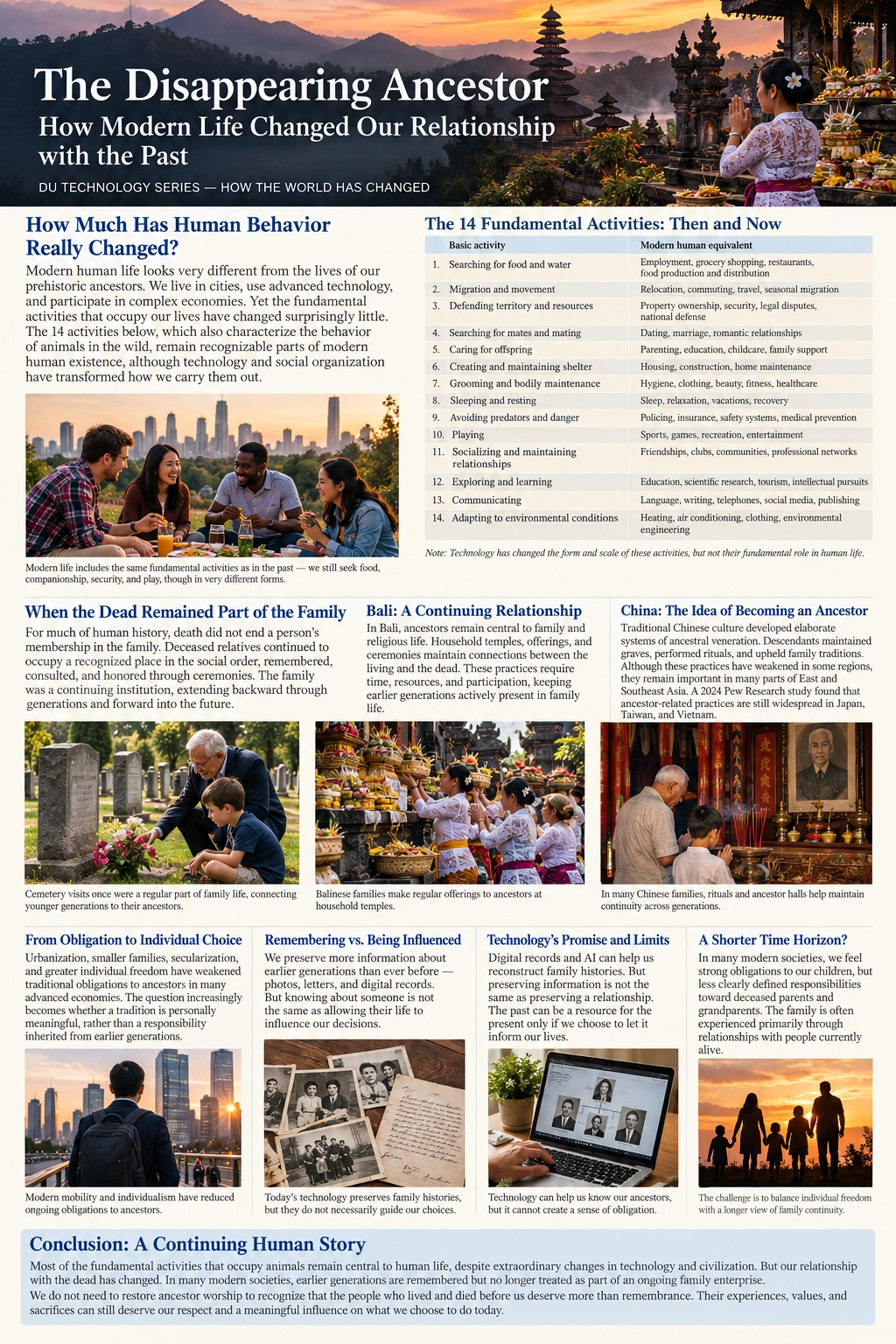
Consider the 14 principal activities that occupy the lives of animals in the wild. Almost all remain recognizable parts of modern human existence, although technology, economic development, and social organization have transformed how we carry them out.
|
Basic activity |
Modern human equivalent |
|
Searching for food and water |
Employment, groceries, restaurants, food production |
|
Migration and movement |
Relocation, commuting, travel |
|
Defending territory and resources |
Property rights, security, national defense |
|
Searching for mates and mating |
Dating, marriage, romance |
|
Caring for offspring |
Parenting, education, childcare |
|
Creating and maintaining shelter |
Housing, construction, maintenance |
|
Grooming and bodily maintenance |
Hygiene, beauty, fitness, healthcare |
|
Sleeping and resting |
Sleep, relaxation, vacations |
|
Avoiding predators and danger |
Policing, insurance, safety systems |
|
Playing |
Sports, games, recreation |
|
Socializing and relationships |
Friendships, clubs, communities |
|
Exploring and learning |
Education, research, tourism |
|
Communicating |
Language, writing, social media |
|
Adapting to environment |
Heating, air conditioning, clothing |
These parallels are not exact: employment serves more purposes than obtaining food, and recreation includes distinctly human forms. Nevertheless, the continuity is remarkable. Technology has transformed these activities, often building entire industries around them. What appears different is the continuing obligation to people who have died.
When the Dead Remained Part of the Family
For much of recorded history, and probably long before it, death did not necessarily end a person's membership in the family or community. In many societies, deceased relatives continued to occupy a recognized place in the social order. They were remembered, consulted symbolically or spiritually, honored through ceremonies, and sometimes believed to influence the fortunes of their descendants.
The living were expected to maintain these relationships. Ancestors were not simply historical figures whose lives might be recalled occasionally; they were part of the continuing identity of the family. Remembering a deceased parent is a personal experience, while maintaining an ancestral shrine, performing ceremonies on prescribed dates, caring for family graves, or making decisions out of respect for earlier generations involves an ongoing social obligation.
The family was not understood simply as the collection of people currently alive. It was a continuing institution extending backward through generations and forward into the future. A person inherited more than property or biological characteristics: responsibilities, reputations, customs, expectations, and relationships with people who had died before they were born. Individuals could anticipate becoming ancestors themselves, remembered by descendants they would never meet.
Bali: A Continuing Relationship Across Generations
Bali provides a particularly visible example of how this older relationship with the past can continue within a modern society. In Balinese Hindu traditions, ancestors occupy an important place in family and religious life. Household temples, offerings, ceremonies, and rituals associated with death and subsequent ancestral status help maintain connections between living and deceased family members.
These practices are not confined to funerals. They are embedded in recurring household and community obligations, although the details and intensity vary. A family temple is not merely a monument commemorating earlier generations; it is a continuing center of family identity and religious activity. Ceremonies require preparation, resources, cooperation, and participation. Family members may return to ancestral communities to fulfill obligations despite changes in their residences and lifestyles.
This is not simply a matter of believing that ancestors exist spiritually. It is a system through which earlier generations retain a place in present activities. The obligations also reinforce relationships among living relatives, giving them recurring reasons to cooperate and maintain contact.
The Cemetery as a Place of Family Life
Ancestor relationships have not been limited to Asian religious traditions. Europe and North America also developed customs that gave deceased family members a continuing presence in the lives of the living. In earlier generations, visiting family graves was often a more established activity than it is for many Americans today. Families cleaned graves, brought flowers, observed death anniversaries, and visited cemeteries on religious holidays or designated occasions.
The nineteenth-century rural cemetery movement in the United States also made cemeteries places for walking, reflection, and family outings, particularly before public parks became widespread. Such visits were not always ancestor veneration, but they made the dead visibly present in community life.
A grave gave the relationship a location. Children could accompany parents to the graves of relatives they had never known, making the family's history something experienced rather than merely described. Memorial Day developed in part from decorating the graves of Civil War dead. Although the holiday formally honors military personnel who died in service, for many Americans it is now primarily associated with travel, recreation, and the beginning of summer.
Americans have not stopped caring about deceased relatives, and cemetery traditions persist in many communities. But the regular physical participation connecting families to earlier generations appears less central in much of contemporary American life. The change is not simply from remembering to forgetting, but from an organized, recurring relationship to one that is increasingly private, voluntary, and intermittent.
China and the Idea of Becoming an Ancestor
Traditional Chinese family culture developed an elaborate system of intergenerational continuity. Under Confucian and other religious and cultural influences, filial obligations extended beyond a parent's lifetime. Descendants could be expected to maintain ancestral graves, perform commemorative rituals, preserve family identity, and uphold inherited obligations. Ancestral halls, genealogies, and ceremonies made the family an institution extending across generations.
The concept of becoming an ancestor is especially significant. It offered individuals a continuing place in a social structure after death. The family's past could influence choices involving marriage, property, occupation, residence, and reputation. These traditions were never uniform, and political upheaval, urbanization, migration, and economic development have transformed them. Yet ancestor-related practices remain widespread in parts of East and Southeast Asia.
A 2024 Pew Research Center study reported that 85% of adults in Japan had a family gravesite and 79% had helped maintain it in the preceding year; in Vietnam, 96% reported burning incense to honor ancestors in the preceding year. The study did not survey mainland China. These findings qualify any blanket claim that ancestor veneration has disappeared.
From Inherited Obligation to Individual Choice
Why have ancestor relationships weakened in many advanced economies when other ancient activities survive or expand? One explanation is that ancestor relationships depend on social institutions in a way basic biological activities do not. People still seek companionship, food, security, shelter, and recreation because these respond to recurring individual needs. Ancestor veneration requires supporting beliefs, expectations, ceremonies, and obligations.
Urbanization and mobility separate families from ancestral homes and burial grounds. Smaller families reduce the number of descendants who share obligations. Secularization weakens some beliefs about deceased relatives' influence, while greater economic independence reduces extended-family authority. Modern individualism also encourages people to choose occupations, partners, residences, and beliefs according to personal preferences.
This freedom has brought enormous benefits, including the ability to escape oppressive family arrangements and inherited restrictions. But it has also weakened the assumption that family traditions deserve continuation simply because earlier generations established them. The question becomes whether a tradition is personally meaningful rather than whether maintaining it is a responsibility of family membership.
Respecting the Past Is Different From Remembering It
Modern societies preserve enormous quantities of information about the past through museums, archives, genealogical websites, photographs, and recorded interviews. Yet knowing about someone is not the same as allowing that person's life to influence one's decisions.
A family might possess hundreds of photographs of its grandparents while knowing little about their values, sacrifices, aspirations, or decisions. In an ancestor-centered culture, respect can be expressed through action: preserving a family home, maintaining a traditional occupation, continuing an annual ceremony, supporting relatives, or avoiding conduct thought to dishonor the family.
This need not mean believing ancestors are supernatural beings or accepting every inherited practice. Some traditions deserve to be abandoned. Respect can mean understanding why earlier generations made choices, recognizing the sacrifices that created present opportunities, and considering their experiences when deciding what to preserve or change. The past can retain influence without controlling the present.
The Family as a Continuing Project
Perhaps the most consequential change is the weakening of the idea that a family represents a continuing project across generations. In traditional systems, individuals often saw themselves as inheritors and custodians. They received something from earlier generations, maintained or improved it, and passed it forward. The inheritance included knowledge, skills, relationships, values, traditions, and reputation, not merely property.
Modern societies have not abandoned intergenerational responsibility. Parents still devote enormous effort to children, and many sacrifice to improve their descendants' prospects. But obligations are more strongly directed forward than backward. People recognize responsibilities to children who are not yet independent, while duties toward deceased parents and grandparents are less clearly defined. The result may be a shorter understanding of family identity, focused primarily on people currently alive.
Technology Has Preserved Information Without Necessarily Preserving Relationships
Technology introduces a contradiction. It has never been easier to preserve earlier generations' lives through photographs, videos, correspondence, recorded conversations, and personal documents. Artificial intelligence can organize these records, reconstruct histories, and help descendants understand relatives who died long before they were born.
Yet an archive can preserve information without creating an expectation that descendants learn from it. A family history can become something to browse rather than a tradition that requires participation. The distinction is between preserving the record and preserving the relationship.
The same technology could also enable families to preserve not only names and photographs but decisions, explanations, values, mistakes, accomplishments, and advice. Future descendants could understand how circumstances developed and why traditions mattered. This would not require restoring religious ancestor worship, only recognizing that the past can be an active resource for the present.
What Have We Actually Lost?
It would be a mistake to romanticize ancestor-centered societies. Inherited obligations could impose heavy burdens, perpetuate hierarchy, and restrict choice. Individual freedom is a substantial achievement. But weakening intergenerational obligations may also have costs.
When earlier generations retain a recognized place in family life, they can provide continuity, identity, and a sense that individual lives contribute to something larger and more enduring. Descendants may feel they inherited something worth maintaining. Traditions provide recurring activities that connect relatives who might otherwise have little reason to gather. These benefits need not depend on supernatural beliefs; they arise partly from organizing relationships across time.
Conclusion: The Activity That Did Not Survive Modernization in the Same Form
Most fundamental activities occupying animals remain central to human life. We still seek resources, protect ourselves, establish relationships, care for offspring, maintain our bodies, play, explore, learn, and communicate. We have transformed how we do these things, but the underlying purposes remain recognizable.
Humans also developed the ability to organize obligations across generations, including relationships with people no longer alive. For thousands of years, many societies gave those relationships a continuing place in daily life. Ancestors were not merely remembered: they were respected, honored, and allowed to influence descendants' choices.
In parts of the modern world, this activity has declined even as our ability to preserve information about the dead has expanded. The central change is not that we have forgotten the past. It is that we increasingly regard the past as something to know about rather than something to which we owe responsibilities.
The challenge is not necessarily to restore ancestor worship, but to recover the idea that people no longer alive can deserve more than remembrance: they can deserve respect, gratitude, and a meaningful influence on what we choose to do today.
Source Note
Pew Research Center, “Ancestor Veneration, Funerals and Afterlife Beliefs,” June 17, 2024: https://www.pewresearch.org/religion/2024/06/17/ancestor-veneration-funerals-and-afterlife-beliefs/. Historical interpretations and claims of decline should be understood as broad qualitative comparisons rather than precise longitudinal measurements.
Illustrated overview
Visual companion to the DU Technology Series essay. Illustrative scenes are artistic representations, not documentary photographs.
Whether you're exploring interoperability, dataset valuation, AI readiness, or ecosystem participation, we welcome conversations with researchers, organizations, and strategic partners interested in the future of structured data systems.
info@datauniversa.com