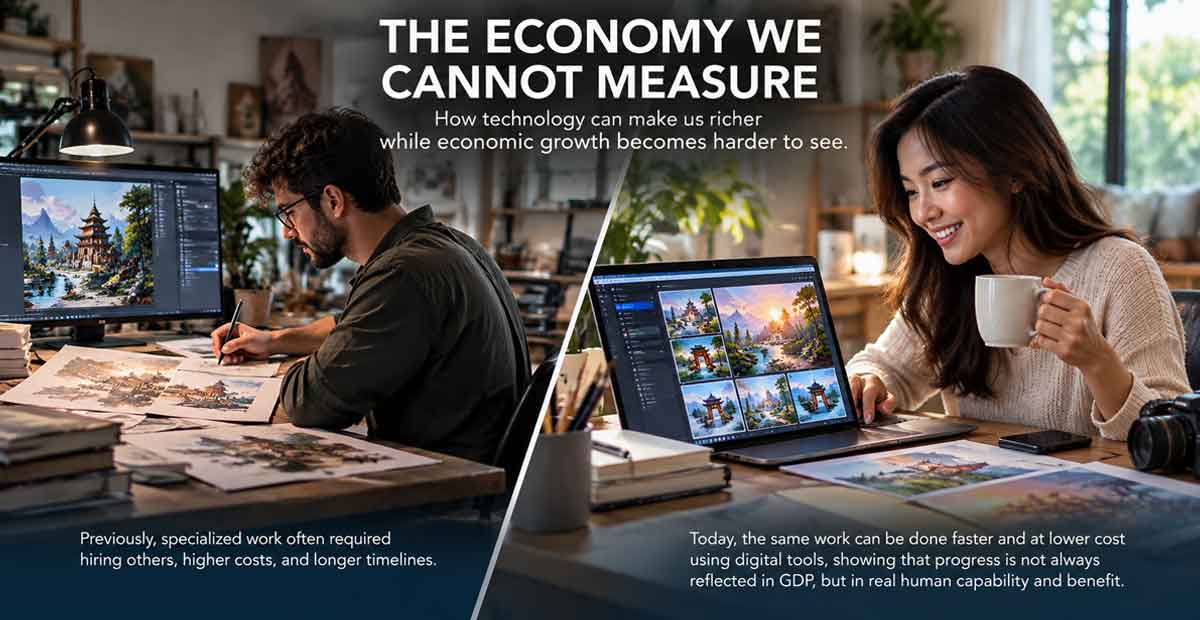
The Economy We Cannot Measure
By: John F Groom
Why Technological Progress Can Make Us Richer While Making Economic Growth Harder to See
A computer that costs $2,000 today might perform work that once required a room full of expensive equipment. Yet a comparison based solely on purchase prices could see little more than two transactions involving computers.
Now consider an even stranger example. You commission an illustration from a freelancer for $500. A year later, you generate a better illustration yourself using an AI service to which you already subscribe. You obtain a better result, spend less money, and wait less time. But the $500 transaction has disappeared. Measured expenditure has fallen while your productive capabilities have increased.
This exposes a growing problem in how we understand economic progress. Technology increasingly creates value by making things dramatically cheaper, improving their quality, eliminating paid intermediaries, and enabling people to perform sophisticated work for themselves. Government statistics capture parts of these changes, but they do not capture every benefit people receive. GDP remains useful for measuring market production. It is not a comprehensive measure of how much better off we are.
The Computer That Keeps Getting Cheaper Without Falling in Price
Imagine two computers sold for the same $2,000 price, one in 1995 and another in 2025. Their purchase prices are identical, but their capabilities are not remotely comparable. The newer machine has vastly greater processing power, memory, storage, and graphical capabilities. It can also perform activities that once required separate devices or institutions. The meaningful question is therefore not simply what a computer costs. It is what a given amount of useful computing costs.
| Older Computer | Newer Computer | |
| Purchase price | $2,000 | $2,000 |
| Useful computing capacity | 1 unit | 1,000 units |
| Price per unit | $2,000 | $2 |
| Illustrative quality-adjusted price decline | 99.9% |
These numbers are illustrative rather than a historical benchmark. The underlying problem, however, is real. Researchers studying personal computers in the early 1990s estimated exceptionally rapid quality-adjusted price declines. Government statisticians have long recognized the issue and use hedonic quality adjustments that account for characteristics such as processor performance, memory, and storage.
Even a carefully adjusted price index, however, cannot measure the entire value of new activities enabled by computing. The challenge is not simply that computers have become better. They have changed what people can do.
When Technology Absorbs Entire Industries
Computers did not merely become faster. They absorbed functions previously performed by entirely different products and businesses.
A smartphone is a telephone, camera, video camera, navigation system, music player, encyclopedia, and communications terminal. Many of these capabilities were once purchased separately. Others were unavailable to ordinary consumers at almost any price.
The economic statistics can capture some of this transition. Film-processing revenue can disappear while people take vastly more photographs at negligible marginal cost. Spending on paper maps can collapse while navigation becomes more accurate, accessible, and convenient.
Statistics can record smartphones, subscriptions, and advertising revenue, but the value of free or bundled services is much harder to identify. Economists have proposed supplementary measures such as GDP-B to estimate welfare gains from digital goods that have little or no separate market price. The problem becomes even more significant when technology does not simply replace a product, but allows people to perform work for themselves.
AI Brings the Problem to Professional Services
The computer revolution made hardware and software extraordinarily inexpensive relative to their capabilities. AI extends a similar process into services that previously required substantial human labor. Return to the $500 illustration.
Suppose you previously purchased ten illustrations annually for $5,000. Now you create twenty equal or better illustrations using an AI subscription costing $240 annually. Even if the entire subscription cost is assigned to illustration, expenditure falls by more than 95% while the number of illustrations doubles.
A freelance marketplace might accurately report falling illustration revenue. That does not establish that fewer illustrations are being produced, that their quality is deteriorating, or that customers are receiving less value. All three may move in the opposite direction.
The disappearance of a paid assignment can reflect the disappearance of demand. But it can also reflect something very different: the customer's acquisition of the ability to satisfy that demand independently.
There are important qualifications. If a business uses AI to create products it sells, the resulting output can still contribute to GDP. AI subscriptions, computing services, and infrastructure are also recorded. Money saved on illustrations may simply be spent elsewhere. The point is not that AI automatically reduces GDP. It is that expenditure, output, and benefit can diverge dramatically.
The Missing Value of Time
Another part of the problem is time. Suppose a research task that once required three hours now takes three minutes. If you use the saved time for paid work, some additional production may appear in GDP. If you use it to exercise, read, spend time with family, or rest, the benefit may generate no market transaction. You might even use AI to plan a trip yourself rather than hire someone, reducing recorded spending while improving your experience.
Unpaid activity is not automatically efficient. It may consume substantial attention, and a professional result may still be worth buying. But an expenditure-based measure cannot distinguish productive self-sufficiency from inefficient unpaid work without information about outcomes and the time costs involved. This creates an important measurement problem. Technology can give people more control over their time while simultaneously reducing the amount of activity that appears as market expenditure.
Why Quality Adjustments Are Necessary, But Insufficient
Hedonic adjustments can estimate the price of measurable characteristics such as memory or processing speed. Yet AI changes the nature of the task itself. How should a research assistant be measured? By words produced, questions answered, hours saved, factual accuracy, or decisions improved?
A million words of unreliable text may be worth less than a carefully researched report. A short answer that resolves an expensive engineering problem may be enormously valuable. The economically meaningful unit is increasingly the successful outcome, not the amount of labor or computing consumed.
Even that is difficult to quantify. People value the same result differently, and more output does not necessarily mean more useful output. This suggests that traditional measures based primarily on inputs and transactions become less informative as technology makes those inputs cheaper.
Three Different Economies
One way to understand the problem is to distinguish between three different economies. The transaction economy records what people pay: market production, income, expenditure, and investment. The capability economy asks what people can actually do, including services they can now perform themselves. The beneficiary economy asks how much better off they become, accounting for time, effort, cost, quality, and risk.
A technology may improve all three. But it can also destroy an established market while increasing the amount of useful work performed and leaving consumers substantially better off. The consequences for displaced workers are real, but they are not necessarily the same as the consequences for customers or for the economy as a whole.
The distinction matters because a shrinking market can sometimes indicate technological improvement rather than declining welfare. If customers can obtain the same or better outcome without purchasing the previous service, the transaction has disappeared, but the underlying benefit has not.
What Should We Measure Instead?
GDP should not be discarded. It offers a standardized framework for measuring market production, and national statistical agencies already publish supplementary accounts and quality-adjusted measures. The more useful approach is to complement GDP with task-based measures of useful capability and realized benefit.
For computers, we could measure the cost of completing standardized tasks rather than relying solely on purchase prices or theoretical processor specifications. For AI, we could measure cost, time, reliability, and quality across real tasks, including work performed without hiring anyone. For free digital services, carefully designed studies could estimate the benefits consumers receive without paying a separate fee. For Valuism, the starting point is the beneficiary.
Identify the person or organization receiving the service. Establish what they want to accomplish. Then measure the change in the cost and quality of achieving that objective. A graphic matters partly because of what it helps its owner accomplish. A research assistant matters partly because of the decisions it improves. A computer matters because of the useful work it enables. The focus therefore shifts from the transaction itself to the outcome created for the beneficiary.
The Possibility of Invisible Prosperity
The coming years may produce an unusual combination of indicators. Paid service categories may shrink. Established companies may lose customers. At the same time, individuals and small organizations may gain capabilities that previously required large staffs and substantial budgets.
GDP will capture AI infrastructure, subscriptions, investment, and additional commercial output. But some of the benefits of sophisticated self-produced services will remain difficult to observe.
A declining industry is not necessarily evidence of declining welfare. Stable spending is not evidence of stable capability. And rapid growth in digital output is not necessarily evidence that people are better off. These are different questions requiring different measures.
The great measurement problem of the technological age is that we may increasingly obtain more of what we want while spending less to get it. If we measure only what we spend, we risk overlooking much of the progress.
Whether you're exploring interoperability, dataset valuation, AI readiness, or ecosystem participation, we welcome conversations with researchers, organizations, and strategic partners interested in the future of structured data systems.
info@datauniversa.com