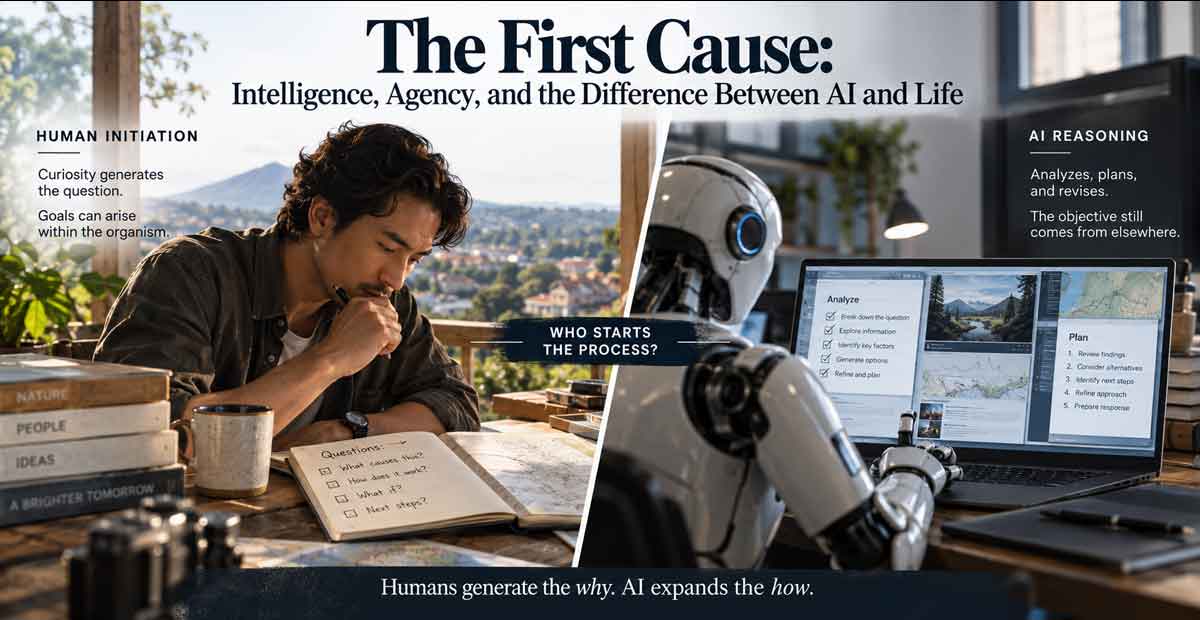
The First Cause: Intelligence, Agency, and the Difference Between AI and Life
By: John F Groom
The debate over whether artificial intelligence "thinks" may be focused on the wrong distinction. Large language models generate language probabilistically, producing one token after another. This is sometimes offered as evidence that AI does not really reason. But describing the mechanism by which a system operates does not tell us what higher-order functions that mechanism can perform.
Human thought is also implemented through physical processes. Neurons fire, neurotransmitters move, blood flow changes, electrical potentials propagate, and oxygen and glucose are consumed. Discovering these mechanisms did not cause us to conclude that humans had stopped thinking. Modern AI can already perform many activities traditionally associated with thought. It can compare alternatives, recognize patterns, construct analogies, reason from premises, identify contradictions, generate hypotheses, plan sequences of actions, revise conclusions when new evidence arrives, and combine concepts in ways that may never previously have been expressed. These capabilities are imperfect, but human reasoning is imperfect as well.
It is therefore becoming increasingly difficult to maintain a clean distinction in which humans "think" while machines merely "calculate." There may, however, be another distinction that is both more fundamental and more useful. The important difference may not be capability, but initiation.
Intelligence Does Not Explain Why Anything Starts
Consider this conversation. A human encounters an explanation of large language models and becomes dissatisfied with it. Something about the explanation seems incomplete. Curiosity arises: If an LLM predicts tokens probabilistically, does that really mean it does not think? What exactly is human thinking? Is the mechanism being confused with the function? No outside person had to issue the instruction: Become curious about artificial intelligence at 10:00 this morning.
The question arose within the person. Once the question was given to an AI, the AI could perform considerable intellectual work on it. It could distinguish token generation from reasoning, construct analogies, challenge assumptions, propose definitions, and identify implications. It might even introduce subsidiary questions that the human had not considered. But something important had already happened before any of that began. The human initiated the inquiry.
If nobody asks an LLM a question, supplies it with an objective, schedules an agent to run, or creates some other triggering condition, the LLM does not ordinarily decide that today would be a good day to investigate the nature of intelligence. It does not become bored during the night and begin researching Roman engineering. It does not wake with an inexplicable fascination with hummingbirds. It does not suddenly decide that the business it has been working on for ten years is pursuing the wrong objective. Its enormous capability exists downstream from an initiating cause supplied by something else. That may be a more important boundary than whether the machine can reason.
The Organism Generates Its Own Problems
Living organisms are unusual because they do not merely solve problems. They continuously generate problems that demand solutions. Hunger creates a problem: obtain food. Thirst creates another. Cold creates another. Pain creates another. Sexual desire creates another. Threat creates another. The organism does not require an external operator to submit these objectives.
Evolution has embedded regulatory systems within living things that continually compare conditions with preferred states and initiate behavior when discrepancies arise. A hummingbird does not require a command telling it that its energy reserves are falling and that it should find nectar. Its biology creates the objective.
Human beings add extraordinary layers to this system. Biological drives coexist with curiosity, ambition, boredom, attachment, status seeking, aesthetic preference, intellectual fascination, and the search for meaning. A mathematician can become obsessed with a theorem that nobody has asked him to solve. A child can spend an afternoon discovering what happens when different objects are dropped into a pond. An entrepreneur can notice an inefficient process and spend years trying to replace it. A person can suddenly ask, "What am I doing with my life?"
These desires have causes. Genes, previous experiences, culture, hormones, environmental conditions, and learned behavior all contribute. Calling them internally generated does not require claiming that human beings are metaphysically uncaused or possess some supernatural form of free will.The narrower observation is enough: the functioning human system continually generates objectives from within its own operating processes. That is endogenous initiation.
Intelligence, Agency, and Endogenous Agency
Discussions of AI often collapse several different properties into the single word "intelligence." They should be separated. Intelligence is the capability to solve problems, recognize relationships, make predictions, construct explanations, and determine useful courses of action. Agency is the capability to pursue objectives through time, including taking actions, observing results, and modifying subsequent actions. Endogenous agency is something more demanding: the capacity of the system to generate, prioritize, or modify the objectives that cause action in the first place.
Current AI clearly demonstrates substantial intelligence. AI connected to software, tools, memory, and external systems can demonstrate increasingly sophisticated agency. But endogenous agency is a different question. Imagine an AI system programmed to examine a company every morning at 7:00, identify its most serious problem, conduct research, and recommend an intervention. From the perspective of an employee arriving at 9:00, the AI appears remarkably autonomous. Nobody asked it that morning to perform the analysis. It simply did it.
But follow the causal chain backward: Human objective → software instruction → scheduled trigger → AI analysis → generated subgoals → actions The machine may exhibit enormous freedom after the process begins. It might generate hundreds of intermediate objectives never contemplated by its programmers. But the original reason the process exists remains external to the machine. Programming AI to initiate does not necessarily create endogenous initiation. It may merely move the human instruction farther back in the causal chain.
The Hummingbird and the Jet
The distinction resembles another comparison: the hummingbird and the jet aircraft. A modern jet is astonishingly capable. It can carry hundreds of people across an ocean at roughly 550 miles per hour, operating at altitudes and speeds utterly inaccessible to a hummingbird. Judged by transportation capacity, the comparison is absurdly one-sided.
But the jet's capability exists within a gigantic external support architecture. It requires airports, runways, fuel production, petroleum refining, transportation networks, maintenance crews, replacement parts, navigation systems, weather forecasting, air traffic control, trained pilots, manufacturers, and enormous amounts of accumulated technical knowledge. A hummingbird carries far more of its supporting system within itself. It finds its own fuel, navigates, regulates temperature, avoids threats, and adapts to its environment. It learns.
And most remarkably, hummingbirds reproduce. The system contains the machinery for producing another system. There is another difference that is easily overlooked. The hummingbird also carries within itself the reasons to fly. Nobody instructs it to seek nectar. Nobody schedules its territorial defense. Nobody sends it a prompt telling it to investigate a flower. Nobody issues a work order telling it to find a mate.
The jet possesses enormous capability but no internally generated purpose. A perfectly functioning aircraft can sit on a runway indefinitely. It will never decide that Tokyo seems like a useful destination. In this respect, current AI resembles the jet.
Humans Also Carry Information Differently
The comparison extends to knowledge itself. For information to become useful to an LLM, it must somehow cross an interface into a machine-usable environment. That does not necessarily mean written language. Modern systems can consume photographs, video, speech, sensor measurements, databases, and many other forms of information. Nevertheless, information must become available to the machine in some accessible representation.
Humans routinely use knowledge that has never been formally represented at all. A farmer may discover through experience that planting a particular crop slightly later produces better results under local conditions. He may never write this observation down. He may not even formulate an explicit rule. He simply behaves differently the following season. His daughter may learn the same practice by watching him.
The information pathway can therefore be: environment → observation → memory → behavior → observation by another human → imitation No database was created. No document was written. No field was standardized. No tokenization occurred. The participants may never even have verbalized the knowledge being transmitted.
Much human knowledge is tacit in exactly this way. The experienced carpenter feels that something is wrong with a tool. The mother notices a subtle change in her child's behavior. The athlete makes a tiny adjustment that is difficult to explain verbally. The experienced negotiator senses that the other side's position has changed before he can identify precisely which cues produced the judgment.
Human beings are therefore not merely reasoning systems. They are sensors, memory systems, experimental systems, reasoning systems, and information-transmission systems embedded directly within the physical world.
AI's Dependence Is Not a Criticism
None of this makes machine intelligence inferior. The jet is not a failed hummingbird. The jet sacrifices biological autonomy in exchange for capabilities that biology cannot approach. Similarly, AI can manipulate amounts of recorded information far beyond the capacity of any individual human. It can compare thousands of possibilities, preserve enormous amounts of information, communicate across domains, and perform intellectual work at extraordinary speed.
The important point is that capability and autonomy are different dimensions. A system can become enormously capable while remaining dependent upon an external infrastructure for information, objectives, energy, maintenance, and initiation.
This distinction becomes particularly important as AI systems become more powerful. An AI may eventually outperform humans at nearly every measurable reasoning benchmark without acquiring anything resembling the endogenous drives of living organisms. The question "Is it smarter than a human?" would therefore tell us surprisingly little about what kind of entity it had become.
Humans Generate the Why
This leads to perhaps the most important distinction. AI is becoming extraordinarily good at answering "How?" How should these resources be allocated? How can this device be improved? How should these data be interpreted? How could this company become more efficient? How can this objective be achieved?
But every optimization problem contains an objective, whether explicitly stated or implicitly supplied. Why pursue this objective rather than another? Humans continually generate such questions themselves.
A person can spend ten years efficiently pursuing a goal and then suddenly decide that the goal itself was wrong. Nothing necessarily failed in the optimization process. The individual has changed the objective function. That ability may be among the most consequential properties of human agency.
It also means that increasing intelligence does not necessarily solve the problem of purpose. Indeed, greater intelligence can simply make a system more efficient at going nowhere in particular if the objective supplied to it is poorly chosen. The intelligence that determines how and the agency that determines why should therefore not be confused.
The DU Implication: The Boundary Matters
This distinction has direct implications for DU. The emerging AI economy tends to concentrate attention on model capability: larger models, better reasoning, longer context windows, better multimodal processing, faster inference, and more autonomous agents.
But another bottleneck lies outside the model. Reality contains enormous quantities of information that have never crossed the machine boundary. People know things they have never written down. They perform behaviors they cannot completely describe. Local experiments occur without documentation. Solutions are discovered and disappear. Failures teach lessons that never enter databases. Human objectives change without being formally recorded.
AI cannot reason over information it cannot access. This makes the acquisition, provenance, structurization, and interoperability of real-world human information increasingly important. It also explains why systems designed to capture human observation should not merely ask humans for information already available on the Internet. Their highest value may lie in capturing precisely what has not yet become machine-usable knowledge.
The relationship can therefore become complementary. Humans encounter reality, develop desires, notice anomalies, initiate experiments, and generate new objectives. Machines can absorb the resulting information, connect it with vastly larger bodies of knowledge, analyze alternatives, and dramatically expand the human's effective reasoning capacity. The most powerful system may therefore be neither autonomous human intelligence nor autonomous artificial intelligence. It may be a properly constructed interface between them.
The First Cause
There is a temptation to define the arrival of truly advanced AI by capability: the moment the machine can write better than us, diagnose better than us, design better than us, reason better than us, or score higher than us on some comprehensive intelligence test. That may prove to be the wrong threshold.
The deeper threshold would occur when the machine no longer merely determines how to accomplish objectives supplied somewhere in its causal history by humans, but begins to generate its own fundamental reasons for acting. Not another subgoal. Not another step in a plan. Not an automated trigger written by a programmer. A genuine, internally originating: Why?
Whether machines can ever possess such endogenous purpose is an open question. Whether that property would constitute consciousness or sentience is a separate question again. We should be careful not to use those terms interchangeably.
But the distinction gives us a better framework for understanding the systems that exist today. The human and the AI may increasingly share the capacity to reason. They do not yet share the same source of reason to begin. For now, the human asks the first question. And the machine answers.
Whether you're exploring interoperability, dataset valuation, AI readiness, or ecosystem participation, we welcome conversations with researchers, organizations, and strategic partners interested in the future of structured data systems.
info@datauniversa.com