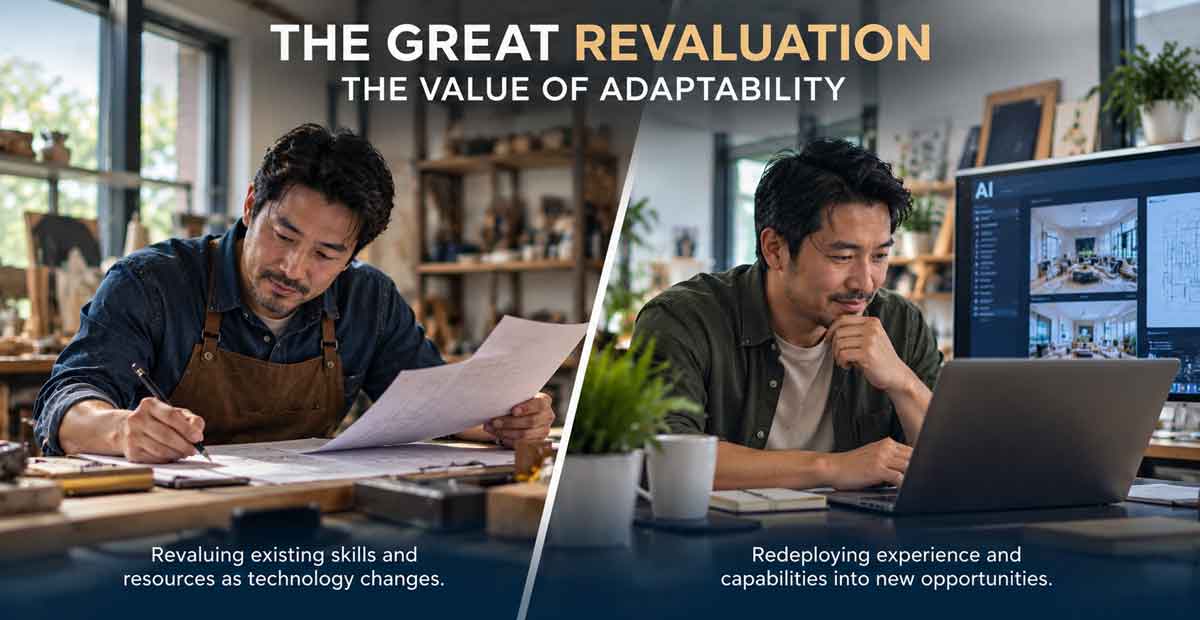
The Great Revaluation: Adaptability in the Age of AI
By: John F Groom
“When I let go of what I am, I become what I might be.” Commonly attributed to Lao Tzu; original attribution unverified For most of human history, people have devoted enormous effort to becoming something: a skilled craftsman, an accomplished professional, a successful entrepreneur, a respected executive, or the owner of valuable assets.
We invest years acquiring knowledge, building careers, developing relationships, and accumulating resources. Eventually, these accomplishments become part of our identities. We are no longer simply people who practice law, design buildings, or operate businesses. We become lawyers, architects, and business owners.
But what happens when technology fundamentally changes the economic value of the things we have spent our lives becoming? Artificial intelligence presents precisely this challenge. It is making previously scarce capabilities increasingly abundant, opening opportunities that would once have required years of education, substantial capital, or entire organizations.
The greatest beneficiaries may not be those with the most impressive existing qualifications or the largest accumulated resources. They may be those most willing to reconsider what they are and discover what they might become.
I. Adaptability: The Multiplier of Economic Value
The greatest asset may be the ability to revalue your assets. Consider two entrepreneurs who possess similar experience, financial resources, and business relationships.
The first has spent twenty years developing a successful company. Its products, employees, and operating methods have generated substantial profits. When AI creates opportunities to automate important parts of the business or enter new markets, this entrepreneur concentrates on protecting the existing organization.
The second entrepreneur has comparable resources but a different attitude. Rather than treating the current business as something that must be preserved, this entrepreneur views it as a collection of resources that can be deployed wherever they create the greatest value.
Existing employees can acquire new capabilities. Customer relationships can support different products. Financial resources can fund experiments in unfamiliar markets. AI can supply expertise that previously required expensive specialists.
The second entrepreneur may eventually operate a business that bears little resemblance to the original company. Both began with comparable resources. The difference was their willingness and ability to reposition them.
This suggests a useful distinction between two forms of economic advantage. Stored value consists of accumulated resources: knowledge, skills, experience, intellectual property, financial assets, physical infrastructure, reputation, and relationships. Adaptive value is the capability to recognize changing circumstances and redeploy those resources in ways that preserve or increase their usefulness.
Neither is sufficient by itself. Someone who continually changes direction without accumulating meaningful capabilities may accomplish very little. Someone who possesses extraordinary resources but refuses to adapt may watch their economic value deteriorate. The powerful combination is accumulated resources and the ability to redeploy them. Adaptability converts stored value into repositioned value.
II. The Twelve Potential Beneficiaries
The emerging AI economy presents opportunities to people possessing different forms of scarcity. Some have unusual human capabilities. Others control physical assets, possess institutional knowledge, or maintain relationships that cannot be manufactured instantly.
These twelve groups illustrate where economic opportunities may develop. Their outcomes will depend substantially on how effectively they adapt.
1. The Adaptive Entrepreneur
Flexible entrepreneurs with broad experience, a willingness to accept calculated risks, and the ability to coordinate small organizations may have substantial advantages. AI reduces the cost of exploring unfamiliar industries, developing products, testing business models, and managing geographically distributed teams.
An entrepreneur with experience in publishing, finance, real estate, or other fields may be able to enter software development or data services without first assembling a large conventional technical organization. The scarce capability is not simply the ability to use AI. It is knowing which opportunities to pursue, how to allocate limited resources, when to change direction, and when to abandon an unsuccessful experiment.
Long experience across multiple domains can be particularly useful because it provides a broader collection of ideas, relationships, and operating methods that can be recombined. But even an adaptable entrepreneur can become attached to a successful strategy. The capacity to pivot must remain active rather than becoming part of a flattering personal identity.
2. The Exceptional Human Performer
Elite athletes, distinctive actors, exceptional entertainers, and unusually recognizable models may benefit from possessing qualities that audiences value precisely because they belong to real human beings. AI can generate convincing synthetic performances, extraordinary simulated athletic achievements, and attractive digital personalities. But a simulated athletic achievement is not equivalent to a real person accomplishing something under genuine physical constraints.
Authenticity, personal history, distinctive appearance, charisma, and documented achievement may become important sources of scarcity. Yet exceptional ability alone will not guarantee commercial success. Performers may need to develop direct relationships with audiences, adopt new distribution methods, establish the authenticity of their work, and explore business models that were previously unavailable to them.
An athlete who once depended entirely on a sports organization or conventional media company may use AI-supported production and distribution to develop an independent international audience. The underlying human talent remains valuable, but adaptability determines how that talent is translated into economic opportunity.
3. The Exceptional Physical Craftsman
Skilled woodworkers, plumbers, electricians, restorers, and other craftsmen possess capabilities that combine specialized knowledge with difficult physical execution. Their work may remain comparatively scarce even as AI reduces the cost of many cognitive services. But the greatest opportunity may arise from combining traditional craftsmanship with entirely new supporting capabilities.
A skilled furniture maker could use AI to explore designs, prepare customer presentations, calculate materials, manage inventory, and reach customers around the world. A plumber could use AI for diagnosis, scheduling, estimates, accounting, and customer communication. The craftsman becomes not merely a producer of physical goods or services, but the operator of a much more sophisticated enterprise.
Adaptability is essential because the technology may also change the underlying craft. New materials, robotic equipment, and automated production methods will continue creating alternatives to traditional techniques. The successful craftsman must distinguish between capabilities that customers genuinely value and production methods maintained primarily through habit.
4. The Institutional Transition Manager
Large organizations possess enormous accumulated resources, but they also carry substantial institutional complexity. Existing employees, contracts, regulations, management structures, customer relationships, and technical systems cannot be replaced overnight. Senior executives and experienced managers who understand these organizations may occupy valuable positions during the transition to AI-intensive operations. Their advantage comes from combining institutional knowledge with the authority to coordinate substantial changes.
However, this position contains an important contradiction. A manager may benefit personally from preserving the organizational complexity that AI could eliminate. The management structures required to oversee a transformation may themselves become unnecessary once the transformation succeeds.
Adaptability therefore requires more than introducing new software. It may require executives to redesign or eliminate the very departments and management arrangements through which they accumulated authority. Those willing to do so may be able to reposition their experience within new organizations. Those who resist may discover that institutional authority is a temporary source of scarcity.
5. The AI-Amplified Professional
Experienced architects, lawyers, engineers, accountants, designers, and other professionals may find opportunities in supervising and improving increasingly sophisticated AI-generated work.
An architect who once devoted substantial time to preliminary drawings may instead direct AI to generate numerous alternatives, evaluate their merits, and refine the final design. A lawyer may concentrate on judgment, negotiation, and accountability while AI performs much of the routine research and drafting. The professional's accumulated experience becomes a means of directing a larger volume of production.
But experience is valuable only to the extent that it remains relevant. A professional who insists on performing every task personally may become less competitive than someone who uses AI to eliminate routine work while concentrating on decisions requiring human judgment. The challenge is to identify which elements of professional expertise remain scarce and continually reposition the business around them.
6. The Accelerated Young Professional
Ambitious young people may have an unusual opportunity to compress the traditional process of professional development. Historically, a young architect, lawyer, or engineer generally joined an established organization, performed relatively simple tasks, and gradually accumulated the experience necessary to manage clients and projects.
AI threatens many of those entry-level tasks, but it also makes sophisticated supporting capabilities available to individuals who previously lacked access to them. A young professional can use AI to develop prototypes, explore unfamiliar subjects, build specialized tools, and establish an independent practice with comparatively little administrative overhead.
This does not eliminate the need for professional competence, licensing, or appropriate supervision in regulated fields. AI-generated answers are not substitutes for the judgment required to protect clients and patients.
But young people who actively experiment, test their work, and learn from real-world consequences may acquire useful capabilities much faster than those who depend entirely on conventional career progression. Their potential advantage is not youth itself. It is the combination of initiative, rapid learning, and freedom from established organizational habits.
7. The Provider of Genuine Human Relationships
Caregivers, personal trainers, tutors, hospitality professionals, personal assistants, and others whose work depends on meaningful human interaction may benefit as artificial communication becomes increasingly abundant. AI can provide inexpensive information, advice, scheduling, educational materials, and simulated conversation. But many customers may continue to value the presence of another human being.
A personal trainer may use AI to develop exercise programs and analyze performance while concentrating personally on encouragement, accountability, movement correction, and the relationship with the client. A caregiver may use automated monitoring and administrative tools to devote more attention to the person receiving care.
Adaptability allows these workers to eliminate routine tasks while improving the human experience that customers actually value. The economic opportunity lies not in competing with AI to perform inexpensive administrative work, but in combining technological efficiency with authentic personal service.
8. The Owner of Scarce Physical Assets
Owners of strategically located real estate, energy infrastructure, specialized facilities, equipment, and other scarce physical resources may capture substantial value from AI-driven economic expansion.
But ownership alone does not guarantee success. A warehouse in an increasingly obsolete distribution network may lose value while a different location becomes essential to a new logistics system. A specialized manufacturing facility may become more valuable if it can accommodate robotics, or less valuable if its equipment cannot be economically adapted.
The owner who continually reassesses potential uses for existing assets may discover opportunities unavailable to someone who treats an asset's historical use as permanent. Adaptability in this context involves repositioning capital, facilities, and infrastructure as the physical requirements of production change.
9. The Producer of Original, Verifiable Information
As AI makes it increasingly inexpensive to generate text, images, and analysis, original information grounded in reality may become relatively more valuable. Investigative journalists, scientific experimenters, field researchers, inspectors, and specialized data collectors can provide evidence that AI cannot reliably manufacture independently.
Someone who can document actual conditions in a particular community, industry, or physical environment possesses something different from someone who merely generates additional commentary about it.
But information collection methods must also adapt. A researcher who previously produced conventional written reports might develop structured datasets, continuous monitoring systems, or verifiable multimedia records that can be used by numerous AI applications. The opportunity is to combine direct access to reality with increasingly sophisticated systems for organizing, validating, and distributing information.
10. The Owner of Trusted Networks and Distribution
As AI makes products and services easier to create, reaching customers and establishing trust may become increasingly important. People who possess longstanding customer relationships, specialized professional networks, or access to established communities may have advantages that cannot be reproduced instantly through software.
A business owner who has spent decades developing trust within a particular industry may use AI to introduce new products and services to existing customers. But those relationships must be repositioned carefully. Trust in one activity does not automatically transfer to another.
A customer who trusts someone to manage financial investments may not trust that person to provide medical advice or construction services. Adaptability therefore requires identifying new opportunities that are compatible with the network's established credibility rather than indiscriminately exploiting access to customers.
11. The Builder of the Physical AI Economy
AI requires substantial physical infrastructure. Data centers, electrical systems, robotic equipment, automated warehouses, and new industrial facilities must be constructed, installed, and maintained. Electricians, construction specialists, robotics technicians, and other workers involved in implementing these systems may benefit from periods of rapid investment. Their opportunity differs from that of craftsmen whose existing work remains difficult to automate. These workers may prosper specifically because businesses are adopting technologies that eliminate other forms of labor. But the opportunity may be transitional.
Once equipment is installed, demand for construction may decline. As robots become more capable, some installation and maintenance tasks may themselves be automated. Workers and businesses that continually acquire new technical capabilities may be able to move from one generation of infrastructure to the next. Those who depend entirely on a particular technology or installation method may eventually face the same displacement affecting other occupations.
12. The Extreme Specialist
People with unusually deep expertise in narrow fields may find that AI makes previously uneconomic businesses commercially viable. A specialist restoring rare mechanical watches, solving obscure engineering problems, or producing highly specialized scientific equipment may serve a small international market without requiring a large supporting organization.
AI can provide marketing, translation, customer communication, administration, and technical assistance, allowing the specialist to concentrate on the scarce expertise. Adaptability does not necessarily require abandoning the specialization. Instead, it may involve finding entirely new markets, applications, or business models for an existing capability. A specialist who previously served a handful of local customers might discover an international market that was inaccessible under conventional business economics.
III. Why Success Can Become an Obstacle
One of the paradoxes of adaptability is that the people with the greatest accumulated resources may have the strongest incentives to resist change. Their existing skills, assets, relationships, and organizational arrangements have served them well. They may have invested decades in acquiring them.
A successful lawyer may resist technology that reduces the economic value of traditional legal services. A corporate executive may oppose organizational changes that threaten established management structures. A business owner may continue defending a profitable product long after a new technology has begun undermining its market. Professional identity can reinforce these tendencies. Someone who has spent an entire career becoming an exceptional practitioner of a particular discipline may find it difficult to accept that the market no longer values that discipline as highly as before.
This is not simply irrational behavior. Existing resources may still produce substantial income, while new opportunities involve uncertainty and risk. Abandoning a proven business prematurely can be as costly as refusing to change an obsolete one. The difficulty is determining when continued commitment becomes attachment to a deteriorating economic position. Adaptability requires the willingness to reconsider assumptions without abandoning the judgment accumulated through experience.
IV. Learning Through Persistence
The ability to adapt is not equivalent to constantly changing direction. Successful adaptation requires recognizing change, evaluating alternatives, conducting experiments, and learning from the results. An entrepreneur who abandons every project at the first difficulty may never accumulate the experience necessary to succeed. A professional who adopts every new technology may waste substantial resources without improving the underlying business.
The more valuable capability is learning through persistence. When an experiment fails, the adaptable individual examines what happened. Was the underlying opportunity misunderstood? Was the execution inadequate? Did the market change? Can the existing resources be recombined in a more effective way?
The response should depend on the evidence. Sometimes the appropriate decision is to improve the existing approach. Sometimes it is to pursue an entirely different opportunity. Sometimes it is to stop. This distinction is especially important in an AI economy because the cost of experimentation may fall dramatically. A small team can test numerous ideas, develop prototypes, and evaluate different markets without committing the resources previously required.
But inexpensive experimentation is valuable only when the results produce meaningful learning. Repeatedly generating new products, business plans, or technological demonstrations without evaluating their real-world performance is activity, not adaptation. The advantage belongs to those who can translate experiments into better decisions.
V. AI Makes Adaptation Less Expensive
Historically, entering an unfamiliar industry could require years of education, substantial capital, and the recruitment of numerous specialists. An experienced publisher who wanted to develop software might have needed to assemble a technical team before testing a product. A skilled craftsman seeking international customers might have required expensive marketing, administrative, and distribution services.
AI reduces many of these barriers. Individuals can investigate unfamiliar subjects, develop prototypes, generate technical documentation, analyze markets, and acquire supporting capabilities at comparatively low cost.
This creates a reinforcing relationship between adaptability and AI. Adaptable people may make unusually effective use of AI because they are willing to explore new applications and reorganize their work. AI, in turn, makes it easier for them to enter unfamiliar fields and test new combinations of existing resources.
The relationship can be especially powerful for people with broad experience. Someone who has worked in numerous industries may possess a collection of ideas, relationships, and practical knowledge that previously seemed unrelated.
AI can make it easier to combine those resources into entirely new enterprises. The economic value of broad experience may therefore increase, provided the individual remains willing to learn and experiment.
VI. Adaptability at the Organizational Level
The same principle applies to organizations. A large company may possess extraordinary resources but struggle to redeploy them because its employees, management structures, and internal incentives are organized around existing activities. A small company may possess fewer resources but be able to reorganize itself quickly.
AI could magnify this difference. A relatively small organization may be able to coordinate people across multiple countries, combine specialized external services, and rapidly construct new products without developing a large permanent workforce.
Its advantage may come from treating the organization as a flexible collection of capabilities rather than a fixed hierarchy of departments and job descriptions. Employees can acquire new skills. Processes can be redesigned. Outside tools, datasets, and specialized services can be incorporated as opportunities arise. However, flexibility requires discipline.
An organization that continually changes direction without maintaining clear objectives, reliable systems, and accountability may become ineffective. The objective is not to eliminate organizational structure. It is to create structures that allow resources to be redeployed without sacrificing coordination and reliability.
This could become an important distinction between conventional corporations and AI-intensive enterprises. The latter may be organized less around permanent occupational categories and more around continuously changing combinations of human and computational capabilities.
VII. The Limits of Adaptability
Adaptability is potentially valuable, but it is not a universal solution. People differ in their available resources, obligations, financial security, and exposure to risk. A wealthy entrepreneur may be able to pursue numerous experiments while a worker supporting a family cannot afford to abandon a stable occupation.
Some professional transitions require years of education, formal licensing, or supervised experience. Others depend on access to capital, infrastructure, or customer relationships that AI cannot provide. Nor will every technological change create an attractive alternative for everyone affected.
A worker displaced from a declining industry may live in a community with few other employment opportunities. A highly specialized professional may face a substantial reduction in earnings even after successfully moving into a different occupation.
Adaptability can improve an individual's ability to respond to changing circumstances, but it cannot eliminate every structural constraint or guarantee economic success. There is also value in continuity.
An exceptional craftsman may preserve traditional methods because customers value the resulting work. A professional may retain a specialized practice because the underlying expertise remains scarce. A successful business may correctly conclude that its existing model is still economically attractive.
Adaptability sometimes means changing dramatically. Sometimes it means recognizing that change is unnecessary. The essential capability is maintaining an accurate understanding of the value of one's resources as circumstances evolve.
VIII. The Greatest Asset Is the Ability to Revalue Your Assets
The twelve potential beneficiaries of the AI economy possess very different advantages. Some have exceptional human talents. Others possess specialized physical capabilities, accumulated professional experience, trusted relationships, institutional authority, or scarce physical assets. Young professionals may benefit from learning rapidly and establishing independent enterprises. Experienced entrepreneurs may benefit from combining decades of knowledge with inexpensive computational capabilities. But none of these advantages is permanent.
Technology will continue changing what people can produce, what customers are willing to purchase, and which capabilities remain scarce. A skill that commands substantial compensation today may become inexpensive tomorrow. An asset that once seemed indispensable may become obsolete. A relationship or specialized capability that previously had limited commercial value may become the foundation of an entirely new business. The defining economic challenge is therefore not simply acquiring valuable resources. It is continually understanding their changing value. This is the central insight of adaptability within Valuism.
Accumulated intelligence, education, experience, wealth, and relationships provide the resources from which opportunities can be created. Adaptability determines whether those resources remain aligned with the changing needs and capabilities of society. In a relatively stable economy, people may prosper for decades by mastering a particular occupation and performing it consistently. In an economy transformed by rapidly advancing AI, the ability to repeatedly reposition one's capabilities may become an increasingly important source of economic advantage.
The enduring beneficiaries may not be those who possess the greatest resources at the beginning of the transformation. They may be those who recognize most effectively how the value of those resources is changing and have the willingness, judgment, and flexibility to deploy them in entirely new ways. The greatest asset is not necessarily what you know, what you own, or what you can do today. It may be your ability to recognize what those things will be worth tomorrow and act accordingly.
Whether you're exploring interoperability, dataset valuation, AI readiness, or ecosystem participation, we welcome conversations with researchers, organizations, and strategic partners interested in the future of structured data systems.
info@datauniversa.com