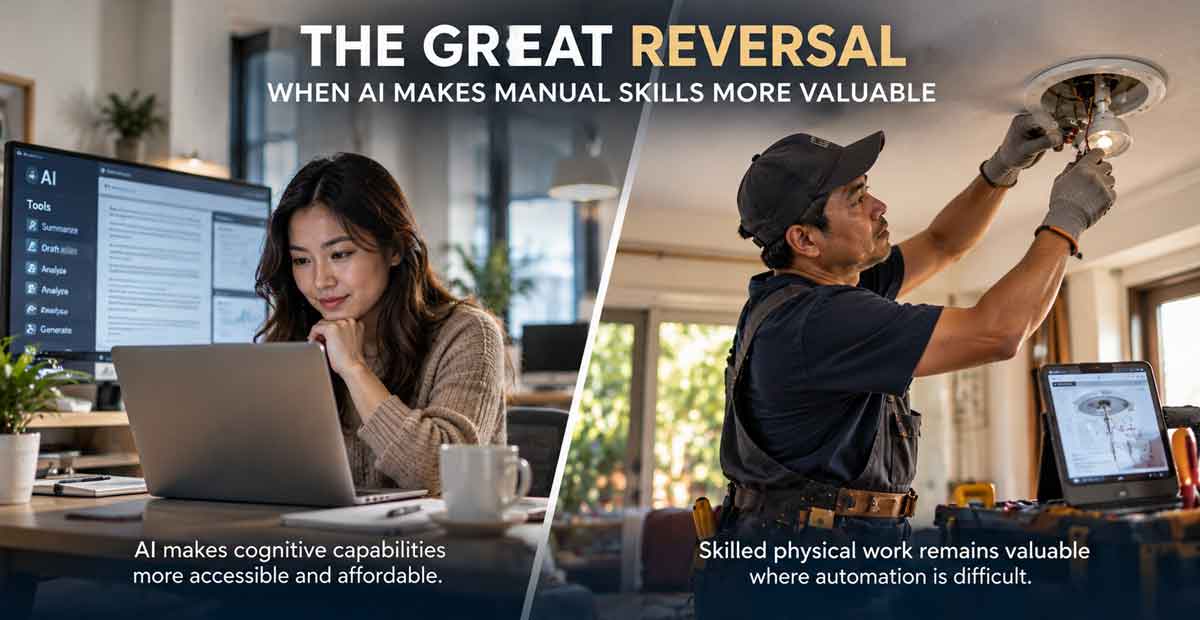
The Great Reversal: How AI May Finally Increase the Relative Value of Manual Labor
By: John F Groom
For hundreds of years, workers have fought technological advancement for a simple economic reason: technology threatens to reduce the market value of their labor. New machines allow fewer workers to produce more goods, new production methods undermine established skills, and new forms of competition can force workers to accept lower wages or move into different occupations.
Resistance has taken almost every imaginable form, including guild restrictions, protective legislation, strikes, destroyed machinery, attacks on employers, and trade barriers. Yet these efforts have repeatedly encountered the same underlying problem. When technology makes production substantially cheaper, restricting it in one location creates an incentive to adopt it somewhere else.
Now comes one of the great ironies of technological history. Artificial intelligence, arguably the most sophisticated technology humanity has developed, may accomplish something that centuries of labor resistance could not: a sustained reordering of economic values in favor of certain kinds of manual labor. It could do this not by protecting manual workers from technology, but by dramatically reducing the scarcity and cost of cognitive labor.
After centuries of workers fighting technology to protect their livelihoods, the most sophisticated technology in history may accomplish what protectionism could not.
London: When Technology Threatened Survival
It is difficult to visit modern London and imagine it as a major manufacturing center. Yet in the eighteenth century, London contained a remarkable concentration of workshops, small manufacturers, craftsmen, and laborers. The city attracted a growing population competing for employment in trades ranging from cabinetmaking and tailoring to construction, transportation, and textile production.
Access to many occupations was controlled through apprenticeships, guilds, and other restrictions intended to protect established practitioners. Many workers lived close to subsistence. Bad weather could drive up food prices, turning a reduction in wages into a threat to survival. An influx of competing workers or the introduction of a new production method could have similarly serious consequences.
Silk weaving in London’s Spitalfields district provides an especially revealing example. Weaving required considerable skill, and established workers had strong incentives to protect the value of that skill. New production methods and competition threatened their bargaining power. Resistance was sometimes violent, with workers attacking workshops and destroying equipment, while employers faced pressure not to introduce new machinery or employ labor at lower rates.
The Spitalfields Act of 1773 empowered magistrates to regulate wages in the London silk industry. In an 1823 petition to Parliament, London manufacturers argued that regulated rates deprived them of the economic advantage created by improved machinery and encouraged production in towns outside the regulated districts. The petition was advocacy for repeal rather than a neutral economic study, but it vividly illustrates the underlying incentive: when rules apply only in one place, production has an incentive to move elsewhere.
The legislation was intended to protect London weavers. Yet geographically limited protection could also encourage employers to take their business elsewhere. The underlying economic forces remained.
The Umbrella Problem
The same economic conflict can arise from technologies far simpler than an industrial loom. Consider the umbrella.
In eighteenth-century London, sedan-chair carriers earned their living transporting passengers through crowded streets. Rain made their services especially valuable. An umbrella offered pedestrians a relatively inexpensive way to avoid getting wet without hiring a chair.
Stories about transport workers attacking early umbrella users illustrate the perceived threat, although particular accounts of violence require careful historical verification. The economic mechanism is clear even without those stories. An umbrella did not perform every task of a sedan-chair carrier. It simply eliminated one reason customers needed that service.
This distinction is fundamental to technological disruption. Technology does not need to reproduce an occupation's entire range of capabilities to reduce its economic value. It only needs to provide a cheaper alternative to something customers previously paid workers to accomplish.
AI-assisted legal drafting provides a modern example. Software does not need to possess every capability of an experienced attorney to change what customers are willing to pay for routine documents. If a task can be performed adequately at a much lower cost, the economic value of the human labor previously required to perform that task can change.
Protectionism Moves the Problem
For centuries, workers and governments have attempted to protect existing economic relationships against new technologies and competitors. Guilds restricted entry into established occupations. Apprenticeship requirements could make it difficult for workers to change trades even when their existing skills were losing value. Restrictions on machinery sought to preserve labor-intensive production.
Modern trade protectionism operates through a related economic mechanism, although it serves additional objectives. As a country develops more productive industries, wages often rise. Higher incomes can contribute to higher living costs and wage expectations, even in occupations whose own productivity has increased less. A relatively simple manufacturing process can therefore become expensive in a technologically advanced country despite the country's superior industrial capabilities.
Manufacturers may relocate labor-intensive production to countries with lower wages. The advanced country may lose certain kinds of manufacturing employment partly because its economy has become more productive and workers have more valuable alternatives.
Tariffs attempt to alter this calculation by increasing the cost of imports. Trump's tariffs, for example, have included stated objectives of encouraging domestic manufacturing, protecting employment, and reducing dependence on foreign production. But foreign cost advantages can also arise from superior supply chains, economies of scale, subsidies, specialized expertise, and advanced technology, not simply lower wages.
Bringing manufacturing back does not necessarily restore the original jobs. A company returning production to a high-wage country may invest heavily in automation to make domestic production viable. The factory returns, but many of the workers who once operated its machinery may not.
Protection can preserve strategically important production, support employment for a period, or give industries time to develop. It cannot indefinitely preserve every production method or occupational valuation against sufficiently large technological advantages.
The Historical Direction of Technological Progress
For much of industrial history, technological advancement disproportionately transformed physical production. Mechanical looms reduced the labor required for textiles. Agricultural machinery allowed fewer farmers to cultivate more land. Assembly lines, industrial robots, and automated warehouses progressively reduced the effort needed to manufacture and distribute goods.
The result was enormous growth in productivity and living standards, accompanied by repeated disruption of established occupations. Meanwhile, many forms of cognitive labor retained substantial economic protection. Lawyers, doctors, accountants, engineers, and designers could command high compensation because their work required specialized knowledge, extensive training, or capabilities that were difficult to reproduce.
Education and professional credentials sometimes reinforced this scarcity. For many people, the path to higher earnings became associated with moving away from manual work and toward specialized cognitive work. Artificial intelligence challenges that relationship.
AI Changes Which Human Capabilities Are Scarce
AI directly reduces the cost of many cognitive tasks. It can write code, analyze documents, generate illustrations, prepare reports, translate languages, conduct research, and assist with sophisticated reasoning. Its capabilities can be distributed digitally at low marginal cost.
A designer increasingly competes with software capable of producing thousands of variations. A programmer can use systems that generate and debug code. An analyst can work alongside systems capable of examining vast amounts of information. These systems do not have to eliminate entire occupations to change their market value.
If one professional using AI can produce what once required five people, the same output may require fewer workers. Alternatively, lower prices may stimulate enough demand to employ more people. The outcome depends on the market, but the cost of producing many cognitive services is changing.
The International Labour Organization's 2025 assessment estimated that about one-quarter of global employment was in occupations with some exposure to generative AI, with particularly high exposure in clerical work. It emphasized job transformation rather than immediate wholesale replacement. Exposure is not a wage forecast, and observed wage effects remain uncertain.
Nevertheless, the technological possibility is clear: capabilities that once required expensive human expertise can increasingly be supplied by relatively inexpensive computational systems. When the scarcity of one kind of labor changes, the relative economic value of other kinds can change with it.
The Great Reversal
Consider a lawyer and a plumber. The lawyer has invested years acquiring specialized knowledge. Much of the work involves processing information, researching precedents, drafting documents, and communicating advice. AI can already assist with many of these activities.
The plumber also possesses specialized knowledge, but must combine it with physical execution. The plumber has to travel to a location, inspect a problem, manipulate tools, navigate the constraints of an existing building, and complete a repair. AI can help diagnose the problem, identify parts, prepare estimates, and manage the business. Software, however, cannot itself repair a leaking pipe.
A robot potentially could. But a machine capable of navigating unpredictable homes and performing varied physical repairs remains a different engineering and economic proposition from generating a document. The lawyer's cognitive output can increasingly be reproduced digitally. The plumber's physical services remain geographically constrained and comparatively difficult to automate.
This does not imply that plumbers will necessarily earn more than lawyers, or that all manual work will become highly compensated. Repetitive factory work has already been automated extensively, and robotics will continue advancing. The important distinction is between work that can be reproduced cheaply through software and work that requires difficult, unpredictable, or individualized physical execution.
Electricians, mechanics, specialized construction workers, caregivers, and skilled craftsmen may find that substantial portions of their work remain comparatively scarce as cognitive services become cheaper. In some occupations, the human interaction itself is part of the product. A trainer, chef, barber, or caregiver may provide an experience valued precisely because a person delivers it.
Valuism: Value Is Relative
The central premise is that economic value is relational. A capability's market value depends not simply on the effort required to acquire it or the prestige of an occupation, but on customers' willingness to pay, available alternatives, and the scarcity of people or systems able to deliver the desired result.
A skill can remain impressive while losing market value. A mathematician did not become less intelligent when electronic calculators arrived. The market simply stopped placing the same value on performing many calculations manually. Likewise, AI does not erase the intelligence or accomplishments of lawyers, programmers, and designers. It changes the supply of capabilities that customers once had to buy from them.
The reversal also does not necessarily mean falling absolute living standards. If AI sharply reduces the price of legal services, software, education, financial analysis, and other cognitive products, manual workers may be able to purchase far more with unchanged incomes. If demand for relatively scarce physical services rises, some manual wages may rise as well. Both mechanisms could operate together.
The Manual Worker Becomes a Cognitive Entrepreneur
Historically, running a manual business required much more than the ability to perform the underlying physical work. A carpenter needed to find customers, estimate costs, buy materials, keep accounts, negotiate contracts, schedule projects, and manage employees. Expansion often required specialized administrative staff. AI can put many of those capabilities directly in the carpenter's hands.
An independent tradesperson can use AI for a website, advertising, customer inquiries, proposals, financial records, and supplier coordination. The physical work remains the scarce capability while much of the supporting cognitive work becomes inexpensive. This could alter the economics of small enterprises. Instead of paying numerous intermediaries for cognitive services, skilled producers may retain more of the value generated by their work. In developing economies, where professional services can be expensive relative to local incomes, the opportunity may be especially significant.
A workshop in Kampala, a neighborhood store in Kenya, or an independent tradesperson in India could gain sophisticated marketing, financial, and technical capabilities without first building the institutional infrastructure accumulated by wealthy countries over generations. The opportunity is not merely greater productivity. It is greater control over businesses built around physical labor.
The Next Constraint: Robotics
The reversal is not guaranteed to last indefinitely. AI is being integrated into robotics, industrial automation, autonomous vehicles, and other systems capable of performing physical tasks. Some occupations that are currently resistant to automation may eventually become more exposed.
But physical automation faces constraints that digital automation does not. Software can serve customers globally from centralized computing infrastructure. A robot repairing plumbing must be present at the customer's home, with mechanical components, energy, maintenance, transportation, and the ability to operate safely in unpredictable environments.
A robot performing repetitive tasks in a controlled factory may be economical. A robot replacing a skilled tradesperson across hundreds of different physical situations presents a substantially harder problem. The relevant distinction, therefore, is not intellectual versus manual work as permanent categories. It is between capabilities that can be reproduced cheaply and capabilities that remain difficult to reproduce.
The Irony of Technological Progress
For generations, workers resisted technology because they feared machines would take away the economic value of their labor. They destroyed looms, defended guild monopolies, demanded protective legislation, organized strikes, and supported trade barriers. Such measures sometimes preserved employment or delayed disruption, but they could not permanently prevent more productive methods from transforming industries. AI introduces a reversal that earlier generations of manual workers could scarcely have imagined. Instead of making physical labor cheaper relative to intellectual labor, technology may make substantial portions of intellectual labor cheaper relative to physical labor.
The skilled tradesperson, craftsman, caregiver, and independent producer may gain relative economic importance as capabilities once monopolized by highly educated professionals become widely available through AI. At the same time, those workers may gain inexpensive cognitive tools that make their own labor more productive and their businesses more valuable. The ultimate outcome depends on AI adoption, robotics, demand, and the distribution of productivity gains. A sustained increase in the relative value of some manual labor is a plausible possibility, not an established result.
After centuries of attempting to protect manual labor from technological progress, humanity may discover that its most advanced technology creates a new economic advantage for some of the very kinds of labor that earlier technologies threatened. The great reversal, if it occurs, will not be the triumph of labor over technology. It will be the result of technology changing what human labor is worth.
Whether you're exploring interoperability, dataset valuation, AI readiness, or ecosystem participation, we welcome conversations with researchers, organizations, and strategic partners interested in the future of structured data systems.
info@datauniversa.com