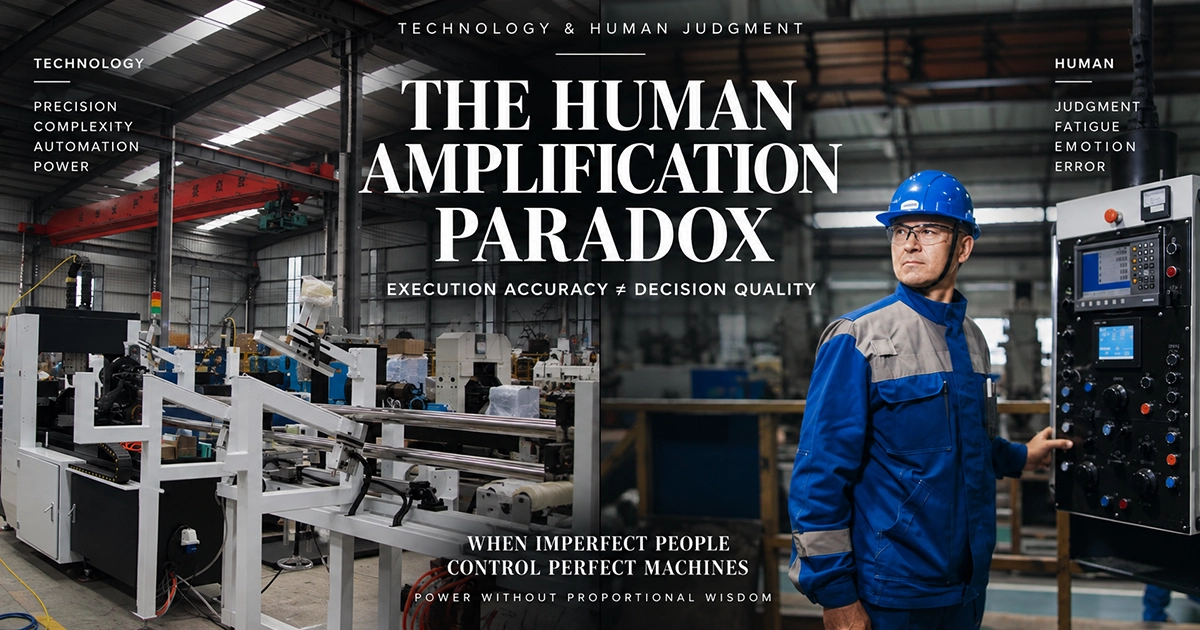
The Human Amplification Paradox
By: John F Groom
When Imperfect People Control Perfect Machines
A MyUniversa White Paper
One of the strangest features of technological progress is that technologies themselves can become extraordinarily precise without producing comparable precision in the human beings who decide how to use them. A modern semiconductor can require manufacturing tolerances measured in nanometers, extraordinary material purity, carefully controlled temperatures, sophisticated optics, vibration management and an environment protected from microscopic contamination. Thousands of engineers can spend years developing a process in which tiny deviations matter. Yet after all that precision has been achieved, the consequences of the resulting technology can depend upon a human being who is tired, angry, frightened, distracted, ambitious, sick, confused, ideological, hungry or simply mistaken.
This creates what might be called the Human Amplification Paradox: As technology becomes more powerful, precise and complex, the human decisions activating it do not necessarily become more powerful, precise or rational. The simplest human choices and errors can therefore command increasingly extraordinary capabilities. Technological progress expands not only what intelligence can accomplish, but what ordinary judgment, chance, fatigue, emotion and error can set in motion.
This is not fundamentally an argument that humans are becoming less competent. Human beings designed the semiconductor, built the aircraft, developed the nuclear reactor and created artificial intelligence. It is an observation about differential rates of improvement. Our tools can become more precise by orders of magnitude while the biological human being making the final decision remains recognizably similar to the person who made consequential decisions hundreds or thousands of years ago. The machine may operate at nanometer tolerances. The person deciding what to do with it still needs sleep.
The Wrong Turn at Sarajevo
Few events illustrate the problem better than the assassination of Archduke Franz Ferdinand on June 28, 1914. The familiar story is sometimes embellished by saying that Gavrilo Princip had given up after an earlier assassination attempt failed and stopped to eat a sandwich, only to have the Archduke’s automobile fortuitously stop in front of him. The sandwich appears to be a later invention; contemporary evidence does not establish that Princip was eating anything. But the historically supported version is remarkable enough without embellishment.
After surviving the first assassination attempt, Franz Ferdinand decided to visit men wounded by the bomb. His chauffeur, unfamiliar with the revised route, turned onto the wrong street. After being told of the error, the vehicle stopped only feet from Princip, giving him an extraordinary second opportunity. A wrong turn did not, by itself, cause the First World War. Europe already contained the Austro-Serbian conflict, nationalism, military competition, alliance commitments, mobilization plans and political leaders willing to escalate the resulting crisis. Those underlying conditions explain why one assassination could produce consequences that another assassination might not have produced.
But that distinction actually makes the example more important. A tiny contingent event encountered an enormous system already capable of amplifying it. The driver did not create the powder keg. His mistake helped place the match beside it. The subsequent consequences were almost incomprehensibly larger than the initiating error. Four years of industrial warfare killed millions of soldiers and civilians, destroyed empires, contributed to revolution in Russia, radically altered the political map of Europe and created conditions that helped shape the remainder of the twentieth century.
The contrast in scale is astonishing: a chauffeur turns onto the wrong street; an industrial civilization mobilizes artillery, railroads, machine guns, chemical weapons, factories and millions of human beings. The sophisticated machinery did not eliminate the significance of the ordinary mistake. It amplified the environment into which the mistake fell.
October 27, 1962
The Cuban Missile Crisis provides an even more disturbing example because the available technology had advanced from industrial warfare to thermonuclear destruction. President John F. Kennedy and his advisers spent thirteen extraordinarily tense days trying to prevent a confrontation over Soviet missiles in Cuba from becoming a nuclear war. Kennedy’s management included consequential acts of restraint, particularly his resistance to immediate military options while maintaining secret communication with Nikita Khrushchev.
Yet the crisis was not controlled solely from the White House and Kremlin. Hundreds of consequential decisions were being made simultaneously by pilots, ship captains, missile crews, intelligence officers, generals and local commanders, some of whom possessed incomplete information about what everyone else was doing. October 27 demonstrated how dangerous that distributed human system could become.
Soviet commanders in Cuba authorized the shooting down of Major Rudolf Anderson’s U-2, killing him. American officials initially interpreted the event as evidence of deliberate Soviet escalation, even though the decision had been made locally rather than ordered by Khrushchev. At almost the same time, another American U-2, piloted by Charles Maultsby, accidentally entered Soviet airspace after navigational problems near the North Pole, and Soviet fighters scrambled to intercept it. American decision-makers therefore faced what appeared to be deliberate hostile actions that were partly the products of decentralized decisions and ordinary human error.
Even more extraordinary events were occurring beneath the ocean. The Soviet submarine B-59 was being pursued by American naval forces using signaling depth charges intended to force it to surface. The Americans did not know the submarine carried a nuclear torpedo. The Soviet crew did not fully understand the Americans’ intentions. A weapon capable of transforming the crisis was therefore present inside a submarine whose exhausted crew was trying to interpret explosions occurring around it with limited communication from Moscow. Meanwhile, Soviet nuclear warheads in Cuba had been moved toward operational positions without American intelligence even knowing they were there.
The crisis therefore wasn’t a chess match between two perfectly informed leaders. It was an unstable network containing hundreds of human beings, powerful technologies, imperfect communications, standing orders, local discretion, misunderstandings and accidents. Kennedy and Khrushchev could exercise excellent judgment and still potentially lose control of events because someone several layers below them made a different decision. That is the Human Amplification Paradox in its most frightening form. The destructive technology was extraordinarily sophisticated. The chain connecting human intention to that technology remained messy.
The Human Being at the End of the Chain
Technological history is full of attempts to make machines more reliable. Engineers introduce redundancy, error correction, automated safeguards, checklists, interlocks, testing protocols and quality-control systems precisely because humans understand that failure is possible. Aviation has become extraordinarily safe partly because generations of engineers and operators systematically studied accidents and designed procedures to prevent their recurrence.
But technological reliability can obscure another problem. Even if the machine behaves exactly as designed, someone still decides what the machine should do. A missile may strike its programmed coordinates with extraordinary accuracy, but that does not establish whether striking those coordinates was a good decision. A financial system can execute millions of transactions correctly while implementing a disastrous strategy. An AI system may perfectly carry out an instruction that should never have been given. A semiconductor can perform billions of operations without error while being incorporated into a system serving a foolish objective. The distinction is fundamental: execution accuracy and decision quality are different variables. The better technology becomes at executing human intentions, the more important the quality of those intentions can become.
The Perfect Chip and the Messy World
Advanced semiconductor manufacturing makes the contrast almost visually perfect. A leading-edge fabrication plant represents one of civilization’s most extraordinary achievements in precision. The facility must control microscopic contamination because particles invisible to the human eye can interfere with manufacturing. Extremely sophisticated lithography systems create structures at scales difficult to intuit. Materials, gases, optics, software, machinery and process controls must interact with remarkable consistency.
The finished chip then leaves that controlled environment and enters human society. Immediately the conditions change. The chip may become part of an artificial-intelligence system, automobile, missile, medical device, smartphone, financial network or industrial machine. Engineers determine some uses. Corporate executives determine others. Consumers make millions more. Governments decide where some chips can be exported, which companies can manufacture them, whether particular technologies can be deployed and how they may be used in national-security systems. Presidents and other political leaders can therefore make consequential policy decisions affecting technologies whose internal operation they need not personally understand at an engineering level.
There is nothing inherently unusual about that division of labor. No modern leader can personally master semiconductor physics, nuclear engineering, biotechnology, monetary economics, artificial intelligence, military strategy and every other technical domain affected by government decisions. Modern civilization could not function if decision-makers had to reproduce the expertise embodied in every technology they governed. But the contrast remains extraordinary. Humanity can exercise almost unimaginable precision in constructing the tool while remaining remarkably imprecise in deciding what the tool ultimately does.
The Amplification of Ordinary Human States
A person living ten thousand years ago could become furious and make a terrible decision. He could misunderstand another person’s intentions, act out of jealousy, become exhausted, misremember something or make a decision while frightened. Those human characteristics have not disappeared. What has changed dramatically is the amplification available to them.
A moment of distraction can occur while driving a vehicle traveling seventy miles per hour. An exhausted physician can make a medication decision affecting a critically ill patient. A trader can move enormous amounts of capital electronically. A programmer can introduce code that reaches millions of devices. A military officer can make a local decision involving weapons whose effects extend far beyond the immediate battlefield. A political leader’s decision can affect technological supply chains spanning continents. The input can remain astonishingly ordinary while the output becomes extraordinary.
This is one of the great achievements of technology. A person does not need to understand thermodynamics to operate an automobile, radio engineering to use a smartphone or semiconductor architecture to run software. Civilization embeds enormous amounts of accumulated knowledge inside tools and allows ordinary users to activate that knowledge through simple interfaces.
Artificial intelligence extends this abstraction dramatically. Increasingly, an ordinary sentence can initiate a process incorporating vast amounts of computation, accumulated information and sophisticated software. A person may be able to ask for an analysis, computer program, design, translation or complex action without understanding the mechanisms producing it. That represents enormous individual empowerment. It also increases the possible distance between the sophistication of the capability and the sophistication of the instruction activating it.
Differential Acceleration
This fits the larger pattern of the Age of Increasing Variance. Technologies do not merely change rapidly; different parts of reality change at radically different speeds. Semiconductors improve rapidly. Artificial intelligence improves rapidly. Sensors become more accurate. Communication becomes faster. Manufacturing becomes more precise. Computing becomes more powerful.
Human biology moves much more slowly. The human operating these technologies still becomes tired after insufficient sleep. Hunger can affect attention. Pain can consume cognitive resources. Anger can alter judgment. Fear can distort risk perception. Status concerns can influence decisions. People become attached to prior beliefs, misunderstand one another, forget things and sometimes simply press the wrong button.
This does not make human beings defective machines. Human beings aren’t machines at all. Many of the same characteristics that produce variability, including emotion, intuition, imagination, curiosity, ambition and willingness to act under uncertainty, also produce extraordinary human achievement. The problem arises from assuming that improvements in the precision of our tools automatically produce equivalent improvements in the quality of the decisions made with them. They do not. The technology may accelerate while the operator remains human.
Complexity Can Increase the Importance of Simplicity
This leads to another apparent paradox. As technology becomes more sophisticated, some of the most valuable protections against catastrophic outcomes can remain remarkably simple. A checklist is simple. Getting enough sleep is simple. Asking another person to review an irreversible decision is simple. Waiting until morning before sending an angry message is simple. Separating the authority to initiate a dangerous action from the authority to approve it is conceptually simple. Designing systems so that mistakes are reversible is simple in principle, even when implementation is difficult.
The complexity of the underlying technology does not make these protections primitive or unimportant. It can make them more valuable. A civilization capable of manufacturing nanometer-scale semiconductor structures may still benefit enormously from someone saying, “Before we do this, have another person check it.” That is not a failure of technological sophistication. It is recognition of the interface between technological sophistication and human variability.
Designing for the Human Rather Than Imagining the Human Away
There are two broad responses to the Human Amplification Paradox. One is to try to remove humans from consequential decisions. Automation can indeed eliminate many categories of human error. Machines do not become tired, forget a checklist item because they are distracted, or become angry at another machine. But removing the human does not eliminate the problem entirely. Someone determines the objective being automated, selects the data, designs the constraints and decides when the automated system should be trusted. Automation moves human judgment to another point in the causal chain rather than necessarily eliminating it.
The more realistic objective is therefore to design systems around the fact that human beings are variable. High-consequence decisions should receive more safeguards than low-consequence decisions. Irreversible actions should require more confidence than reversible ones. Systems should create opportunities to catch mistakes before they propagate. Decisions made under unusual fatigue, emotional stress, illness or time pressure should receive additional scrutiny when circumstances permit. Where uncertainty is high, smaller experiments can substitute for large commitments. The objective isn’t to turn humans into semiconductors. It is to build systems that recognize that they never will be.
The MU Implication
This matters particularly to MyUniversa because MU is designed around the sentient beneficiary rather than an idealized rational actor. A real individual has changing energy, incomplete knowledge, emotional states, competing demands, physical limitations, habits, relationships and purposes. The same person can make an excellent decision on Monday morning and a poor version of the same decision late Friday night.
A genuinely individualized system should therefore care not only about what decision is being made, but also about who is making it, under what conditions, with what consequences and with what possibility of reversal. This becomes increasingly important as individuals gain technological leverage. A person equipped with AI may soon be capable of initiating work that previously required an organization. That expands individual efficacy, which is enormously valuable. It simultaneously increases the importance of judgment because a single decision can activate more capability.
MU should therefore seek to increase the quality of the interface between the beneficiary and the beneficiary’s expanding technological power. Sometimes that means providing more information. Sometimes it means recognizing that additional information has little value and action should begin. Sometimes it means suggesting a small experiment. Sometimes it means introducing another perspective. And sometimes the most intelligent intervention may simply be recognizing that an irreversible decision does not have to be made tonight.
This connects directly to the principle of Efficacy Without Comprehension. An individual does not need to understand the entire technological system in order to use it effectively. But greater technological leverage makes it increasingly important to understand the parts of reality relevant to the decision and to recognize the limits of one’s own current state.
Power Without Proportional Wisdom
The deepest point is not really about mistakes. It is about an asymmetry that may become one of the defining characteristics of technological civilization. Humanity’s ability to create capability is increasing extraordinarily rapidly. Our ability to place that capability into the hands of individuals is also increasing. Yet there is no corresponding law requiring wisdom, judgment, emotional stability or foresight to increase at the same rate.
The person does not have to become as sophisticated as the tool. That is precisely why tools are useful. But it means that the consequences available to an ordinary human decision can become increasingly disproportionate to the decision itself. A wrong turn can place an assassin beside an archduke. A navigational error can send an American reconnaissance aircraft into Soviet airspace during a nuclear crisis. A local military decision can suddenly confront national leaders with what appears to be an act of escalation. A simple instruction can activate a computational system containing complexity no individual could reproduce.
The future therefore will not consist simply of increasingly intelligent technologies producing increasingly intelligent outcomes. It will consist of extraordinarily sophisticated technologies continually encountering human beings: brilliant and foolish, rested and exhausted, generous and selfish, careful and impulsive, informed and mistaken, sometimes all within the same individual at different moments.
That interaction will produce extraordinary good. It will also produce accidents, surprises and outcomes nobody intended. The lesson is not that humans should reject powerful technology. The extraordinary opportunity of the coming period comes precisely from putting capabilities once reserved for governments and large organizations into the hands of individuals.
The lesson is that technological precision does not produce decision precision. As the power of our tools increases, seemingly mundane questions about human judgment may become more consequential rather than less. Who is making the decision? What does that person actually know? What state are they in? What happens if they are wrong? Is the action reversible? Can it be tested at smaller scale? Does someone else need to look at it? Is a decision required now at all?
Those questions would have been recognizable centuries ago. The technology surrounding them would not. That may be one of the central paradoxes of the world now emerging: we are building tools of almost unimaginable precision and complexity, and then handing them to the same wonderfully capable, hopelessly variable human beings who have always inhabited the Earth.
Whether you're exploring interoperability, dataset valuation, AI readiness, or ecosystem participation, we welcome conversations with researchers, organizations, and strategic partners interested in the future of structured data systems.
info@datauniversa.com