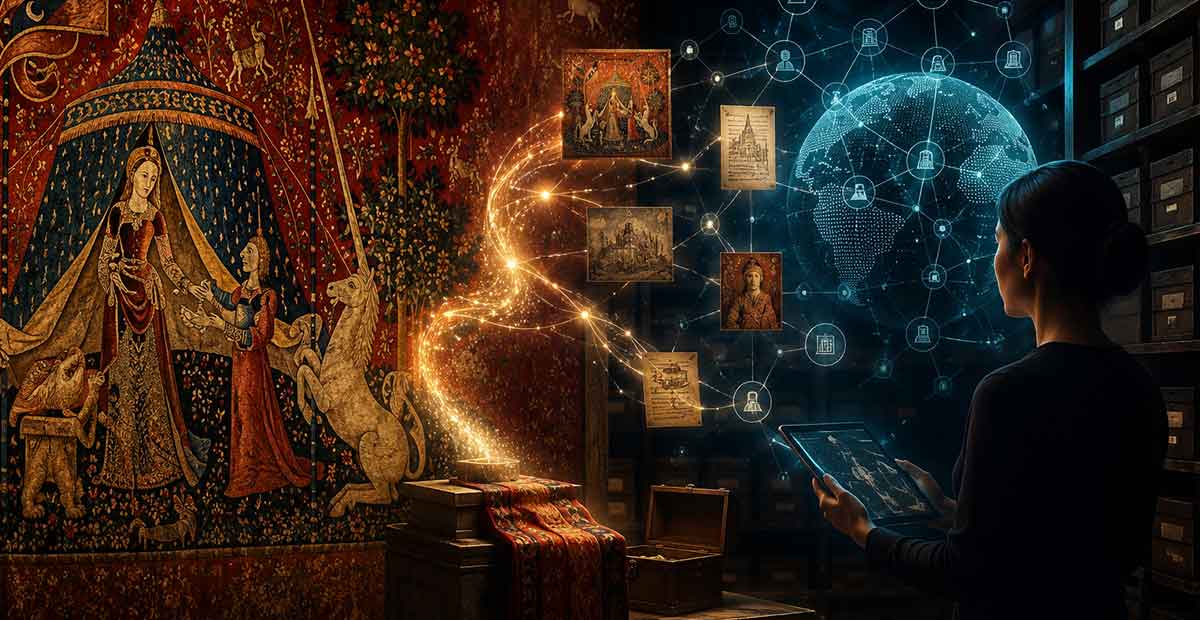
The Lady, the Unicorn, and the Lost Story: Why Provenance Matters Across Generations
By John F. Groom
Six magnificent tapestries survive from the beginning of the sixteenth century. Known collectively as The Lady and the Unicorn, they are among the most celebrated works of medieval European art. Five appear to represent the five senses—sight, hearing, taste, smell, and touch—while the sixth bears the enigmatic inscription À mon seul désir, usually translated as “To my only desire.”
We can stand before these tapestries today and examine their thousands of threads, brilliant colors, animals, flowers, heraldic symbols, and the mysterious lady who appears in each scene. Yet we cannot answer many of the questions that seem most natural. Who conceived them? Who designed them? Who actually wove them? Who was the lady, and why was the unicorn chosen? What did À mon seul désir mean to the people who created it?
We also do not know what disagreements occurred during the creative process, what alternatives were considered and rejected, or whether one person contributed an idea that fundamentally changed the final work. The objects survived, but much of the intelligence behind them did not.
That is the central problem of provenance.
A Masterpiece Survives, but Its Human Story Disappears
Tracy Chevalier’s novel The Lady and the Unicorn is compelling precisely because it attempts to fill this enormous historical void. The tapestries are real. The Le Viste family, whose heraldic arms appear in them, was real. The historical setting and the craft of tapestry making are grounded in reality.
Much of the human story, however, must be invented. Chevalier creates an artist, Nicolas des Innocents, and imagines weavers, families, relationships, rivalries, sexual encounters, creative decisions, negotiations, and conflicts. Her fictional characters provide what history failed to preserve: the human intelligence surrounding the creation of the physical object.
The novel therefore demonstrates something profound about the nature of historical loss. We have not necessarily lost the masterpiece itself. We have lost the network of human knowledge that produced it.
We know the result, but not the process. We possess the object, but not its complete history. We can see what was created, but we cannot reliably reconstruct who contributed what, why particular decisions were made, what alternatives were considered, or how the final result emerged through interactions among different people.
Five hundred years later, fiction must occupy the space where provenance should have been.
Provenance Is More Than a Chain of Ownership
Traditionally, provenance has been understood as a chain of ownership: who owned an object, when it changed hands, and whether it is authentic. That remains an important part of provenance, but it is far too narrow for the world we now inhabit.
At its deepest level, provenance is about preserving relationships across time.
A complete provenance record does far more than establish ownership. It can identify who created something, who contributed to it, what source material was used, where and when it was created, what decisions shaped it, what earlier versions existed, what evidence supports claims about it, how it was modified over time, how different people, objects, documents, and events relate to one another, and ultimately what happened to it afterward.
The surviving tapestry is only one node within a much larger human story. The artist's original sketch is another. The commission is another. The wool, dyes, and workshop all form part of that story, as do the weavers, patrons, assistants, family members, rejected designs, correspondence, payments, and later owners.
The tragedy is not simply that some of these details have been forgotten. It is that most of the connections between them have disappeared.
The Reversibility of Value
There is another reason provenance matters: human beings are constantly changing their minds about what is valuable.
Something regarded as extraordinarily important today may be forgotten tomorrow. Likewise, something considered ordinary—or even worthless—today may become priceless centuries later.
Sandro Botticelli died in relative obscurity, yet his surviving works are now among the most treasured paintings in the world. Early copies of Shakespeare's plays were not treated as sacred artifacts when they were first printed, yet surviving First Folios are now among the most valuable books ever produced.
The lesson is simple: we cannot assume that the present generation knows what future generations will value.
In this sense, provenance represents the reversibility of valuation across time. It gives humanity the ability to change its mind.
We may fail to recognize the importance of a person, object, idea, photograph, performance, experiment, solution, or creative act today. But if we preserve its identity, history, and relationships, people living fifty, one hundred, or even five hundred years from now still have the opportunity to rediscover it.
Without provenance, however, changing our minds may come too late. The object may survive, but its identity may be lost. The photograph may remain, but no one knows who is pictured. The solution may be copied while its originator disappears. The dataset may still exist, but its source can no longer be verified. The video may survive, yet its date, location, and circumstances have been forgotten.
The future cannot recover what the present failed to connect.
Everything Tag: Giving Things a Persistent Identity
This is where Everything Tag (ET) begins.
The fundamental idea behind ET is simple: anything that may matter should have a persistent identity. A painting can have one. So can a photograph, document, video, dataset, performance, physical object, prototype, solution, historical event, or individual creative contribution.
Identity alone, however, is not enough. That identity must become an anchor around which information can accumulate over time.
Imagine if every surviving component of The Lady and the Unicorn had possessed such an identity. The tapestries themselves. The original drawings. The artist. The individual weavers. The workshop. The patron. The commission. The dyes and materials. The preliminary designs. The rejected alternatives. The letters discussing the project. Even the people depicted—or symbolized—within the work.
Each of these elements could have been independently identified while remaining permanently connected to the others. The result would not simply be a database entry describing six tapestries. It would be a living, interconnected history of how those tapestries came into existence.
That is the first objective of ET: persistent identity.
In effect, ET says, This particular thing existed. This is its identity. Information about it can remain attached to it, continue to grow, and remain discoverable over time.
DataUniversa: Preserving the Relationships Among Things
But the true story of The Lady and the Unicorn cannot be understood through isolated objects alone. Its meaning exists in the relationships between those objects.
This is where DataUniversa (DU) comes in.
DU is built on the principle that data becomes exponentially more valuable when it is structured, identified, connected, attributed, and interoperable across different systems and contexts.
ET establishes that a person, object, document, or contribution has a persistent identity. DU helps establish how those identities relate to one another.
A particular person created a particular design. That design preceded a specific tapestry. A patron commissioned the work. A document records the transaction. A photograph depicts the object at a particular location on a particular date. A later interpretation relies upon earlier sources. One claim is supported by evidence, while another remains uncertain.
The objective is not simply to preserve more data. Humanity already produces extraordinary quantities of data every day.
The objective is to preserve the connections that make data intelligible. A thousand isolated facts are not necessarily history. A thousand connected facts may become one.
From Static Provenance to Living Provenance
Traditionally, provenance has been a retrospective exercise. Someone encounters an old painting and attempts to reconstruct its history by asking questions such as: Who owned it? Where was it before 1940? Is the signature authentic? Was it really painted by the artist to whom it is attributed?
This is provenance after the fact—an effort to rebuild history once much of the evidence has already disappeared.
ET and DU make possible a very different model: living provenance.
Instead of waiting centuries to reconstruct the past, provenance can begin the moment something is created. A person records a performance. The performance receives a persistent identity. The performer is identified. The date and location are recorded. The video is connected. The measurement methodology is preserved. The equipment used can be identified. Future performances can be linked to earlier ones, while corrections, annotations, and interpretations can be added without ever erasing the original record.
In this model, the history grows alongside the object itself.
Future generations no longer have to work backward from a surviving artifact and hope enough evidence remains to reconstruct its story. Instead, they inherit an accumulated record that has grown continuously over time.
Preserving Human Intelligence, Not Merely Objects
This distinction becomes even more important as artificial intelligence continues to advance.
Future AI systems may analyze The Lady and the Unicorn tapestries with extraordinary sophistication. They may identify materials, artistic influences, weaving techniques, or visual patterns that no human scholar has ever recognized.
What even the most powerful AI cannot do, however, is recover a conversation that was never recorded.
It cannot know with certainty who first suggested a particular symbol if no evidence survives. It cannot reliably distinguish historical fact from plausible speculation when the underlying provenance has vanished.
AI can reason over surviving evidence. It cannot recreate missing ground truth. For that reason, provenance becomes more important in the AI era, not less.
A connected AI system needs more than information. It needs to know what something is, where it came from, who created it, what evidence supports it, how it relates to other people and objects, and how much confidence should be placed in each claim.
ET provides persistent identity. DU provides structure, interoperability, and relationships. Provenance provides continuity across time.
Together, they create the possibility that future intelligence—whether human or artificial—inherits not merely our digital debris, but something much closer to an authenticated history of human activity.
What Will People Five Hundred Years From Now Wish We Had Preserved?
This is ultimately the question that The Lady and the Unicorn raises.
We know what we wish the people of 1500 had preserved for us. We wish we knew who designed the tapestries. We wish the original drawings had survived. We wish we knew the identities of the weavers. We wish we could read the correspondence, understand the negotiations, follow the creative decisions, and distinguish historical fact from later speculation.
The challenge is that the people of 1500 could not have known we would care. Neither can we know what people living in 2526 will find important about our own time.
Perhaps they will be fascinated by an obscure artist who goes unnoticed today. Perhaps it will be a small scientific experiment, an unknown athlete, an ingenious solution developed in a Kenyan village, a child's unique approach to learning, a building that no longer exists, or a failed prototype that quietly contained the seed of a later breakthrough. It may even be the firsthand account of an ordinary person who witnessed an event that history ultimately judges to have been transformative.
The greatest mistake we can make is assuming that we are capable of deciding, in advance, which human stories deserve to survive.
We are not.
What we can do is build systems that allow far more of those stories to remain identifiable, attributable, and connected, leaving future generations with the evidence to determine their significance for themselves.
The Difference Between an Artifact and a History
The Lady and the Unicorn survived. Its complete story did not.
That distinction explains why provenance is more than an administrative function for museums, collectors, archives, or corporations. It is part of the infrastructure of civilization.
An artifact tells us that something existed. Provenance tells us where it came from. Identity tells us that it is this particular thing and not another. Relationships explain how it connects to people, events, places, evidence, and other objects. Accumulated across generations, those connections become history.
The ambition behind Everything Tag and DataUniversa is not to determine what future generations should value. It is something both more modest and, perhaps, more important: to give future generations a better opportunity to make that determination for themselves.
Five centuries from now there will still be mysteries. There will still be gaps, forgotten people, and lost stories. But perhaps there will be fewer instances where a magnificent object survives while nearly all of the human intelligence behind its creation has vanished.
Perhaps the people of the future will not always need a novelist to invent the missing story.
Perhaps, this time, we can leave them the connections.
Whether you're exploring interoperability, dataset valuation, AI readiness, or ecosystem participation, we welcome conversations with researchers, organizations, and strategic partners interested in the future of structured data systems.
info@datauniversa.com