The Litter Box and the Future: Technology Does Not Have to Change the World
By: John F Groom
When we talk about technology, particularly now, we tend to talk about enormous things. Artificial intelligence may transform how humans create knowledge, make decisions, diagnose disease, educate children, operate businesses, and communicate with one another. Nuclear technology gave humans the ability to destroy cities in seconds. The internet connected billions of people. Electricity transformed virtually every aspect of modern life.
These are technologies that change the structure of society. But most useful technology isn't like that. Sometimes technology simply finds a better way to solve a problem that humans have been dealing with for a very long time. Consider the litter box.
A Very Old Problem
Humans have lived with domesticated cats for thousands of years. Once cats began living primarily indoors, their waste presented an obvious problem. The modern solution was simple: put absorbent material in a box, let the cat use it, and have a human periodically remove the waste.
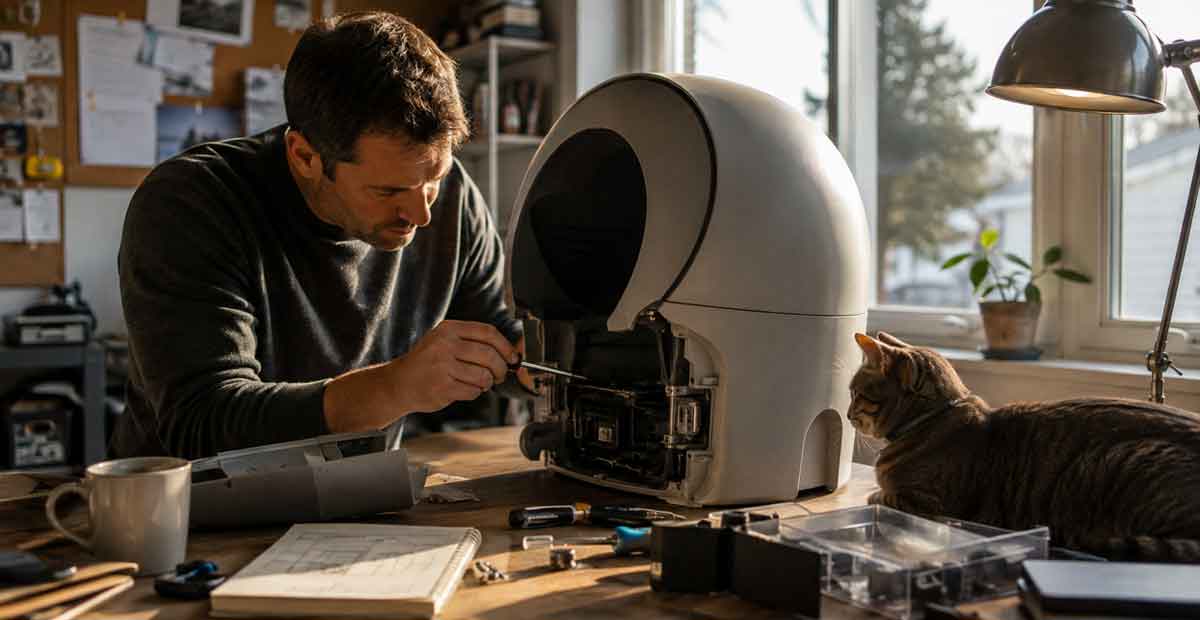
It works. But it creates another problem: someone has to clean the litter box. That is where Brad Baxter entered the story. Baxter was a mechanical engineer who acquired two cats in 1999. Like millions of other cat owners, he didn't particularly enjoy cleaning their litter box. When it wasn't cleaned frequently enough, his cats sometimes went outside the box. There were already technological solutions. Baxter bought an automatic litter box that used a mechanical rake to remove clumped waste.
The machine represented technological progress, but Baxter concluded that it didn't solve the problem particularly well. The rake could become dirty and clogged, and it could push waste and litter around rather than simply removing it. Baxter began thinking about the problem differently. Instead of moving a rake through the litter, why not move the litter itself?
Rotate the Box
The fundamental idea behind what became the Litter-Robot was remarkably simple. Put the litter inside a rotating chamber. After the cat leaves, rotate the chamber so that gravity moves the litter through a screen. Clean litter passes through while the larger clumps are separated and deposited into a waste compartment. Then rotate everything back into position.
The next cat finds clean litter. There was nothing revolutionary about any of the underlying physical principles. Gravity had existed for quite some time. So had screens, rotating drums, and cats. The innovation was putting these things together in a way that solved a mundane human problem better.
Baxter also discovered that another inventor, Don Reitz, had previously patented a similar rotating litter-box concept. Rather than pretending the previous work didn't exist, Baxter licensed the technology and developed it further. He built prototypes, improved the sensing and mechanical systems, found ways to manufacture the unusual plastic components economically, and gradually turned the idea into a viable consumer product.
The first Litter-Robot appeared in the early 2000s. What started as a man trying to avoid scooping cat litter eventually became the foundation of Whisker, a substantial consumer technology company.
Innovation Doesn't Require a New Problem
This is an important lesson about technology. We frequently confuse technological innovation with the discovery of entirely new problems. But most human problems aren't new.
People have always needed food. They have always needed shelter and transportation. They have always needed to communicate, deal with illness, dispose of waste, and save time.
Technology often changes how we solve these problems rather than changing the underlying problem itself.
The washing machine didn't discover dirty clothing. The refrigerator didn't discover spoiled food. The automobile didn't discover transportation. The calculator didn't discover arithmetic. And the Litter-Robot didn't discover cat waste. Each simply offered a different solution to an existing problem.
The Importance of the Ordinary Problem
There is a tendency, particularly in technology circles, to attach importance to the apparent sophistication of a problem. Building artificial intelligence sounds important. Cleaning a litter box does not. But this is a poor way to measure value.
For the person who has to scoop a litter box every day for 15 years, eliminating most of that task creates real value. Suppose an invention saves someone five minutes every day. That doesn't sound transformative. But over 20 years, that is more than 600 hours of human life. Multiply that by a million users and the supposedly trivial invention has returned hundreds of millions of hours to people.
The problem may be small at any particular moment while enormous in aggregate. This is one reason mundane problems can produce very successful businesses. A problem doesn't have to be profound if it is experienced frequently by enough people.
Observation Before Technology
The Baxter story also illustrates something important for DataUniversa. Start with reality. Baxter didn't begin by saying, "I have developed a rotating electromechanical platform. What consumer application can I find for it?"
He had cats. The cats produced waste. The waste had to be removed. He didn't like removing it. An existing machine attempted to solve the problem. He used that machine and observed its shortcomings. Then he asked whether there was a better way.
That sequence matters: Reality → Observation → Problem → Existing Solution → Failure or Constraint → Better Solution → Evidence
Technology comes relatively late in the chain. This is almost the opposite of one of the great temptations of the AI era: Technology → Search for Problem
When a powerful new technology appears, people understandably begin looking everywhere for applications. Some will prove enormously valuable. Others will be elaborate technological solutions to problems that barely exist. Baxter's approach started at the other end. The problem unquestionably existed.
The HOSI Perspective
This is also why Baxter's experience resembles the logic behind Human Observation and Solution Intelligence, or HOSI. A HOSI begins with something observed in the real world. Someone encounters a problem, constraint, or opportunity. They try something. Something happens. The result can be documented. Other people can then examine what happened and determine whether the observation or solution might be useful elsewhere.
Baxter's story could almost be expressed as a primitive HOSI. The observation was that cleaning a cat's litter box is unpleasant and must be performed repeatedly. An existing intervention used an automatic rake to remove waste, but the rake itself became part of the problem. Baxter's alternative was to rotate and sift the litter using gravity. The result was a mechanism that could separate waste without repeatedly dragging a rake through the litter.
From there, the idea required iteration. Geometry, liner design, sensors, manufacturing, reliability, and user experience all had to be improved. External validation came when other cat owners bought and continued using the product.
The eventual size of the company is interesting, but it isn't what makes the original observation valid. The observation was valid when Baxter was standing next to his cats' litter box. Commercial success simply demonstrated that a great many other people had essentially the same problem.
AI and the Litter Box Are Part of the Same Story
Artificial intelligence and an automatic litter box seem to belong in entirely different conversations. In one sense, they do. AI could become one of the most consequential general-purpose technologies humans have ever developed. An automatic litter box will not reorganize civilization. But they are also points on the same spectrum.
Technology is simply a means of increasing our ability to accomplish something. Sometimes the thing being accomplished is extraordinary. Can a machine reason across millions of pieces of information? Can we predict the structure of proteins? Can a person on one side of the planet communicate instantaneously with someone on the other?
And sometimes the question is much simpler: can I avoid scooping this litter box every morning? There is no reason to dismiss the second category. In fact, most improvements in human life probably come from thousands of relatively small solutions accumulating over time rather than from a handful of spectacular inventions.
Better hinges, insulation, shoes, packaging, irrigation, toothbrushes, mattresses, worker scheduling, methods for identifying a sick child, ways of keeping food cold, and ways of cleaning up after a cat all remove some amount of friction from human life.
AI May Make Small Innovation More Important
There is another reason the Baxter example matters now. AI dramatically reduces the cost of knowledge and analysis. Someone encountering a mundane problem today can potentially ask an AI system about materials, existing patents, manufacturing techniques, competing products, scientific principles, costs, and possible designs.
That doesn't eliminate the need for human observation. It makes the observation more valuable. Millions of people encounter small problems every day and think, "There has to be a better way to do this."
Historically, the distance between that observation and a viable solution could be enormous. The observer might lack engineering expertise, access to research, capital, programming ability, manufacturing knowledge, or simply the ability to find someone who had previously encountered the same problem.
AI can shorten that distance. Systems such as HOSI can preserve the observations themselves, while AI can help connect those observations to accumulated knowledge and possible solutions.
The combination could be powerful. Humans encounter reality. They identify problems. Evidence systems preserve what happened. AI connects the observation to accumulated knowledge. Technology helps construct and test possible solutions. Reality determines whether they work.
Progress Usually Looks Smaller Up Close
We tend to write the history of technology around spectacular breakthroughs: the steam engine, electricity, antibiotics, automobiles, computers, nuclear power, the internet, and artificial intelligence. That makes technological progress look like a sequence of revolutions.
Living through it looks different. It is millions of people repeatedly encountering the world and asking whether some part of it could work a little better. Occasionally, the answer changes civilization. Usually, it doesn't.
Sometimes it changes how humans produce knowledge. Sometimes it changes how we treat cancer. Sometimes it changes how we communicate across continents. And sometimes a mechanical engineer looks at a dirty litter box and thinks: Why are we raking this when we could rotate it? That, too, is technological progress.
Whether you're exploring interoperability, dataset valuation, AI readiness, or ecosystem participation, we welcome conversations with researchers, organizations, and strategic partners interested in the future of structured data systems.
info@datauniversa.com