The Lost Recipes of My Childhood: Provenance Is Not Just for Great Art
By John F. Groom
When people hear the word provenance, they usually think of rare and valuable objects—an Old Master painting, an ancient manuscript, a historic piece of furniture, or perhaps a famous diamond. Provenance is traditionally understood as the documented history of an object: who created it, who owned it, where it has been, and how we know it is authentic.
But provenance is really about something much broader.
At its core, provenance is about preserving the history of anything that people create and value before that history disappears. That may include a painting worth fifty million dollars, but it can just as easily include something far more ordinary, such as a plate of spaghetti with meat sauce that a child loved at a neighborhood restaurant.
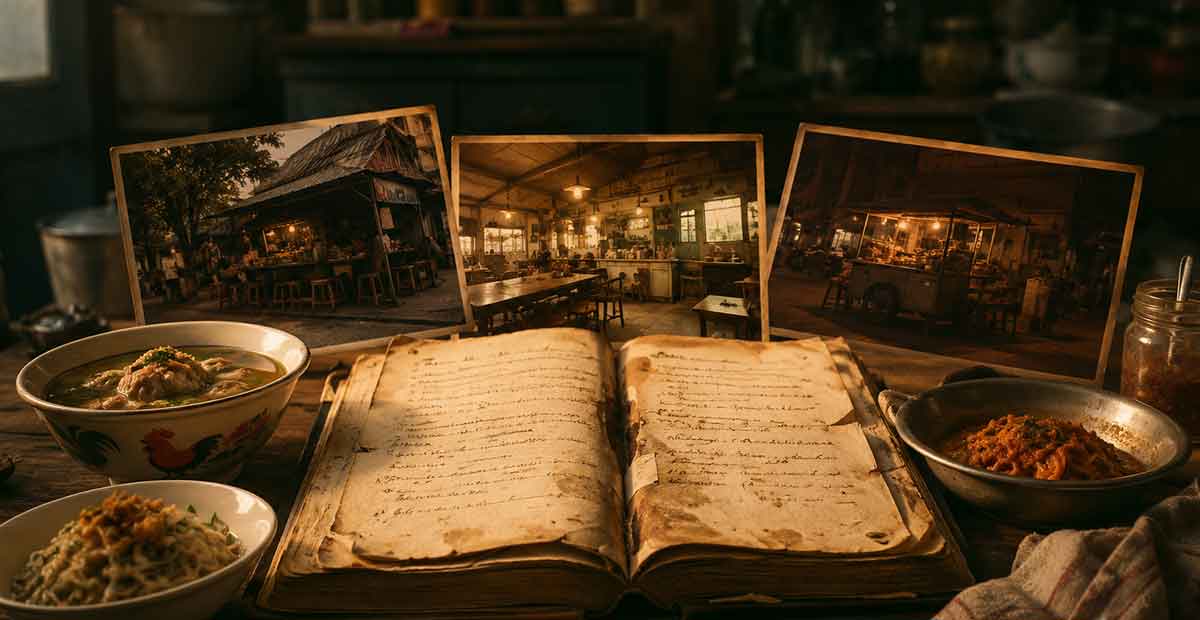
I have been thinking about this because of three restaurants I remember from my childhood and youth in Northern Virginia: Taco Laredo in Falls Church, Lum's in Rosslyn, and The Alpine on Lee Highway in Arlington.
None of them was a destination for haute cuisine. I do not remember eating foie gras, truffles, or caviar at any of them. What I remember instead are remarkably simple foods—a melted-cheese enchilada and burrito, a roast beef sandwich, and a plate of spaghetti with meat sauce.
Yet I still remember those meals more than fifty years later.
As far as I know, however, the exact recipes that created those memories may no longer exist.
Three Restaurants, Three Memories
Taco Laredo was an inexpensive Tex-Mex restaurant in Falls Church, near the State Theatre. The dish I remember most vividly was its cheese enchilada and burrito. The ingredients were almost certainly simple—tortillas, cheese, sauce, and a handful of basic components—but the result was distinctive. There was something about the flavor that has stayed with me for decades.
That distinction matters.
It is easy to dismiss the memory by saying, "It's just a cheese enchilada." After all, there are thousands of cheese enchilada recipes.
But that misses the point.
There are thousands of landscape paintings as well, yet we do not consider them interchangeable simply because they depict similar scenes.
The question is not whether someone can make a cheese enchilada.
The question is whether anyone can recreate that cheese enchilada—the one served at Taco Laredo in Falls Church during a particular period of my childhood.
Lum's in Rosslyn represents a different kind of memory. Although the chain became nationally known for its beer-steamed hot dogs and eventually operated hundreds of locations, what I remember is a particularly good roast beef sandwich. The chain ultimately disappeared, and with it may have vanished countless details about how individual menu items were prepared in particular restaurants.
Then there was The Alpine on Lee Highway in Arlington, a true neighborhood institution. For forty-four years, chef-owner Ermanno Tonizzo served Italian food before retiring and closing the restaurant in 2010. The dish that remains with me is its spaghetti with meat sauce. There was nothing exotic about the meal itself, yet I still remember that particular spaghetti and that particular sauce as being exceptionally good.
Today the restaurant is gone, and even the building has disappeared.
These restaurants also represent something that seems increasingly uncommon: affordable neighborhood establishments that serve familiar food consistently for decades. They become woven into the geography of people's lives. Families return year after year. Children grow up eating there. While they remain open, few people think of them as historically significant.
Then, almost without notice, they close.
And one day, they exist only in memory.
What Actually Happens to a Recipe When a Restaurant Closes?
We often think about recipes as though they are simple collections of instructions: a cup of this, a teaspoon of that, bake for twenty minutes at 350 degrees.
In reality, a restaurant dish is often a far more complex information system.
The written recipe may specify the ingredients, but it may not identify the exact brand of cheese that was used or the supplier whose product consistently had a slightly different texture or fat content. It may not explain that the sauce was routinely simmered longer than the official instructions suggested, that a particular pan produced better results, that one oven consistently ran a little hotter than another, or that the dish tasted noticeably better after resting for several hours before service.
The finished meal is often the product of far more than a written formula.
It reflects the formal recipe, the specific ingredients and suppliers available at the time, the brands and formulations that happened to be used, the equipment in the kitchen, the order in which ingredients were combined, the temperatures and cooking times, undocumented adjustments made by experienced cooks, changes that occurred during holding or service, and countless pieces of practical knowledge that nobody ever thought to write down because they seemed obvious to the people preparing the food every day.
In other words, the real recipe is not simply a piece of paper.
The real recipe is a provenance chain.
When a restaurant closes, that chain begins to break apart.
The owner retires. The cooks move on to other jobs. Ingredient suppliers disappear or change their products. Menus are discarded. Handwritten recipe cards end up in a forgotten box in someone's basement. Manufacturers reformulate cheeses, tomato products, spices, and sauces. Eventually the building itself may be demolished.
Ten years later, someone remembers the food.
Fifty years later, someone asks how it was made.
And no one knows.
The Strange Inequality of What We Preserve
There is something remarkably uneven about the way society decides what deserves a documented history.
If a painting is worth millions of dollars, experts may spend years reconstructing its provenance. They trace auction records, family collections, gallery sales, old photographs, correspondence, shipping documents, restoration histories, and ownership records. A gap of only a few years in the history of a famous painting can become an important scholarly question.
Now consider a very different example.
Suppose a neighborhood restaurant serves a particular dish to one hundred thousand customers over the course of forty years. Suppose thousands of those people genuinely love it and continue remembering it decades later.
When the restaurant closes, what survives?
In many cases, almost nothing.
The exact recipe may be lost. No one records videos showing how the dish was prepared. Ingredient suppliers are forgotten. The cooks are never interviewed. The subtle changes made over decades are never documented. In some cases, even a complete copy of the menu disappears.
The information was never worthless.
It simply existed in a world that lacked systems designed to recognize and preserve its value while it was still available.
The Alpine illustrates this perfectly. Historical records allow us to document that the restaurant operated for forty-four years, closed in 2010, and even replaced an earlier business known as the Evans Coffee Shop. We can reconstruct the history of the building and the succession of businesses that occupied it.
But can we reconstruct, with confidence, the exact spaghetti with meat sauce that I remember eating there?
That is a far more difficult question.
And it reveals the deeper provenance problem.
Human beings have become remarkably good at recording that something existed.
We are far less successful at preserving the knowledge required to recreate it.
Provenance for Ideas, Processes, and Experiences
The lesson extends far beyond restaurants.
An idea can disappear because no one recorded who first proposed it or how it evolved. A manufacturing technique can vanish when the one experienced worker who understood it retires. A family recipe may be lost when the only person who knows how to prepare it dies. A craftsman's methods can disappear because the finished object survives while the knowledge required to create it does not. A medical observation may never influence future care because it was never formally documented, and a practical solution developed by an ordinary person can vanish simply because no one thought it important enough to preserve.
Although these examples come from very different fields, they all share the same underlying problem.
Human beings created something valuable, but the provenance chain was incomplete.
Sometimes we preserve the final result but lose the history behind it. Sometimes we remember the creator but forget the process. Sometimes we keep the written instructions while losing the practical knowledge that made those instructions work in the first place.
This is why provenance should not be viewed as a specialized concern reserved for museums, auction houses, collectors, or historians.
Provenance is the infrastructure of human memory.
It allows us to answer questions that apply to almost everything we create:
Where did this come from? Who created it? How was it made? What changed over time? What evidence still exists? Can it be reproduced? Can we trust the reconstruction? And ultimately, what will future generations know that we know today?
Those questions apply just as naturally to a family recipe, a scientific discovery, a software program, a manufacturing process, or a business decision as they do to a famous painting hanging in a museum.
The Recipe Nobody Thought to Save
Perhaps somewhere, someone still remembers exactly how Taco Laredo prepared its cheese enchilada.
Perhaps a former employee from Lum's could still explain how the Rosslyn location made its roast beef sandwich.
Perhaps one of The Alpine's former cooks could recreate its spaghetti with meat sauce entirely from memory.
The knowledge may not yet be gone.
But if it survives only in someone's memory, then it is already vulnerable.
That is the central lesson.
Knowledge rarely disappears because of a single catastrophic event. There is no dramatic fire, no deliberate destruction, and no moment when humanity consciously decides that something should be forgotten.
Instead, information simply stops being tracked.
One cook retires.
One recipe card is discarded.
One restaurant closes.
One supplier disappears.
One person who remembers dies.
Eventually the chain becomes impossible to reconstruct.
What disappears may be something universally celebrated or something wonderfully ordinary—a cheese enchilada served in a small neighborhood restaurant, a roast beef sandwich from a chain that no longer exists, or a plate of spaghetti that a child remembers more than fifty years later.
The monetary value of the thing is not what determines whether provenance matters.
What matters is that something distinctive once existed, someone found value in it, and without a preserved record, the knowledge of what it was, how it was created, and why it mattered can disappear forever.
That is why provenance is not really about old paintings.
It is about preventing the unnecessary loss of human knowledge.
Sometimes the easiest way to understand that idea is not by looking at a masterpiece displayed behind museum glass.
Sometimes it begins with remembering a plate of spaghetti that no one today may know exactly how to make.
What a Modern Provenance System Could Have Preserved
Imagine if, before each of these restaurants disappeared, someone had created a living provenance record for the foods people remembered most.
Not simply a typed recipe, but a continuously evolving record of everything that made those dishes unique.
For Taco Laredo's cheese enchilada in Falls Church, the record might have included the exact cheese or cheese blend, the tortilla supplier, the sauce ingredients, photographs of the original packaging, videos showing how the dish was prepared, cooking temperatures and timing, the identities and recollections of the cooks who made it, the years during which that particular version was served, and comments from customers who remembered eating it. The same approach could have preserved the roast beef sandwich at Lum's in Rosslyn and the spaghetti with meat sauce at The Alpine on Lee Highway.
Just as importantly, the system would not need to pretend that every piece of information carried the same level of certainty.
Perhaps the original written recipe still survives. That would represent one form of evidence. A former cook who prepared the dish hundreds of times but no longer has written documentation would contribute another. Longtime customers might independently remember the unusual cheese used in the Taco Laredo enchiladas or the distinctive flavor of The Alpine's meat sauce. Those recollections would not prove the recipe, but they would still become valuable evidence within the historical record.
Even modern reconstruction attempts could contribute to that history. If someone recreated the recipe and ten former customers independently agreed that it tasted remarkably close to the original, that consensus would become another layer of evidence rather than a final declaration of certainty.
The objective is not to manufacture certainty where certainty does not exist.
It is to preserve what is known, distinguish it from memory and inference, document the evidence supporting each claim, and allow the record to become richer and more accurate as new information is discovered.
That is the broader vision behind Everything Tag and DataUniversa.
Everything Tag provides a persistent identity for anything people consider worth remembering, whether it is a painting, a physical object, a recipe, a manufacturing process, an idea, a practical solution, or even a particular version of a neighborhood restaurant's signature dish served during a specific period of time. DataUniversa then transforms the information surrounding that identity into a structured, connected, machine-readable, provenance-aware record that continues evolving as additional evidence emerges.
The Taco Laredo cheese enchilada therefore becomes much more than a nostalgic memory in an article.
It becomes a living knowledge object.
Its record could include the restaurant's location, years of operation, surviving menus, recipes where available, ingredient suppliers, photographs and videos, the people who prepared it, customer recollections, documented reconstruction attempts, changes made to the recipe over time, conflicting memories where they exist, confidence levels associated with each claim, and links to related restaurants, people, places, dishes, and historical events.
Most importantly, the record would acknowledge that the recipe itself may never have been a single fixed thing.
Perhaps Taco Laredo changed cheeses in 1978. Perhaps one cook consistently added a little more sauce than another. Perhaps the Lum's roast beef sandwich served in Rosslyn differed slightly from the official chain recipe. Perhaps The Alpine's meat sauce evolved gradually during its forty-four years of operation.
A traditional database wants one definitive answer to a simple question:
What was the recipe?
A provenance system preserves a more truthful answer:
Here is what we know about the recipe, here is the evidence supporting each claim, here is how it changed over time, here are the people who remember it, and here is our current level of confidence in each part of the historical record.
That distinction becomes even more important in the age of artificial intelligence.
AI can generate a plausible 1970s cheese enchilada recipe in seconds. It can produce an Italian meat sauce that sounds authentic. It can even describe, with remarkable confidence, how a long-closed restaurant probably prepared one of its signature dishes.
But plausibility is not provenance.
A generated recipe is not Taco Laredo's recipe simply because it tastes good. A generic roast beef sandwich is not the one once served at Lum's in Rosslyn. A convincing spaghetti sauce is not necessarily the sauce prepared for decades at The Alpine.
As AI makes plausible reconstruction increasingly effortless, authenticated history becomes increasingly valuable.
The scarce resource is no longer the ability to generate something that appears convincing. The scarce resource is knowing where something came from, how it evolved, who contributed to it, what evidence supports its history, and how closely any modern reconstruction is connected to the original.
The same principle applies to paintings, documents, inventions, family traditions, practical solutions, manufacturing methods, and human observations. There is no reason provenance should be reserved only for expensive works of art. A recipe can have provenance. An idea can have provenance. A practical solution can have provenance. A family tradition can have provenance. A lifetime of experience accumulated by a skilled worker can have provenance.
The fact that we have failed to preserve these things has never meant they lacked value. More often, it has meant only that we lacked the infrastructure to identify, connect, and preserve their histories before they disappeared.
The lost recipes of my childhood are simply modest examples of a much larger problem.
Somewhere in Falls Church, an inexpensive cheese enchilada was once prepared in a particular way that I have remembered for nearly half a century. In Rosslyn, a roast beef sandwich had a distinctive taste that still comes to mind. On Lee Highway, The Alpine served a plate of spaghetti with meat sauce that remained with me long after the restaurant closed.
Perhaps those exact recipes can still be recovered.
Perhaps only fragments remain.
Perhaps they have already been lost forever.
The purpose of modern provenance infrastructure is to ensure that future generations are far less likely to discover they have asked those questions too late.
Whether you're exploring interoperability, dataset valuation, AI readiness, or ecosystem participation, we welcome conversations with researchers, organizations, and strategic partners interested in the future of structured data systems.
info@datauniversa.com