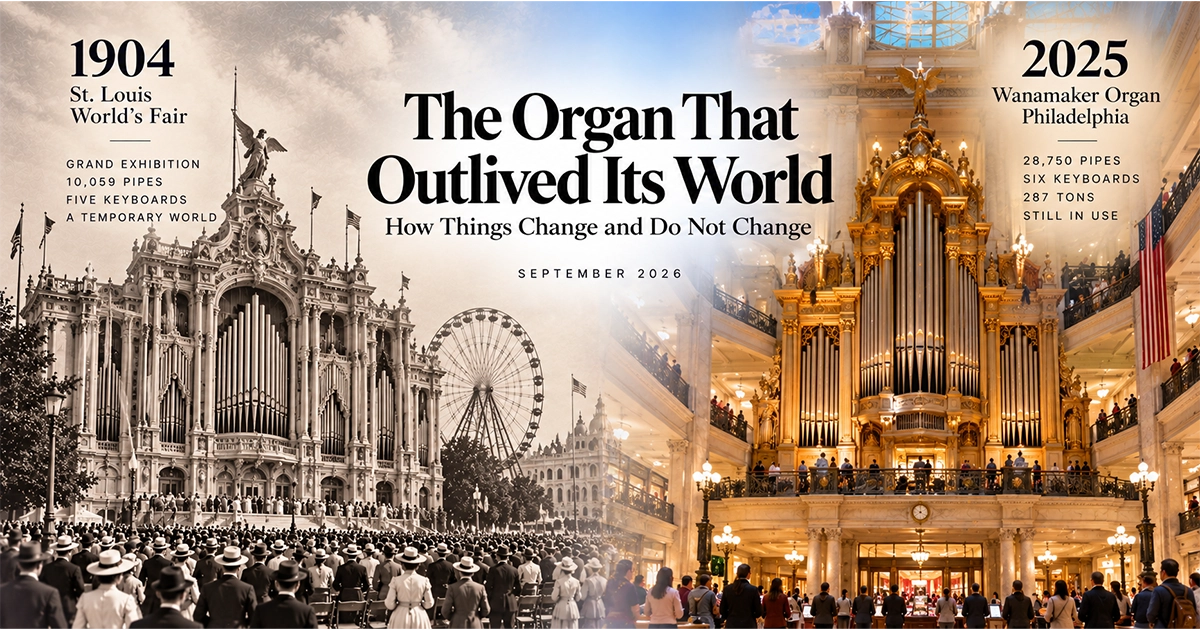
The Organ That Outlived Its World
By: John F Groom
How Things Change and Do Not Change | September 2026
An enormous organ was built for the St. Louis World’s Fair in 1904. The fair ended, its exhibition buildings largely disappeared, and the organ went to a department store that eventually lost its name and identity. Other retailers occupied the building in succession, and they, too, moved on. The last department store closed in 2025. Yet the organ remains, and the instrument that was already a giant in 1904 became almost three times as large in its number of pipes.
That last detail makes the story more interesting than ordinary preservation. People did not simply save an impressive relic. They decided that something already extraordinary deserved further investment. The institutions around it changed while its musical possibilities continued to develop. This is an unusually clear example of how historical change works unevenly: one part of a system can lose its purpose while another retains enough value to grow.
The original instrument was designed by George Ashdown Audsley and completed by the Los Angeles Art Organ Company. It had 10,059 pipes and five keyboards. Its construction costs reached $105,000, and the company ultimately failed. A spectacular technical and artistic achievement did not guarantee commercial success for its builder. The organ’s value and the enterprise’s survival were already telling different stories.
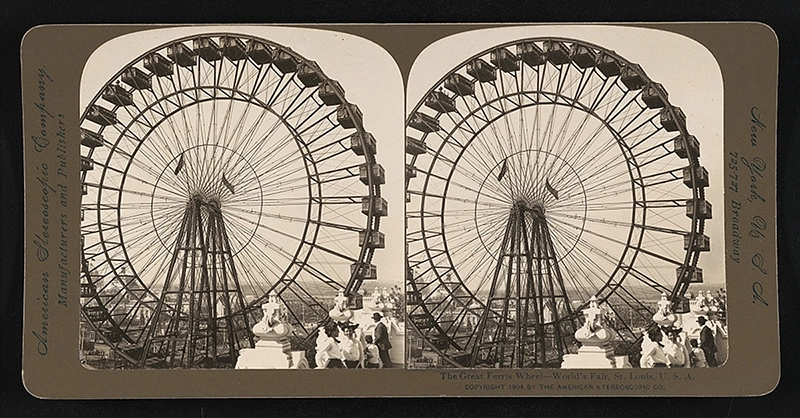
The Ferris wheel at the 1904 St. Louis fair, where the organ was also exhibited. Photograph: Library of Congress, item 2005686728. The fair was temporary; the afterlives of its attractions differed dramatically.
From World’s Fair to Department Store
John Wanamaker bought the organ in 1909 for his Philadelphia store. Moving it required thirteen freight cars, and installing it required two years. It first sounded in the store’s seven-story atrium on June 22, 1911. An object designed for an international exhibition had found a second purpose inside a commercial building. It would become part of the experience of shopping, a civic attraction, and a serious concert instrument at the same time.
Then came the remarkable judgment: it was not enough. Despite the organ’s size, its sound was considered inadequate to fill the enormous court as desired. Wanamaker’s established a private organ factory in the store’s attic, employing as many as forty people. More than 8,000 pipes were added between 1911 and 1917, followed by roughly another 10,000 between 1924 and 1930. The organ now has 28,750 pipes, six keyboards, and a total weight of 287 tons. Its original design became the nucleus of a much larger musical system.
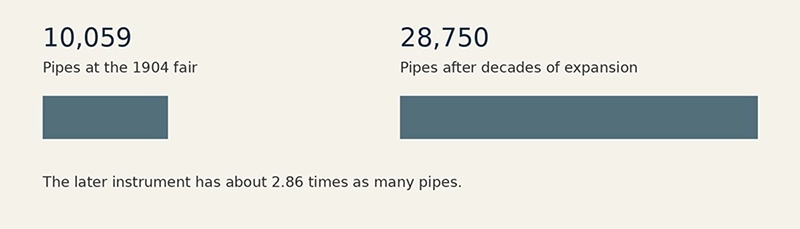
Pipe counts reported by Friends of the Wanamaker Organ. The comparison measures the number of pipes, rather than loudness or musical quality.
It is easy to imagine the practical objection. Why buy a huge organ and then build a factory to make it bigger? Why put that effort into a store? Because the ambition extended beyond selling merchandise. The instrument offered something the owners wanted their building to contain: music on a scale and with a range of expression that ordinary retail space could not provide. The spending served a conception of what the place should be. Its commercial usefulness and artistic value could reinforce each other without being identical.
The Businesses Changed, the Organ Stayed
The succession of names tells the other half of the story. Wanamaker’s became Hecht’s, then briefly Strawbridge’s, then Lord & Taylor in 1997, and Macy’s in 2006. The organ stayed through these changes. Macy’s closed the location in March 2025. The building is entering another transformation, with plans for housing, smaller retail spaces, and other uses. The Grand Court and its organ are being preserved, and restoration work continues while the retail space is closed for renovation.
The organ’s continuity should not be mistaken for permanence without effort. People maintained it, repaired it, raised money, and played it. Its survival is an achievement of continued attention. A useful or beautiful object can still be lost if nobody takes responsibility for it. Here, generations of owners, musicians, craftspeople, and supporters kept recognizing something worth the work. They could not preserve every feature of the world that produced it, but they could preserve and develop this one.
What Survives When Systems Change
The distinction matters when we talk about progress. A world’s fair concentrated encounters with unfamiliar inventions and distant cultures. A department store concentrated merchandise and services. New forms of distribution gradually reduced the necessity of those particular arrangements. The organ’s value rested on a different experience: hearing a vast physical instrument fill an architectural space. A recording can widen access to its music, but it does not reproduce being inside that space as the air moves around you.
This does not mean that craftsmanship always survives while businesses vanish, or that age itself creates value. Many old objects disappear for good reasons. The more useful question is what continues to serve a human purpose after its original setting changes. Sometimes the answer is a building, a book, a painting, or a musical instrument. Sometimes an old form becomes useful again when it acquires a new setting. The survival of one component need not require the survival of the whole arrangement.
Size Is Not the Same as Obsolescence
The organ also shows why size and obsolescence are different questions. It was huge at the beginning, yet it still had room to become more capable. The enlargement pursued a desired musical result. Meanwhile, the surrounding businesses could become larger or more consolidated and still lose their place. Growth by itself tells us little. We have to ask what is growing, what purpose it serves, and whether people continue to value the result.
The fair gave the organ its first audience. Wanamaker’s gave it a long-term home and expanded its possibilities. Later retailers carried it forward. Its next setting may give it another kind of public life. Each host has been temporary; the instrument has connected them across more than a century.
The fair was an event. The stores were businesses. The organ became a continuing work. It survived because people kept finding something in it worth hearing and, for a remarkable stretch of its history, worth making even better.
Sources
Friends of the Wanamaker Organ, history, specifications, and current restoration notice: https://wanamakerorgan.com/about-the-organ/ and https://wanamakerorgan.com/
The Philadelphia Inquirer, store history timeline, January 11, 2025: https://www.inquirer.com/news/inq2/macys-center-city-philadelphia-history-timeline-20250111.html
PAU, Wanamaker Building redevelopment design: https://pau.studio/work/wanamaker-building/
Whether you're exploring interoperability, dataset valuation, AI readiness, or ecosystem participation, we welcome conversations with researchers, organizations, and strategic partners interested in the future of structured data systems.
info@datauniversa.com