The Technology of Life vs. The Technology of Death
By: John F Groom
When we think about the technology of the 20th century, some of the first images that come to mind are technologies of death. The machine gun, the tank, the bomber, poison gas, the V-2 rocket, and finally, most dramatically, the atomic bomb became symbols of the century. There is good reason for this. These technologies were extraordinary, their effects were horrifying, and above all, they were visible. A bomber could destroy much of a city in a night. A nuclear weapon could do so in seconds. A tank could roll through a village, while a machine gun could kill in minutes the number of soldiers who might previously have required hundreds of men to defeat.
The violence itself was equally extraordinary. World War I killed roughly 15 to 22 million people. World War II killed perhaps 70 to 85 million. The Korean War killed roughly 2.5 to 3 million, while the wars in Vietnam and Indochina killed several million more. Beyond conventional warfare were Stalin's collectivization, famines, executions, deportations, and camps; Mao's Great Leap Forward, which probably caused something on the order of 30 to 40 million excess deaths, although estimates vary widely; the Cultural Revolution; the Khmer Rouge; Rwanda; and many other civil wars, genocides, and politically imposed catastrophes.
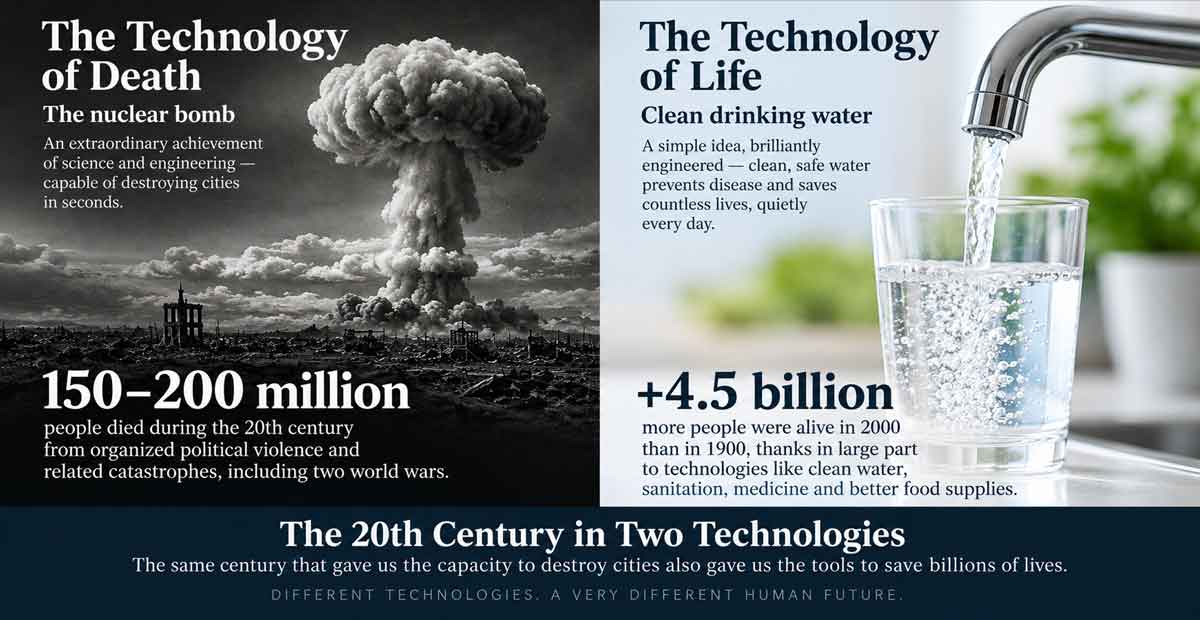
Depending on exactly what is included and how overlapping categories are handled, a reasonable broad estimate is that approximately 150 to 200 million people died during the 20th century from organized political violence and closely related government-created catastrophes. It is a staggering number, and it is therefore understandable that we remember the 20th century as an extraordinarily violent period. But there is another set of numbers that tells a very different story.
There were approximately 1.6 billion human beings alive in 1900. By 2000, there were approximately 6.1 billion. During a century containing two world wars, the Holocaust, Stalin, Mao, Cambodia, nuclear weapons, and perhaps 150 to 200 million deaths from organized political violence, the human population nearly quadrupled. Humanity ended the century with approximately 4.5 billion more people than it had when the century began. That net increase in living human beings was more than twenty times larger than the number killed by the organized violence that dominates our historical memory of the century.
The explanation is not that the technologies of death were less destructive than we imagine. They were every bit as destructive as we remember. Rather, while spectacular technologies were making human beings much better at killing one another, thousands of quieter technologies were making human beings much harder to kill. Their cumulative effect was vastly greater.
The Quiet Technologies of Life
Consider clean drinking water. There is no equivalent of the mushroom cloud to symbolize it. Someone builds a municipal filtration system. Engineers improve sewers and separate drinking water from human waste. Chlorination becomes routine. Pipes improve, pumps become more reliable, and waterborne diseases become less common. Nothing dramatic happens on the day the system works properly. A child simply does not get cholera or typhoid.
Vaccines work in much the same way. A child receives an injection and does not contract a disease two years later. Antibiotics prevent an infection from becoming fatal. Sterile surgical techniques prevent infections that previously killed patients after otherwise successful operations. Improved obstetric care allows a mother and infant to survive childbirth. Refrigeration prevents food from spoiling. Better nutrition strengthens resistance to disease, while mosquito control prevents infections that would otherwise have occurred.
Agricultural technology may have been even more consequential. Synthetic fertilizer, mechanization, improved plant varieties, irrigation, pesticides, transportation, and refrigeration dramatically increased both the quantity and reliability of the world's food supply. These innovations were not usually experienced as spectacular technological events. They accumulated gradually, often becoming invisible infrastructure that people noticed only when it failed.
The technology of life was therefore not a single invention comparable to the atomic bomb. It was an enormous interconnected system of clean water, sanitation, medicine, agriculture, transportation, refrigeration, public health, housing, and energy. No single component explains what happened. Together, however, they changed the fundamental mathematics of human existence.
This creates a great historical optical illusion. Imagine that Technology A kills 10,000 people tomorrow, while Technology B quietly prevents 100 people from dying every year for the next century. Technology A produces headlines, photographs, memorials, documentaries, and history books. Technology B produces almost nothing visible at all, even though their ultimate effects on the number of human lives are identical. The problem becomes much greater when this phenomenon is multiplied across the entire planet. We can observe death, but we generally cannot observe prevented death.
The person killed by a bomb has a name, a photograph, and a date of death. The person who would have died from contaminated drinking water at age four but instead lives until 81 never knows that anything happened. There is no photograph of his non-death and no monument commemorating it. He simply grows up, works, has relationships, and perhaps has children and grandchildren of his own.
The Bomb and the Water Pipe
This gives us two very different symbols for 20th-century technology. One is the atomic bomb. The other might simply be a water pipe. The bomb is incomparably more dramatic. It represents an extraordinary concentration of scientific knowledge, industrial capacity, and organizational skill directed toward destruction. The images of Hiroshima and Nagasaki became permanent parts of human consciousness. A municipal water pipe seems almost absurdly mundane by comparison.
Yet if our criterion is the effect upon the number of human beings who lived rather than the dramatic quality of the technology, the water pipe and the enormous technological system surrounding it may be more representative of what actually happened during the century.
The atomic bomb demonstrated that humanity had acquired the technological capacity to destroy civilization. The population statistics demonstrate that we had simultaneously acquired an unprecedented capacity to keep human beings alive. In terms of actual demographic consequences, the latter won by an overwhelming margin.
China provides an extreme illustration. The Great Leap Forward was one of the most catastrophic government policies in history, probably causing tens of millions of excess deaths. Yet China's population was roughly 540 million in 1949 and more than 1.25 billion by 2000.
This does nothing to diminish the catastrophe of the Great Leap Forward. Tens of millions of individual deaths remain tens of millions of tragedies. What it demonstrates is the extraordinary power of the demographic forces operating underneath the political catastrophe. Even policies capable of killing tens of millions could interrupt, but not permanently reverse, the much larger process by which ordinary mortality was declining.
The same phenomenon can be seen globally. World War II may have killed 70 to 85 million people, an almost unimaginable number, yet the world's population was larger at the end of the 1940s than it had been at the beginning. The technology of death could produce horrifying, concentrated catastrophes while the technologies of life continued operating quietly across billions of ordinary lives.
The Real Revolution Was Ordinary Survival
For most of human existence, people had many children in a world in which many children died. Disease was ubiquitous, food supplies were unreliable, a minor wound could become a fatal infection, childbirth was dangerous, drinking water could kill you, and epidemics periodically swept through entire populations. Humanity existed in a rough demographic equilibrium characterized by both high fertility and high mortality. Technology disrupted that equilibrium. Mortality began falling rapidly while fertility remained high. The resulting gap produced the great population expansion of the 20th century.
The fundamental demographic achievement was therefore not that humans suddenly became extraordinarily good at reproducing. Humans had always been good at reproducing. We became extraordinarily good at not dying. This distinction also tells us something important about how we perceive technology more generally. Technology is easiest to notice when something happens. A rocket launches, a bridge collapses, a bomb explodes, an artificial intelligence produces an extraordinary answer, or a robot walks across a room.
Yet many of our most valuable technologies are successful precisely when something does not happen. The bridge does not collapse. The airplane does not crash. The infection does not develop. The crop does not fail. The child does not die.
Success therefore causes some technologies to disappear into ordinary life. Once clean drinking water becomes universal, turning on a faucet ceases to seem like a technological achievement at all. Once refrigeration becomes ubiquitous, we cease to think about the extraordinary system required to keep food safe from the farm to the kitchen. Once vaccines suppress a disease, people who have never encountered the disease may begin to forget why the vaccine mattered in the first place.
There are therefore at least two legitimate technological histories of the 20th century. One is the familiar history in which machine guns led to tanks, tanks were joined by strategic bombers, rockets and nuclear physics produced atomic weapons, and industrial organization allowed governments to mobilize millions of people and enormous productive capacity for warfare. That history is real and important.
Running underneath it, however, is another technological history composed of better sewers, cleaner water, more reliable food supplies, vaccination, antibiotics, safer childbirth, electricity, refrigeration, better housing, improved transportation, and a better understanding of disease. Individually, most of these developments lacked the drama of a bomber flying over a city. Collectively, they produced one of the largest transformations in the history of our species. That transformation can be summarized in two numbers: 1.6 billion people in 1900 and 6.1 billion in 2000.
Perhaps this is the technological story of the 20th century that we have most underestimated. The technologies of death dominate our memory because their consequences were concentrated, intentional, and spectacularly visible. The technologies of life disappear into the background because their consequences were dispersed, cumulative, and frequently invisible.
The wars and destruction were entirely real, and perhaps 150 to 200 million deaths from organized violence and politically created catastrophe should never be reduced to a statistical abstraction. But while those terrible events were occurring, something even larger was happening almost unnoticed. Billions of people who would previously have died as infants, children, young adults, or middle-aged adults simply continued living.
The atomic bomb may therefore be the most memorable technological symbol of the 20th century, but it is not necessarily the most representative one. If we want an object that captures what technology actually did to human life during those hundred years, we might be better served by something far less dramatic: a clean glass of water coming from a tap.
Whether you're exploring interoperability, dataset valuation, AI readiness, or ecosystem participation, we welcome conversations with researchers, organizations, and strategic partners interested in the future of structured data systems.
info@datauniversa.com