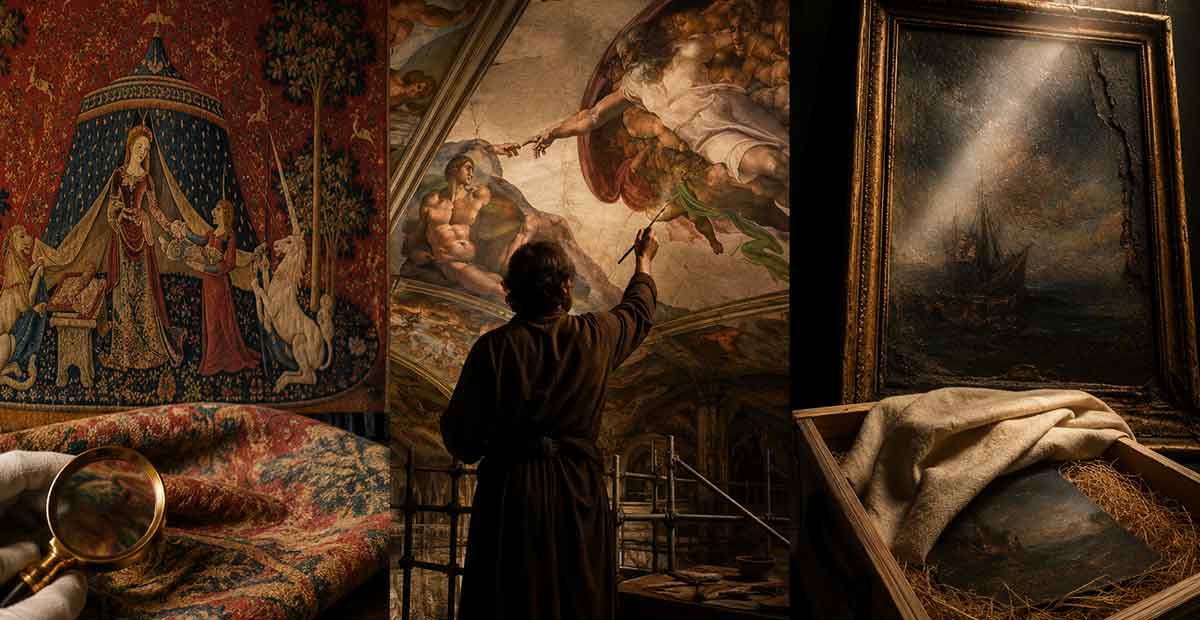
Three Masterpieces, Three Provenance Problems: What The Lady and the Unicorn, Michelangelo's Ceiling, and The Lost Painting Teach Us About Preserving Human History
By John F. Groom
A great work of art can survive for centuries while the story behind its creation quietly disappears. This distinction is easy to overlook because we naturally associate the survival of an object with the survival of its history. If a painting, tapestry, manuscript, sculpture, or building still exists, we tend to assume that the people who created it, the decisions they made, and the circumstances surrounding its creation somehow survive with it. In reality, an object and its history are two very different things.
An object is physical. Its history exists in a network of relationships: who conceived the idea, who created it, who commissioned it, who contributed to it, what alternatives were considered, what materials were used, what problems arose during its creation, how those problems were solved, where the object traveled, who owned it, how it changed over time, and what evidence supports each part of that story. When those relationships disappear, the object may remain perfectly intact while much of its meaning is permanently lost.
Three remarkable books illustrate this problem from very different perspectives: Tracy Chevalier's The Lady and the Unicorn, Ross King's Michelangelo and the Pope's Ceiling, and Jonathan Harr's The Lost Painting. Together they demonstrate three very different outcomes when the relationship between an object and its history is broken, preserved, or painstakingly reconstructed. In the first, the masterpiece survives but so much of its creation story has disappeared that a novelist must imagine what history can no longer tell us. In the second, enough evidence survives to reconstruct the extraordinary human story behind one of history's greatest artistic achievements. In the third, the artwork itself survives, but its identity becomes separated from its creator and must be rediscovered through years of provenance research.
Together these books reveal one of the most important lessons about provenance. Preserving an object is not the same as preserving the human intelligence that brought it into existence. One story was largely lost, one was substantially preserved, and one had to be recovered. The differences among them reveal not only how fragile historical knowledge can be, but also why provenance is ultimately about preserving relationships rather than simply preserving objects.
The Lady and the Unicorn: When the Masterpiece Survives but the Story Does Not
The six tapestries known collectively as The Lady and the Unicorn are among the greatest surviving masterpieces of medieval European art. Created around the year 1500, they depict a mysterious lady accompanied by a unicorn, a lion, countless animals, and thousands of flowers against brilliant crimson backgrounds. Five of the tapestries are generally associated with the traditional five senses—sight, hearing, taste, smell, and touch—while the sixth bears the enigmatic inscription À mon seul désir ("To my only desire"), a phrase whose meaning continues to be debated more than five hundred years later.
The tapestries themselves have survived remarkably well. We can examine their materials, analyze their weaving techniques, identify the heraldic arms of the Le Viste family, and study their symbolism, artistic influences, and probable geographic origins. Yet despite everything we know about the finished works, many of the questions we most naturally want to ask remain unanswered. Who conceived the original idea? Who designed the imagery? Who were the individual weavers whose hands created these extraordinary works? Who decided that a unicorn should stand beside the lady? What conversations took place between patron and artist? Were preliminary designs rejected? Did the concept evolve during production? Were there disagreements, compromises, mistakes, or unexpected breakthroughs?
Those events unquestionably occurred. Real people conceived these tapestries, debated ideas, solved technical problems, revised designs, and ultimately created one of the great artistic achievements of medieval Europe. They had names, personalities, ambitions, frustrations, and creative insights. Yet much of that human story has disappeared, leaving behind the finished masterpiece but only fragments of the intelligence that produced it.
This is precisely the historical space that Tracy Chevalier's novel occupies. Her fictional account imagines Nicolas des Innocents as the artist commissioned to design the tapestries, populating the historical record with weavers, patrons, rivalries, negotiations, ambitions, and creative decisions. The novel succeeds because history leaves enough unanswered questions for imagination to fill the gaps. That is not a criticism of historical fiction—it is what makes historical fiction possible. The tapestries survived, but much of the network of human relationships behind them did not.
Michelangelo's Ceiling: When Enough of the Story Survives
Ross King's Michelangelo and the Pope's Ceiling presents almost the opposite situation. The Sistine Chapel ceiling survives, but so does an extraordinary amount of information about how it came into existence. We know the artist, Michelangelo Buonarroti, and we know the patron, Pope Julius II. We know Michelangelo accepted the commission in 1508 despite considering himself primarily a sculptor rather than a painter. We know about his difficult relationship with Julius, the technical challenges of fresco painting, the scaffolding constructed for the project, the assistants who contributed, the financial arrangements, the physical demands of working overhead for years, and the broader political and artistic climate in which one of history's greatest masterpieces was created.
Because so much documentary evidence survived, Ross King is able to write narrative history rather than historical fiction. Letters, contracts, financial records, contemporary accounts, and other surviving documents allow him to reconstruct the human story behind the ceiling with remarkable confidence. There are certainly gaps—as there are in every historical record—but the essential framework remains intact. We may never know every conversation that took place inside the chapel or every thought Michelangelo had while painting The Creation of Adam, yet we know enough to understand the people, decisions, struggles, and circumstances that transformed an ambitious commission into one of the defining works of Western civilization.
That surviving context fundamentally changes the way we experience the artwork. We are not simply looking at painted plaster on a ceiling. We can connect the finished work to a named individual, understand many of the constraints under which he worked, appreciate his evolving relationship with Pope Julius II, and place the project within the broader story of Renaissance Italy. The masterpiece remains inseparable from much of the human intelligence that produced it because the relationships surrounding its creation were preserved alongside the physical object.
This illustrates what successful provenance really accomplishes. It does far more than authenticate an object or establish legal ownership. It preserves the connections that allow future generations to understand how something came into existence, why particular decisions were made, who influenced the outcome, and what challenges shaped the final result. The object survives, but so does much of its human story.
The Lost Painting: When an Artwork Loses Its Identity
Jonathan Harr's The Lost Painting demonstrates a third and equally important possibility.
In this case, the artwork survives, but its identity does not.
The book tells the remarkable true story of the rediscovery of Caravaggio's The Taking of Christ, a painting that had effectively disappeared from the known body of the artist's work for centuries. The canvas itself had never been destroyed. It still existed. What had been lost was the crucial relationship connecting the painting to the artist who created it.
That distinction is profound because the painting never physically changed. The pigments remained the same. The composition remained the same. The canvas did not become larger, more beautiful, or technically more accomplished. Yet almost everything about its historical meaning changed once researchers were able to reconnect it with Caravaggio through painstaking provenance research.
Before rediscovery, it was simply an old painting.
After rediscovery, it became a Caravaggio.
The transformation occurred not because the object changed, but because its identity was restored. Harr's account follows the years of archival research, documentary evidence, ownership history, and scholarly investigation required to reconnect the physical object with its creator. It demonstrates that an artwork can survive physically while becoming historically disconnected from itself. Restoring that connection may require decades of research, extraordinary expertise, surviving documentary fragments, and a considerable amount of good fortune. In many cases, that restoration never occurs.
Together, these examples reveal three very different relationships between an object and its history. The Lady and the Unicorn shows us what happens when the masterpiece survives but much of its creation story disappears. The Sistine Chapel ceiling demonstrates the extraordinary understanding that becomes possible when enough evidence survives to preserve the human story behind the work. The Lost Painting reminds us that even when an object survives, losing a single critical relationship—its connection to its creator—can fundamentally alter its identity until that relationship is painstakingly restored.
Three Masterpieces, Three Different Outcomes
Taken together, these three works illustrate three fundamentally different outcomes for provenance. The Lady and the Unicorn shows us a masterpiece whose physical form survived while much of the human story behind its creation disappeared. Michelangelo and the Pope's Ceiling demonstrates what becomes possible when enough evidence survives to preserve not only the finished work but also the relationships, decisions, and circumstances that shaped it. The Lost Painting reveals a third possibility: the artwork survives physically, yet its identity becomes separated from its creator and must later be painstakingly reconstructed through provenance research.
Although these examples come from the history of art, they are far from unique. The same patterns appear repeatedly throughout human civilization. Objects survive while the stories behind them disappear. Stories survive after the objects themselves have been lost. Buildings remain standing long after the people who designed, built, and inhabited them have been forgotten. Recipes continue to be prepared even though nobody remembers who first created them. Practical solutions spread from one community to another while the people who developed them receive no attribution. Datasets remain available years after their sources, methodologies, or limitations have become unclear, and videos persist online long after the circumstances surrounding their creation have been forgotten.
The provenance problem is therefore much larger than the history of art.
It is a recurring characteristic of human knowledge itself.
The Object Is Not the History
This broader perspective also reveals why the traditional definition of provenance is too limited.
Provenance is often described simply as a chain of ownership that establishes authenticity. For works of art, that typically means documenting who owned the object, when ownership changed, and whether its authenticity can be verified. Those questions are undeniably important, but they capture only a small part of what provenance is capable of preserving.
A more complete understanding views provenance as the preservation of relationships across time.
For a painting, those relationships may include the artist, patron, assistants, workshop, preliminary sketches, source materials, contracts, correspondence, locations, restoration history, successive owners, and even alternative designs that were considered but never completed. The artwork itself becomes only one element within a much larger network of people, decisions, evidence, and events that collectively explain how the object came into existence and how it evolved through history.
When those relationships disappear, information is lost even if the object remains perfectly intact.
That distinction explains why The Lady and the Unicorn and the Sistine Chapel ceiling feel so different despite both surviving for more than five centuries. In each case we possess the masterpiece itself, but our ability to reconstruct the human intelligence behind its creation differs dramatically because the surrounding network of relationships has survived to very different degrees.
The Lost Painting demonstrates an even more dramatic consequence.
Lose one sufficiently important relationship—the connection between an object and its creator—and the identity of the object itself can effectively disappear. The painting remains physically unchanged, yet without that connection it becomes something fundamentally different from what it once was.
Why Provenance Matters Even More in the AI Age
At first glance, the digital era might seem to have solved this problem.
Humanity now produces more photographs, videos, documents, datasets, software, designs, conversations, measurements, and digital records than at any other point in history. We have become extraordinarily good at creating information.
Creating information, however, is not the same as preserving its relationships.
A billion photographs without reliable information about who appears in them, where they were taken, when they were taken, or why they matter leave future historians with an enormous archive of disconnected evidence. A dataset may survive while its methodology disappears. A video may remain online while the circumstances surrounding its creation become impossible to verify. An idea may spread through AI systems until nobody can identify who originally developed it, and a practical solution created by someone in a remote community may eventually influence millions of people without its creator ever receiving recognition.
Artificial intelligence makes this challenge even more significant.
AI can analyze enormous amounts of evidence, identify patterns, generate hypotheses, and infer likely explanations with extraordinary sophistication. What it cannot do is recover ground truth that was never recorded. No matter how advanced future AI becomes, it cannot determine with certainty who designed The Lady and the Unicorn if that evidence no longer exists. It can estimate probabilities. It can compare artistic styles. It can construct plausible narratives.
But inference is not provenance.
Probability is not ground truth.
As AI becomes increasingly capable of producing convincing explanations, preserving the distinction between authenticated evidence, informed inference, and imagination becomes one of the most important responsibilities of modern information systems.
Everything Tag and DataUniversa: Preserving Relationships, Not Just Records
This is where the roles of Everything Tag and DataUniversa become much clearer.
Everything Tag begins with a simple but powerful concept: persistent identity. A physical object, artwork, photograph, video, document, dataset, performance, invention, solution, prototype, or virtually any other entity can be assigned a durable identity around which information accumulates over time. That identity becomes the anchor that allows knowledge to grow rather than fragment as new evidence emerges.
DataUniversa addresses the larger challenge of preserving relationships. It captures not only what something is, but also the network of information that gives it meaning. Who created it? Who contributed to it? What evidence supports that attribution? Which earlier versions preceded it? What datasets or source materials were involved? Where and when did the activity occur? Which documents record its development? What other people, objects, ideas, and events are connected to it? Which claims have been verified, which remain disputed, and which are informed inferences rather than established facts?
Rather than preserving isolated pieces of information, the objective is to preserve an evolving network of identities, relationships, evidence, and provenance that remains understandable to both humans and machines.
Imagine if an infrastructure like this had existed around the year 1500.
The Lady and the Unicorn tapestries could each have possessed persistent identities. The designer could have been connected directly to the finished works. Every individual weaver might have been identified and credited. Preliminary sketches, rejected concepts, patron correspondence, contracts, material suppliers, workshop records, and revisions made during production could all have remained connected to the completed tapestries. Even uncertainty could have been preserved honestly, distinguishing between documented facts, contemporary observations, informed hypotheses, and unresolved questions instead of forcing future historians to choose between certainty and speculation.
Five hundred years later, we would inherit far more than six extraordinary works of art.
We would inherit the human story that created them.
Provenance Is an Inheritance for the Future
Perhaps the most important lesson shared by these three books is that provenance ultimately determines what future generations are capable of knowing about us.
The people living in 1500 could not have imagined that historians centuries later would want to know the identities of individual tapestry weavers. Those responsible for allowing a Caravaggio to lose its attribution could not have anticipated that researchers would one day spend years searching archives in an effort to restore that missing connection. In exactly the same way, we cannot know what people living in 2526 will consider important about our own world.
We do not know which little-known artist will eventually reshape art history, which ordinary photograph will become an essential historical record, which local solution will transform an industry, which failed experiment will contain the missing clue to a future breakthrough, or which seemingly routine observation will become invaluable decades or centuries from now.
That uncertainty changes the purpose of provenance.
Its objective should never be to decide what future generations ought to value. Instead, it should preserve enough identity, evidence, relationships, and context that future generations retain the ability to make those decisions for themselves.
The Difference Was What History Remembered
Taken together, these three books reveal three very different outcomes.
The Lady and the Unicorn shows us what happens when the masterpiece survives but much of its human story disappears.
Michelangelo and the Pope's Ceiling demonstrates what becomes possible when enough evidence survives to reconstruct the creative process behind one of history's greatest artistic achievements.
The Lost Painting reminds us that even a masterpiece can lose its identity—and how extraordinarily difficult it can be to restore a broken connection centuries later.
One story had to be imagined.
One could be reconstructed.
One had to be rediscovered.
The difference was never the greatness of the art.
The difference was what history remembered.
That is ultimately the purpose of provenance. It is not simply to preserve objects or establish authenticity. It is to preserve enough of the relationships among people, ideas, objects, evidence, and events that future generations can understand what those things truly were, how they came into existence, and why they mattered.
In the AI era, that responsibility becomes even more significant. As our ability to create convincing information continues to accelerate, the long-term value of authenticated relationships will only increase. The greatest inheritance we can leave future generations may not be the objects themselves, but the connected history that allows those objects—and the people behind them—to be understood with confidence centuries from now.
Whether you're exploring interoperability, dataset valuation, AI readiness, or ecosystem participation, we welcome conversations with researchers, organizations, and strategic partners interested in the future of structured data systems.
info@datauniversa.com