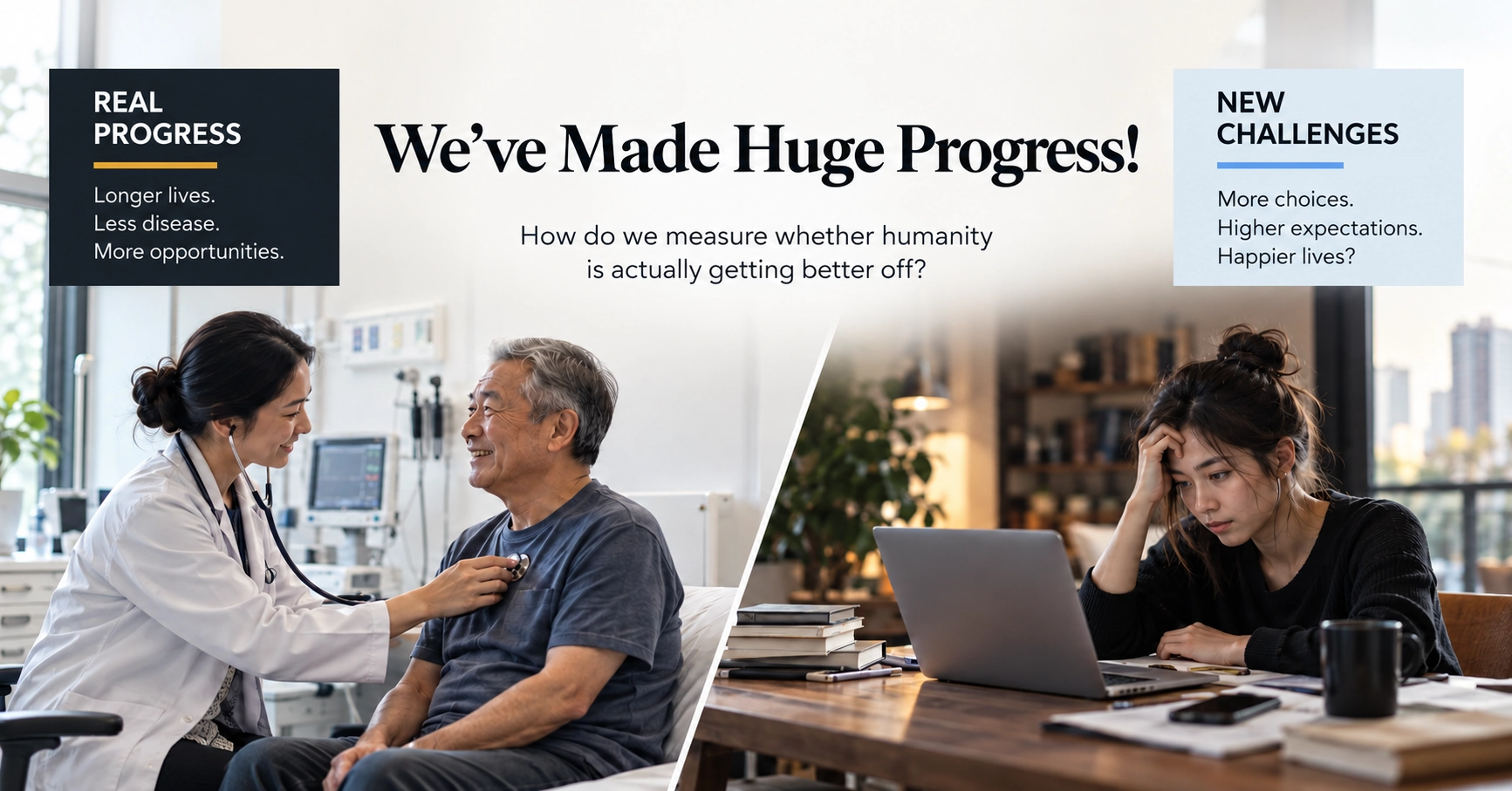
We've Made Huge Progress!
By: John F Groom
Or Very Little. Or Who Really Knows?
How do we measure whether humanity is actually getting better off?
DU | Human Progress & Society | October 2026
Introduction
Humanity has made extraordinary progress. Or perhaps very little. In some respects, we may even be going backward. The answer depends on what we measure, where we look, what we value, and who gets to decide what constitutes progress.
For much of history, families could reasonably expect that some children would die before adulthood. Hunger, infectious disease, and physical hardship were routine features of life. Today, these conditions have been dramatically reduced in much of the world.
But are people more satisfied with their romantic relationships than 200 years ago? Are they happier? Do they enjoy sex more? Do they find greater meaning in their lives? We have remarkably little reliable evidence with which to answer these questions. Perhaps our very concept of progress is inadequate.
1. Problems We Have Largely Solved
For most of human history, hunger was a pervasive threat. Today, the world produces enough food in aggregate to feed its population. Hunger remains a terrible problem for hundreds of millions, but major obstacles include poverty, conflict, distribution, and political conditions rather than a global inability to produce sufficient calories.
Child mortality has also declined enormously. In wealthy countries, childhood death has become comparatively rare, and globally the risk of dying before age five has fallen dramatically. Sanitation, vaccination, antibiotics, safer childbirth, and improved nutrition have transformed survival.
These are genuine achievements, not matters of taste or fashion. But when a problem that once dominated human existence largely disappears, people do not simply declare victory. They move on to other problems.
2. Problems That Turn Into Their Opposites
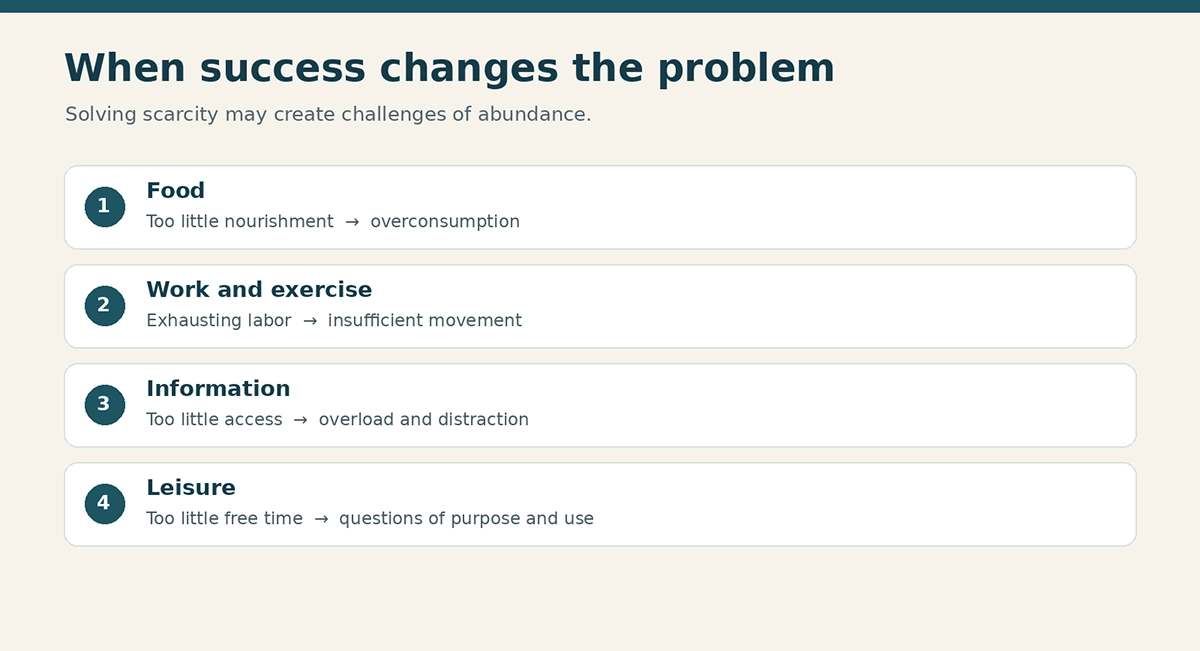
Where food was scarce, getting enough was the challenge. In many societies today, avoiding excess is more common. Physical labor once exhausted large portions of the population; now millions pay for gyms to perform strenuous exercise. Excessive work and insufficient leisure were major concerns during industrialization. Today, some populations struggle with boredom, sedentary habits, and unstructured time, although overwork remains widespread elsewhere.
Too little food becomes too much food. Too much exertion becomes too little. Too little information becomes information overload. Progress can solve a problem so successfully that the opposite condition becomes a problem. There may be an optimal range, not an endlessly rising curve.
3. Problems We Cannot Reliably Measure
Sexual desire is fundamental to human life, but has sexual satisfaction improved? We can measure modern sexual frequency, reported satisfaction, marriage, and reproductive health. We cannot reliably compare the average sexual experience in ancient Rome, Victorian England, and modern America.
Were friendships stronger in agricultural villages? Were marriages happier when divorce was rare? Did close-knit communities provide more fulfillment than affluent individualistic societies? Historical evidence cannot settle these questions.
We measure what is measurable, then risk treating the measurements as the totality of human experience. Life expectancy can be measured. The depth of friendship, love, belonging, and purpose cannot be measured nearly as well. That does not make them less important.
4. Problems We Have Only Recently Decided Are Problems
Depression, anxiety, and psychological suffering are not modern inventions. What has changed is the prominence of psychological well-being as an explicit social objective. Self-fulfillment is even more revealing. For much of history, people were expected to support family, practice a trade, follow religious teachings, and fulfill established social roles. The widespread expectation that everyone should discover a unique identity and find meaningful work is comparatively recent.
Have greater opportunities for self-fulfillment improved life? Or have they also created a new burden of expectation? Possibly both. A condition can become a recognized problem because expectations change, not necessarily because it has worsened.
5. Things We May Have Lost
Religion and structured communities once offered many people broadly shared answers about existence, morality, obligation, and death. These systems could also be restrictive or coercive. Modern societies have often expanded freedom of conscience and personal autonomy.
Yet freedom to choose a purpose is not the same as possessing one. A person in a traditional community might have less autonomy but stronger continuity and belonging. A modern person may have far more choices but fewer shared answers. Which represents progress? There is no simple calculation. Progress in one human value can coincide with regression in another.
6. Problems That Change Shape
In many societies, some forms of interpersonal violence have declined over long historical periods. But organized violence, including war, repression, and institutionally directed harm, can operate on enormous scales. Its historical trajectory is not a simple upward or downward line: organized violence has existed for millennia and fluctuated greatly.
A society can reduce everyday violence while remaining vulnerable to war or coercion. Exploitation, discrimination, and conflict can likewise change mechanisms without disappearing. Reducing one manifestation of a problem does not necessarily eliminate the underlying problem.
7. Progress for Whom?
Freedom, security, prosperity, and opportunity differ enormously across places and populations. Individual freedom has expanded in many societies, while highly restrictive systems such as North Korea persist. A global average can improve while particular groups suffer deterioration.
Even within a country, change may benefit some and harm others. A technological advance may help consumers while displacing workers. Urban development may expand housing while disrupting communities. When someone announces that humanity has made progress, we should ask: Which humanity?
8. Who Gets to Decide What Better Means?
In some societies where food was scarce, fuller bodies signaled prosperity. As calories became abundant, thinness and fitness gained prestige in many affluent circles. Premarital virginity once had considerable social value in many cultures; it receives less emphasis in many societies today. Are these changes progress, decline, or shifts in expectation?
Traditional Western painting often emphasized beauty, craft, proportion, and representation. Influential modern movements elevated originality, abstraction, and conceptual experimentation. Critics, museums, collectors, and the public need not agree about what counts as better. Progress is often presented as an objective achievement when it is partly a change in the criteria used to judge achievement.
9. The Difference Between More and Better
A six-hour bus trip is faster than a twelve-hour luxury train trip, but a traveler may greatly prefer the train for comfort, scenery, food, and the experience itself. If the goal is arrival, speed matters. If the journey is part of the product, speed may be secondary.
A larger house is not necessarily a better home. More entertainment does not guarantee more enjoyment. More information does not ensure better understanding. We often confuse an increase in a measurable quantity with an improvement in lived experience.
10. Does Solving Problems Make People Happier?
A modern person in many countries enjoys better healthcare, comfort, knowledge, freedom, and prospects of survival than someone 200 years ago. These gains are substantial. But is that person happier? We cannot answer with comparable confidence.
People adapt to improvements. Reliable electricity becomes an invisible expectation. People compare themselves with neighbors, not just ancestors. Greater living standards can be accompanied by greater expectations. Objective conditions and subjective satisfaction do not necessarily move together.
11. What Should We Expect From the Future?
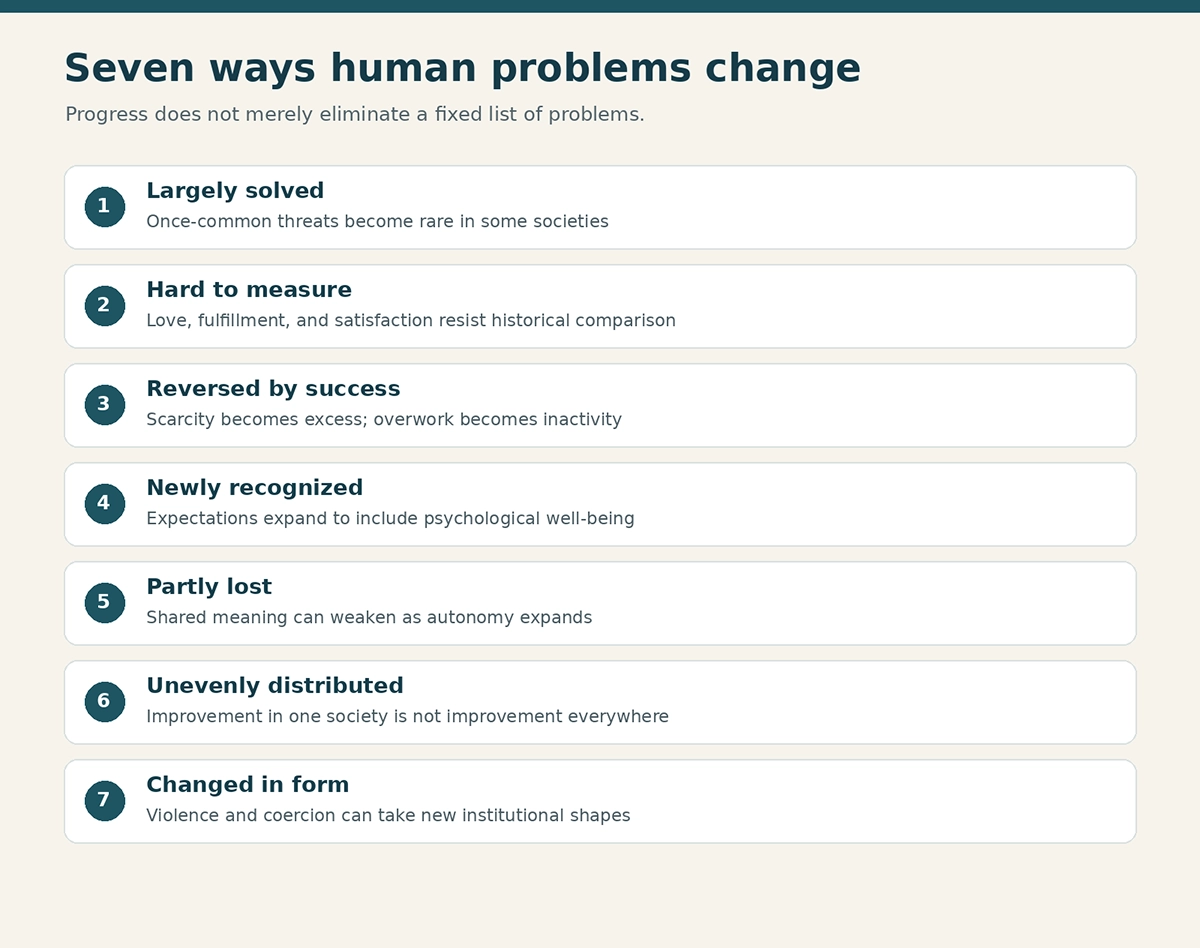
We should not imagine a fixed inventory of human problems that will steadily shrink. Some will be substantially solved. Others will persist in certain regions. Some will change shape. Some will arise because earlier improvements create new conditions. Others will be newly recognized as expectations change.
A future society might be extraordinarily wealthy and medically sophisticated yet struggle with loneliness, meaninglessness, or weak relationships. Another may have fewer resources but stronger communal ties. Statistics alone cannot determine which offers the better life.
12. The Limits of Progress and of Our Knowledge
Have human capabilities improved? In many areas, unquestionably yes. Have objective conditions improved? Again, in many important respects, yes, though not for everyone. Has the experience of being human improved? That is far more difficult to establish.
We lack reliable historical measures for love, friendship, sexual satisfaction, belonging, and fulfillment. Nor is there a universally accepted method of weighing these against security, comfort, and freedom. Perhaps the biggest mistake is assuming there must be one overall answer.

Conclusion: Progress Is Not One Thing
Human history is not simply the story of a species steadily solving problems. It is the story of a species that solves some, creates others, changes expectations, redefines ideals, and discovers that improvements in one dimension do not guarantee improvements in another.
We should celebrate genuine achievements, particularly dramatic reductions in childhood death and material deprivation. But a longer life is not automatically a more meaningful one. Greater wealth does not guarantee happiness. More freedom does not necessarily produce stronger relationships.
Perhaps the useful question is not whether humanity has made progress overall, but whether we are improving the particular conditions and experiences that matter, and understanding what we sacrifice along the way. We've made huge progress. Or very little. Or who really knows? The answer, almost certainly, is all three.
Whether you're exploring interoperability, dataset valuation, AI readiness, or ecosystem participation, we welcome conversations with researchers, organizations, and strategic partners interested in the future of structured data systems.
info@datauniversa.com