What Changes, What Doesn’t
By: John F Groom
I was born in 1961, at the beginning of a long period of radical change. Fashion, technology, civil rights, gender relations, and many other parts of society seemed to be changing as I was growing up. But there is a funny thing about a hurricane-force wind: it can completely demolish some things while leaving others strangely untouched.
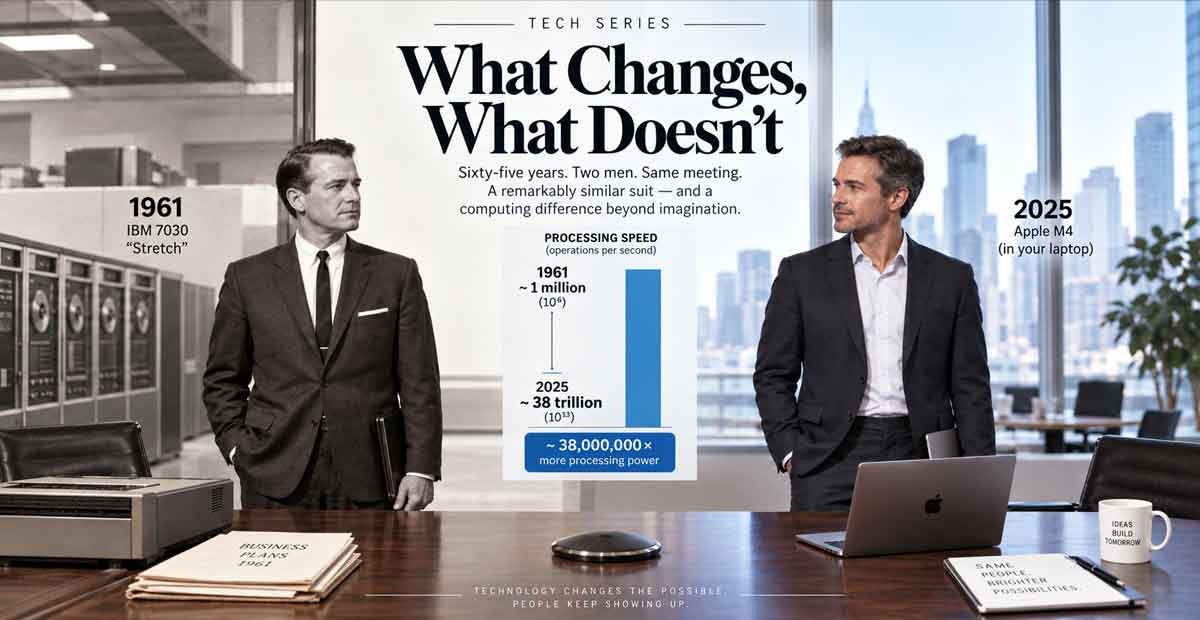
Consider two things that existed in 1961: the computer and the well-dressed man. Imagine a successful businessman walking into an important meeting in New York, London, or Washington in 1961. He would probably be wearing a dark or gray suit, a white or light-colored shirt, leather shoes, and a tie.
Now put the same man into an important meeting in 2026. The tie may be gone. The suit may be slightly slimmer or less structured. Fabrics are lighter and more comfortable, and shoes may be less formal. But if he is dressed conventionally for an important business occasion, the basic visual architecture is remarkably similar.
A photograph of the two men standing beside each other would immediately reveal which one belonged to 1961. Yet neither would look absurdly out of place in the other man's world. Now put their computers beside each other, and the comparison almost ceases to make sense.
65 Years of Computational Change
In 1961, serious computing meant large, extremely expensive machines occupying substantial physical space and generally operated by specialists. Computers were scarce institutional resources. People did not casually own them, carry them around, or expect them to respond instantly to natural-language questions.
The IBM 7030 Stretch, one of the most advanced computers of the period, was a multimillion-dollar machine built from hundreds of thousands of transistors. Even attempting to compare its computational capabilities with a modern consumer processor is difficult because the architectures and workloads are so different.
But the scale of the change is unmistakable. A modern processor contains tens of billions of transistors. A high-end computing system can perform trillions of operations per second, while specialized AI hardware can operate at still greater effective rates for particular workloads.
The extraordinary part is not merely that today's computers are vastly more powerful. They are also vastly smaller, cheaper per computation, more reliable, more accessible, and connected to billions of other machines.
The 1961 computer was something an institution possessed. The 2026 computer is something you carry in your pocket, wear on your wrist, install in your automobile, hide inside your thermostat, and use without even consciously thinking of it as a computer.
Increasingly, you do not even tell it precisely what to do. You tell an AI what you want, and the machine attempts to determine how to accomplish it. That is not an incremental improvement in the 1961 computer. It is a transformation of what a computer is.
And Yet the Suit Survived
Now return to our businessman. Why isn't his clothing a million times better? The question sounds ridiculous, which is precisely why it is useful. There is no equivalent of Moore's Law for trousers. A suit cannot become 1,000 times more effective every twenty years. A shirt cannot eventually contain a billion collars. Reducing a shoe to one-thousandth its previous size would not represent technological progress.
The human body imposes an extraordinary degree of continuity. A man in 2026 is approximately the same size and shape as a man in 1961. He has two arms, two legs, a torso, and a head. He experiences roughly the same range of temperatures. Clothing still has to allow him to sit, stand, and walk. Other humans still interpret clothing socially. Technology can improve the materials, manufacturing, cost, and distribution of the suit. But it cannot escape the basic problem the suit is solving.
Computing is different. Its essential output is information processing. Once we discovered ways to make the physical components doing that processing smaller, faster, and cheaper, improvement could compound upon improvement. The suit ran into the dimensions of the human body. The computer ran into the dimensions of the transistor, and we kept making the transistor smaller.
Not Everything Wants a Revolution
This suggests a broader principle that is easy to miss when we talk about technological change: different parts of civilization have radically different rates of possible improvement. Some things are highly susceptible to exponential technological change. Computation is the obvious example. Data storage, communications, and certain forms of biotechnology have experienced similarly extraordinary improvements.
Other things improve, but much more slowly. A house built today is better in many respects than a house built in 1961. It may have better insulation, windows, HVAC systems, appliances, electronics, and building materials. But it is still recognizably a house.
A chair is still a chair. A fork is still a fork. A bed is still a bed. And a suit is still a suit. That does not necessarily represent technological failure. Sometimes it represents solution stability. Human beings have been working on clothing for thousands of years. Once a reasonably effective configuration emerges, with trousers covering the legs, a shirt covering the torso, and a jacket providing another layer and structure, there may simply not be enormous gains available from radically changing the configuration.
Fashion changes constantly at the edges precisely because its functional core changes so little. Lapels widen and narrow. Trousers flare and taper. Ties widen, narrow, and occasionally disappear. Colors and fabrics move in and out of favor. But beneath all of this movement is remarkable structural continuity.
Change Is Not Evenly Distributed
This becomes particularly important when thinking about AI and the next technological era. We tend to imagine "the future" as though everything advances together. It does not. A man can sit at essentially the same kind of desk, wearing essentially the same kind of suit, drinking coffee from essentially the same kind of cup, and interact with a machine possessing computational capabilities that would have been almost unimaginable when he was born.
The physical scene can remain nearly stationary while the invisible capabilities embedded within it change by orders of magnitude. This is already happening with AI. The office does not necessarily look radically different. The human being does not look different. The keyboard may not look very different. The screen is still rectangular. But what happens when the person begins interacting with the machine is changing extraordinarily quickly.
That distinction matters because humans tend to judge change visually. We notice skyscrapers, cars, clothing, roads, and physical machines. Yet some of the most consequential technological changes increasingly occur inside systems that look almost exactly as they did before. The intelligence changes while the furniture stays put.
The Hurricane Leaves Strange Survivors
This is why looking backward from 2026 to 1961 is so revealing. The intervening 65 years brought computers, satellites, the Internet, smartphones, genetic engineering, social media, and artificial intelligence. Political institutions changed. Family structures changed. Racial and gender relations changed dramatically. Entire industries appeared and disappeared.
Yet put a well-dressed man from 1961 beside a well-dressed man from 2026, and their clothing might be surprisingly similar. Put their computers beside each other, and they barely belong to the same conceptual category. The hurricane did not blow equally hard everywhere.
Perhaps that is a better way to think about technological change. The interesting question is not simply what will change. It is also what will not. What is constrained by physics? What is constrained by human biology? What has already reached a highly effective configuration? What changes primarily because tastes change? And what sits on top of a technology capable of compounding improvement for decades?
These questions become particularly important in an age of AI because we may be entering a period in which the difference between rates of change becomes even greater. The intelligence available to a person may change radically while the person does not. The computer may become a thousand times more capable while the desk remains a desk. Medicine may learn to manipulate biology at extraordinary levels of precision while the human organism retains needs that are hundreds of thousands of years old.
An AI may perform billions or trillions of operations while the human interacting with it still needs eight hours of sleep, dinner, companionship, and some reason to get out of bed in the morning. That may be one of the central paradoxes of technological civilization: we are creatures that change very slowly surrounded by technologies that can change very quickly. Understanding the future therefore requires studying both sides of the equation. We need to understand the things caught directly in the hurricane, but we may learn just as much by noticing the things still standing after it passes.
Whether you're exploring interoperability, dataset valuation, AI readiness, or ecosystem participation, we welcome conversations with researchers, organizations, and strategic partners interested in the future of structured data systems.
info@datauniversa.com