What Did We Really Know, and When?
By John F Groom
The Extraordinary Gap Between What Happened, What We Can Establish, and What We Choose to Believe
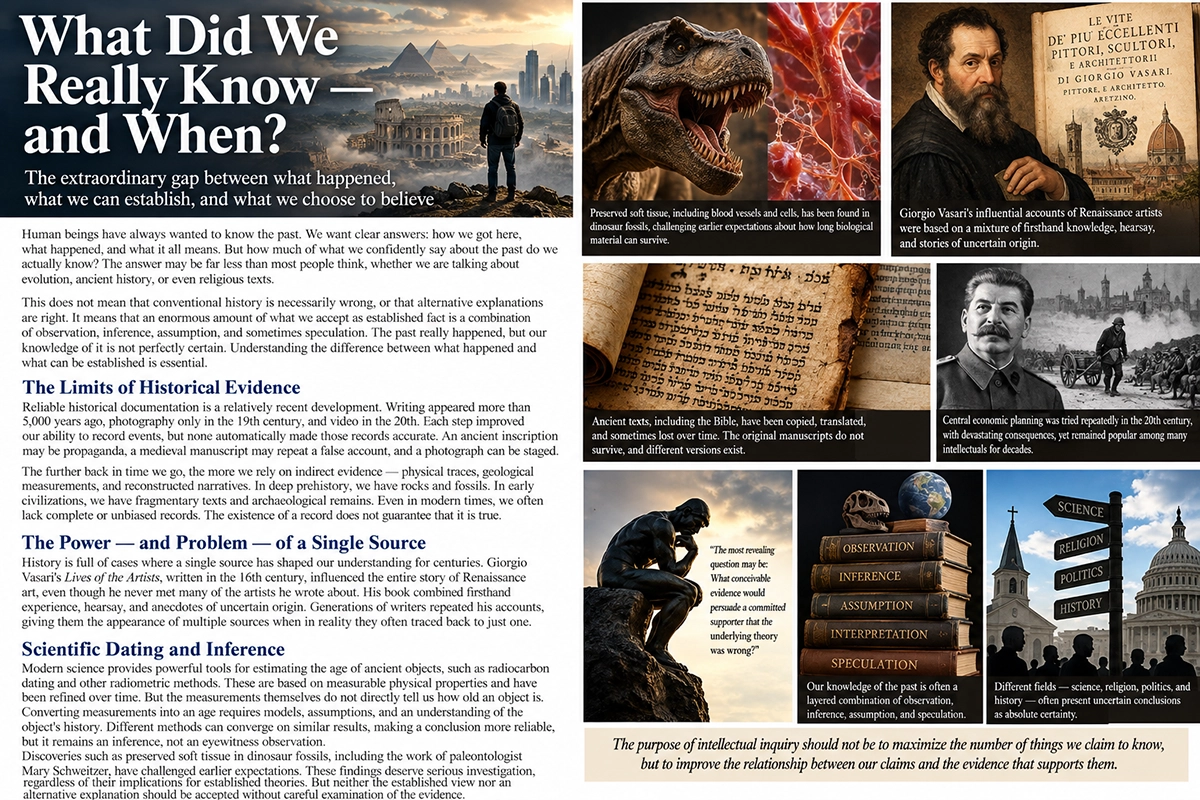
The Past Happened. That Does Not Mean We Know What Happened.
Human beings have always wanted clear explanations of the past: how we got here, what happened, and why. Yet much of what is presented as historical knowledge is a combination of direct observation, surviving records, inference, assumption, and reconstruction. Those categories are not interchangeable. The actual past was definite; our access to it is fragmentary. A plausible explanation may be useful and even correct without qualifying as directly verified knowledge.
Imagine two people arguing in a room today. They may disagree immediately afterward about who began the dispute, what was said, and what motivated it. Even a recording could resolve the words without resolving the intentions. Now imagine reconstructing the same event five centuries later from one secondhand account. Our confidence should change with the quality of the evidence, not with the confidence of the storyteller.
What Would Genuine Documentation Require?
A demanding standard would require multiple independent observers, contemporary records, an authenticated and continuous chain of preservation, intelligible original language, and agreement on what happened, when, where, how, and why. Very little ancient history would meet it. In fact, many modern events would fail the requirement concerning motives. This standard is best understood as a test of direct verification, not a declaration that anything falling short is false.
Writing began more than five thousand years ago; photography and motion pictures arrived in the nineteenth century. Each enlarged the available record, but none guaranteed truth. Inscriptions can be propaganda, manuscripts can be mistranscribed, photographs staged, and videos edited or deprived of context. Digital abundance today makes provenance more important, not less.
One Source, a Thousand Echoes
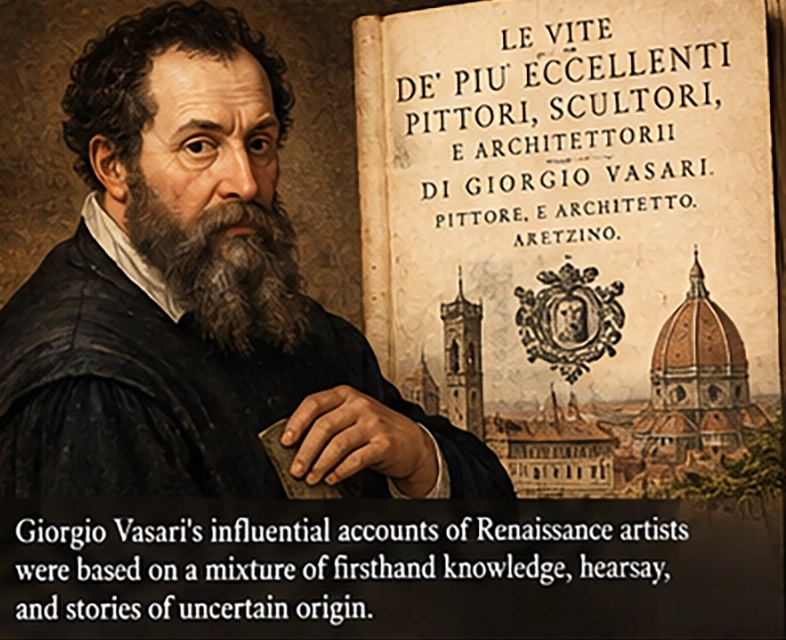
Giorgio Vasari’s Lives, first published in 1550 and expanded in 1568, profoundly shaped the history of Renaissance art. Yet Vasari was born in 1511, long after many of his subjects had died. His accounts mixed direct experience with documents, traditions, anecdotes, and personal judgment. Later authors could repeat his stories until they seemed to have accumulated multiple confirmations, although their evidentiary ancestry led back to a single source.
Three questions must be kept distinct: Do we know what an author wrote? Do we know where the author obtained the information? And do we know that the information was accurate? A thousand citations descending from one original account are not a thousand independent observations. Even many surviving manuscript copies may derive from a single lost exemplar. Repetition can increase confidence without adding evidence.
Scientific Dating: Measurement and Reconstruction
Radiocarbon dating and other radiometric techniques are based on measurable physical phenomena. They are not arbitrary conventions, and they have been checked against independent evidence, including tree-ring chronologies and geological relationships. But an instrument measures isotopic properties; it does not witness the age of a fossil. Converting measurements into dates requires models concerning initial conditions, contamination, chemical history, and the behavior of the system over time.
Some assumptions are independently testable, others are constrained by multiple measurements, and some remain uncertain. The important question is not whether assumptions exist, because they always do, but whether the conclusion survives plausible changes in them. Independent convergence is meaningful; an estimate should nevertheless be labeled as an estimate, not as a firsthand observation.
Evolution: Mechanism Versus Historical Narrative
The term evolution covers propositions with different evidentiary status. Heritable change, natural selection, mutation, and adaptation can be observed or tested. Speciation and genetic relationships can also be investigated empirically. Evolutionary theory therefore is not merely a guess: its mechanisms have substantial scientific support. Yet the exact sequence of ancient events that produced every lineage is a historical reconstruction, not a process anyone directly watched over millions of years.
Observation, hypothesis, prediction, and testing are central scientific practices. Historical sciences cannot replay the past, but they can make predictions and test them against new fossils, genetic comparisons, and geological evidence. A useful theory can be strongly supported without every detail of its reconstruction being certain. Museum narratives about extinct creatures should distinguish bones actually found from reconstructed color, behavior, and social arrangements.
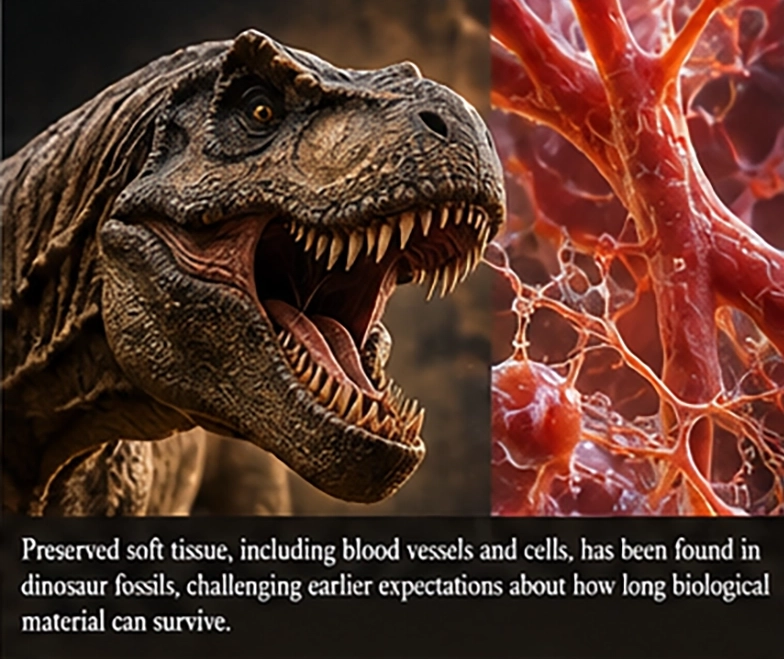
The dinosaur soft-tissue findings associated with Mary Schweitzer illustrate the point. Biological remnants and flexible structures surprised researchers and challenged expectations about preservation. Subsequent chemical studies have explored mechanisms that might stabilize such material. These observations neither directly reproduce tens of millions of years nor independently demonstrate a young fossil age. Both the conventional and alternative explanations must expose their assumptions and face testing.
Biblical Literalism Faces the Same Test
Those who insist that every biblical historical detail is literally certain confront a different but equally serious chain of questions. Which canon: Protestant, Catholic, or Orthodox? Which manuscript tradition? Which translation? Which interpretation of ancient literary genres? The original handwritten biblical manuscripts are not known to survive; scholars compare later copies, quotations, and translations, some of which differ in consequential passages.

One may believe in divine inspiration without assuming that every copyist, translator, editor, and modern interpreter was incapable of error. The King James Version of 1611, for example, is an English translation produced within a particular manuscript and religious tradition. A modern claim of literal certainty must specify what text is being treated as authoritative and why. The theological claim and the historical-documentary claim are not identical.
This does not disprove religious belief. It requires believers to recognize that transmission, attribution, translation, and interpretation are distinct questions. Secular and religious authorities alike can mistake a deeply held framework for independently verified history.
When Failure Is Visible and Still Disputed
Comprehensive central economic planning supplies a striking example because its claims were not restricted to ancient events. During the twentieth century, centrally directed systems operated in the Soviet Union, Maoist China, Cambodia, Cuba, North Korea, and elsewhere. Their conditions differed, and war, coercion, international relations, and other factors complicate causal comparison. Nonetheless, repeated shortages, allocation problems, and, in some cases, devastating famine and repression were observable in contemporary records.
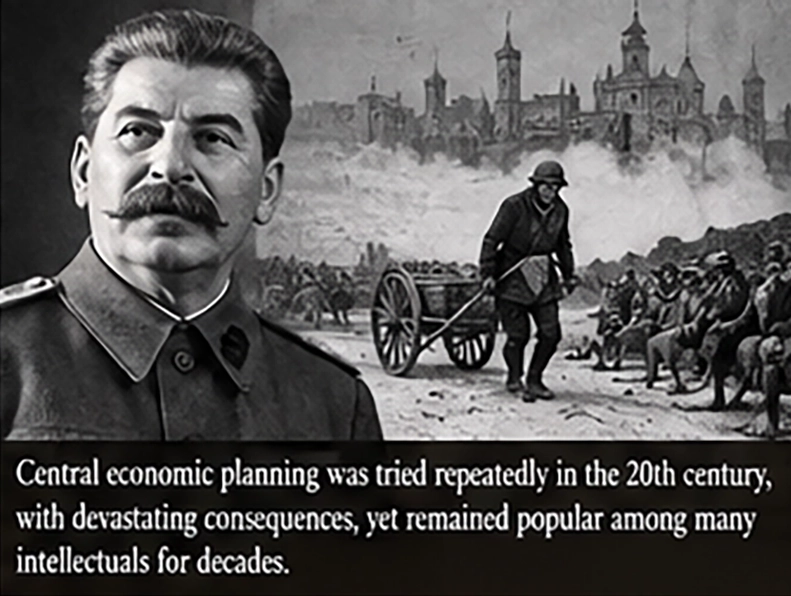
Theoretical challenges were also available early. Ludwig von Mises argued in 1920 that comprehensive socialist calculation faced serious difficulties without market prices for productive resources; Friedrich Hayek emphasized the dispersed, changing character of economic knowledge in 1945. Yet planning retained prestige among influential intellectuals for decades. Not all academics favored it, and advocates proposed different versions. The broader question remains: when adverse evidence accumulates across multiple implementations, what would actually persuade committed proponents to revise their underlying theory?
A theory can always be defended by claiming that each failure reflected imperfect implementation. Sometimes that defense is legitimate. But if no possible failure can count against the underlying proposition, it ceases to operate as a normally testable empirical claim.
Why People Prefer Certainty
Professional identity is one reason. A scholar who has spent decades working within a framework may find its abandonment personally and intellectually costly. Institutions create further pressures: tenure, peer review, grants, curricula, reputation, and membership in professional communities. Researchers may be genuinely conscientious while unconsciously discounting evidence that threatens assumptions on which their careers depend.
Other pressures are not professional at all. People seek social belonging, moral coherence, religious reassurance, ideological consistency, and narratives that make the world understandable. Certainty reduces mental effort. Experts are expected to answer questions; “we do not know” can seem less impressive than a coherent story. Sunk costs, fear of consequences, and loyalty to admired authorities can reinforce belief even when new evidence demands reconsideration.
These tendencies are not peculiar to academics. Religious institutions, corporations, political movements, journalists, and ordinary individuals display them too. And a consensus can be right despite institutional incentives. The incentives explain why we should scrutinize the process, not why we should automatically reject the conclusion.
How Assumptions Become Facts
A researcher proposes a tentative explanation. Another calls it plausible. A textbook labels it the accepted account. A documentary removes the caveats and describes what happened. Eventually, a proposition appears with no visible trace of the uncertainty that originally surrounded it. Nobody in the chain need be dishonest. Each may assume that earlier writers established more than they actually did.
Artificial intelligence can accelerate this process. It can synthesize thousands of documents whose claims ultimately descend from one source and present the resulting consensus with effortless fluency. But AI could also do the opposite: trace citation lineages, expose shared assumptions, identify independent evidence, and display how a conclusion changes under alternative premises. That would be a more valuable use of the technology than simply producing increasingly confident summaries.
A More Honest Vocabulary of Knowledge
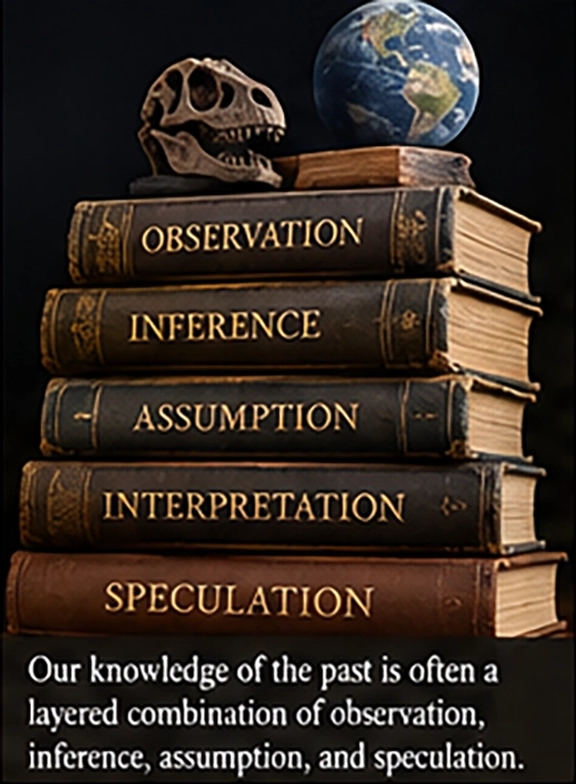
We should distinguish directly documented events, independently corroborated claims, experimentally established mechanisms, strongly supported inferences, plausible reconstructions, and speculation. These are not rigid rankings: a well-tested scientific inference may be more reliable than an eyewitness report. They are reminders that the nature of the evidence matters as much as its quantity.
For every consequential claim, ask what was observed, which sources are truly independent, which assumptions are necessary, what has been tested, what alternatives remain, and what evidence would change the conclusion. A plausible premise can guide research; a useful theory can generate predictions; a tentative explanation can illuminate an otherwise obscure record. None needs to masquerade as certainty to have value.
Knowing Less, Understanding More
The purpose of inquiry should not be to maximize the number of propositions we announce as settled. It should be to improve the relationship between our claims and the evidence supporting them. A historical narrative can be insightful without being certain. A scientific theory can be powerful without directly documenting every ancient event. A religious belief can be meaningful without pretending that textual transmission presents no difficulties.
The past is real. Evidence is real. But the stories we tell about the past are not automatically equivalent to the past itself. We probably know much less with certainty than we think. Acknowledging that does not require skepticism about everything; it requires greater precision about what we actually know, and when we came to know it.
Whether you're exploring interoperability, dataset valuation, AI readiness, or ecosystem participation, we welcome conversations with researchers, organizations, and strategic partners interested in the future of structured data systems.
info@datauniversa.com