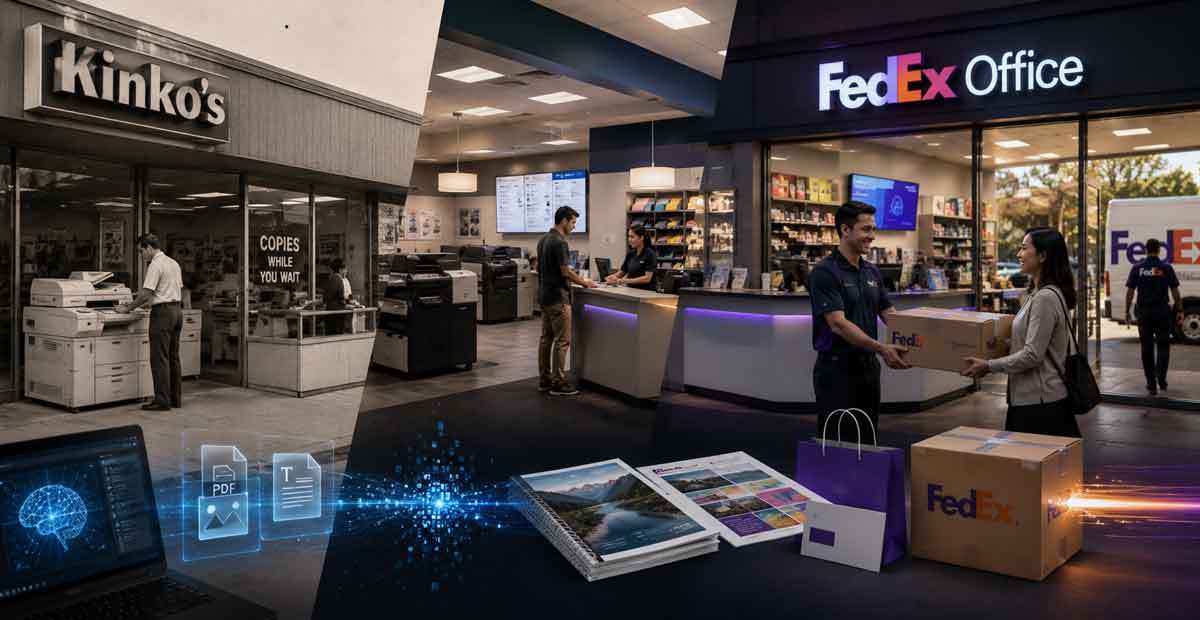
What Happened to Kinko’s? A Lesson for the AI Age
By: John F Groom
Technology does not always destroy an industry. Sometimes it destroys the reason an industry originally existed while leaving enough valuable pieces behind to build something new, Kinko’s is an unusually good example.
For millions of Americans who went to school or worked in an office in the 1980s and 1990s, Kinko’s was part of everyday life. You went there to make copies, print a report, send a fax, bind a presentation, create a résumé, or use a computer and printer that were considerably better than anything you had at home, Then much of that world disappeared.
Computers became cheap. Printers became cheap. Email largely replaced faxing. Documents became PDFs. Cloud storage replaced boxes and folders of paper. Presentations could be distributed electronically rather than reproduced 30 times and placed in binders, yet the business did not simply disappear, it became FedEx Office.
Kinko’s Was Really Selling Access
Kinko’s was founded in 1970, when photocopiers and other document-production technologies were relatively expensive and inaccessible. That created a simple business opportunity. A customer did not need to own a $10,000 machine if a nearby business owned one and would let the customer use it for a few cents per page.
As office technology expanded, so did Kinko’s. The company added computers, printers, fax machines, binding, desktop publishing, and increasingly sophisticated document-production services.
In retrospect, however, many of these services shared a common economic foundation: Kinko’s owned technology that customers needed but did not own themselves, that was a valuable position until the technology became cheap enough that almost everyone could own it.
Digitization Attacked the Business From Two Directions
The personal-computer revolution initially created business for Kinko’s before it began taking business away.
During the early stages of digitization, people could suddenly create sophisticated documents themselves. But creating a document and physically producing it were still different things. You might create a presentation on your computer and then take the file to Kinko’s to print 50 color copies, collate them, and bind them, eventually, however, technology attacked both sides of that transaction.
The equipment became inexpensive enough that homes and offices could produce increasingly good documents themselves. More importantly, many documents no longer needed to become physical objects at all.
A report could become a PDF. A memo could become an email. A photograph could be viewed on a screen. A presentation could be projected from a laptop. A document that once had to be copied 100 times could simply be downloaded 100 times.
The marginal cost of producing another digital copy approached zero, That was a fundamental threat to a company whose name had practically become synonymous with making copies.
Kinko’s Disappeared. Its Stores Did Not.
In 2004, FedEx acquired Kinko’s, which had grown into a network of more than 1,000 locations. FedEx initially called the operation FedEx Kinko’s and then, in 2008, eliminated the Kinko’s name altogether and renamed the business FedEx Office.
That change was more significant than a rebranding exercise. It represented a transformation in what the physical network was for, consider what survived.
People might not need Kinko’s to fax a memo anymore, but businesses still needed banners and signs. Architects still needed large drawings. Companies still produced promotional material. Conferences needed displays. Documents still sometimes needed professional binding and finishing and, crucially, physical objects still had to move, A PDF can travel across the world instantly. A package cannot.
That made the combination with FedEx particularly logical. The surviving scarce resources were not merely photocopiers. They were physical locations, sophisticated production equipment, employees, commercial relationships, and access to a logistics network.
Today's FedEx Office still offers ordinary copying and printing, but its capabilities extend far beyond the old neighborhood copy shop. It produces signs, graphics, commercial print projects, and marketing materials; handles packing and shipping; operates corporate print and parcel facilities; and connects thousands of printers and production facilities through a distributed production network, In other words, the valuable part of Kinko’s migrated.
Now Comes AI
Artificial intelligence presents FedEx Office with another version of the same problem, Generative AI makes it dramatically easier to create things that historically required specialized human skills. A small-business owner can ask AI to draft a brochure. An entrepreneur can generate several versions of a logo. A restaurant can create a menu. A conference organizer can generate signs, schedules, and promotional material. A job seeker can create and format a résumé. A company can generate customized marketing materials for hundreds of locations.
Some of this threatens existing businesses. Graphic designers, copywriters, advertising agencies, and print-production specialists may see portions of their traditional work automated, but something interesting happens when the AI finishes its work.
The brochure may still need to become a brochure. The sign still needs to become a sign. The trade-show display still needs to become a display. And the package still needs to get from one physical location to another.
AI can generate an extraordinarily good image of a 10-foot banner. It cannot hang the banner in a convention center, that distinction could make FedEx Office more relevant to the AI economy rather than less.
From Print Shop to Physical Output Layer
Imagine a small-business owner telling an AI system, "We're opening a second restaurant next month. Create everything we need for the opening." An advanced AI could potentially create the invitations, menus, window graphics, promotional posters, employee materials, direct-mail pieces, and social-media campaign, But there is an obvious next question: now what?
Some outputs remain digital and can simply be published. Others need to enter the physical world, that creates an opportunity for businesses like FedEx Office to become something analogous to a physical output layer for AI.
The customer might never need to think about paper dimensions, printing technology, file formats, color settings, binding methods, or which production facility should handle the job. The AI could determine those things.
The customer describes the desired outcome. AI creates the content. A production network manufactures the physical components. A logistics network delivers them where they need to go.
There are already pieces of this infrastructure in place. FedEx Office offers online print management and APIs that allow organizations to embed print ordering into other software systems. Its commercial network can route production geographically rather than necessarily printing something where the order originated, AI could make that model considerably more powerful.
AI Could Also Reduce Demand
There is, of course, another possibility, AI could accelerate the long-term decline of printed information AI assistants may replace additional reports, manuals, forms, presentations, and marketing documents with interactive digital experiences. Instead of receiving a 30-page employee handbook, a worker might simply ask a corporate AI assistant whatever they need to know.
Instead of printing a product catalog, customers might describe what they want to an AI shopping agent. Instead of handing attendees a conference program, organizers might provide an AI event assistant.
AI could therefore simultaneously increase our ability to create printed material while decreasing our need to consume it That tension will determine which portions of the business grow and which decline.
Commodity document printing looks vulnerable. Physical production that serves a purpose precisely because it is physical, such as signage, packaging, displays, events, branded environments, and shipping, looks considerably more durable.
The Deeper Technology Lesson
Kinko’s illustrates something important about technological disruption. We often describe new technologies as though they confront existing industries in a simple contest between new technology and old business. Reality is usually more complicated. A business is a bundle of capabilities.
Kinko’s contained photocopiers, printers, employees, stores, customer relationships, production expertise, locations, computer equipment, and a recognizable brand. Digitization did not assign the same value to every one of those things. It made some nearly worthless, made others less important, and left some surprisingly valuable.
FedEx effectively recombined the surviving assets with another set of assets, transportation and logistics, and created a different business. AI is likely to repeat this process across thousands of industries.
The most important question therefore may not be, "Will AI destroy this business?" A better set of questions is: Which parts of the business does AI make abundant? Which parts remain scarce? And can the scarce parts be recombined into something more valuable?
Kinko’s once provided access to machines that allowed humans to turn information into documents. Digitization made much of that access unnecessary. AI may now make the creation of the information itself extraordinarily cheap. But the physical world remains stubbornly physical. Something still has to manufacture the sign, pack the box, install the display, and deliver the package.
The history of Kinko’s suggests that surviving a technological revolution does not necessarily mean defending the business you already have. Sometimes it means discovering what technology has not made obsolete and building the next business around that.
Whether you're exploring interoperability, dataset valuation, AI readiness, or ecosystem participation, we welcome conversations with researchers, organizations, and strategic partners interested in the future of structured data systems.
info@datauniversa.com