What Is Progress, and What Can We Expect?
By: John F Groom
Why the Future Will Not Be a Collection of Exponential Curves
DU Technology & Society | October 2026
We are surrounded by predictions of astonishing progress. Artificial intelligence will grow more capable, robots will perform more human work, medicine will become more powerful, and the next generation of technology will transform everyday life. Some of these predictions will be right. But they often omit a fundamental question: what exactly is improving, and by whose definition?
A useful theory of the future must account not only for the potential for change, but also for limits, plateaus, changing preferences, and regression. It must distinguish what technology can do from what human beings actually value.
The Myth of a Single Curve
The most common forecasting error is to observe a period of rapid improvement and extend its trajectory indefinitely. Yet different activities follow radically different paths. Computing has undergone extraordinary cumulative advances. Commercial flight became dramatically faster in its early decades, but ordinary passenger speeds have changed comparatively little since the jet age. Virtual reality has repeatedly improved technically without becoming a universal daily activity. Robotics combines rapid advances in perception and reasoning with stubborn physical constraints in dexterity, reliability, and cost.
Some domains improve quickly, some slowly, some not at all, and some move backward. Even a rapidly advancing technology eventually encounters limits, whether physical, economic, institutional, or human.
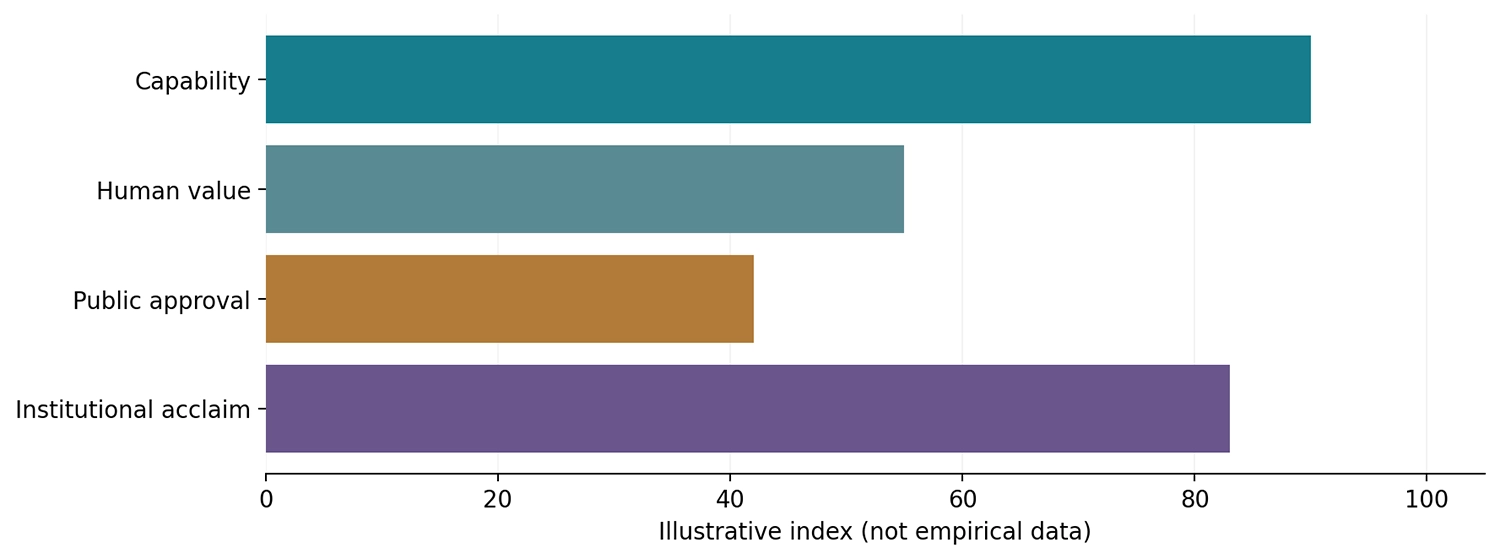
Figure 1. Five possible trajectories. These are conceptual illustrations, not historical measurements.
Some Human Achievements Are Not Cumulative
People still read Jane Austen and Shakespeare, study Aristotle, and stand in awe of Michelangelo’s Sistine Chapel. Their achievements have not been rendered obsolete by the passage of centuries. Great art and philosophy are not like successive generations of computer chips: a later generation does not automatically inherit the creative genius of its predecessors.
There is a selection effect: we remember exceptional historical works while comparing them with the much larger output of the present. But that does not negate the essential point. In some fields, the highest levels of human achievement may have been reached long ago. Newness does not guarantee superiority.
This also means that innovation and improvement are different concepts. An artist can create something unprecedented without creating something more beautiful. A philosopher can introduce a new framework without resolving an old question more convincingly.
When the Definition of “Better” Changes
The criteria for progress are themselves historical. In societies where food was scarce, a fuller figure could signify prosperity and security. Where food is abundant, thinness, fitness, and visible self-discipline can become more desirable. In many cultures, premarital virginity was once central to assessments of marriageability; today its social significance varies enormously and has diminished in many settings. These are not universal transitions, but they demonstrate how ideals move as circumstances and institutions change.
A particularly revealing example is transportation. If the goal is simply to reach a destination, a six-hour journey is generally preferable to a twelve-hour one. But a passenger may happily pay a premium for a slow luxury train with excellent meals, scenery, comfort, and conversation. A faster, cramped, unpleasant bus ride is technically superior in speed and inferior in experience. Once the journey itself becomes the product, speed may cease to be the main measure of value.
Yesterday’s scarce luxury can become today’s commonplace commodity. When a benefit becomes widely available, the status attached to possessing it may disappear. Desire shifts toward something else: exclusivity, authenticity, leisure, personal service, or a new form of distinction.
Who Has the Authority to Declare Progress?
Modern art exposes another problem. Critics, curators, collectors, galleries, and artists can establish standards emphasizing originality, conceptual innovation, or deliberate challenges to conventional beauty. Those standards may differ sharply from the preferences of ordinary viewers, many of whom still prize recognizable subjects, craftsmanship, and visual pleasure.
New York’s postwar art establishment was unusually influential in legitimizing movements such as Abstract Expressionism, although modernism’s history is broader and international. It would be too strong to claim without representative surveys that nearly everyone rejects modern art. The sounder point is that professional acclaim, market prices, and popular appreciation are separate measures, and no one of them should silently stand in for the others.
The same distinction applies to architecture, education, and medicine. A profession may celebrate technical sophistication, methodological innovation, or institutional prestige while the people it serves place greater weight on beauty, accessibility, affordability, comfort, or outcomes.
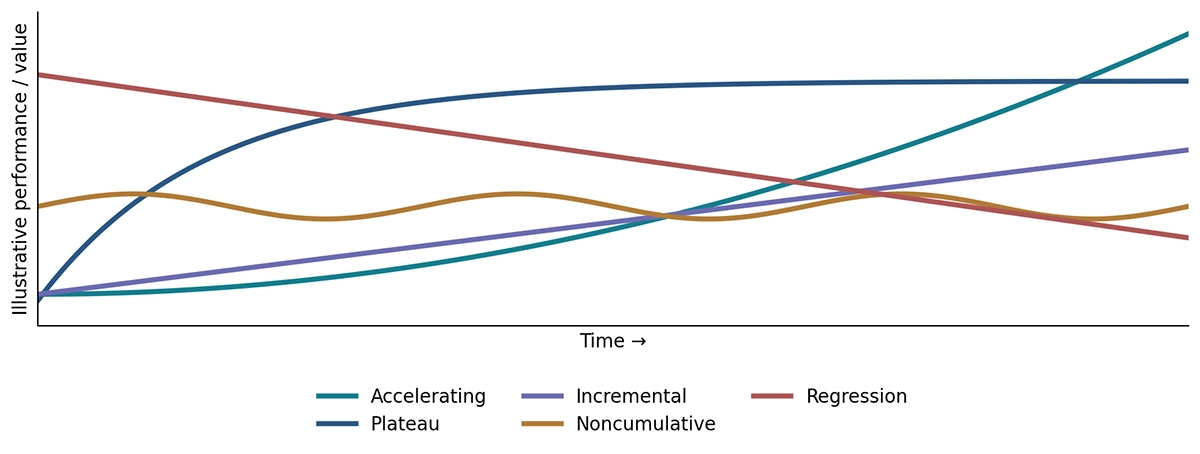
Figure 2. A hypothetical example: capability, human value, public approval, and institutional acclaim need not move together.
The Difference Between Means and Ends
Many measures of progress are proxies. Processing speed is a proxy for useful computing. Square footage is a proxy for desirable housing. Travel speed is a proxy for good transportation. The number of published papers is a proxy for useful knowledge. Each can become misleading once the obvious gains have been captured.
Imagine an AI that can write a good article in three seconds. Reducing that time to three hundredths of a second represents a hundredfold speed improvement, but may offer a reader almost no additional value. A million excellent articles do not create a million times more attention. Human reading speed, available hours, trust, and appetite for information remain limited.
AI could also make human-created works more prized rather than less. If abundant machine-generated images, music, and prose become nearly free, audiences may attach more value to provenance, human intention, scarcity, or the experience of encountering a particular creator. Technical abundance can produce new forms of cultural scarcity.
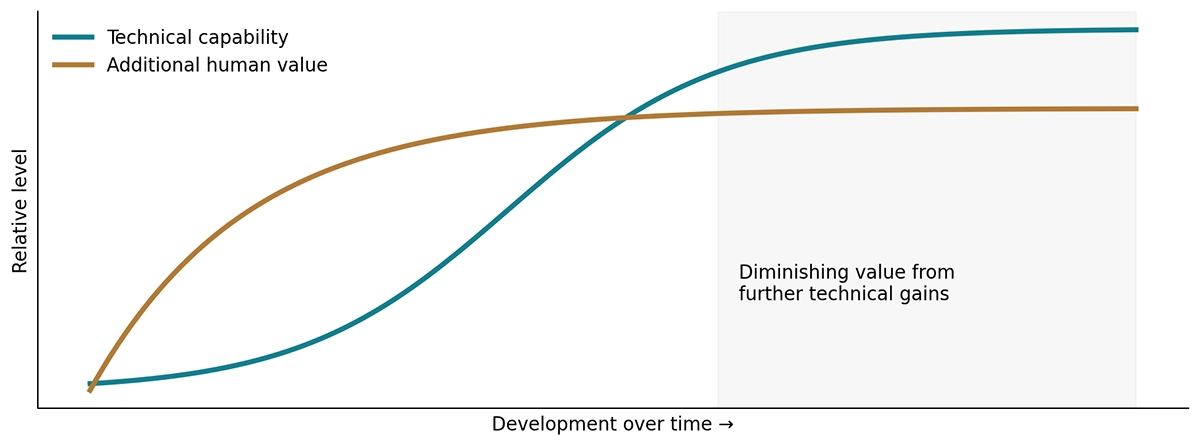
Figure 3. Technical performance can keep rising after the incremental benefit to people has largely flattened.
Three Kinds of Limits
Physical limits arise from the properties of the world: energy, materials, friction, aerodynamics, biological constraints, and the difficulty of manipulating complex environments. Human limits include attention, physical capacity, time, aesthetic preferences, and the finite desire to consume any particular experience. Institutional limits arise from laws, incentives, professional standards, organizational complexity, and established market structures.
These limits differ in their permanence. A physical constraint may be extremely difficult to escape. A human preference may change rather than disappear. An institutional bottleneck may be overcome through a new arrangement without any underlying scientific breakthrough. Forecasts become unreliable when they assume that progress in one component automatically carries the entire system forward.
Regression Is a Real Possibility
Technology is not the same thing as civilization, and capability is not the same thing as performance. Institutions can become less responsive; public spaces can become less beautiful; services can become more cumbersome; knowledge and craft traditions can be lost. Better tools may coexist with worse experiences. Progress in one dimension can even contribute to deterioration in another. For example, limitless content generation can increase noise and make trustworthy information harder to identify.
This does not mean the past was generally better. It means that improvement must be demonstrated in the particular dimension being discussed rather than assumed from chronology.
The Opportunity: Changing the Structure of Value
One of the most promising possibilities is not to make an underlying human activity dramatically better, but to create a system that allows existing achievements to become more useful, accessible, measurable, or valuable. An athlete may be near a biological ceiling, yet systems for recording, comparing, and recognizing performances can still improve dramatically. People have always observed their environments, but new methods can verify those observations, connect them to demand, and compensate contributors.
This is relevant to DU’s work. Local Records (LR) seeks to make ordinary exercise performances measurable and competitive across people and places. DAM seeks to turn smartphone-based evidence collection into a paid, verifiable activity. GMIP aims to establish mechanisms through which data, processes, intellectual property, and related assets can be discovered, evaluated, exchanged, and used. The opportunity is not necessarily a new human capability; it is a new structure for realizing value from capabilities that already exist.
Such structures, too, have limits. Markets can fail, verification can become costly, participation can plateau, and value can shift as supply expands. The point is not that structural innovation escapes constraints, but that it often encounters a different set of constraints than the underlying activity.
A More Useful Forecasting Discipline
A more reliable approach to forecasting progress begins by identifying the specific dimension claimed to be improving, rather than speaking of progress in general. It then asks whether the improvement is cumulative, constrained, or already near a useful ceiling, and distinguishes technical capability from the human benefit delivered by that capability.
It also considers whether the definition of “better” is likely to change as scarcity, wealth, and culture change. Whose judgment is being used: experts, institutions, markets, users, or the wider public? Which components of the system remain weakest, regardless of how quickly its leading technology improves? Finally, a sound forecast must explicitly allow for stagnation, reversal, and improvements that make other outcomes worse.
Conclusion: The Future Has Many Directions
The future is not a collection of exponential curves pointing toward infinity. It is a landscape of radically different trajectories: accelerating capabilities, slow improvements, hard plateaus, timeless achievements, shifting ideals, and outright reversals. Even the meaning of progress changes, and the people empowered to define it may not be those who experience its consequences.
The right question is not merely “What will technology allow us to do?” It is “What will be better, for whom, according to what standard, and at what cost?” Only then can we begin to distinguish genuine human progress from novelty, greater technical capability, and the shifting fashions of the age.
Editorial note: Figures are original conceptual illustrations. Historical examples are interpretive, not claims that all cultures or populations share one preference.
Whether you're exploring interoperability, dataset valuation, AI readiness, or ecosystem participation, we welcome conversations with researchers, organizations, and strategic partners interested in the future of structured data systems.
info@datauniversa.com