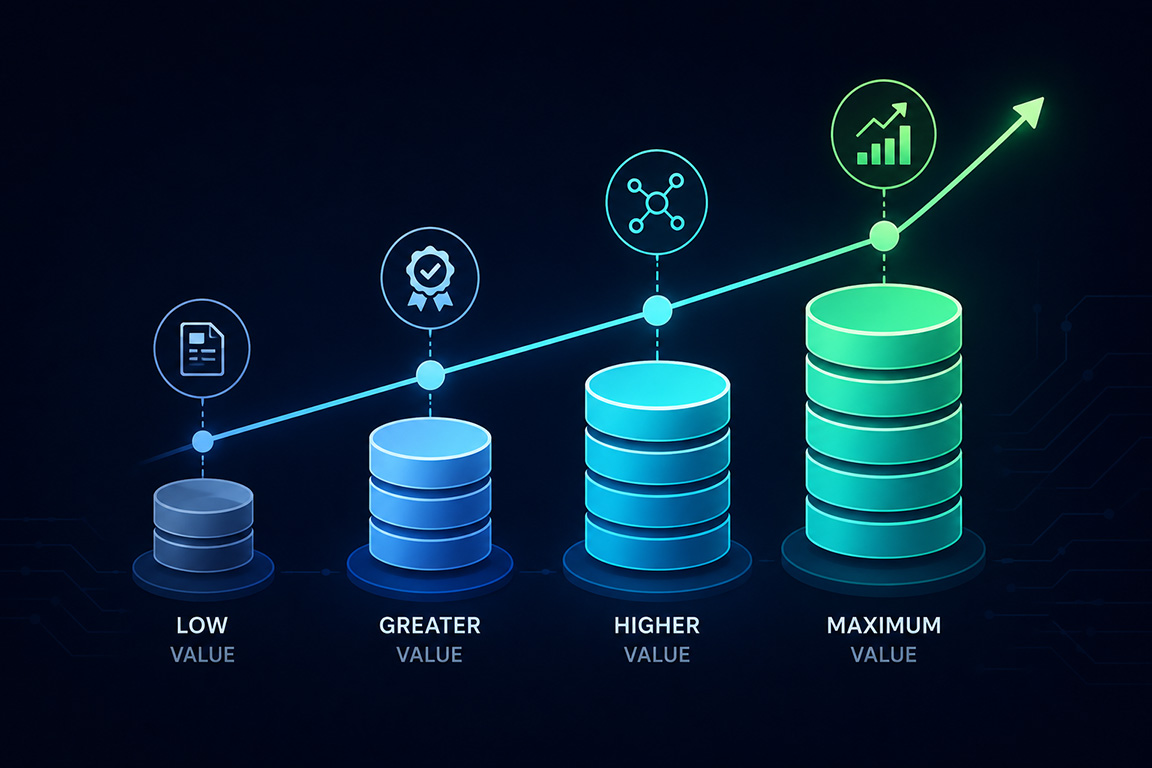
What Makes a Dataset Valuable?
By: John F Groom
Not all datasets are equally valuable. Two organizations may each have one million records, yet one dataset may attract significant interest while the other generates little or no demand. The difference is not simply the amount of data collected. Value is determined by how useful, trustworthy, and applicable that data is to real-world problems.
As artificial intelligence, analytics, and decision-support systems continue to expand, organizations are increasingly asking a fundamental question: What actually makes a dataset valuable?
The answer involves far more than record counts alone.
The Biggest Misconception: More Data Means More Value
Many people assume that larger datasets are automatically more valuable. This is not always true.
A small dataset with excellent provenance, strong quality controls, and unique information may be far more valuable than a much larger dataset containing inconsistent or poorly documented records.
Value comes from usefulness. Organizations purchasing or licensing data are typically trying to solve a problem, improve a model, answer a question, or make a decision. The more effectively a dataset supports those objectives, the more valuable it may become.
1. Uniqueness
Datasets that capture rare events, specialized industries, long-term observations, or difficult-to-access populations often command greater interest because they are difficult to reproduce.
If anyone can easily collect the same information, the value tends to decrease.
2. Provenance
A dataset with strong provenance is generally more trustworthy than one with unknown origins. This is particularly important for artificial intelligence, analytics, compliance, research, and benchmarking applications.
Data without provenance may still have value, but uncertainty often reduces confidence and limits potential uses.
3. Data Quality
Organizations often spend substantial resources cleaning data before it can be used.
Datasets that require less correction and preparation are generally more attractive because they reduce implementation costs.
4. Interoperability
These connections create opportunities for new insights that would not exist within a single dataset. DataUniversa refers to this capability as interoperability.
As AI systems increasingly consume information from multiple sources simultaneously, interoperability is becoming one of the most important drivers of long-term dataset value.
5. Admissibility
As organizations place greater emphasis on trustworthy AI and evidence-based decision making, admissibility is becoming an increasingly important consideration.
6. Coverage
Coverage can increase value because broader datasets often support more use cases.
However, coverage alone is rarely sufficient if quality and provenance are weak.
7. Demand
Demand changes over time, meaning dataset value can change as new technologies and industries emerge.
Why Dataset Connections May Matter More Than Dataset Size
Historically, data was often viewed as a standalone asset. Today, many organizations are discovering that the greatest value comes from connecting information together.
A fitness dataset alone may have value. A fitness dataset linked to health outcomes, demographics, training history, and longitudinal performance measurements may become substantially more useful. This principle applies across industries.
The future value of data may increasingly depend on its ability to participate in larger information ecosystems rather than remaining isolated in separate silos.
How DatFlash Helps Identify Valuable Data
One challenge in evaluating dataset value is understanding what the market is actually doing.
DatFlash was created to help address this problem. DatFlash tracks dataset transaction activity, licensing events, acquisitions, marketplace activity, and other market signals related to the data economy.
This helps organizations better understand:
- What types of datasets are attracting interest
- Which sectors are actively acquiring data
- Emerging trends in data demand
- Activity across the broader data marketplace
While no single transaction determines value, market activity can provide useful signals regarding the types of data buyers are seeking.
How DataUniversa Evaluates Dataset Value
DataUniversa approaches dataset value through multiple dimensions rather than relying solely on dataset size.
These dimensions include:
- Provenance
- Admissibility
- Quality
- Interoperability
- Coverage
- Uniqueness
- Market demand
The goal is not simply to determine whether data exists.
The goal is to understand whether the data can be trusted, connected, analyzed, and used to generate meaningful outcomes.
Conclusion
The most valuable datasets are rarely the largest. They are the datasets that can be trusted, verified, connected, and applied to important problems. As the data economy continues to evolve, organizations are increasingly recognizing that provenance, admissibility, interoperability, and utility may be more important than volume alone.
In many cases, the fastest way to increase the value of a dataset is not collecting more information. It is improving the quality, structure, documentation, and connectivity of the data that already exists.
Whether you're exploring interoperability, dataset valuation, AI readiness, or ecosystem participation, we welcome conversations with researchers, organizations, and strategic partners interested in the future of structured data systems.
info@datauniversa.com