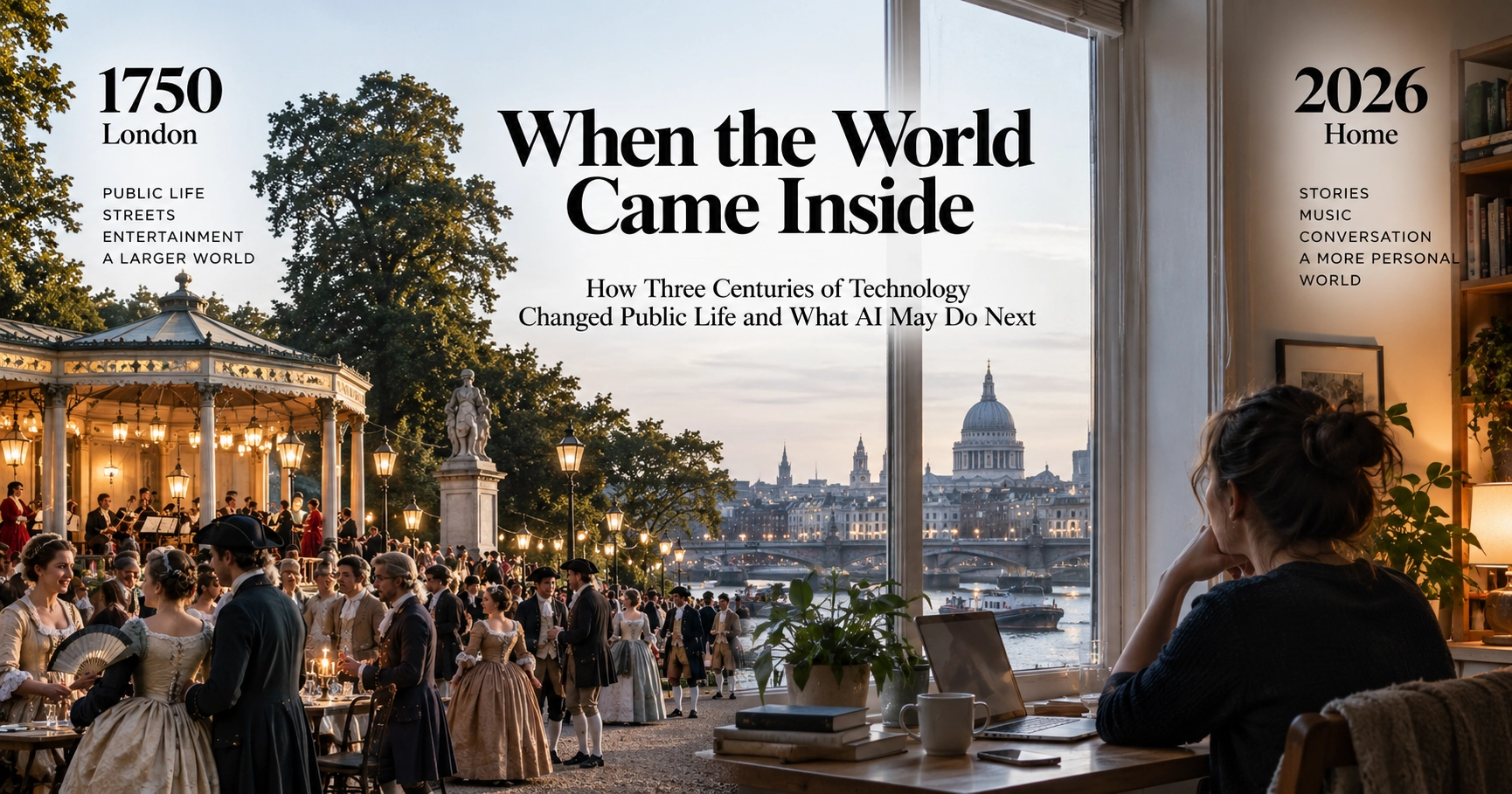
When the World Came Inside
By: John F Groom
How Three Centuries of Technology Changed Public Life and What AI May Do Next
Imagine a Londoner in 1750 who has finished the day’s work and wants something interesting to happen. An obvious response is to go outside. The street offers a changing stream of shops, hawkers, animals, coaches, arguments, gossip, and performances. Taverns, coffeehouses, theaters, fairs, and pleasure gardens supply more organized entertainment. Desire often requires a journey, and the journey exposes the person to much more than the experience originally sought.
Over the following centuries, technology progressively brought these experiences home. Stories, music, voices, moving images, shopping, and conversation became available without a physical journey. AI may carry this process further by making private experience adaptive and increasingly generated for the individual. Yet the same intelligence could also help people discover reasons to leave home. The important historical change is therefore more than a migration indoors: it is a growing ability to control the world we encounter.
London Came Through the Window
Entertainment in eighteenth-century London was never entirely public. People read, played cards, made music, entertained visitors, and talked at home. Access to leisure also depended on money, gender, occupation, and social position. Nevertheless, many forms of spectacle and social possibility required going somewhere. Vauxhall and Ranelagh were particularly revealing examples. Their attractions included music, eating, drinking, fashionable company, and strolling. Vauxhall also displayed paintings, combining elements of a garden, restaurant, concert venue, and art exhibition.
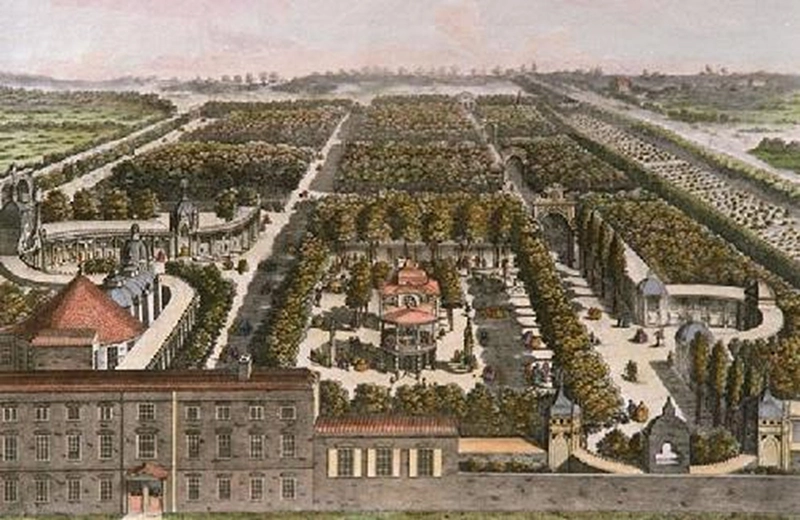
Vauxhall Gardens around 1751, attributed to Samuel Wale. Public domain reproduction via Wikimedia Commons. Music and social observation shared a physical setting.
Even staying home did not mean shutting London out. Street sellers advertised through distinctive cries, projecting their wares into the surrounding neighborhood. Bells, horses, cart wheels, craftsmen, musicians, and crowds added to the soundscape. London Museum’s account of street traders documents a longstanding culture in which the human voice served as a mobile advertisement.
In homes close to the street, open windows and limited acoustic separation allowed public life to penetrate domestic space. Conditions varied by dwelling, wealth, and neighborhood, but the boundary could be thin. A person sewing or reading in a front room might hear a seller, a coach, an argument, or a musician without having chosen any of them. Hogarth’s The Enraged Musician, published in 1741, makes the point vividly: a musician at his window is overwhelmed by activity and noise outside. It is satire rather than a sound measurement, but its joke depends on a recognizable experience.

William Hogarth, The Enraged Musician, 1741. Yale Center for British Art, B1981.25.1430. Public domain image via Wikimedia Commons.
Being physically indoors was therefore different from being experientially sealed off. We can distinguish public immersion, domestic permeability, and domestic control. In the first condition, a person participates directly in the surrounding world. In the second, that world reaches into the house. In the third, the resident has much greater power to decide what enters. The historical movement toward private leisure has involved both spending more time at home and making home a more controllable environment.
What the Journey Supplied
The journey between desire and fulfillment once supplied a substantial part of the experience. Someone going to Vauxhall for music encountered streets, travelers, weather, buildings, and commerce on the way. At the destination, the music came with strangers, conversation, food, fashion, and the possibility of something unexpected. The intended attraction generated incidental experiences that no one had ordered in advance.
The street itself functioned as a medium. A hawker’s cry advertised a product. Clothing communicated status or taste. A crowd announced that something might be happening. A shop displayed possibilities; an overheard argument introduced an opinion. These encounters could be unpleasant, intrusive, or dangerous, but they also exposed people to information outside their immediate purposes. Public life continually placed the individual in contact with things that had not been selected for him.
This does not make the old city an ideal. Privacy, quiet, sanitation, and the ability to read without interruption are valuable achievements. Nor does physical encounter automatically produce meaningful discovery. Much of it is simply inconvenience. The point is that obtaining one desired experience used to require accepting a larger surrounding experience. Technology has made it increasingly possible to obtain the first without the second.
The Migration Into Private Space
Print provided an early means of bringing stories and information home, although books and domestic leisure long predated our London starting point. Recorded music separated listening from the presence of a performer. Radio delivered voices, news, and drama; television delivered moving spectacle. Home video, cable, and games expanded the choices. The Internet added searchable information and remote communication, while streaming and smartphones made an enormous range of material continuously accessible.
The sequence was uneven. Cinema created a new reason to gather outside the home. Greater prosperity and mobility opened opportunities for restaurants, travel, sport, and recreation. Digital communication can arrange meetings and sustain relationships across distance. It would be misleading to depict three centuries as a smooth, universal withdrawal. Technologies can enlarge private leisure while simultaneously supporting new forms of public life.
Nevertheless, the recent movement homeward is measurable. Sociologist Patrick Sharkey’s study of American Time Use Survey data found that U.S. adults spent an average of one hour and 39 minutes more at home each day in 2022 than in 2003. The shift began before the pandemic, although COVID accelerated it. This measures total time at home, including activities other than entertainment; it does not establish how much leisure moved indoors or tell us what Londoners did in 1750.
That distinction matters because there is no defensible continuous percentage series here stretching from Georgian London to the present. Historical diaries and records could support a reconstruction, but they would require careful treatment of class, gender, season, and definitions. The argument rests on documented changes in available experiences and a modern time-use finding, not on invented historical leisure shares.
More Choice and a Different Kind of Surprise
A modern home can offer extraordinary intellectual and artistic range. A person can study a distant civilization, hear unfamiliar music, talk to someone abroad, or encounter an argument that changes his mind. Digital life contains accidents and surprises of its own. Algorithms do not eliminate discovery, and the physical street never exposed everyone equally to the whole world.
What changes is the character of exposure. Digital systems often select material using our requests, previous behavior, and predicted interests. Their surprises arrive through an interface that can be dismissed, muted, or replaced. Physical surroundings include people and events with purposes independent of ours. Weather does not adjust to our preferences, and a stranger is not present because a system predicted we would enjoy him.
The distinction is therefore between different relationships with experience, rather than between a real world outside and an unreal world on a screen. Reading, learning, and remote friendship are real activities. But a mediated environment can increasingly spare us the surrounding demands and incidental encounters that accompany physical participation. It makes pursuing a particular desire more efficient while changing what else happens along the way.
AI Makes the Room Responsive
AI could deepen this change by making the private environment responsive. Earlier technologies mainly delivered material that already existed. An AI system can converse, explain, help create, recommend, and adapt its responses to the user. As these capabilities develop, a request such as “I’m bored” could produce an experience shaped by the person’s interests, recent activities, and longer ambitions. The following possibilities are a projection of that direction, rather than a claim that every capability already works reliably.
Instead of choosing from a catalog, the user may increasingly help generate a story, game, lesson, musical experiment, or imagined environment. The system could adjust difficulty, tone, and subject as the interaction unfolds. Combined with richer audiovisual tools, this could make staying home more engaging than earlier forms of entertainment. The room would offer an active counterpart that responds, rather than merely a supply of things to watch.
But endless output is not endless original human achievement. AI can generate variations without producing another Sade, Jane Austen, or distinctive human life. The value of an exceptional voice comes partly from the person whose judgment and experience produced it. An abundance of generated entertainment may be satisfying in its own terms while leaving that source of value scarce. Distribution, generation, and human originality are different things.
The attraction of responsive entertainment could still be powerful. Physical activities have friction: the museum requires a journey, rain changes a plan, friends are unavailable, and strangers may decline conversation. A synthetic environment can remove some of these obstacles and tailor itself to the user. It need not compel anyone to remain inside. It may simply become an increasingly appealing choice.
One possible result is that fewer unsatisfied desires lead to physical action. Novelty, challenge, and conversation might be available instantly, reducing the pressure to seek them elsewhere. Yet easy fulfillment is not necessarily the most engaging life. Desire can have value while it is being pursued, particularly when effort and judgment make progress possible. A system that resolves every restless moment may also remove opportunities for anticipation, initiative, and discovery.
AI Can Also Open the Door
A personal AI could serve a different purpose. If it understands the user’s goals and circumstances, it could recognize when another indoor experience is less useful than an encounter outside. It might identify an exhibition, suggest a walking route, help arrange a game, locate a class, or remind someone of a friendship he wants to maintain. Its response to boredom could become an invitation to act.
This fits a prescriptive MU approach. The system would consider the person’s wider life and chosen purposes, including physical activity, relationships, competence, and exploration. Someone who wants adventure but repeatedly chooses easy substitutes might benefit from help finding a manageable first step. Guidance would need to respect the user’s agency while making worthwhile possibilities concrete enough to pursue.
The difference depends on what the system is designed to serve. An entertainment service rewarded for longer sessions has reasons to keep offering another experience. A personal guide evaluated against the user’s own broader objectives has reasons to help him finish the session and do something else. The same underlying capabilities can support either direction. Useful personalization requires judgment about the life the person wants, as well as predictions about what will hold attention.
AI could also make physical outings richer. It could provide context for a building, help someone understand a performance, or prepare him to participate in an unfamiliar activity. Here the technology supports contact with the world. It removes some barriers while leaving room for encounters that were not anticipated. The challenge is to provide enough assistance without scripting every moment.
Choosing What Reaches Us
The Londoner in 1750 had limited control over much of the surrounding sound and activity. The modern resident can exercise far more control, although notifications, advertising, and algorithmic feeds introduce intrusions of their own. AI may expand that control further by helping construct the experience itself. What once required a public setting may increasingly be available in a private room.
That is a major increase in capability. Quiet reading, remote learning, and an evening of great music need no defense. But as technology removes practical reasons to leave home, physical participation becomes more dependent on deliberate choice. We gain the ability to select our surroundings while taking on more responsibility for ensuring that our choices lead somewhere worth going.
AI may make private experience extraordinarily abundant. Its greatest contribution to a person’s life may sometimes be an excellent explanation, a creative partnership, or companionship during a difficult evening. At other times, it may be the judgment to recognize that another generated experience will add little and to help turn desire into action. There is something worth experiencing outside. Go see it.
Sources and Image Credits
[1] London Museum. What were London’s pleasure gardens?
https://www.londonmuseum.org.uk/collections/london-stories/what-were-londons-pleasure-gardens/
[2] London Museum. The calls of London’s historic street traders.
https://www.londonmuseum.org.uk/collections/london-stories/calls-londons-historic-street-traders/
[3] National Gallery of Art. William Hogarth, The Enraged Musician, 1741.
https://www.nga.gov/artworks/30427-enraged-musician
[4] Patrick Sharkey. Homebound: The Long-Term Rise in Time Spent at Home Among U.S. Adults. Sociological Science 11 (2024), 553–578.
https://doi.org/10.15195/v11.a20
Vauxhall image: Wikimedia Commons, File Vauxhall Gardens by Samuel Wale c1751.jpg. Public domain.
Hogarth image: Yale Center for British Art, via Wikimedia Commons, File William Hogarth The Enraged Musician B1981.25.1430. Public domain.
Whether you're exploring interoperability, dataset valuation, AI readiness, or ecosystem participation, we welcome conversations with researchers, organizations, and strategic partners interested in the future of structured data systems.
info@datauniversa.com