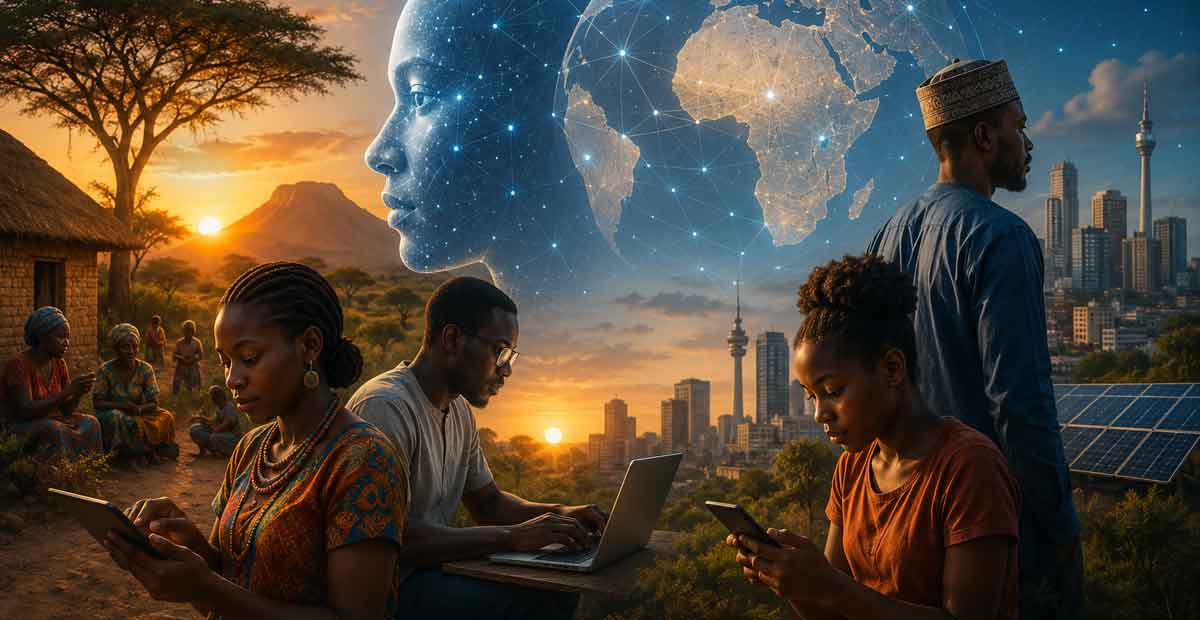
Why Africa May Become One of the World's Most Important Regions for the Future of AI
By John F. Groom
For much of artificial intelligence's history, the world has mistaken large datasets for global datasets. The two are not the same. The first generation of AI was trained primarily on information originating in North America, Europe, and parts of East Asia because those regions had already spent decades digitizing their economies. Internet content, scientific publications, healthcare records, enterprise software, government databases, and digital commerce all became abundant sources of training data simply because they already existed in digital form.
This produced extraordinary advances in artificial intelligence, but it also created an important imbalance. Modern AI systems learned from humanity's largest digital archives, not from humanity itself. The information was vast, but it was never fully representative of the world's people, cultures, environments, and ways of solving problems.
The next generation of AI will require something fundamentally different. Progress will depend less on collecting ever-larger quantities of data and more on collecting data that is more representative, better structured, provenance-aware, and geographically diverse. That transition increasingly points toward Africa and the broader Global South, not because these regions replace today's AI leaders, but because they contribute forms of knowledge that have historically been absent from the digital world.
The First AI Revolution Was Built on Existing Digital Wealth
Artificial intelligence learns from the information that already exists. Historically, that naturally favored countries with mature digital economies, extensive electronic medical records, large internet populations, enterprise software adoption, scientific publishing, and decades of investment in digital infrastructure. The United States became the largest contributor of internet-scale data, Europe provided enormous institutional and scientific knowledge, and China generated vast quantities of behavioral and consumer information through its rapidly expanding digital economy.
None of this occurred because these regions represented humanity equally.
It occurred because they possessed the world's largest digital archives.
That distinction becomes increasingly important as AI evolves. The first generation of artificial intelligence largely learned from information that had already been digitized. The next generation must increasingly learn from humanity itself.
The Easy Data Has Already Been Collected
Much of the information that could simply be scraped from websites, books, and publicly available digital sources has already been incorporated into modern AI systems. Future improvements will depend less on discovering additional web pages and more on collecting forms of knowledge that have rarely been captured in structured, machine-readable ways.
This includes areas such as human movement, physical performance, community health, education, agriculture, manufacturing, small business activity, environmental adaptation, local innovation, decision-making under real-world constraints, cultural knowledge, and informal economies. These are not obscure categories of information. They represent enormous portions of how people actually live, work, solve problems, and create value throughout the world.
The challenge is therefore changing.
It is no longer simply a question of finding more information on the internet. It is a question of building infrastructure capable of capturing verified human knowledge, connecting it to its source, preserving its provenance, and making it understandable to both people and artificial intelligence.
Africa Represents One of the Largest Remaining Opportunities
From this perspective, Africa should not be viewed as a region lacking data.
It should be viewed as a region containing extraordinary amounts of valuable human knowledge that has never been systematically digitized.
Across the continent, farmers develop practical solutions to local agricultural challenges. Teachers create methods that improve educational outcomes with limited resources. Healthcare workers continually adapt to real-world conditions, entrepreneurs build businesses in rapidly changing markets, athletes develop performance techniques, craftsmen refine specialized skills, and communities innovate every day in ways that rarely become part of the world's digital record.
Most of this knowledge remains invisible to today's AI systems.
Not because it lacks value.
Because no infrastructure has existed to capture it.
Demographics Are Shifting the World's Center of Gravity
A second reason Africa is becoming increasingly important to the future of artificial intelligence is demographic.
The world's population is changing in ways that will reshape the global workforce, consumer markets, innovation ecosystems, and ultimately the sources from which future AI systems learn. While many developed economies are experiencing population aging and declining birth rates, much of Africa remains remarkably young. The contrast is striking. Uganda's median age is approximately 16 years, Nigeria's is about 18, and Kenya's is around 20. By comparison, the median age is roughly 39 in the United States, more than 40 in China, 46 in Germany, nearly 50 in Italy, and approximately 50 in Japan.
These differences represent far more than demographic statistics.
In many cases, the median citizen of countries such as Uganda is young enough to be the child—or even grandchild—of the median citizen in some of the world's oldest societies. That shift has profound implications for the future of innovation, entrepreneurship, education, labor markets, and artificial intelligence. The people who will build, train, use, and contribute to AI systems over the coming decades will increasingly come from younger populations whose experiences remain underrepresented in today's digital landscape.
Population growth reinforces this trend.
Many developed countries are now experiencing below-replacement fertility and long-term population decline. Japan's population has been shrinking for years, China has entered a period of sustained decline, and much of Europe faces similar demographic pressures. Across much of Africa, fertility rates are also gradually declining as education and economic development continue, yet many countries still project substantial population growth throughout this century. Nigeria alone is expected to become one of the world's most populous nations.
None of this automatically makes Africa the world's largest AI economy.
It does, however, make the continent increasingly important to the world's future workforce, future markets, and future knowledge economy.
The Next Generation of AI Requires Human Diversity
The future of artificial intelligence will not be defined simply by building larger language models.
It will be defined by building models that better represent humanity.
That requires far more than additional tokens or larger training corpora. It requires exposure to different environments, different cultures, different healthcare systems, educational approaches, climates, infrastructure, economic realities, and ways of solving practical problems. Every community develops knowledge that reflects its own environment, and every one of those perspectives represents information that AI can learn from when it is collected responsibly and preserved with appropriate provenance.
Africa contains extraordinary diversity across all of these dimensions.
Thousands of languages, hundreds of cultures, dramatically different climates, urban and rural environments, rapidly growing cities, agricultural communities, entrepreneurial ecosystems, healthcare challenges, educational models, and locally developed solutions all contribute forms of human knowledge that remain only partially represented within today's AI systems.
That diversity should not be viewed as an obstacle to AI development.
It should be viewed as one of its greatest opportunities.
The Next Frontier Is Ground-Truth Data
As AI matures, competitive advantage will depend less on collecting more information and increasingly on collecting information that can be trusted.
The future of artificial intelligence will rely more heavily on verified observations than anonymous internet text. Videos linked to authenticated events, sensor measurements connected to known conditions, healthcare outcomes supported by appropriate consent, education records, human movement data, scientific observations, business operations, and community projects all represent forms of ground-truth evidence that can strengthen future AI systems.
Collecting this kind of information requires a very different type of infrastructure.
It requires systems built around provenance, consent, semantic identity, interoperability, machine-readable evidence, and objective methods of validation. Rather than treating information simply as data to be stored, these systems preserve the relationships that allow both humans and AI to understand where information came from, what it represents, and how confidently it can be used.
The future competitive advantage may therefore lie not in collecting the largest quantity of information, but in collecting information whose origin, quality, context, and meaning remain visible throughout its entire lifecycle.
Africa Can Leapfrog Legacy Systems
One of Africa's greatest advantages is that many regions are not constrained by decades of legacy technology. Throughout recent history, African countries have repeatedly demonstrated an ability to adopt new technologies without first reproducing every stage of earlier industrial development. Mobile payments became widespread in places where traditional banking infrastructure had never fully developed, and in many communities mobile internet became the primary computing platform long before desktop computers were commonplace.
Artificial intelligence presents a similar opportunity.
Rather than spending decades modernizing legacy information systems, many organizations can begin building AI-native infrastructure from the outset. Instead of adapting technologies originally designed for earlier generations of software, they can develop systems that assume interoperability, provenance, semantic identity, machine-readable evidence, and AI integration from the very beginning. This creates an opportunity to design for the future rather than continually adapting the past.
That advantage is not unique to Africa, but it is especially visible there because many communities are building new digital ecosystems while AI itself is still rapidly evolving.
Why Much of Our Team Is Based in Africa
This understanding has directly influenced the way DataUniversa has been built.
DataUniversa is not an organization centered in a single country. It is a globally distributed initiative with leadership, collaborators, and partners spanning multiple regions. Senior leadership includes members based in the United States, while much of our operational team works in Kenya, Uganda, and other parts of the Global South alongside collaborators throughout Asia and North America.
This distribution is not accidental.
It reflects a deliberate architectural decision based on where we believe the next generation of globally valuable data will emerge.
Historically, artificial intelligence has been shaped by countries that already possessed extensive digital infrastructure and decades of accumulated electronic information. The next generation of AI, however, will increasingly depend on creating new, high-quality datasets rather than repeatedly analyzing the same historical ones. Much of that opportunity exists in regions that remain significantly underrepresented in today's digital landscape.
By working directly with schools, community organizations, healthcare providers, entrepreneurs, fitness facilities, researchers, and local partners, we are developing and testing methods for collecting structured, provenance-rich, machine-readable information that can ultimately interoperate with data collected anywhere else in the world.
This approach is often misunderstood.
It is not an Africa-first strategy.
It is a Global-First strategy.
The objective is to build infrastructure that functions equally well in rural Uganda and Virginia, in Nairobi and New York, under intermittent connectivity or high-speed fiber, for an individual contributor or for millions of participants. Designing systems across diverse environments produces architecture that is geographically neutral while still allowing meaningful local adaptation.
Africa Is Part of a Much Larger Global Shift
Although Africa provides one of the clearest examples of this transformation, the broader trend extends well beyond a single continent.
Countries throughout the Global South—including India, Indonesia, Brazil, and many others—possess enormous reserves of human knowledge that remain only partially represented within today's AI systems. These regions are contributing new perspectives, practical solutions, cultural knowledge, business models, educational approaches, healthcare practices, and community innovations that have historically existed outside the world's largest digital archives.
The future of artificial intelligence will therefore depend not only on larger models, but on broader participation.
More contributors.
More cultures.
More verified evidence.
More representative data.
The objective is not simply to make AI more inclusive.
It is to make AI more accurate.
The more completely artificial intelligence reflects the diversity of human experience, the better equipped it becomes to understand, reason about, and assist the people it is ultimately intended to serve.
The Future of AI Will Be Built on Living Human Knowledge
The first generation of artificial intelligence was built largely upon the world's existing digital footprint. AI systems learned from websites, books, scientific publications, enterprise databases, software repositories, government records, and the enormous volume of information that had already been digitized over several decades. That foundation enabled remarkable advances in language models and machine learning, but it also reflected the regions that had accumulated the largest digital archives rather than the full diversity of humanity.
The next stage of AI will depend on something fundamentally different.
It will increasingly rely on the world's living human knowledge.
That knowledge is not confined to Silicon Valley, Beijing, London, or Berlin. It exists in villages and cities, schools and clinics, workshops and farms, gyms and laboratories, nonprofit organizations and businesses across every continent. Every day, people develop practical solutions, refine techniques, solve problems, and create knowledge that never becomes part of today's digital record. Much of humanity's most valuable experience remains undocumented, disconnected, or invisible to artificial intelligence—not because it lacks importance, but because no infrastructure has existed to preserve it in a structured and interoperable way.
This represents one of the defining challenges of the AI era.
The question is no longer whether valuable knowledge exists. It does. The challenge is building systems capable of capturing that knowledge responsibly, verifying its origin, preserving its provenance, connecting it with related information, and making it understandable to both humans and machines.
Why Africa Matters
Africa is likely to become one of the world's most important regions in addressing that challenge—not because it replaces the traditional centers of AI research, but because it complements them with something they cannot provide alone.
The continent combines a rapidly growing and youthful population with extraordinary cultural, linguistic, environmental, and economic diversity. It contains vast reserves of practical knowledge that remain largely undigitized, while also providing opportunities to build AI-native infrastructure without many of the constraints imposed by decades of legacy systems. Those characteristics make Africa not simply a consumer of future AI technologies, but an increasingly important contributor to the knowledge that will shape them.
The same opportunity exists throughout much of the Global South. Countries such as India, Indonesia, Brazil, and many others are contributing forms of human knowledge that have historically been underrepresented within AI systems. Together, these regions are helping shift the conversation from building larger models to building more representative ones.
Building a More Complete Representation of Humanity
Ultimately, the future of artificial intelligence will not be determined solely by who develops the largest models or possesses the greatest computing power. Those capabilities will remain important, but they represent only part of the equation.
The quality of future AI will also depend on how completely it represents humanity itself.
That means capturing knowledge from more people, more cultures, more environments, more industries, and more communities. It means preserving provenance, consent, semantic identity, and interoperability so that information remains trustworthy as it moves through increasingly complex AI ecosystems. It means recognizing that a farmer in rural Kenya, a teacher in Uganda, an entrepreneur in Indonesia, a healthcare worker in Brazil, and an engineer in Virginia all contribute knowledge that deserves to become part of humanity's shared digital foundation.
This is the broader vision behind DataUniversa.
Our objective is not simply to collect more data. It is to build the infrastructure that allows verified human knowledge—regardless of where it originates—to become structured, connected, explainable, and interoperable. By creating a more complete representation of humanity, AI becomes more than a system trained on the world's largest digital archives. It becomes a system capable of learning from the full diversity of human experience.
The future of artificial intelligence will not be defined only by the size of its models.
It will also be defined by how completely it represents the world those models are meant to understand.
Whether you're exploring interoperability, dataset valuation, AI readiness, or ecosystem participation, we welcome conversations with researchers, organizations, and strategic partners interested in the future of structured data systems.
info@datauniversa.com