Yes, AI Is Amazing. But Not as Amazing as a Hummingbird
By: John F Groom
Artificial intelligence is amazing. It can write software, translate languages, analyze medical images, generate pictures, search enormous bodies of information, recognize patterns humans would miss, and increasingly help people solve problems across almost every field of human activity.
We should not minimize any of this. AI may turn out to be one of the most consequential technologies humans have ever developed. But consider a hummingbird. A typical hummingbird weighs only a few grams. You could hold one comfortably in the palm of your hand. Some weigh about as much as a penny. Yet packed into those few grams is a technological system vastly beyond anything humans know how to build.
The Few-Gram Miracle
A hummingbird contains a brain that receives information from sophisticated sensory systems, interprets a constantly changing three-dimensional environment, remembers locations, identifies food sources, recognizes threats and competitors, and coordinates extraordinarily complicated movements in real time.
Its eyes guide high-speed flight through branches and vegetation. Its body contains a heart, blood vessels, lungs, liver, kidneys, muscles, bones, skin, feathers, an immune system, a digestive system, and a reproductive system. It can maintain its body temperature, heal injuries, sleep, learn, defend territory, find a mate, and reproduce. And then there is flight.
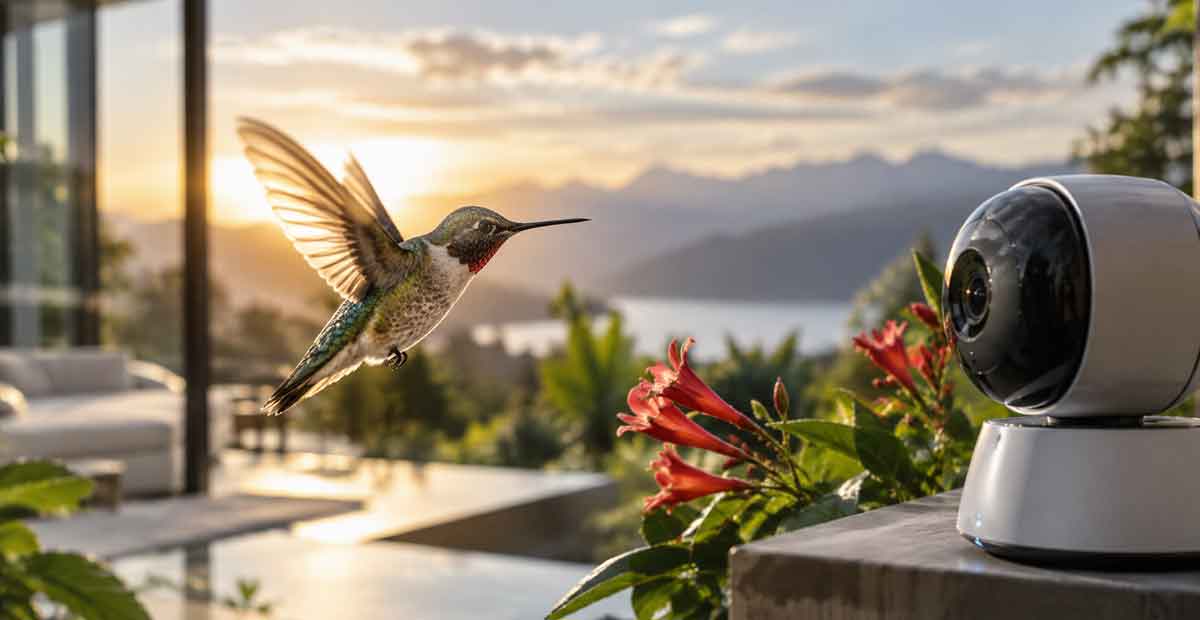
A hummingbird can accelerate, decelerate, hover almost motionless in space, move laterally, and fly backward. Its wings can beat dozens of times every second while its nervous system continuously integrates visual information, balance, muscle control, and changing aerodynamic conditions. All of this operates on tiny quantities of fuel gathered autonomously from the surrounding environment. Imagine presenting that engineering specification to a technology company:
Build us an autonomous flying machine weighing four grams. It must find its own fuel, recognize suitable fuel sources without human assistance, navigate an unstructured outdoor environment, survive rain, wind, and substantial temperature changes, avoid predators, diagnose and repair many forms of internal damage, continually replace worn components using materials obtained from its environment, learn from experience, communicate with other machines of its type, and manufacture another complete machine without a factory. We would regard the specification as ridiculous. Nature does it routinely.
The Factory Is Inside the Product
This last capability deserves particular attention because it reveals how misleading our normal comparisons between biological and technological systems can be. Consider an advanced aircraft. The aircraft itself may be extraordinarily sophisticated, but the aircraft is only the visible endpoint of an enormous technological ecosystem. Behind it are mines, oil fields, electrical grids, refineries, semiconductor factories, machine tools, software companies, engineers, universities, transportation systems, maintenance facilities, spare-parts inventories, and thousands of specialized workers.
Remove that supporting civilization and the aircraft eventually becomes an inert object. The hummingbird is different. Much of the factory is inside the hummingbird. It takes relatively simple materials from its environment and converts them into energy, feathers, muscle, blood, bone, and replacement cells.
Reproduction goes considerably further. Two hummingbirds can initiate a process that ultimately produces another hummingbird, another autonomous flying, seeing, learning, self-fueling biological system. No external hummingbird factory is required. The manufacturing instructions are embedded within the biological system itself.
Matter Is Not the Important Part
This leads to a deeper technological lesson. A hummingbird is made from ordinary matter: carbon, hydrogen, oxygen, nitrogen, calcium, and other common elements. There is no magical hummingbird element on the periodic table. What makes the hummingbird extraordinary is therefore not primarily what it is made from. It is how those materials are organized.
A living hummingbird and a hummingbird immediately after death may initially contain essentially the same atoms in essentially the same locations. Yet something profound has changed. The difference is not primarily matter. It is organized process. Millions upon millions of interacting biological operations have been continuously sensing conditions, exchanging information, consuming energy, correcting errors, and maintaining the larger system.
Life is therefore an extraordinary demonstration of what structure can accomplish. Matter provides the substrate. Energy keeps the system operating. Information helps specify the organization. Structure turns all three into capability.
AI Makes the Comparison Even More Interesting
AI itself provides an excellent example of the same principle. The physical ingredients of a computer are not especially exotic. What matters is their organization, and then the organization of information running through them. Rearrange the same physical resources differently and their capabilities can change dramatically.
AI takes this principle another step. Increasingly, intelligence comes not simply from possessing information but from finding useful structures and relationships within enormous quantities of information. That is one reason AI represents such an important technological development.
But it is also why biological systems should make us humble about where we are. An AI model may require enormous data centers, specialized chips, power generation, cooling systems, communications networks, and a vast industrial supply chain. The hummingbird's brain weighs a fraction of a gram, and that brain operates while the entire system flies around looking for dinner.
Technology Is the Discovery of Better Organization
We often describe technological progress in terms of new materials or greater quantities of resources. But much of technological progress is really the discovery of better arrangements of existing things. The transistor reorganized electrical switching. Software reorganized instructions. The internet reorganized communication. AI reorganizes the relationship between computation and information.
Biology represents an incomparably older experiment in the same general process. Evolution has spent billions of years testing structures against physical reality. Variations occur. Most disappear. Some work better. Successful structures reproduce and are modified again.
The hummingbird is one surviving result of an unimaginably large series of experiments. It is not "designed" in the conventional engineering sense. It is something perhaps even more interesting: a structure relentlessly tested against reality over immense periods of time. Every hummingbird alive today descends from an uninterrupted chain of organisms that successfully survived long enough to reproduce. That is an extraordinary validation process.
The Lesson Isn't That Technology Is Primitive
It would be easy to draw the wrong conclusion from this comparison. The lesson is not that human technology is unimpressive. Quite the opposite. In only a few thousand years of organized technological development, and barely a few centuries of modern science, humans have discovered principles that biological evolution never did.
Hummingbirds cannot build radio telescopes. DNA never developed calculus. Evolution did not put astronauts on the Moon. And no biological brain can directly perform trillions of numerical operations every second. Technology explores portions of the possibility space that biological evolution never reached. AI dramatically expands that exploration. But biology reminds us how enormous that possibility space actually is.
Imagine Closing the Gap
Now imagine combining the strengths of both worlds. What happens when technological systems become dramatically more energy-efficient? When machines can continuously diagnose themselves? When materials can repair themselves? When manufacturing becomes distributed? When AI systems can learn continuously from their physical environments? When machines can autonomously obtain the resources necessary to maintain themselves?
What happens when the distinction between product, computer, factory, and maintenance system begins to disappear? The hummingbird suggests that none of these ideas violates physical reality. We already know that an autonomous, intelligent, self-maintaining flying system weighing a few grams is physically possible. One is hovering outside somewhere right now.
That may be one of nature's most important contributions to technological imagination. Nature establishes existence proofs. It tells us that something can be done. We simply do not know how to do it yet.
A Different Standard for "Amazing"
We live at a moment when the word amazing is applied almost daily to technological advances, and sometimes appropriately. AI really is amazing. But our standards are distorted because we tend to compare new technology with yesterday's technology.
Compared with a computer from 1990, today's AI systems seem almost miraculous. Compare our technology instead with the full range of systems that physical reality has already demonstrated are possible, and the perspective changes. Pick up a leaf. Watch an ant. Consider the human brain. Or spend a few minutes watching a hummingbird hover beside a flower.
Inside those few grams is propulsion, navigation, vision, computation, energy conversion, structural engineering, thermal regulation, waste processing, maintenance, learning, and reproduction, all operating simultaneously in an autonomous system assembled largely from commonplace materials. We have built nothing remotely comparable.
That should not diminish our enthusiasm for technology. It should expand it. Because the hummingbird demonstrates something much more exciting than the limitations of human engineering. It demonstrates how much more may be possible. Yes, AI is amazing. But not as amazing as a hummingbird.
Whether you're exploring interoperability, dataset valuation, AI readiness, or ecosystem participation, we welcome conversations with researchers, organizations, and strategic partners interested in the future of structured data systems.
info@datauniversa.com