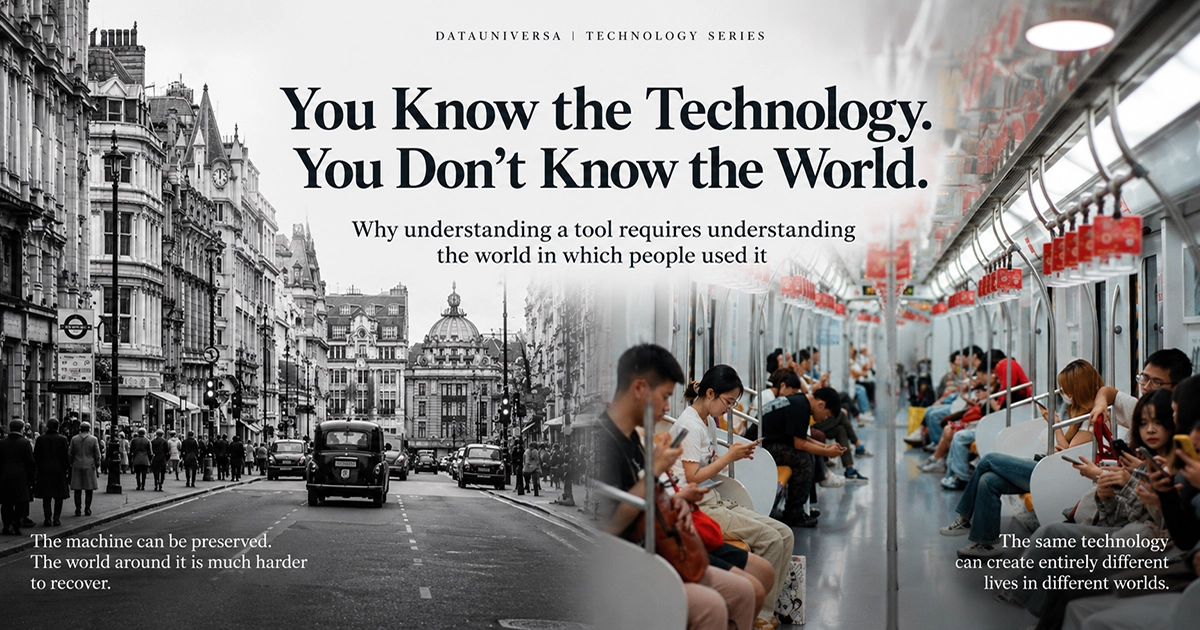
You Know the Technology. You Don't Know the World.
Why Understanding a Tool Requires Understanding the World in Which People Used It
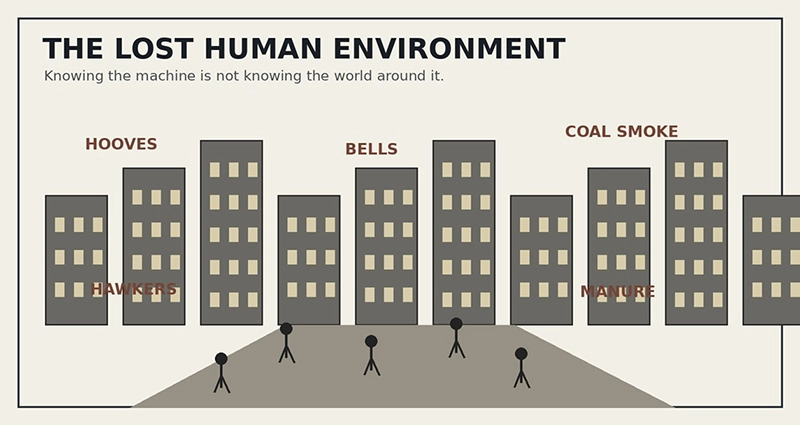
A historical image can preserve a street. It cannot preserve the complete sensory or mental world of the people in it.
It is relatively easy to discover what technologies existed in London in 1775. There were printing presses, newspapers, postal services, clocks, carriages, sailing ships, firearms, street lighting, scientific instruments, and increasingly sophisticated manufacturing machinery. We can examine surviving examples, read specifications, and study diagrams showing how they worked. Move forward to 1926 and the technological record becomes vastly richer: automobiles, telephones, radios, airplanes, electric lighting, elevators, motion pictures, typewriters, cameras, and industrial machinery. We have photographs, advertisements, instruction manuals, and surviving examples of almost everything. It creates an illusion of understanding. We know the technology, and therefore we think we know the technological world. We do not.
Knowing what a technology could do tells us surprisingly little about what people actually did with it. To understand that, we need the environment surrounding the technology: economics, infrastructure, laws, customs, expectations, social roles, geography, institutions, habits, and the millions of assumptions residing inside people's heads. Much of that information disappears. The machine survives. The world in which the machine made sense does not.
The World Around the Machine
Suppose we possessed an extraordinarily detailed database describing every significant technology available in London in 1850. We could reconstruct the city's transportation systems, communications networks, manufacturing processes, water infrastructure, heating, lighting, and construction technology. We would still know remarkably little about what it felt like to live there.
We cannot hear London. We know it was noisy: horses, iron-rimmed wheels, hawkers, street musicians, workshops, bells, dogs, and thousands of human voices. But knowing the sources of the sounds is not hearing them. We cannot smell London. Horse manure and urine, coal smoke, human waste, breweries, slaughterhouses, cooking, tobacco, leather, fish, wet wool, and the Thames all contributed to the city's smell. We can compile the ingredients. We cannot reconstruct the experience.
Nor can we fully recover the physical environment: heavy clothing, primitive heating, cold rooms, uncomfortable transportation, smoke in the lungs, muddy streets, inadequate dentistry, summer heat, insects, and physical fatigue. A perfectly accurate photograph would recover only one part of reality. And even if someone miraculously discovered ten thousand hours of motion picture footage of Victorian London, the most important information would remain inaccessible. We could see the people. We still could not see what was inside their heads.
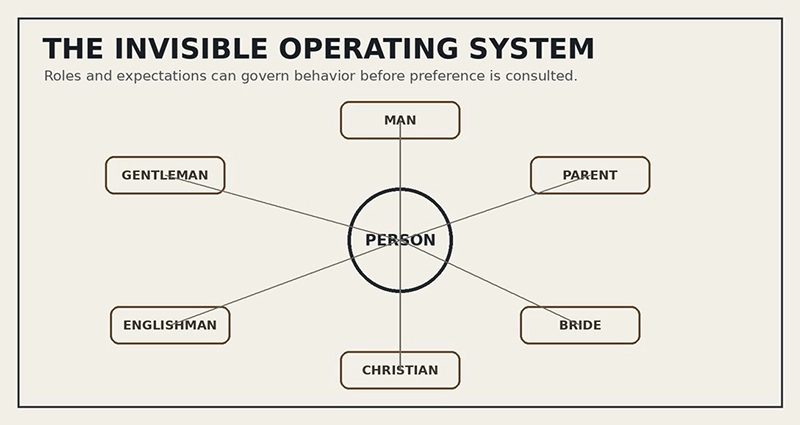
The most consequential context may never appear in the technical record: the roles, expectations, and meanings people carried with them.
Consider religion. A modern person can be deeply religious, but that is not necessarily the same experience as living in a society in which religious belief permeates institutions, calendars, family life, education, marriage, death, morality, and the assumptions of most people around you.
Consider monarchy. We can reconstruct an eighteenth-century royal ceremony with astonishing visual accuracy. We can reproduce the clothes, music, carriages, buildings, and rituals. What is much harder to reproduce is what kingship meant to someone standing there. The king was not simply a celebrity with a crown. Monarchy could be intertwined with assumptions about hierarchy, national identity, providence, legitimacy, and the proper ordering of society. A modern observer could see exactly what an eighteenth-century observer saw and still fail to see what the eighteenth-century observer saw in it.
“This is what a man does.” “This is what a woman does.” “This is what a father does.” “This is what a bride does.” “This is what a gentleman does.” “This is what an Englishman does.” “This is what a Christian does.” Such statements once provided powerful behavioral scripts. People certainly violated them. History contains no shortage of cowardly men, irresponsible parents, unfaithful spouses, dishonest gentlemen, and bad Christians. But violating a standard is different from living without a widely understood standard. The individual often knew what his role supposedly required before deciding what he personally wanted. That matters enormously when we try to understand how people used technology.
The sinking of the Titanic provides an unusually stark illustration. The technology is relatively easy to understand. We know how the ship was constructed, the capacity of the lifeboats, the communications equipment, and much about how the evacuation proceeded. But none of those technical facts explains what happened by itself. Human behavior interacted with the technology.
The lifeboat was a tool. Who entered it depended partly on something that was not contained anywhere in its engineering specifications: ideas about sex, age, class, duty, courage, and proper behavior. “Women and children first” was not a universal maritime rule, and its implementation aboard Titanic was inconsistent. Yet the different outcomes cannot be understood simply by studying davits and lifeboat capacity. For some men, remaining behind may have reflected an extraordinarily powerful cultural proposition: this is what a man does. A lifeboat has a physical capacity. Society helps determine who gets into it.
That distinction applies to almost every technology. A smartphone can display a textbook or pornography. It can conduct a business transaction, summon a taxi, teach mathematics, spread a rumor, arrange a marriage, coordinate a political movement, record a police officer, transfer money to another continent, or occupy three hours with short videos. Nothing about the processor determines which of those things happens. Technical capability defines a possibility space. Human environments determine which possibilities become common behavior. A tool does not contain its use. Its use emerges from the interaction between the tool and everything surrounding it.
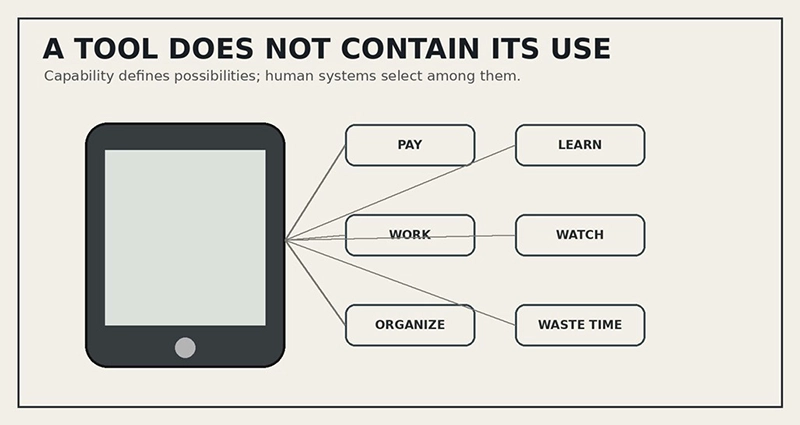
Technical capability defines a possibility space. The surrounding human system determines which possibilities become ordinary use.
Consider the automobile. Its fundamental capabilities are straightforward: relatively rapid personal transportation of people and goods. Put the automobile into different environments, however, and entirely different systems emerge. In one place, dense development, expensive parking, and extensive public transportation may make the car an occasional convenience. In another, suburban land use and limited public transportation may make automobile ownership almost essential to ordinary participation in society. The technology is essentially the same. The surrounding system changes its role.
The smartphone provides an even more dramatic example. In a wealthy country with mature banking infrastructure, it may supplement credit cards, computers, and physical bank branches. In places where extensive landline and banking infrastructure never developed, mobile technology can leapfrog systems that richer countries built over generations. The phone can become not merely a communications device but a financial terminal, marketplace, educational interface, and connection to services. Same object. Different environment. Different behavior. Different value.
This is why technological development rarely proceeds in a simple sequence. A new technology enters a world already occupied by other technologies and institutions. Sometimes existing infrastructure accelerates adoption. Sometimes it prevents it. A country with an enormous landline network may have billions invested in maintaining it. A country without that infrastructure has less to protect and may move directly to mobile communications. The technically superior solution therefore does not automatically win. Technology encounters incentives. It encounters sunk costs, regulation, culture, habits, power, and people.
Imagine handing the same smartphone to someone in London in 1850, 1926, 1976, and 2026. Ignore the obvious problem that the networks required to operate it do not exist in the earlier periods. Suppose somehow they did. Would the device produce the same behavior? Almost certainly not. The Victorian user brings different assumptions about privacy, sexuality, class, religion, authority, gender, work, family, reputation, and acceptable public behavior. The 1926 user brings another set, the 1976 user another, and the 2026 user another. The device may be technically identical. The human operating environment is not.
Modern historians have one enormous advantage over historians studying earlier periods: we are producing accidental archives on an unprecedented scale. A movie filmed in Bangkok in 1974 unintentionally records Bangkok. The filmmakers may want an exciting chase, but behind the actors are streets, cars, buildings, pedestrians, clothing, traffic patterns, advertisements, and fragments of ordinary behavior. Home movies preserve kitchens. Television news preserves streets. Sports broadcasts preserve crowds. Advertisements preserve aspirations. Security cameras preserve mundane behavior nobody thought worth documenting. Smartphones preserve almost everything.
But even this extraordinary archive has limits. A camera records what someone wore. It does not necessarily record why wearing it mattered. It records someone standing for the national anthem but not what that act meant inside his head. It records a wedding but does not completely capture what marriage meant within that society. It records someone entering a church but does not measure faith. The visual archive gets better and better. The internal archive remains incomplete.
This creates an important problem for AI and data systems. More data can create the impression that uncertainty has disappeared. Suppose an AI system possesses every surviving newspaper from 1850, every census record, every map, every diary, every photograph, every commercial directory, every court record, and every surviving object. It will know an astonishing amount about Victorian London. It still should not claim to know Victorian London completely.
Some variables were never recorded. Some were recorded selectively. Some were so obvious to contemporaries that nobody bothered mentioning them. Some experiences could not be captured by the available technology. And some information existed only as distributed assumptions inside millions of human minds.
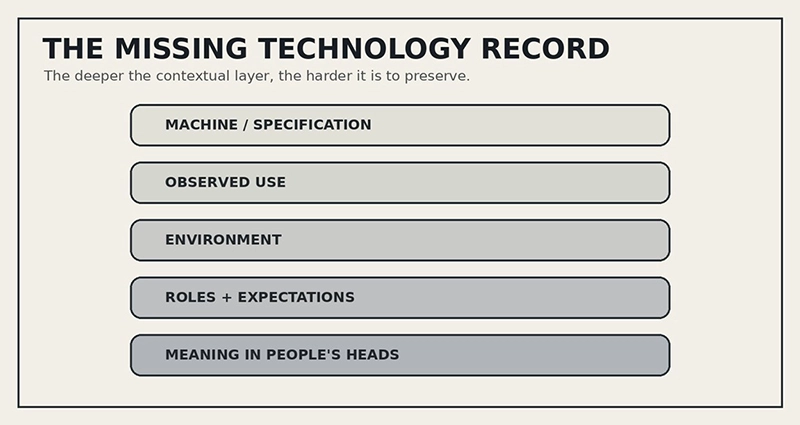
Data becomes thinner as we move from the preserved object toward the unrecorded human environment that gave the object meaning.
This is why DataUniversa should distinguish between available evidence and reality itself. They are never identical. The missing data may be precisely the data required to answer the question. Observed capability, observed use, and contextual conditions are separate kinds of evidence, and none should be mistaken for the others.
Capability Is Not Use
A technology makes certain actions possible, easier, cheaper, or faster. That matters enormously. But it does not dictate what happens next. The printing press can distribute scientific knowledge and propaganda. Radio can broadcast symphonies and political messages. Television can educate children and sell breakfast cereal. Nuclear physics can produce electricity and nuclear weapons. Artificial intelligence can help diagnose disease, generate entertainment, automate bureaucracy, design products, manipulate people, discover patterns, teach students, or waste enormous quantities of time. The technology establishes affordances. Human systems select among them.
Those selections depend upon economics, incentives, law, culture, institutions, status, habits, identity, and purpose. There is no clean boundary between “the technology” and “society.” The realized technology is the combination. This matters especially for artificial intelligence because its possibility space is enormous. Asking what AI can do is useful. It is not enough. We must also ask what people will trust it to do, what institutions will permit it to do, what companies will have incentives to make it do, what individuals will want it to do, which existing institutions will resist it, which societies may leapfrog legacy systems, and what identities and expectations people will bring to their interactions with it.
The same AI capability introduced into different social environments could produce dramatically different outcomes. The technology does not arrive on an empty planet. It arrives in human civilization.
When we look backward, this should make us humble. Knowing the specifications of a carriage does not tell us what travel meant in 1775. Knowing how a telephone worked does not tell us what receiving a telephone call meant in 1926. Knowing the dimensions of a Titanic lifeboat does not tell us who believed he should enter it. Knowing that a household owned a radio does not tell us how the family organized itself around listening to it. Knowing what technologies existed tells us what was possible. It does not tell us what was normal.
When we look forward, the same principle applies. We can model technical capabilities, extrapolate processing power, measure costs, and enumerate features. But the ultimate use of technology emerges from the entire environment in which it operates. Capability is not use. Use is capability interacting with economics, infrastructure, institutions, regulation, culture, identity, expectations, habits, incentives, and human purpose.
That is why understanding technology requires much more than understanding machines. The tool matters. But so does the hand holding it. So does the reason the person picked it up. So do the people watching. So do the rules they believe they should follow. So does the world they believe they inhabit. And that world, the sounds, smells, expectations, roles, assumptions, fears, obligations, and meanings surrounding the tool, is often precisely the part of technology history that is hardest to recover.
We preserve the machine. We preserve the manual. We preserve the patent. Sometimes we preserve photographs of people using it. What we rarely preserve is the complete human environment that determined what the machine actually became. That is the missing technology record.
“A tool does not contain its use.”
Whether you're exploring interoperability, dataset valuation, AI readiness, or ecosystem participation, we welcome conversations with researchers, organizations, and strategic partners interested in the future of structured data systems.
info@datauniversa.com